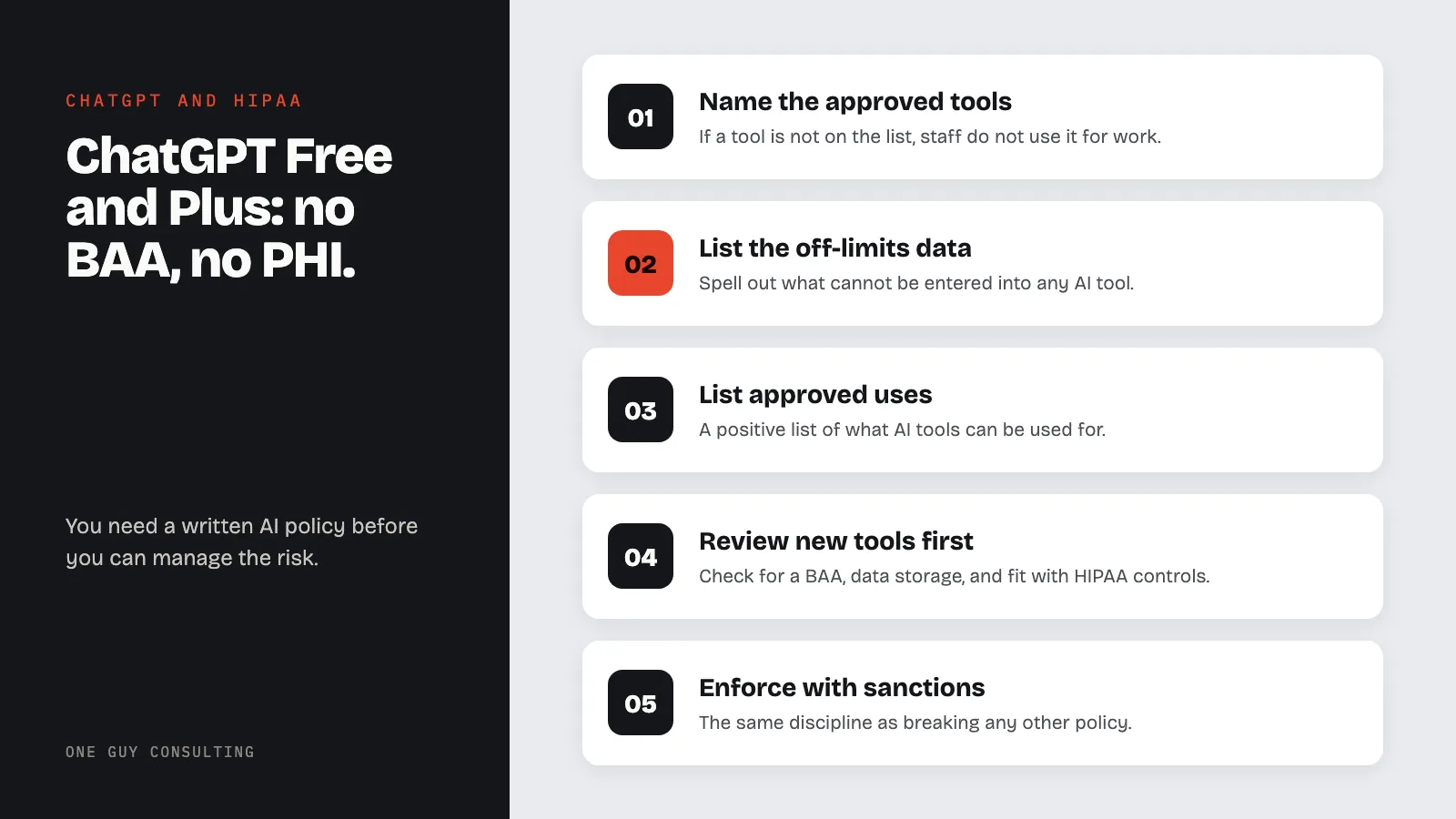
ChatGPT Free and Plus are not HIPAA compliant: OpenAI offers no Business Associate Agreement (BAA) for these tiers. It offers a BAA only for certain business products, such as ChatGPT Enterprise and the OpenAI API. Even then, a BAA alone does not make a tool compliant; you also need the right settings, access controls, and staff policies.
Key Definitions
- Business Associate Agreement (BAA): A contract required under 45 CFR 164.502(e) between a covered entity and any vendor that creates, receives, maintains, or transmits protected health information on its behalf. Without a BAA, any disclosure of PHI to that vendor is a HIPAA violation.
- PHI (Protected Health Information): Any individually identifiable health information held or transmitted by a covered entity or business associate, in any form. Defined at 45 CFR 160.103. PHI includes names, dates, diagnoses, treatment details, and any combination of data that could identify a patient.
- ePHI (Electronic Protected Health Information): PHI that is created, stored, transmitted, or received in electronic form. Subject to the HIPAA Security Rule safeguards at 45 CFR 164.308-312.
- Minimum Necessary Standard: The requirement under 45 CFR 164.502(b) that covered entities and business associates limit how much PHI you use, share, or ask for to the minimum amount necessary to accomplish the intended purpose. Pasting entire patient records into an AI prompt can violate this standard even when a BAA exists.
Your staff is likely already using ChatGPT. That is what is happening at many healthcare organizations right now.
Someone in billing uses it to draft appeal letters. A nurse uses it to summarize discharge instructions. An admin pastes in a case note to clean up the language. It feels harmless. It is fast. And nobody has told them not to.
That is a problem.
AI carries real HIPAA risk when it interacts with patient information. The risk is not hypothetical. It comes from specific behaviors that already exist in your organization. These behaviors develop when there isn't any policy in place.
This post covers what you need to know: BAAs, PHI in AI prompting, and how to build the right policy for your staff.
The Short Answer: Is ChatGPT HIPAA Compliant?
For the free tier and the standard paid tier (ChatGPT Plus), the answer is no.
OpenAI does not offer a Business Associate Agreement for that service level. No BAA means you cannot share PHI with it. It's that simple.
Under HIPAA, a vendor that creates, receives, keeps, or sends PHI for your practice is a business associate (BA). In plain terms, it is a vendor who handles patient data for you.
Before sharing PHI with a vendor, you need a signed BAA in place. Without one, you are in for a bad time.
ChatGPT Free and Plus can use your conversations to train future models by default. So even without the BAA problem, patient data does not belong in these versions.
What About ChatGPT Enterprise and the API?

This is where it gets more nuanced.
OpenAI does offer BAAs for ChatGPT Enterprise customers. It also offers them for the OpenAI API. If you have a signed BAA with OpenAI under one of these arrangements, you have cleared the first hurdle.
A BAA alone doesn't make a company HIPAA compliant. The BAA is a contract. It shifts some liability and documents the relationship. Configuration is a large factor in your compliance.
Some questions to ask before treating Enterprise as 'HIPAA-ready':
- Is your data used for model training? (Under Enterprise, the default is no. Verify this in your agreement.)
- Who in your organization has access to the account?
- Is access logged and auditable?
- What data retention policies apply?
- How does it fit into your existing ePHI access controls?
If you cannot answer those questions, you are not ready to use Enterprise AI for PHI-related tasks. Consult an attorney before finalizing any arrangement, especially where AI tools will touch patient data. One Guy Consulting is not a law practice, and Chuck Weiselberg is not an attorney.
What Counts as PHI in an AI Prompt?
This is the question most organizations get wrong, and it is where most of the real risk lives.
Staff think of PHI as a medical record or a lab result. Something formal. Something that looks like a file. So when they paste a case summary into ChatGPT, they do not think of it as a PHI disclosure. They think of it as a writing task.
But PHI is broader than most people realize. Under HIPAA, PHI is any individually identifiable health information. Names, dates, geo-data, phone numbers, email addresses, account numbers, and more all qualify. We break down all 18 HIPAA identifiers and how they apply to AI workflows in our guide on what counts as PHI in AI prompts.
A prompt like this is PHI:
"Can you help me write a follow-up note? It is for a 67-year-old male patient seen on April 14 in our downtown clinic for Type 2 diabetes management. His A1C was 8.2."
The patient is not named. The disclosure can still be identifiable. This depends on context, and it contains health information tied to age, date, and location. That is the kind of detail that can qualify as PHI.
The same logic that applies to de-identification requirements applies here. Information is not safe because a name is absent. If the combination of details can identify a patient, it is PHI and it requires protection.
Common PHI that ends up in AI prompts:
- Patient names embedded in draft letters or notes
- Diagnosis or treatment details tied to age, date, or location
- Insurance or billing information pasted for formatting help
- Appointment details that include identifiers
- Case descriptions meant to be anonymous yet contain enough detail to identify a patient in context
The Real Risk: Copy-Paste Behavior
The biggest HIPAA risk with AI tools is not a technical exploit. It is copy-paste.
Staff paste from EHRs, from email threads, from billing systems. They do it fast and without thinking. They focus on their task, not on what is in the clipboard.
This is especially common with:
- Clinical documentation: "Help me clean up this note"
- Prior authorization letters: "Make this more persuasive"
- Patient communication drafts: "Rewrite this with more simplicity"
- Billing appeal letters: "I need help appealing this denied claim."
- Incident summaries: "Summarize what happened for the report"
In every one of these scenarios, the staff member may paste raw PHI into tools. Tools with no BAA, no access controls, and no audit trail. That is a potential violation each time it happens.
The problem compounds because AI tools are useful. Staff who discover a shortcut do not stop using it. They tell coworkers. The behavior spreads. By the time leadership finds out, dozens of staff members may have learned a habit that is hard to unwind.
How to Build an AI Acceptable Use Policy for Healthcare
You need a written policy before you can manage this risk. A verbal directive is not enough. Staff need clear, written rules they can follow and that you can enforce.
Your AI acceptable use policy should cover:
1. Which Tools Are Okay
Name permitted tools. If a tool is not on the approved list, staff should not be using it for work tasks. This stops someone from finding a program and using it without checking for a BAA. The app may not even be proper for healthcare.
2. What Data Is Off-Limits
Be explicit. Do not say "do not enter sensitive information." Say what's prohibited:
- Patient names
- Dates of service or birth
- Diagnoses, medications, or treatment details
- Insurance or billing information
- Any content copied from the EHR, patient portal, or clinical systems
The more specific you are, the fewer interpretations staff can make in the moment.
3. What AI Can Be Used For
Give staff a positive list, not a negative one. Approved uses might include:
- Drafting general policy or procedure language (with no patient data)
- Summarizing non-clinical administrative topics
- Writing staff communications, job postings, or training outlines
- Grammar and clarity edits on documents that contain no PHI
If staff know what they can do, they are less likely to improvise in ways that create risk.
4. Approval Process for New Tools
Any AI tool a staff member wants to use for work needs to go through a review process before using it. This review checks if a BAA is available, what data gets stored, and how the tool fits into existing HIPAA controls.
5. Sanctions
This policy needs teeth. Staff who break the AI acceptable use policy should face the same sanctions (discipline) as for breaking any other policy. Staff need to know this is a real rule with real consequences, not a suggestion.
What to Tell Staff
Policy language is for documentation. What you actually say to staff has to be simpler.
Here is a usable framework for talking to your team:
The one-sentence rule: If it has anything to do with a patient, do not put it in ChatGPT or any AI tool.
When in doubt: If you are not sure whether something counts as patient information, assume it does. Do not paste it!
Approved tools are on the list: If the tool is not on the approved list, do not use it for work tasks. Period.
What to do instead: If you want to use an AI tool for a task, ask your supervisor or compliance contact first. They will check on approval and what the rules are.
Staff are not trying to cause problems. Most of them do not know that pasting a clinical note into a free chatbot is a HIPAA concern. Clear, plain-language guidance matters more than long policy documents most people never read.
This is a topic that should be part of an ongoing HIPAA privacy program. This is not a one-time announcement. AI will be a recurring conversation. This is why it gets backed up with written policy and real training.
The same BAA principle applies to every tool your team uses with PHI. Check whether your platforms qualify:
- Is Zoom HIPAA compliant?
- Is Google Drive HIPAA compliant?
- Is Microsoft Teams HIPAA compliant?
- Is Slack HIPAA compliant?
- Is Dropbox HIPAA compliant?
- Is Gmail HIPAA compliant?
- Is iCloud HIPAA compliant?
- Is WhatsApp HIPAA compliant?
- Is Calendly HIPAA compliant?
- Is QuickBooks HIPAA compliant?
The Encryption and Data Handling Side
If you move forward with Enterprise or API vendors, make sure they sign a BAA. From there, data handling still deserves review.
Questions to work through with your vendor and your IT or security team:
- Is data encrypted in transit and at rest? See our breakdown of HIPAA encryption requirements for what the standard looks like.
- Where is data stored geographically?
- How long does the vendor hang onto conversation data?
- Who can access your organization's data on the vendor side?
- How does the vendor handle a breach involving your data?
These are not hypothetical questions. They are the same questions you should be asking every business associate. The fact that the vendor is a well-known tech company does not reduce your obligation to vet them with care.
Where This Fits in Your HIPAA Program
AI tools are a new form of an old problem: staff behavior that puts patient data at risk of exposure.
The same program elements that address other workforce risks apply here. Written policies. Staff training with real examples. Sanctions for violations. Periodic review as tools and behaviors change.
The difference is pace. AI tools spread through organizations fast! They spread fast because they are useful and free or cheap. They also often need no IT team to set up. The policy and training have to get ahead of the behavior, not chase it.
If your organization does not have an AI acceptable use policy in place yet, that gap belongs on your to-do list. Your HIPAA risk analysis should flag this as a risk today, not a future one. A risk analysis is a written look at the risks to your patient data. The Security Rule requires it at 45 CFR 164.308(a)(1)(ii)(A).
PHI vs. Non-PHI Use Cases for AI Tools
| Use Case | Involves PHI? | Permitted Without BAA? | Notes |
|---|---|---|---|
| Drafting a general HIPAA policy template (no patient data) | No | Yes | No patient-specific information enters the prompt |
| Writing job postings or staff communications | No | Yes | Administrative content with no clinical data |
| Summarizing a published medical journal article | No | Yes | Public information, no patient identifiers |
| Cleaning up a patient discharge note | Yes | No | Contains patient-identifiable health information |
| Drafting a prior authorization appeal with patient details | Yes | No | Includes diagnosis, treatment, and patient identifiers |
| Summarizing a patient case for a referral letter | Yes | No | Clinical details tied to an identifiable individual |
| Reformatting a billing appeal with claim numbers and diagnoses | Yes | No | Billing data tied to patient identity is PHI |
| Asking a general question about ICD-10 coding rules | No | Yes | No patient data in the prompt |
| Pasting an incident report to "summarize what happened" | Likely Yes | No | Incident reports typically contain patient identifiers and clinical details |
ChatGPT Consumer Products vs. the OpenAI API
There is an important distinction between ChatGPT as a consumer product and the OpenAI API as a developer platform. They have different data handling policies, different BAA availability, and different levels of organizational control.
- ChatGPT Free and Plus are consumer products. OpenAI does not offer a BAA for these tiers. By default, conversations may be used to train future models. There are no organization-level access controls or audit logs. These tiers cannot be used with PHI under any circumstances.
- ChatGPT Enterprise is an organizational product. OpenAI offers a BAA for Enterprise customers. Data is not used for model training. The platform includes organizational controls such as admin consoles, usage analytics, and SSO integration. However, the BAA and Enterprise features alone do not make the tool HIPAA compliant. Your organization must also implement access controls, audit logging, workforce policies, and minimum necessary safeguards.
- OpenAI API is a developer platform. OpenAI offers BAA eligibility for API customers. Data submitted through the API is not used for model training by default. The API provides programmatic access that can be integrated into HIPAA-compliant workflows with appropriate technical controls built around it. Organizations using the API are responsible for all access controls, encryption, audit logging, and data handling on their end.
What Should an AI Usage Policy Include?
Any healthcare organization using or considering AI tools should have a written AI acceptable use policy. This policy should address the following elements at minimum:
- Approved tools list. Name every AI tool staff are permitted to use for work tasks. If a tool is not on the list, it is not approved. This prevents staff from adopting new tools without BAA verification and security review.
- Prohibited data types. Explicitly list what cannot be entered into any AI tool: patient names, dates of birth or service, diagnoses, treatment details, insurance information, and any content copied from the EHR, patient portal, or clinical systems.
- Approved use cases. Provide a positive list of what AI tools can be used for: drafting general administrative content, summarizing non-clinical topics, grammar editing on non-PHI documents. Staff are less likely to improvise when they know what is permitted.
- Review and approval process. Define how new AI tools are evaluated before adoption, including BAA availability, data storage and retention policies, encryption standards, and integration with existing access controls.
- Incident reporting. Specify what staff should do if they realize PHI was entered into an unapproved tool. This should be treated as a potential security incident and documented per your incident response procedures.
- Sanctions. The policy must be enforceable. Tie AI policy violations to your existing HIPAA sanction policy under 45 CFR 164.308(a)(1)(ii)(C). Staff need to understand this is a compliance requirement, not a suggestion.
- Training and acknowledgment. Include AI-specific scenarios in your workforce training program. Require staff to acknowledge the AI acceptable use policy in writing.
Bottom Line
- ChatGPT free and Plus tiers are not HIPAA compliant. No BAA is available. Do not use them with any patient information.
- ChatGPT Enterprise and the API can include a BAA, but a BAA alone is not compliance. Configuration, access controls, and staff behavior all matter.
- The biggest risk is copy-paste. Staff paste PHI into free AI tools without realizing it is a problem.
- You need a written AI acceptable use policy that names approved tools. It prohibits specific data types, and includes sanctions.
- Train staff with plain language. The one-sentence rule covers most situations: if it involves a patient, do not put it in an unapproved AI tool.
- Consult your attorney before using any AI tool in workflows that touch PHI. This post is information, not legal advice.
This content is for educational and informational purposes only and should not be construed as legal advice. Organizations should consult qualified legal counsel before using AI tools in workflows that involve protected health information.
FAQ
Is ChatGPT HIPAA compliant for healthcare use?
Not by default. The free and Plus tiers do not come with a Business Associate Agreement. Without a BAA, you cannot use those products in workflows that involve PHI. ChatGPT Enterprise and the API can include a BAA. Even then, you still need the right settings and written policies.
What is a Business Associate Agreement and why does it matter?
A BAA is a contract required under HIPAA when you share PHI with a vendor. The vendor promises to protect the data and follow HIPAA requirements. If no BAA exists, sharing PHI with that vendor is a HIPAA violation regardless of whether any harm occurs.
What if my staff removes patient names before using ChatGPT?
Removing a name does not de-identify PHI. If details like dates, diagnoses, locations, or other identifiers can identify a patient, it is still PHI. The same standard that applies to formal de-identification applies here.
Can I use AI tools for administrative tasks that do not involve patient data?
Yes. Drafting policies, writing job descriptions, building training outlines, and other tasks that involve no PHI are lower-risk uses. The issue arises when any patient information enters the conversation.
Do I need a lawyer to set up an AI acceptable use policy?
That depends on your organization's situation. For arrangements involving PHI and AI vendors, consulting an attorney is a good idea. For internal policy about how staff uses AI, your compliance officer can handle it. They may need a touch of guidance. When in doubt, ask your attorney.
Key stat: As of 2026, OpenAI does not offer a Business Associate Agreement for ChatGPT Free or ChatGPT Plus. Under 45 CFR 164.502(e) and 164.504(e), any use of these tiers with protected health information violates HIPAA because no BAA exists to govern the disclosure. ChatGPT Enterprise and the OpenAI API do offer BAA eligibility, but a signed BAA alone does not establish HIPAA compliance.
Sources
- 45 CFR 164.502: Uses and Disclosures of PHI
- 45 CFR 164.504: Business Associate Contracts
- 45 CFR 160.103: Definitions (PHI, Covered Entity, Business Associate)
- HHS OCR Resolution Agreements and Civil Money Penalties
Related Articles
- What Counts as PHI in AI Prompts?
- What Is ePHI? Definition and Compliance
- PHI vs PII vs ePHI: Key Differences
Related Reading

- HIPAA Privacy Rule Requirements: The foundation for understanding what PHI is and how disclosure rules work
- HIPAA De-Identification Requirements: What actually makes data de-identified under HIPAA, and why "I removed the name" often is not enough
- ePHI Access Control Best Practices: How to control who can reach sensitive data across your systems
- HIPAA Encryption Requirements 2026: What the current standard looks like for data at rest and in transit
- HIPAA Risk Assessment Template Guide: How to identify and document exposures like AI tool use in your risk program