HIPAA Compliance Consultant for Small Practices
Full-Scope is $1,300 a year. That gets you four hours a month of 1:1 implementation calls with Chuck Weiselberg, a Certified HIPAA Professional, plus the full HIPAA compliance platform. Flat fee. No per-user charges.
What hiring Chuck costs, and what you get
Full-Scope is $1,300 a year. You can also pay $120 a month, or $2,300 for two years (Loyalty Discount automatically applied for purchases of 24 month plans!). It includes four hours a month of one on one brainstorm time with Chuck, and the full HIPAA compliance software platform.
One Guy Consulting's HIPAA Compliance Solutions are designed for small practices tackling the feat that is reaching HIPAA compliance without the need to add headcount. Our HIPAA compliance software is also a perfect fit for those moving over from other platforms, that want a person guiding the work. There is no per-user fee. There is no five-figure invoice.
- Security Risk Assessment tool
- Automated gap analysis
- Automated remediation plans
- Policy and procedure templates
- Staff training with progress tracking
- Administrative, physical, and technical audits
- Vendor management with digital BAAs
- Incident management system
- Compliance dashboard
- Everything in Self-Guided
- 4 hours a month of 1:1 implementation calls with Chuck
- Personalized implementation
- Incident response guidance
- CMS audit response support
Secure checkout by Stripe. Your payment details go straight to Stripe and never touch our servers.
Self-Guided is the same platform with no charges for consulting time present. It fits an organization that already has someone who knows HIPAA well. If nobody on your team does know HIPAA well, that is why the Full-Scope tier comes with four hours per month of 1:1 time with an expert.
Who does what on Full-Scope
Three parties share the work: Chuck, your practice, and the platform. The platform automates the repeatable work. Chuck exemplifies how to use HIPAA compliance software throughout the process. Your practice makes the decisions and keeps the program running.
| Area | Chuck | Your practice | The platform |
|---|---|---|---|
| Security Risk Assessment | Guides you through answering the audit | Tells the platform which systems, devices, and workflows touch ePHI | Scores each risk and turns your answers into a gap analysis |
| Gaps and remediation | Walks you through your gap analysis and remediation plan | Approves the plan and gets the assigned tasks done | Finds the gaps, writes the remediation plan, and tracks your progress |
| Policies and procedures | Walks you through the policy templates and how to adopt them | Reads each policy and adopts it | Stores and maintains all of your HIPAA compliance templates. |
| Staff training | Guides training delivery | Staff complete HIPAA 101 + CyberSecurity Awareness modules before signing policy attestations | Records completion |
| Vendors and BAAs | Answers vendor questions you have + aids technologically as needed with regard to the vendor profile | Has working inventory of every vendor that touches PHI | Execute and store BAAs in vendor profiles, plus automated vendor risk analysis. Only in O.G.C.'s HIPAA compliance software. |
| Incidents | Incident response guidance as needed | Reports the incident | Notifies the Compliance Officer once the incident is logged |
| Audits | CMS audit response support, audit-readiness prep, and evidence packaging (all 3 = as needed) | Pulls the records it is asked for | Retains evidence for at least six years |
Chuck Weiselberg, C.H.P.
HIPAA Compliance Consultant | Certified HIPAA Professional (CHP)
Chuck Weiselberg is a C.H.P. (Certified HIPAA Professional) and Founder of One Guy Consulting, a HIPAA compliance SaaS solution. He has been consulting since 2015.
He has helped support thousands of users at healthcare organizations, where he aided Compliance Officers in implementing sensible compliance solutions without any of them failing an audit, or receiving a fine. This success is attributable to a repeatable and proven process, realistic and applicable policies, and intuitive compliance management software that requires no technological know-how. Read the client testimonials.
Chuck is not an attorney, and One Guy Consulting is not a law firm. More about Chuck
Still deciding between a consultant and compliance software? Read HIPAA Consulting vs Compliance Software: Which Fits Your Practice?
What Is HIPAA Compliance Consulting by Specialty?
HIPAA consulting helps you put the Privacy Rule, Security Rule, and Breach Notification Rule into practice. We adapt the process to fit your field. That means your workflows, your staff, and your risks.
Core HIPAA Compliance Requirements
These six requirements apply to every covered entity and business associate. Each has specific duties under the HIPAA regulations. We start with the highest-risk areas first.
- Security Risk Assessment (SRA). Called for under 45 CFR §164.308(a)(1)(ii)(A). You have to name the threats and weak spots around every bit of electronic PHI (ePHI) you create, receive, maintain, or transmit. A HIPAA gap analysis often comes next, to tie each finding to the control behind it.
- Written policies and procedures. Called for under 45 CFR §164.316(a). They have to cover privacy, security, breach notice, and how staff behave. And they have to match how you really work. A stock template that does not fit the office turns up as an audit finding again and again.
- Workforce training. Called for under 45 CFR §164.308(a)(5)(i). Every workforce member who can reach PHI is trained at hire, and again when a policy changes. Keep the records for six years per §164.530(j).
- Business Associate Agreements (BAAs). Called for under 45 CFR §164.502(e). Get one signed with every vendor that creates, receives, maintains, or transmits PHI for you. BAA management means keeping the vendor list current, checking that each one who touches PHI is covered, and watching renewal dates.
- Documentation retention. HIPAA says you keep your records at least six years per 45 CFR §164.530(j). That covers risk assessments, policies, training logs, BAAs, and breach files.
- Breach notification within 60 days. A covered entity tells the people affected without unreasonable delay, and no later than 60 days after finding a breach of unsecured PHI, per 45 CFR §164.404(b). HHS gets told too: at the same time if 500 or more people are affected, or in a yearly log for smaller breaches. The press gets told when more than 500 residents of a state are affected, per §164.406 and §164.408. Your Incident management steps have to be written down ahead of time to hit those dates.
Why Specialty Alignment Matters in HIPAA Consulting
Different healthcare specialties face different HIPAA risks.
Medical practices juggle EHR links and access for many providers at once. A common risk: staff sharing one log-in across workstations, which runs against the unique user ID rule at 45 CFR §164.312(a)(2)(i).
Dental offices hold digital images (X-rays, CBCT scans) that count as ePHI. A common gap: those files sit on a local drive, or move on a USB stick, with no encryption.
Behavioral health providers have to meet 42 CFR Part 2 for substance use records on top of HIPAA. The main risk: a psychotherapy note or a substance use record goes out to the wrong person.
Pharmacies move a lot of prescription data across many linked systems. A typical finding: the screen at the counter shows patient data the next customer can read.
A business associate has to prove itself to the covered entities it serves, with records that hold up in a contract review. That takes BAA management and vendor oversight working together.
The Office for Civil Rights (OCR) enforces HIPAA. Civil money penalties run from $145 to $2,190,294 per violation category, per year, under 45 CFR §160.404. Criminal penalties under 42 U.S.C. §1320d-6 can reach $250,000 and up to 10 years in prison.
Organizations That Benefit from Specialty HIPAA Consulting
Specialty HIPAA consulting helps most when generic programs fail. It also helps when audit risk is rising or you need a real plan, not more checklists.
- Covered entities that tried an off-the-shelf program and could not make it stick
- Businesses whose policies no longer match how they work, or that keep drawing the same audit finding. A remediation plan goes at the root, not the surface
- Practices getting set for an OCR review, an insurer audit, or a contract renewal that asks for proof
- Growing businesses that need to hand out HIPAA roles and run one standard across sites, including physical safeguards at each building and device and IT audits as the tech stack grows
- Business associates that have to prove themselves to the covered entities they serve, including vendor management controls those partners will check
Seven-Step HIPAA Consulting Process
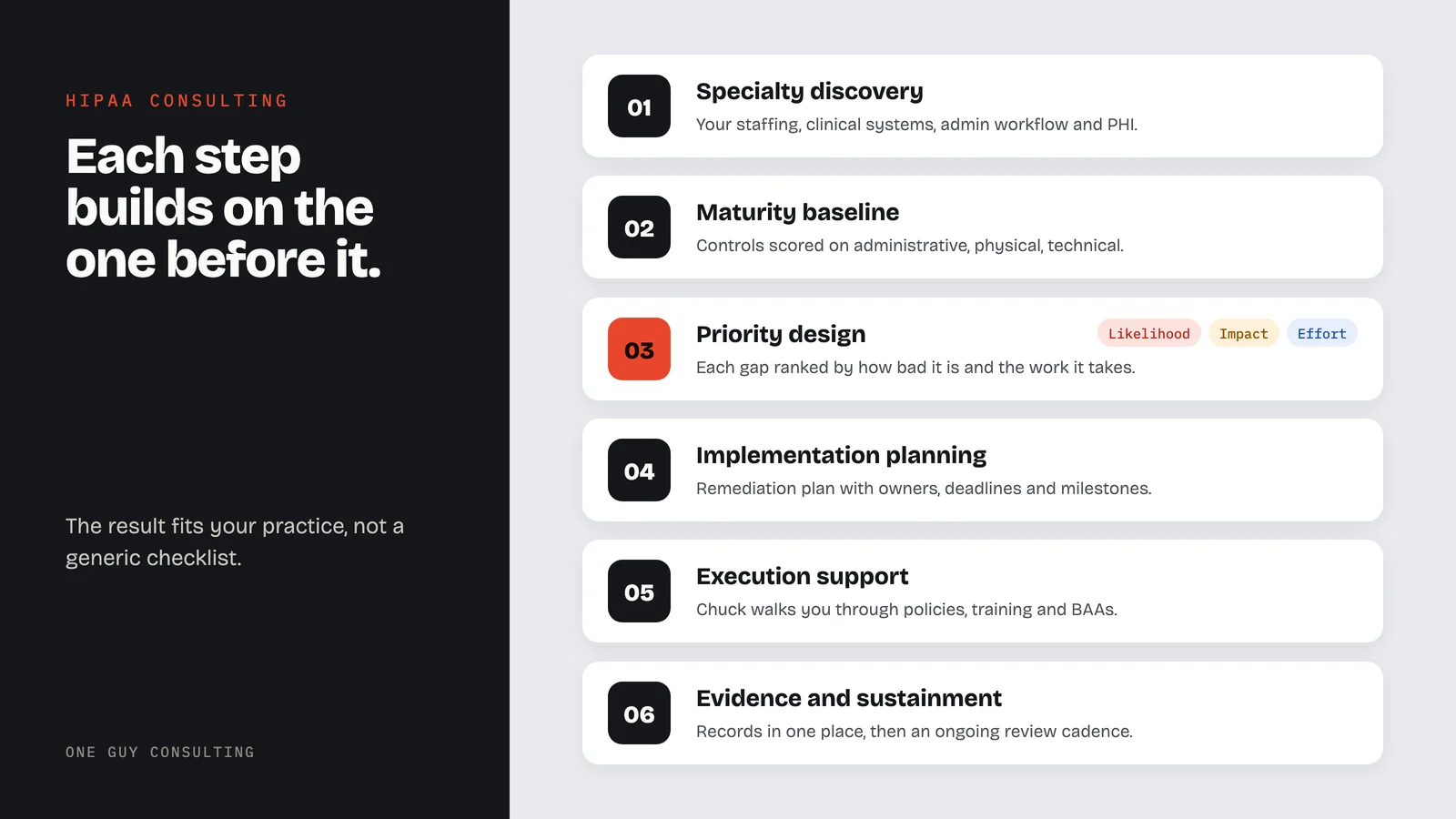
Each step builds on the one before it. The result fits your practice, not a generic checklist.
- 01
Specialty Discovery
The SRA starts with your staffing, your clinical systems, your admin workflow, and how you handle PHI.
WorkflowsSystemsPHI handling - 02
Maturity Baseline
The platform scores your controls on the administrative (§164.308), physical (§164.310), and technical (§164.312) safeguards to set a baseline.
- 03
Priority Design
The platform ranks each gap by how bad it is and how much work it takes. The threats to ePHI most likely to land, and to hurt, go first.
LikelihoodImpactEffort - 04
Implementation Planning
Create a remediation plan with assigned owners, deadlines, and milestones aligned to your staffing capacity and operational constraints.
OwnersDeadlinesMilestones - 05
Execution Support
On your 1:1 calls, Chuck walks you through adopting policies per §164.316(a), assigning workforce training per §164.308(a)(5)(i), and executing BAAs per §164.502(e) in the platform.
- 06
Evidence Packaging
The platform keeps your records (risk assessments, policies, training logs, BAAs) in one place, ready to hand an auditor, for the six years §164.530(j) calls for.
- 07
Sustainment
Establish ongoing review cadences for annual risk assessment updates, policy reviews, training refreshers, and BAA renewals to maintain continuous compliance.
Annual SRA updatePolicy reviewsBAA renewals
Consulting Considerations by Healthcare Specialty
HIPAA hits different specialties in different ways. We know the issues your field faces and plan around them.
Medical Practices
Multi-provider EHR access controls, lab integration security, and referral platform data handling. Common risk: shared login credentials across clinical workstations.
Medical guide → BehavioralBehavioral Health
Psychotherapy note protections, 42 CFR Part 2 alignment, and telehealth session security. Common risk: misdirected session notes containing substance use records.
Behavioral health guide → DentalDental Practices
Digital imaging (X-ray, CBCT) encryption, practice management software access, and operatory workstation controls. Common risk: unencrypted imaging files on local drives.
Dental guide → PharmacyPharmacies
Prescription data access controls, POS system security, and wholesaler data link protections. Common risk: patient information visible on screens at the counter.
Pharmacy guide → BABusiness Associates
Contract-grade compliance documentation, multi-client data segregation, and downstream vendor controls. Common risk: missing subcontractor BAAs in the vendor chain.
BA guide →How We Compare to Other HIPAA Platforms
We wrote honest breakdowns of how One Guy Consulting stacks up against every major HIPAA compliance vendor. Read them before you buy anything.
vs Accountable
Self-service software vs 1:1 implementation calls. Which fits your practice?
Comparevs Paubox
Email encryption tool vs full compliance program. See the tradeoffs.
Comparevs Drata
Big-company automation vs healthcare-focused consulting.
Comparevs Secureframe
Multi-framework tool vs HIPAA-only depth. What matters more?
Comparevs Sprinto
Auto evidence collection vs a guided HIPAA program.
Comparevs Vanta
Always-on monitoring vs flat-fee compliance builds.
Comparevs Dot Compliance
Life sciences QMS tool vs healthcare HIPAA consulting.
What Your Consulting Engagement Includes
Specialty-Calibrated Compliance Strategy
A written plan, laid out around how your field works, who reaches PHI, and what 45 CFR Part 164 asks of you.
Practical Implementation Support
1:1 implementation calls where Chuck walks you through setting up your program in the platform, including the policies §164.316(a) calls for and the training §164.308(a)(5)(i) calls for. Every task gets one named owner and a due date.
Prioritized Remediation Sequence
Each gap ranked by how bad it is and how likely it is to draw action, with the fix tied to a CFR section.
Audit-Ready Evidence Documentation
Your records sorted (risk assessments, policies, training logs, BAAs) and held for the six years 45 CFR §164.530(j) calls for.
Sustainment Guidance
A written rhythm for the yearly risk assessment update, policy reviews, refresher training, and BAA renewals, so it does not slip.
Want to see how it works?
Book Your Free 30 Minute HIPAA Compliance Review.
Book a review →Specialty Consulting Roadmap
The road map runs in three phases, each built on the one before, and most practices get through it in weeks, not months. Phase 1 sets the baseline and says who owns what, as 45 CFR §164.308(a)(1) and §164.316(b) call for. Phase 2 closes the top control gaps and starts your proof file. Phase 3 fixes what is left and sets the rhythm that keeps it going.
Alignment & Baseline
- Align stakeholders on priorities
- Validate specialty maturity baseline
- Lock priority sequence by impact
- Assign control ownership
Quick Wins & Governance
- Execute high-priority quick wins
- Establish core governance routines
- Reduce recurring confusion points
- Begin evidence records
Structural & Sustainment
- Close structural compliance gaps
- Strengthen evidence discipline
- Prepare handoff for internal teams
- Activate ongoing review cadence
By the end of Phase 3, you should be able to name your top risks, your open gaps, and your next steps. If you can, the program is working.
Common Pitfalls in Generic Consulting
We avoid these problems by planning for real follow-through from day one, not treating action as an afterthought.
Too-general advice. It may sound right, but it is hard to act on without field-specific context.
Unclear ownership. Teams get a list of fixes but no named owners. So nothing moves forward.
No order of steps. Too many projects at once overload staff and slow real progress.
Weak proof. Fixes happen, but the records stay messy and hard to defend in a review.
No upkeep plan. Progress fades after the first project ends if no review rhythm is in place.
Slow decisions. When no one owns the call, fixes stall and the team drifts apart.
Why Specialty Alignment Matters
Programs fail when the advice does not match how the team works. Your plan is built from your own SRA answers, so it fits your real setting. Less friction. More follow-through. Better proof over time. A remediation plan puts a name on each gap, so findings turn into finished work instead of a stalled list.
Leaders get clear choices, not vague compliance talk. You see what to fix first, who owns it, and how to track progress. That makes budget calls easier too. Spend on what cuts the most risk, not on what looks good on paper. That includes what you put into physical safeguard work, and how far your device and IT audit reaches. Both are called for under 45 CFR §164.310, and both tend to get less than they should.
Additional Success Metrics to Track
- % controls still operating as designed after 60 days
- Number of recurring exceptions by specialty
- Avg. time from finding identification to verified closure
- Decision latency on control ownership questions
- Fewer repeat findings across successive reviews
Deep-Dive Resources
If you are comparing consulting options and specialty scope, these posts can help you frame the decision:
HIPAA Consulting FAQ
How does the program fit my specialty?+
Can businesses with multiple specialties use this service?+
Do you replace existing compliance teams?+
How quickly can we see progress?+
How much does a HIPAA consultant cost?+
What do the four hours a month cover?+
HIPAA Compliance Self-Assessment
Check off what you have in place. Your score updates instantly. No sign-up required, and your progress is saved automatically.
You have big HIPAA gaps that need work now. Start with the Security Risk Assessment. Everything else is built on it.
This self-assessment is for educational purposes only and does not constitute legal or compliance advice.
Need Consulting That Matches How Your Team Actually Works?
Book an intro call and we will map your specialty context to a practical compliance execution plan.
Zero client fines. Zero failed audits.
“One Guy Consulting is super easy to work with. I actually look forward to my implementation meetings for HIPAA.” Samantha M.