HIPAA Compliance for Mental Health and Behavioral Health
Mental health and behavioral health providers must comply with HIPAA regulations that impose stricter requirements than those for other healthcare providers, including additional protections for psychotherapy notes under 45 CFR 164.508 and substance use disorder records under 42 CFR Part 2.
Why Behavioral Health Has Different HIPAA Rules
Therapists, counselors, psychologists, and psychiatrists must follow these added rules on top of the standard Privacy and Security Rules.
Under 45 CFR 164.508, psychotherapy notes are notes recorded by a mental health professional documenting or analyzing the contents of a counseling session. These notes must be stored separately from the medical record and require patient authorization for most disclosures.
SUD records · 42 CFR Part 2Records from federally assisted substance use disorder treatment programs are subject to 42 CFR Part 2, which requires written patient consent for most disclosures, a stricter standard than HIPAA's treatment/payment/operations exception.
What We Focus On for Behavioral Health Providers
These are the highest-risk gaps we see across therapy practices, counseling centers, and behavioral health programs.
Risk and gap reviews
Risk and gap reviews for sessions, care handoffs, and records based on the security risk assessment rules in 45 CFR §164.308(a)(1).
Intake, notes, and patient messages
Policies for intake, notes, and patient messages, including psychotherapy note controls under 45 CFR §164.508(a)(2). See our guide on HIPAA authorization form requirements.
Vendor and BAA controls
Vendor and BAA controls under 45 CFR §164.308(b) for your EHR, telehealth platform, billing service, and any other vendor that touches PHI.
Required HIPAA Compliance Steps for Behavioral Health
Every behavioral health covered entity must complete these steps. Each ties to a specific CFR rule. For cost details, see our HIPAA compliance cost breakdown.
- 01
Security Risk Assessment (SRA)
You must find threats to all ePHI your practice creates, stores, or sends. A documented risk assessment is the item OCR looks for first when it investigates a behavioral health practice.
Start hereOCR looks for it first. - 02
Written policies and procedures
Must cover privacy, security, breach notification, and staff conduct. Your policy templates should also cover psychotherapy notes, SUD record consent, and telehealth protocols.
Behavioral fitTherapy notes, SUD consent, telehealth. - 03
Workforce training
Everyone with PHI access must complete HIPAA training at hire and when policies change. Keep training records for six years.
Keep the proofTraining records for six years. - 04
Business Associate Agreements
You need signed BAAs with your EHR vendor, telehealth platform, billing service, cloud storage, and any other vendor that handles PHI.
Check the listEHR, telehealth, billing, cloud storage. - 05
Psychotherapy notes protections
Therapy notes kept separate from the medical record need written authorization before almost any disclosure. Standard TPO exceptions do not apply.
No TPO shortcutWritten authorization first. - 06
42 CFR Part 2 review
If your practice treats substance use disorders with federal funding, those records have stricter consent rules than HIPAA. The more protective standard always wins.
42 CFR Part 2Stricter rule winsSeparate consent workflows for SUD records.
Common HIPAA Compliance Gaps in Behavioral Health
Many practices have no documented risk assessment. They use generic policies that skip psychotherapy note rules. They lack BAAs with telehealth or EHR vendors. They do not keep training records. A gap analysis maps each gap to the CFR rule it violates and ranks fixes by risk.
Group practices face extra challenges. Therapists use different tools, keep notes differently, and work from different locations. A gap analysis at the organization level is the right starting point.
Telehealth Compliance for Behavioral Health
Telehealth platforms used for behavioral health sessions must implement encrypted transmission, access controls, and require a signed BAA. The platform vendor is a business associate under HIPAA.
The same technical safeguards under §164.312 apply here: unique user IDs, automatic logoff, and encryption. Which platform you pick and how you set it up matters more than most practices think. See our guide on HIPAA and telehealth compliance for the full list.
Regulatory Standards Specific to Behavioral Health
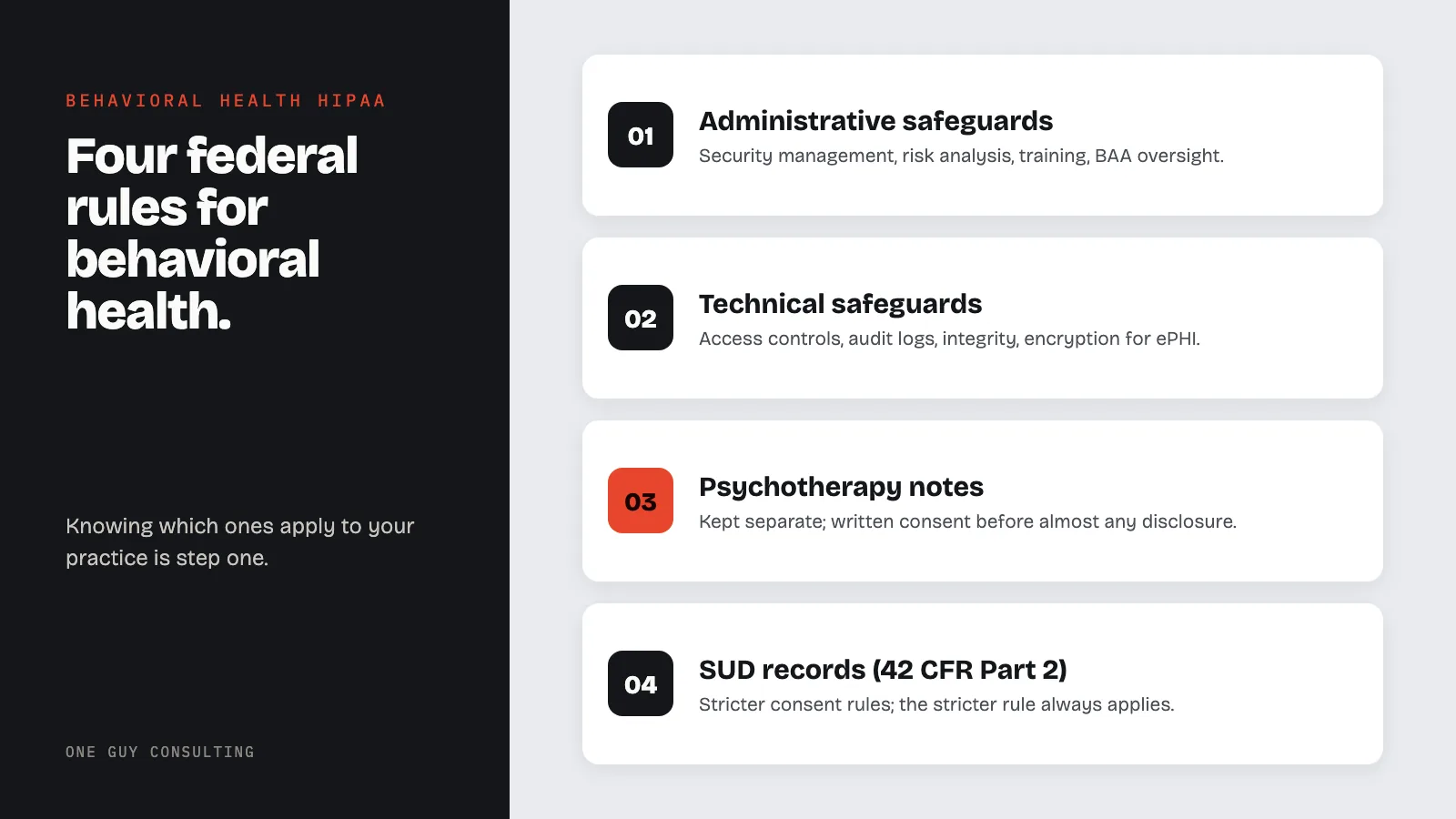
These federal rules govern HIPAA for behavioral health providers. Knowing which ones apply to your practice is step one.
Administrative Safeguards
Covers security management, risk analysis, staff training, contingency plans, and BAA oversight. Every covered practice must document policies for all required specs.
Technical Safeguards
Access controls, audit logs, data integrity, and encryption for all ePHI. Applies to EHRs, telehealth tools, patient portals, and any tech that touches ePHI.
Psychotherapy Notes Authorization
Therapy notes kept separate from the medical record need written consent before almost any disclosure. Standard TPO exceptions do not apply. This is one of the most misunderstood rules in behavioral health.
Substance Use Disorder Records
SUD program records have stricter consent rules than HIPAA. Disclosures allowed under HIPAA's TPO exceptions are not allowed under Part 2 without patient consent. The stricter rule always applies.
HIPAA Enforcement for Behavioral Health
OCR enforces HIPAA for all covered entities, including behavioral health providers. Fines range from $145 to $2,190,294 per violation type per year under 45 CFR §160.404. OCR has investigated therapy practices for unauthorized record sharing, missing risk assessments, and slow patient record access (the 30-day rule under §164.524(b)(2)). See our breakdown of 2026 HIPAA penalty amounts for recent trends.
Who We Help With Behavioral Health HIPAA Compliance
We work with behavioral health providers across the United States, including:
- Licensed therapists and clinical social workers (LCSW) in private practice
- Psychologists and psychiatrists managing patient records
- Group counseling practices with multiple providers
- Substance use disorder treatment programs subject to 42 CFR Part 2
- Integrated behavioral health programs within larger health systems
- Telehealth-only therapy practices needing platform compliance
Whether you are a solo therapist or a multi-location organization with dozens of providers, the same HIPAA rules apply.
The difference is scale. We tailor our approach to your practice size, budget, and risk level.
One flat price for the whole practice.
Two plans, six ways to pay. No per-user fees, so adding a clinician does not change your bill.
- The platform on its own
- SRA, gap analysis, remediation plans
- Policy templates and staff training
- Vendor and BAA management
- Everything in Self-Guided
- 4 hours a month of 1:1 implementation calls with Chuck
- Incident response guidance
- CMS audit response support
One payment, two full years of coverage.
Flat rate per location.
Secure checkout by Stripe. Your payment details go straight to Stripe and never touch our servers.
Behavioral Health HIPAA FAQ
Can we improve compliance without disrupting patient care?+
Are psychotherapy notes treated differently under HIPAA?+
How do 42 CFR Part 2 records interact with HIPAA?+
What about telehealth HIPAA compliance?+
How does HIPAA handle PHI for minors in behavioral health?+
Chuck Weiselberg, C.H.P.
Certified HIPAA Professional (C.H.P.). Zero client fines. Zero failed audits.
“One Guy Consulting is super easy to work with. I actually look forward to my implementation meetings for HIPAA.”
Samantha M.