Business Associate Agreement Services
BAAs (Business Associate Agreements) are among the most commonly missing pieces of a HIPAA program. This service identifies which vendors actually need one, executes each agreement with built-in e-signature (no printing required), and tracks every signed BAA, contact, and document in one portal.
Required under 45 CFR 164.502(e) and 45 CFR 164.504(e)
HIPAA BAA Definitions You Should Know
Business Associate (BA)
A person or organization that performs functions or activities on behalf of a covered entity that involve access to Protected Health Information. Common examples include cloud hosting providers, billing companies, IT service firms, and EHR vendors. Under HIPAA, every business associate relationship requires a written agreement, the BAA, defining each party's duties for safeguarding PHI.
Protected Health Information (PHI)
Any individually identifiable health information created, received, maintained, or transmitted by a covered entity or business associate. PHI includes medical records, billing data, insurance details, and any data that can identify a patient and relates to their health condition, treatment, or payment. When stored or transmitted electronically, it is referred to as ePHI (electronic Protected Health Information).
Covered Entity
A health plan, healthcare clearinghouse, or healthcare provider that transmits health information electronically. Covered entities are directly regulated under HIPAA and are responsible for ensuring that every vendor with access to PHI has a valid BAA in place.
Business Associate Agreement (BAA)
A legally required written contract between a covered entity and a business associate (or between a business associate and a subcontractor). The BAA establishes the permitted uses and disclosures of PHI, requires appropriate safeguards, and defines breach notification duties. Without a BAA, both parties face enforcement risk under HIPAA, as defined in 45 CFR § 164.502(e).
Who Is NOT a Business Associate?
Not every vendor that handles data qualifies as a business associate under HIPAA. The conduit exception applies to entities that transport PHI but do not access it. Internet service providers, the U.S. Postal Service, and courier services that carry sealed packages containing PHI are generally not business associates because they do not routinely access the information they transport.
HHS clarified this distinction in the 2013 Omnibus Rule preamble: a conduit transports information but does not access it other than on a random or infrequent basis. An entity that stores PHI on behalf of a covered entity, even temporarily, goes beyond the conduit function and would often require a BAA.
A BAA must be in place before any PHI is shared with a business associate. Sharing PHI without a signed BAA is itself a HIPAA violation under 45 CFR 164.502(e).
What Is This Service?
This service helps businesses decide which vendors require a Business Associate Agreement, review existing agreements for compliance gaps, and build a repeatable workflow for BAA execution and renewal.
The process brings structure to contract handling across legal, compliance, procurement, and operations teams.
Vendor lists change frequently. A structured BAA program defines when to review, what triggers a reassessment, and who owns each decision so agreements stay current.
Who Needs This?
BAA management gaps appear across all business types. The following situations are the most common triggers for bringing in structured support:
Not sure which of your vendors need a BAA? Try the free Who Needs a Business Associate Agreement? game.
- Covered Entities with any number of vendors, especially those whose vendor management records are incomplete or out of date.
- Business associates that need to show clients they manage their own vendors well, including maintaining downstream BAA coverage for all subcontractors.
- Teams getting ready for audits, vendor reviews, or third-party RFPs that need clear BAA records. This is particularly useful alongside a HIPAA gap analysis to identify broader compliance gaps at the same time.
- Groups using old templates that do not match their real services or sub-vendor chains. Misaligned BAAs are among the most common findings in IT and device audits.
- Leaders seeking a faster and more efficient method of executing needed BAAs, and who want to align vendor governance with their broader remediation plans.
Organizations without a defined BAA workflow risk gaps when vendor onboarding depends on individual memory rather than a documented process.
How BAA Management Works, Step by Step
The vendor and BAA management workflow One Guy Consulting runs for every client, from finding your vendors to the annual review.
- Inventory every vendor and service provider your practice works with.
- Classify which vendors create, receive, maintain, or transmit PHI on your behalf. Those are your business associates.
- Execute a written Business Associate Agreement with each one, containing the elements required by 45 CFR 164.504(e).
- Upload every signed BAA into the portal and track it in one place.
- Send each vendor a risk questionnaire to document the safeguards they have in place.
- Review each BAA at least once a year and record whether a material change occurred in the vendor relationship.
- Handle termination: when a vendor relationship ends, confirm PHI is returned or destroyed as the agreement requires.
What a compliant BAA must contain
Under 45 CFR 164.504(e), the agreement must:
- Limit how the business associate may use and disclose PHI to what the contract permits or the law requires.
- Require appropriate safeguards, including compliance with the Security Rule for electronic PHI.
- Require the business associate to report any use or disclosure not allowed by the contract, including breaches of unsecured PHI.
- Bind any subcontractors to the same restrictions and conditions.
- Make PHI available for individual access, amendment, and an accounting of disclosures.
- Make internal records available to HHS to determine compliance.
- At termination, return or destroy all PHI if feasible.
The BAA Workflow Inside the Portal
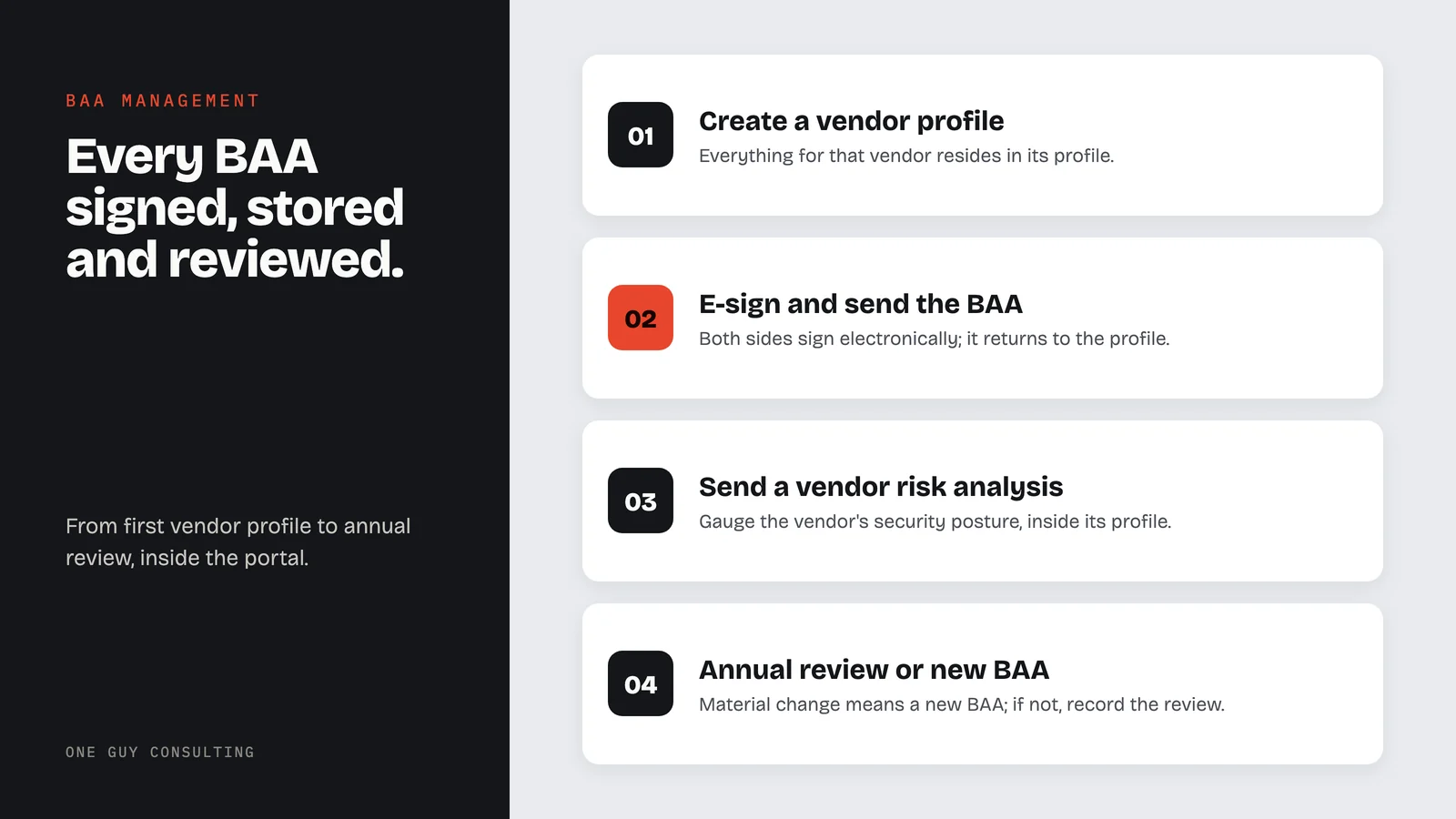
Each BAA engagement follows a defined sequence inside the compliance portal. The steps below reflect the required workflow for establishing, executing, and maintaining a vendor relationship under HIPAA, from first profile creation through annual review.
- 01
Create a Vendor Profile
Navigate to the Vendor Management section of the tool on the left-hand side. Create a vendor profile first. Everything resides in that profile, so without it, you're treading water.
- 02
E-Sign and Send the BAA
After constructing the profile, you will e-sign the business associate agreement and send it to your vendor to do just the same. Once the other side signs (electronically), the agreement returns fully signed to the profile it originated from.
- 03
Send a Vendor Risk Analysis
Aside from enacting a BAA, a new business associate relationship has one more hurdle before legal. You will want to send the BA a Vendor Risk Analysis to get an idea of their security posture (plus, it's a legal requirement). This can be done inside of the vendor profile just like the BAA.
- 04
Annual Review or New BAA
If there have been any material changes to the business relationship between the two parties, this constitutes the execution of a new BAA. If there have been no significant changes in the last year, complete the field marked for Annual Review to have a record of this review available if needed.
Where Vendor Risk Concentrates
Representative patterns across BAA engagements, showing where gaps, complexity, and remediation effort most commonly concentrate.
Where BAA Gaps Are Found
Common root causes in vendor inventory audits
- Missing agreements35%
- Outdated/expired terms25%
- Clause misalignment20%
- Subcontractor gaps12%
- Fragmented records8%
Remediation Throughput by Phase
Progress trajectory across a standard engagement, completed in weeks, not months
Typical Coverage Rate Improvement
Before vs. after structured BAA program build
- Before: avg. coverage48%
- After: avg. coverage94%
BAA Considerations by Specialty
BAA risk differs by specialty and vendor mix. Knowing where risk sits in your practice type helps you fix the right things faster.
Medical Practices
Medical practices use many vendor types. EHR tools, billing firms, and patient messaging platforms each need different BAA terms.
Medical guide → BehavioralBehavioral Health
Behavioral health deals with sensitive data. Telehealth vendors, care tools, and niche platforms need close review and clear sub-vendor terms.
Behavioral health guide → DentalDental Practices
Dental practices rely on imaging and practice management tools. These systems move data in ways that need careful scope mapping.
Dental guide → PharmacyPharmacies
Pharmacies handle many integrations at a fast pace. That calls for tight roles, clear duties, and well-defined sub-vendor terms.
Pharmacy guide →Business Associates
Business associates must match their own vendor controls to the terms in their upstream contracts. Our business associate compliance guide covers the subcontractor side of that chain.
BA guide →Health Tech / SaaS
Health tech firms add vendors and sub-vendors fast. Strong BAA oversight stops coverage gaps from piling up as your platform grows.
BAA management is included in both plans.
Two plans, six ways to pay. No per-user fees. Pick the level of help you want from Chuck.
- The platform on its own, no consulting time
- SRA, gap analysis, remediation plans
- Policy templates and staff training
- Vendor and BAA management
- Everything in Self-Guided
- 4 hours a month of 1:1 implementation calls with Chuck
- Incident response guidance
- CMS audit response support
One payment, two full years of coverage.
Secure checkout by Stripe. Your payment details go straight to Stripe and never touch our servers.
Why This Matters for Long-Term Compliance
At its core, a BAA exists to properly place liability on the correct party in the event of a cybersecurity breach. Without one, your business may absorb the full legal and financial consequences of a vendor's failure to protect PHI, even when the breach was entirely on their side. Breach events that trace back to a vendor without a valid BAA in place are a direct HIPAA violation and may require reporting under the incident management process.
Vendor risk shifts over time
Services change. Tools expand. Priorities move. Contract terms can drift from what really happens. A solid BAA program keeps you on track and stops hidden risk from piling up. Organizations that conduct regular vendor management reviews catch these drift points before they become enforcement findings.
It also cuts friction across teams
Legal, compliance, and operations move faster when roles and workflows are clear. That speed matters when you bring on key vendors while guarding PHI.
A structured BAA program keeps your business aligned and stops silent exposure from building up, even as vendor relationships change.
Building Sustainable BAA Governance
Durable governance depends on three structural elements: clear ownership, event-triggered reassessment, and disciplined evidence management. Each is described below.
Clear Ownership Across the Contract Lifecycle
Procurement starts the request. Legal negotiates the terms. Compliance checks the requirements. Operations owns setup. When each team knows its role, work moves faster without cutting corners.
Trigger-Based Re-Evaluation
Service expansions, integration changes, new sub-vendors, and business model shifts all affect BAA requirements. Trigger-based reviews stop outdated assumptions from taking hold.
Evidence Discipline
Keep a current inventory with clear yes/no rationale for each vendor decision. Maintain a status view of active agreements, renewals, and exceptions. Audits should not require last-minute scrambling.
Evaluating BAA Service Quality
Ask whether the engagement covers both agreement review and workflow design. Many services focus only on contract language and miss operational controls. A strong engagement should also include inventory governance, exception handling, and practical evidence standards for audits. These are what make the program last.
It is also worth asking how quickly high-risk contract gaps can be flagged and escalated. Speed matters when vendor onboarding timelines are tight. A service that combines clear risk criteria with practical escalation paths usually delivers better results while keeping compliance strong.
The right engagement closes both the contract quality gap and the process gap, not just one or the other.
The questions below address the most common points of uncertainty businesses encounter when assessing BAA requirements or selecting a vendor governance approach.
Frequently Asked Questions
Is every vendor that touches data automatically a business associate?+
Can we use one standard BAA template for all vendors?+
What happens when a vendor refuses specific terms?+
How often should BAA inventory be reviewed?+
Can this service support both covered entities and business associates?+
Questions About Your BAA Program?
Schedule a call to discuss your current vendor contract posture and identify where gaps may exist.
Deep-Dive Resources
For contract quality and vendor classification alignment, these articles provide practical depth:
- HHS.gov: Business Associate guidance
- 45 CFR § 164.502(e): Uses and disclosures of PHI: business associate contracts
- HHS.gov: Business Associate fact sheet
Explore our other HIPAA services
Questions About BAA Management?
Tell us about your situation or question.
Or email us at hello@oneguyconsulting.com
Book Your Free 30-Minute Intro Call