HIPAA Staff Training Services
HIPAA requires covered entities and business associates to train all workforce members on policies and procedures for protecting PHI, as specified in 45 CFR §164.530(b) and §164.308(a)(5).
Training Modules and Records at a Glance
What the training covers, how it is delivered, and what HIPAA requires you to keep. You can also try three free training games: the phishing game, the Who Needs a Business Associate Agreement? game, and Sharps Shootout on bloodborne pathogens.
- HIPAA 101
- Cybersecurity Awareness
- Fraud, Waste, and Abuse
- Sexual Harassment Prevention
- Bloodborne Pathogens
- Phishing, Smishing, and Vishing
- Delivered through the Privacy Officer Portal.
- You invite each employee by name and work email.
- You track everyone's progress and send reminders from the platform.
- Annual training reminders are sent automatically.
- Provide workforce training (45 CFR 164.530(b)(1)).
- Document that training was provided (164.530(b)(2)(ii)).
- Retain the documentation for six years from creation or when it last was in effect, whichever is later (164.530(j)(2) and 164.316(b)(2)(i)).
What Is HIPAA Staff Training, and Why Most Programs Fail
HIPAA staff training educates workforce members on the application of the Privacy Rule (45 CFR Part 164, Subpart E) and Security Rule (45 CFR Part 164, Subpart C) to their daily responsibilities.
Effective training covers policies, incident recognition, communication, access habits, and breach reporting duties under 45 CFR §164.404. Training must be role-appropriate and updated when workflows, systems, or regulations change. Under the Privacy Rule, covered entities must train each member of the workforce on policies and procedures with respect to PHI, as needed and appropriate for that member to carry out their functions (45 CFR §164.530(b)(1)). The Security Rule requires a separate security awareness and training program for all workforce members, including management (45 CFR §164.308(a)(5)(i)).
Training must be role-specific: a billing clerk's training should differ from a clinician's training, addressing the specific PHI access patterns and risks relevant to each role.
Key HIPAA Training Requirements
- Privacy Rule Training45 CFR §164.530(b)(1)
Train each workforce member on PHI policies and procedures as needed for their job functions. New members must be trained within a reasonable period after joining. - Security Awareness Program45 CFR §164.308(a)(5)(i)
Implement a security awareness and training program for all members of the workforce, including management. - Addressable Training Specifications45 CFR §164.308(a)(5)(ii)
Security reminders (A), protection from malicious software (B), log-in monitoring (C), and password management (D). - Material Change Retraining45 CFR §164.530(b)(2)(i)
Retrain workforce members whose functions are affected by a material change in policies or procedures. - Documentation Retention45 CFR §164.530(j)
Maintain training records for six years from the date of creation or the date last in effect, whichever is later. - Sanctions for Non-Compliance45 CFR §164.308(a)(1)(ii)(C) and §164.530(e)
Apply appropriate sanctions against workforce members who fail to comply with policies and procedures.
Security Rule Addressable Specifications: 45 CFR §164.308(a)(5)(ii)
The Security Rule identifies four addressable implementation specifications that must be evaluated and, where reasonable and appropriate, implemented as part of a workforce security awareness program:
- Security reminders: periodic updates on current threats, policy changes, and security best practices
- Protection from malicious software: training on recognizing and avoiding malware, phishing, and ransomware
- Log-in monitoring: procedures for monitoring log-in attempts and reporting discrepancies
- Password management: guidance on creating, changing, and safeguarding passwords
Seven-Step Implementation Process
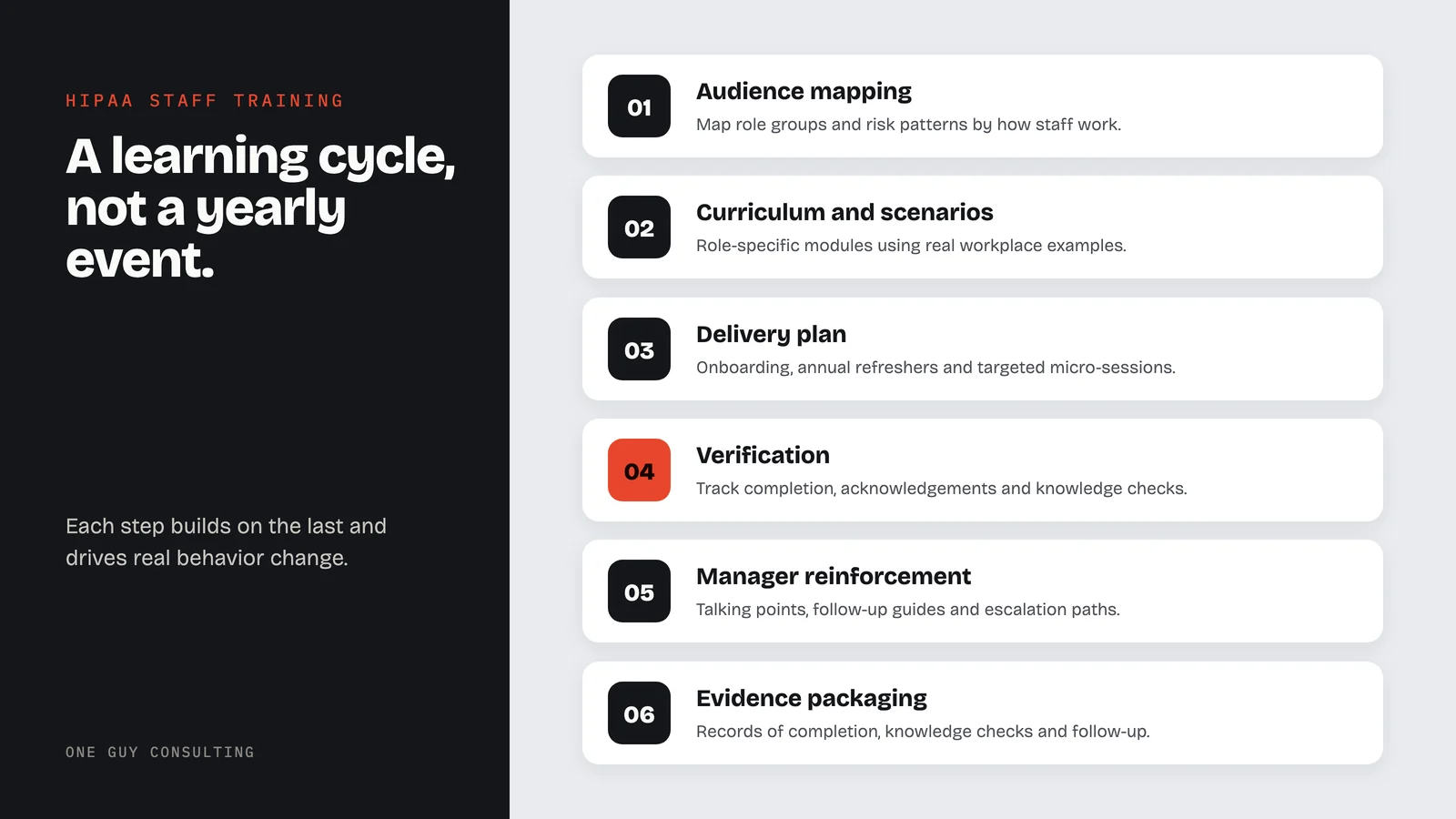
This creates a lasting learning cycle, not a yearly event staff forget. Each step builds on the last and drives real behavior change.
- 01
Audience Mapping
Map role groups and risk patterns based on how the workforce actually operates. Under §164.530(b)(1), training must be appropriate for each member's functions.
- 02
Curriculum Design
Build role-specific modules tied to organizational policies and workflows. The Security Rule's addressable specifications (§164.308(a)(5)(ii)(A) through (D)) define the minimum scope: security reminders, malicious software protection, log-in monitoring, and password management. Beyond HIPAA-specific content, many healthcare businesses also need bloodborne pathogen training for healthcare staff and fraud, waste, and abuse (FWA) training to meet federal program requirements.
- 03
Scenario Customization
Use real workplace examples so content is immediately applicable. Scenarios should cover PHI disclosure limits under the Minimum Necessary Rule (§164.502(b)) and breach identification under §164.404.
- 04
Delivery Plan
Plan onboarding, annual refreshers, and targeted micro-sessions. New workforce members must be trained within a reasonable period after joining (§164.530(b)(2)(i)). Retraining is required after material policy changes.
- 05
Verification
Track completion, acknowledgements, and knowledge checks. HIPAA requires records of training activities and retention for six years (§164.530(j)(2)).
- 06
Manager Reinforcement
Equip supervisors with talking points, follow-up guides, and escalation paths. The sanctions standard (§164.308(a)(1)(ii)(C)) requires a defined process for addressing workforce non-compliance.
- 07
Evidence Packaging
Package records of completion, knowledge checks, and follow-up actions. Under §164.530(j), covered entities must retain training records for six years. OCR reviews these records during compliance audits and breach investigations. See a full breakdown of what you receive in our training modules and completion documentation overview.
Where Training Programs Break Down
These are representative patterns we see across healthcare workforce compliance engagements.
Training Coverage by Role Group
Typical gap distribution at program start
Groups
- Clinical staff34%
- Front desk / intake27%
- Billing / coding19%
- Leadership12%
- IT / technical8%
Knowledge Retention Over Time
With refreshers vs. without: 12-month window
Representative retention pattern. Actual results vary by content design and reinforcement frequency.
Typical Readiness Score
Before vs. after a structured program
Target post-engagement metrics
Where Does Your Training Program Stand Today?
Adjust the slider to reflect your current program maturity. See what that means for urgency and recommended next steps.
Move the slider to assess your program
Rate your training program from 0 (no program) to 100 (fully governed, role-based, and audit-ready).
From Checkbox Completion to Behavior Change
A mid-sized healthcare group had high yearly training scores. But staff still made access and communication errors. They knew the basics. They struggled with hard calls under pressure.
We split staff into role tracks. We swapped generic examples for real scenarios from their specialty. We added short refreshers tied to recent incidents. Managers got follow-up guides and monthly review prompts.
Teams felt more sure in real situations. Repeat issues dropped over two quarters. Leaders had clear proof that training was not just done but put to use.
Training Considerations by Healthcare Specialty
Training should match how your specialty works. Generic content that ignores daily routines fails staff when it counts.
Medical Practices
Clear role expectations for intake, clinical, and billing staff. Scenarios cover real decision points.
Behavioral Health
Covers communication discretion, records sensitivity, and platform boundary decisions.
Dental Practices
Covers front-desk to operatory workflow consistency and handoff compliance.
Pharmacies
Training for fast-paced settings. Covers quick access choices and safe daily habits.
Business Associates
Covers client-facing duties, when to escalate, and how to report incidents.
Training Is Included in Both Plans
Two plans, six ways to pay. Flat pricing for your whole team, with no per-user fees.
The platform only, no consulting time. Training is delivered through the Privacy Officer Portal, with progress tracking, reminders, and records kept for you.
Compare plansEverything in Self-Guided, plus:
- 4 hours a month of 1:1 implementation calls with Chuck
- Incident response guidance
- CMS audit response support
Secure checkout by Stripe. Your payment details go straight to Stripe and never touch our servers.
What Your Training Engagement Includes
Role-Based Training Framework
A structured curriculum tied to your policy environment and actual workflow risk by role group.
Scenario-Driven Content
Practical examples aligned to your operating context, not generic industry scenarios.
Completion and Acknowledgement Evidence Structure
Documentation designed to satisfy auditor requests and show active program management.
Refresher Cadence and Reinforcement Model
A layered schedule that combines onboarding, annual updates, and targeted micro-learning tied to real events.
Manager Reinforcement Tools
Supervisor prompts, talking points, and escalation paths that do not require managers to become compliance instructors.
Audit-Ready Documentation Support
Records structured for regulatory review, due diligence, or OCR inquiry, with clear accountability by role.
A Three-Phase Path to Durable Training
Foundation
- Establish role mapping and risk exposure
- Define required modules by role
- Confirm manager accountability model
- Design completion reinforcement plan
Rollout
- Deliver role-specific sessions
- Run scenario exercises by track
- Activate manager reinforcement prompts
- Document completions and acknowledgements
Validation
- Review behavior change via manager feedback
- Assess incident trend shifts by department
- Deploy targeted micro-refreshers where needed
- Finalize audit-ready evidence package
Common Training Pitfalls
Addressing these pitfalls improves compliance and operational confidence. Teams spend less time second-guessing under pressure.
- One-size-fits-all content: Staff get generic instruction that is not tied to role responsibilities or daily decisions.
- No reinforcement: Training is delivered once, with no structured follow-up to sustain behavior change.
- Completion-only metrics: Programs track attendance, but not practical understanding or behavior change.
- Weak manager integration: Supervisors lack the tools to reinforce behavior expectations between training cycles.
- Disconnected policy updates: Training materials do not reflect policy or workflow changes when they happen.
- No leadership track: Governance decisions and escalation frameworks are left out of training.
How to Build a Durable Training Cadence
A good training schedule combines onboarding, annual refreshers, and short targeted updates tied to real events. Onboarding gives every new hire a baseline. Annual refreshers reinforce policies and catch drift. Short refreshers address specific issues from incidents, audits, or workflow changes.
Manager participation matters just as much. Supervisors should get simple prompts to reinforce key behaviors in team meetings and one-on-ones. They do not need to become compliance experts. They do need clear talking points and escalation paths. When managers set consistent expectations, staff apply their training under pressure.
Buyer Checklist for Training Services
Before selecting a training provider, confirm these capabilities. A strong training service should improve behavior, not just completion stats.
- Content is role-based, not generic across all staff
- Scenarios are specialty-specific to your operating context
- Implementation support includes evidence workflows
- Manager reinforcement tools are explicitly included
- Content can be updated quickly when processes change
- Targeted follow-up strategy exists for underperforming areas
- Provider can coordinate with compliance, ops, and IT teams
- Program tracks behavior outcomes, not only attendance
Deep-Dive Resources
These resources help connect training completion metrics to real compliance behavior:
Staff Training Frequently Asked Questions
How long should each training session be?+
HIPAA does not specify a minimum session length. The Privacy Rule (§164.530(b)(1)) requires training that is needed and appropriate for each workforce member's functions. Many businesses use shorter core sessions (15 to 30 minutes) plus focused refreshers rather than one long annual block. The Security Rule's addressable specifications (§164.308(a)(5)(ii)) should guide scope. For more on scheduling, see our guide on HIPAA staff training frequency for small practices.
Can we train leadership differently from frontline staff?+
Yes. Under §164.530(b)(1), training must be appropriate to each member's functions. Leadership training often covers governance decisions, risk management oversight (§164.308(a)(1)(i)), and sanction enforcement (§164.308(a)(1)(ii)(C)). Frontline training should emphasize role-specific PHI handling, access controls (§164.312(a)(1)), and scenario-based breach identification.
Do we need documented quizzes or assessments?+
HIPAA does not mandate quizzes, but records of training is required under §164.530(j). Competency checks strengthen audit evidence by demonstrating that training covered practical application, not just attendance. OCR has cited insufficient training records in enforcement actions including the 2018 Anthem settlement ($16 million) and the 2023 Banner Health case ($1.25 million).
How do we handle policy changes between annual cycles?+
Under §164.530(b)(2)(i), covered entities must retrain workforce members whose functions are affected by a material change in policies or procedures. This means waiting for annual training is not enough when significant changes occur. Targeted micro-refreshers tied to the specific policy change satisfy this requirement without repeating the full program.
Can this be combined with broader compliance consulting?+
Yes. The Security Rule requires that training be part of the broader security management process (§164.308(a)(1)). Training should align with findings from the required risk analysis (§164.308(a)(1)(ii)(A)), the risk management plan (§164.308(a)(1)(ii)(B)), and current written policies (§164.316(b)). Integrated planning ensures the training program addresses real, identified gaps rather than generic content.
Why This Delivers Better Compliance Behavior+
Training works when people can apply it quickly in real decisions. We prioritize practical relevance, short reinforcement loops, and clear accountability so teams are not guessing when pressure rises. That reduces preventable incidents and improves confidence across the business, while giving leadership measurable evidence that the program is working.
Chuck Weiselberg, Certified HIPAA Professional (C.H.P.). Zero client fines. Zero failed audits.“One Guy Consulting is super easy to work with. I actually look forward to my implementation meetings for HIPAA.”Samantha M.
Ready to Improve Training Outcomes?
Book a short intro and we will walk you through how training works in the platform for a team your size.