Fraud, waste and abuse (FWA) training teaches healthcare staff to spot and report improper billing, coding, and documentation before it becomes a legal problem. Fraud requires intent. Waste does not. Medicare Advantage and Part D plans must include training in their compliance programs. The False Claims Act allows penalties of up to $28,619 per false claim.
Fraud, Waste and Abuse Training: What It Is and Why It Matters
Key Definitions
- Healthcare Fraud: Knowingly and willfully executing or attempting to execute a scheme to defraud a healthcare benefit program, or obtaining money or property from a healthcare benefit program through false pretenses or representations. Fraud requires intent. Examples: billing for services not rendered, upcoding, unbundling claims to inflate reimbursement.
- Healthcare Waste: Overutilization of services or other practices that directly or indirectly result in unnecessary costs to the healthcare system. Waste does not require intent or knowledge that the action is wrong. Examples: ordering duplicate tests, prescribing brand-name drugs when generics are available and clinically appropriate.
- Healthcare Abuse: Practices that are inconsistent with accepted sound fiscal, business, or medical practices and that result in unnecessary cost, improper payment, or services that do not meet professionally recognized standards of care. Abuse falls between waste and fraud in severity. Examples: billing for a higher level of service than provided, misusing billing codes to increase reimbursement.
Governing Laws and Regulations
- False Claims Act (31 U.S.C. 3729-3733): The federal government's primary tool for combating healthcare fraud. Imposes civil penalties of up to $28,619 per false claim. That is the inflation-adjusted amount for penalties assessed after July 3, 2025 (28 CFR 85.5). It also adds treble damages, which means three times the government's losses. Allows private citizens to file qui tam (whistleblower) lawsuits on behalf of the government.
- Anti-Kickback Statute (42 U.S.C. 1320a-7b(b)): Prohibits offering, paying, soliciting, or receiving anything of value to induce or reward referrals for services covered by federal healthcare programs. Criminal penalties include fines up to $100,000 and up to 10 years imprisonment per violation.
- Physician Self-Referral Law / Stark Law (42 U.S.C. 1395nn): Prohibits physicians from referring Medicare patients to entities with which the physician (or an immediate family member) has a financial relationship, unless an exception applies. Claims tied to a violation can also lead to False Claims Act liability.
- OIG Compliance Program Guidance: The HHS Office of Inspector General publishes compliance program guidance for various healthcare sectors. These documents outline the seven elements of an effective compliance program, including training requirements.
Fraud, waste and abuse training is one of those compliance topics that organizations often treat as routine. That is until a billing issue, reporting failure, or internal complaint creates urgency. That is backwards. By the time a regulator, payer, or whistleblower comes around, things are bad. The real problem is usually not the lack of a training module. It is the lack of a workforce that knows what to notice, what to question, and what to report.
For healthcare organizations, fraud, waste and abuse training helps create that baseline. It gives employees a clearer understanding of what improper conduct can look like. It explains why small decisions can snowball. It gives a procedure on how concerns should move through the organization. That is, before they turn into something harder to contain.
This guide explains what FWA training covers, who is required to complete it, and what makes it work in daily operations.
What Is Fraud, Waste and Abuse Training?
Fraud, waste and abuse training, often shortened to FWA training, teaches workforce members how to recognize conduct that can lead to improper payments. It discusses false claims, avoidable cost, and compliance failures in healthcare as well. At a basic level:
- Fraud involves knowingly submitting false information or misrepresenting facts for payment or benefit. Intent is a key element: the person knows what they are doing is wrong.
- Waste involves overutilization of services, inefficient practices, or unnecessary costs to the healthcare system. Unlike fraud, waste does not require intent.
- Abuse involves practices inconsistent with accepted sound medical, fiscal, or business standards that result in unnecessary cost or improper payment. Abuse is more severe than waste but does not require the same level of intent as fraud.
In Medicare-related environments, FWA training is an expectation for payment integrity. Other health organizations find it useful because it targets the practices behind weak billing controls and questionable documentation. Those practices undermine trust, oversight, and accountability.
What Fraud, Waste and Abuse Training Should Cover
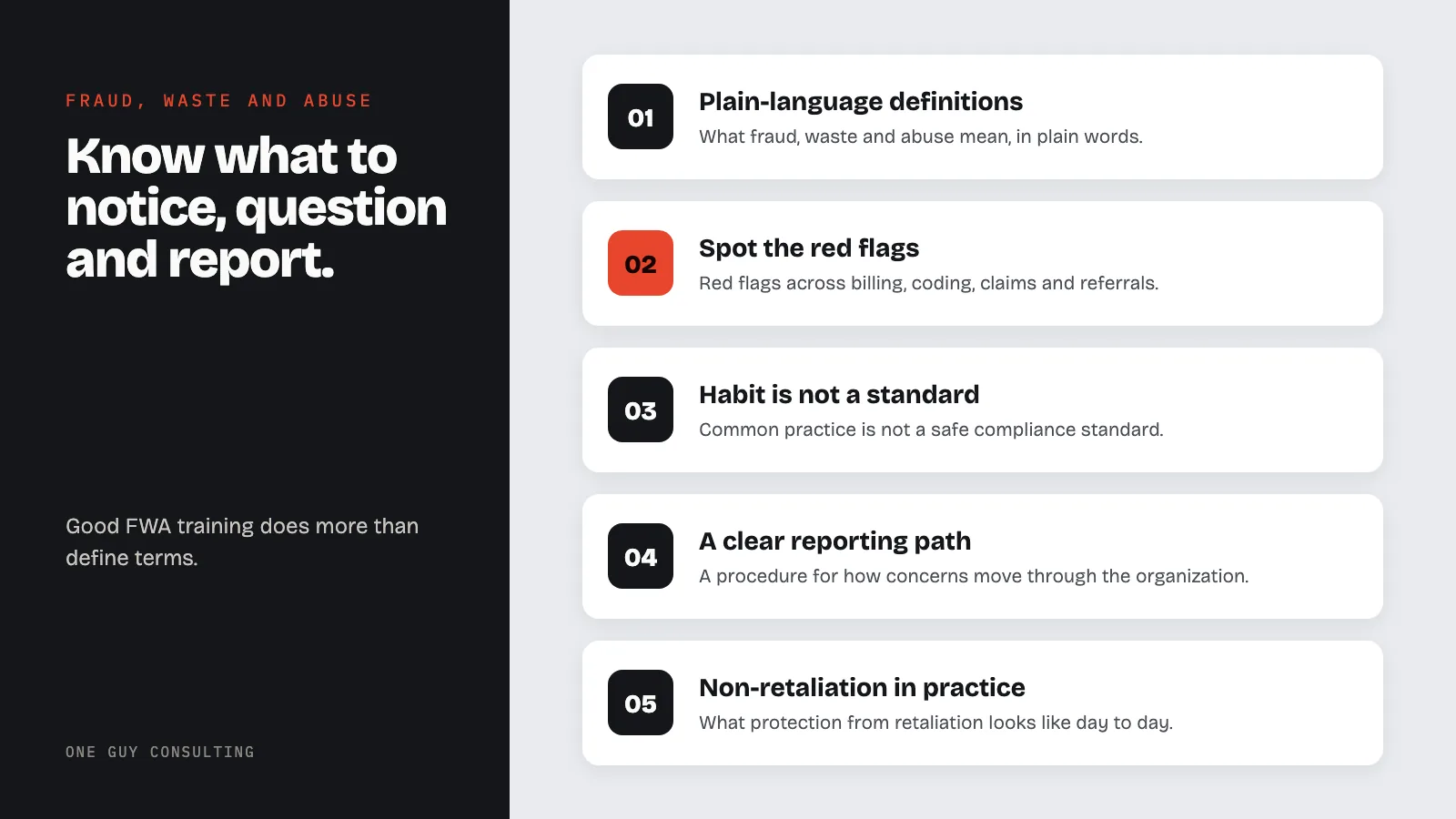
Strong fraud, waste and abuse training in healthcare should do more than define terms. It should help employees understand where risk shows up in daily operations. That usually means covering:
- Clear definitions of fraud, waste, and abuse in plain language.
- Common red flags in billing, coding, claims, referrals, and documentation.
- Why "everyone does it this way" is not a safe compliance standard.
- How employees should raise concerns internally.
- What non-retaliation expectations should look like in practice.
- How managers and compliance leads should respond to reports.
- Why documentation and escalation processes matter.
If training does not help staff recognize realistic scenarios, it has failed. It won't do much when real issues emerge.
Why Fraud, Waste and Abuse Training Matters for Your Organization
Fraud, waste and abuse training matters because healthcare organizations rarely get into trouble from one dramatic movie-scene event. They get into trouble because of what goes unaddressed. Things we may find silly but are harmful. Shortcuts, poor management, wrong hunches, or weak reporting culture going unaddressed is problematic. Especially when issues like this continue long enough to become systemic.
It gives staff a shared compliance vocabulary
Most employees are not lawyers or auditors. They need plain language that helps them distinguish between a low priority incident and something needing escalation immediately. Training gives the organization a shared vocabulary for those moments.
It supports earlier reporting
People are much more likely to report a concern when they can recognize it and understand what to do next. That matters because early reporting is crucial. It is the same principle behind building a strong healthcare compliance culture. It often gives an organization options it no longer has once a problem spreads across departments or payers.
It reinforces management accountability
FWA issues do not sit only with front-line staff. Supervisors need to understand how to respond when someone raises a concern. The HIPAA compliance officer guide covers how to document concerns and build a culture where employees feel safe speaking up.
It strengthens the entire compliance program
Training works best when it is backed by policies, reporting pathways, documentation practices, and oversight. If you are reviewing your broader compliance education stack, see our articles on essential employee HIPAA training topics, how to roll out a HIPAA training program, and bloodborne pathogen training requirements for healthcare organizations.
Who Should Prioritize Fraud, Waste and Abuse Training?
Fraud, waste and abuse training for healthcare organizations is especially important for:
- Medical practices and physician groups.
- Behavioral health and specialty care providers.
- Organizations with billing, coding, reimbursement, or utilization review functions.
- Managers and compliance leaders responsible for internal reporting.
Who Is Required to Complete FWA Training?
- Medicare Advantage organizations: CMS requires MA plans to run a compliance program. The program must train the compliance officer, employees, managers, and governing body members (the plan's board). It must also include steps to prevent, find, and fix fraud, waste, and abuse (42 CFR 422.503(b)(4)(vi)). This is a condition of the plan's contract with CMS.
- Medicare Part D plan sponsors: Same training requirements apply under 42 CFR 423.504(b)(4)(vi).
- Medicaid managed care organizations: Federal rules require these plans to run a compliance program. The program must include effective training for the compliance officer, senior management, and employees (42 CFR 438.608(a)(1)(iv)). Each state's contract sets the details.
- First-tier, downstream, and related entities (FDRs): These are outside companies that contract with an MA or Part D plan to provide administrative or healthcare services. Since plan year 2019, CMS rules no longer require them to complete FWA training. The plan must still keep watch over them. Plans can also write training requirements into their contracts.
- Federal healthcare program providers broadly: Outside these plans, federal rules may not require FWA training for your practice. Still, OIG's compliance program guidance names seven parts of an effective compliance program. Training is one of them.
FWA Examples and Potential Penalties:
| Category | Example | Potential Penalty |
|---|---|---|
| Fraud | Billing for services never rendered | Up to $28,619 per false claim plus three times the government's losses under the False Claims Act; criminal penalties up to $250,000 and 10 years imprisonment |
| Fraud | Upcoding (billing a higher-level code than the service provided) | False Claims Act liability; exclusion from federal programs |
| Fraud | Paying kickbacks for patient referrals | Criminal fines up to $100,000 + up to 10 years per violation under the Anti-Kickback Statute |
| Waste | Ordering duplicate diagnostic tests already performed | No direct criminal penalty; may trigger payer audits and repayment demands |
| Waste | Prescribing brand-name drugs when clinically equivalent generics exist | May trigger plan formulary audits; pattern behavior may escalate to abuse findings |
| Abuse | Billing for services not medically necessary | Repayment demands; civil money penalties (fines) for each item or service billed; possible exclusion from federal programs |
| Abuse | Unbundling (billing separately for services that should be billed together) | Repayment demands; potential False Claims Act liability if pattern is established |
Not every organization will need the same rollout structure. Many benefit from treating FWA training as core compliance infrastructure rather than optional annual filler. It belongs alongside the fundamentals covered in the HIPAA compliance checklist for small practices.
What Makes FWA Training Work
Many off-the-shelf compliance training programs share the same weak spots. They are full of jargon. Their examples do not match real healthcare work. They focus on finishing modules, not on whether staff actually understand. Good fraud, waste and abuse training is built for practical use.
Plain-language explanations instead of jargon-heavy filler
People do not make better compliance decisions because a slide deck sounds official. They make better decisions when they understand what they are seeing and how to interpret it.
Healthcare-specific framing
Good FWA training is not generic corporate ethics content with a few healthcare terms dropped in. It is made for organizations dealing with healthcare operations, reimbursement, and training.
Built to support behavior, not only completion
The goal is not passive module completion. The goal is stronger recognition, better reporting, and fewer preventable issues caused by confusion.
Aligned with broader compliance operations
Good training should fit your onboarding, annual refreshers, internal reporting, and documentation expectations.
How FWA Training Fits Alongside Other Compliance Training
For many organizations, a stronger training structure includes:
- HIPAA training for privacy, security, and patient information handling.
- Fraud, waste and abuse training for reporting culture, payment integrity, and red-flag awareness.
- Cybersecurity awareness training for phishing, access hygiene, and device risk.
If you are building a more complete training program, our HIPAA training page, HIPAA consulting page, and HIPAA compliance checklist for small practices can help you map what belongs in scope.
Whistleblower Protections in Healthcare Fraud Cases
Employees who report suspected fraud, waste, or abuse are protected under several federal and state laws:
- False Claims Act Qui Tam Provisions (31 U.S.C. 3730): Private individuals (called "relators") can file lawsuits on behalf of the federal government against organizations submitting false claims. Successful relators generally receive 15% to 30% of any recovered funds. The False Claims Act includes strong anti-retaliation protections: employees who are fired, demoted, suspended, threatened, or harassed for reporting false claims can seek reinstatement, double back pay, and compensation for litigation costs.
- Anti-Retaliation Protections: Under 31 U.S.C. 3730(h), employers cannot discharge, demote, suspend, threaten, harass, or discriminate against an employee for lawful acts done in furtherance of a False Claims Act action. This protection can apply even if the employee never files a qui tam (whistleblower) lawsuit. The law also protects "other efforts to stop" violations. That can include reporting concerns inside the organization or to a government agency.
- State Whistleblower Laws: Many states have their own false claims acts and whistleblower statutes with additional protections. These vary by state but often cover state Medicaid fraud and other healthcare program violations.
- OIG Hotline: The HHS Office of Inspector General operates a fraud hotline (1-800-HHS-TIPS) for reporting suspected fraud, waste, or abuse in HHS programs. Reports can be made anonymously.
FWA training should cover these protections so employees understand that reporting concerns is not only protected by law but is an expected part of a functioning compliance program.
Frequently Asked Questions
What is fraud, waste and abuse training in healthcare?
Fraud, waste and abuse training teaches healthcare workforce members how to recognize improper billing, documentation, claims, referral, and reporting issues. Such issues can create compliance risk or unnecessary cost. It helps employees identify red flags and understand how to escalate concerns.
Who needs fraud, waste and abuse training?
The answer depends on the organization's role, payer relationships, and compliance structure. But FWA training is especially important for healthcare organizations involved in:
- Billing.
- Coding.
- Reimbursement.
- Claims support.
- Utilization review.
Why is fraud, waste and abuse training important?
It helps organizations create a reporting culture. It also helps reduce preventable compliance failures. And it gives staff a clearer understanding of what questionable conduct looks like, before issues become larger and harder to correct.
Is fraud, waste and abuse training only for Medicare plans?
No. Medicare-related organizations may have especially visible FWA training expectations. However, many healthcare organizations benefit because it reinforces:
- Billing integrity.
- Documentation quality.
- Escalation.
- Internal reporting.
About One Guy Consulting
One Guy Consulting helps healthcare organizations turn compliance into something approachable. If you want help fitting training into how your organization really works, contact us here.
By the numbers: In fiscal year 2024, the U.S. Department of Justice reported more than $1.67 billion in health care False Claims Act settlements and judgments. When staff miss the warning signs, the organization can be held liable under the False Claims Act.
Key stat: The False Claims Act allows civil penalties of up to $28,619 per false claim, for penalties assessed after July 3, 2025. It also allows three times the government's losses. Medicare Advantage and Part D plans must include FWA training in the compliance programs they run.
Sources
- 45 CFR 164.530(b): HIPAA Training Requirements.
- HHS OIG Fraud and Abuse Laws.
- 42 CFR 422.503(b)(4)(vi): Medicare Advantage Compliance Program Requirements.
- 28 CFR 85.5: False Claims Act Civil Penalty Amounts.