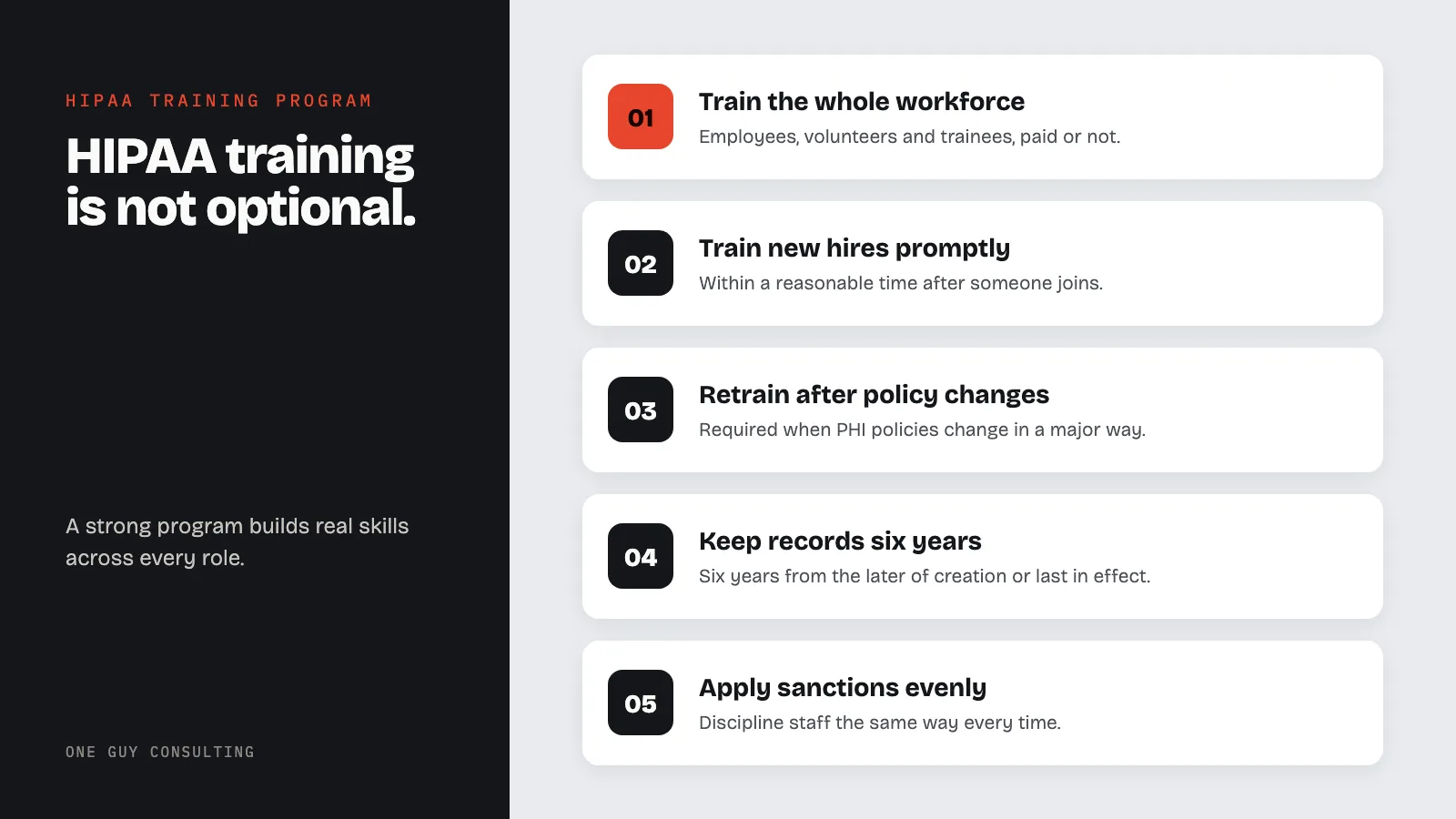
To build a HIPAA training program, train every workforce member on your privacy and security policies. Train new hires within a reasonable time after they join. Retrain affected staff when a policy changes in a material (major) way. Fit training to each role and keep session records for six years. Apply sanctions (discipline) the same way every time.
HIPAA Training Program: Complete Implementation Guide
Building an Effective Training Program
HIPAA training is not optional. Every covered entity must train its staff on its policies for protecting patient health information. A covered entity is a health plan, a healthcare clearinghouse, or a provider that bills insurance electronically. Business associates (vendors that handle PHI for you) must run security training for their own staff. Many practices treat training as a checkbox. That leaves your practice open to breaches and fines.
Dental offices face unique training challenges. See our dental practice HIPAA compliance guide for role-specific examples.
A strong HIPAA training program builds real skills across every role. It makes people accountable at every level. It also cuts the risk of compliance failures.
This full guide covers every step of building a HIPAA training program that works. Use it whether you are starting fresh or fixing an existing program.
HIPAA Training Requirements: What the Law Demands
Legal Foundation
The HIPAA Privacy Rule (45 CFR 164.530(b)) requires covered entities to train all workforce members on their PHI policies and procedures. The Security Rule (45 CFR 164.308(a)(5)) requires a security awareness and training program for all staff, including managers. These are federal mandates with real penalties, and many state laws can add their own requirements.
Key rules include:
- All workforce members must get training. Workforce means employees, volunteers, trainees, and anyone else whose work is under the practice's direct control, paid or not.
- Training must be given within a reasonable period of time after someone joins the workforce.
- Retraining is required when your PHI policies or procedures change in a material (major) way. Retrain the staff whose jobs the change affects, within a reasonable time.
- Training records must be kept for six years. Count from the date they were created or last in effect, whichever is later.
- Sanctions (appropriate discipline) must be applied against staff who break your policies.
You must also keep written proof that training happened. The Office for Civil Rights (OCR), which enforces HIPAA, can ask for that proof during an investigation. Without it, you cannot show you met the rule.
Who Must Be Trained
A common mistake is training only clinical staff with direct access to patient records. HIPAA's definition of "workforce" is broad. Your program must reach everyone who works for your practice, no matter their title or whether they are paid.
Your training list must include:
- Full-time and part-time employees across all departments.
- Temporary and contract workers.
- Volunteers and interns.
- Board members and executives.
- IT staff and system admins.
- Facilities and upkeep staff.
- Front desk and reception staff.
- Billing and coding staff.
- Vendor staff whose work is under your practice's direct control.
If someone can access, overhear, or encounter PHI during their work, they need HIPAA training. Practices that skip training for non-clinical staff can find that person was their weakest link.
Timing Requirements
HIPAA does not set an exact deadline for first training. The rule says "within a reasonable period of time." Setting your own clear deadlines helps prevent gaps.
- New hires: Set a firm deadline, such as 30 days from the start date. Ideally, train them during onboarding before they get PHI access; the employee onboarding checklist covers the full sequence.
- Role changes: Set a similar deadline, such as 30 days, to retrain when a person moves to a role with different PHI access.
- Policy updates: Retrain affected staff within a reasonable time after a material (major) change to your policies or procedures.
- Annual refresher: The law does not require it by name. The Security Rule does call for periodic security updates, called security reminders. A yearly refresher is a common way to keep staff current.
Designing Role-Based Training Content
Core Training for All Workforce Members
Every person in your practice needs a baseline understanding of HIPAA. This core module builds shared knowledge. It helps everyone act in a consistent, compliant way.
Core topics must include:
- What is HIPAA and why it matters: Brief history, purpose, and real consequences of non-compliance.
- Protected health information (PHI): What it is, the 18 identifiers, and how to spot it in all forms.
- The Minimum Necessary Standard: Use and share only the PHI needed for a specific purpose.
- Patient rights: The right to see their records, ask for corrections, get a list of certain times their PHI was shared (called an accounting of disclosures), and ask you to limit its use.
- Permitted uses and disclosures (sharing): Treatment, payment, healthcare operations, and when the patient's written permission (called an authorization) is required.
- Breach definition and reporting: What counts as a breach and how to report it right away.
- Social engineering and phishing: How to spot attempts to trick staff into revealing PHI.
- Physical security basics: Clean desk rules, screen locks, secure disposal, and visitor rules.
- Sanctions for non-compliance: What happens when rules are broken, from counseling up to firing.
This core module should take 60 to 90 minutes for first training. Annual refreshers should take 30 to 45 minutes. Keep the language simple and skip legal jargon.
Role-Specific Training Modules
Beyond the core, different roles need targeted training. Each role has unique PHI interactions and risk areas. Targeted modules make training more relevant and effective.
Clinical staff (physicians, nurses, therapists):
- Rules for verbal disclosures in clinical settings.
- Sharing PHI with other providers for treatment. This generally does not need the patient's written permission.
- Research use of PHI and de-identification standards.
- Handling patient requests for records and amendments.
- Telehealth privacy rules.
Administrative and front desk staff:
- Verification steps before releasing information.
- Handling phone and in-person PHI requests.
- Appointment scheduling privacy rules.
- Fax and mail rules for PHI.
- Managing patient sign-in sheets and waiting areas.
IT and technical staff:
- Technical safeguard setup and upkeep.
- Access control management and audit log review.
- Encryption for data at rest and in transit.
- Steps to follow when a security incident happens.
- Secure system setup and patch management.
Management and executives:
- Compliance program oversight duties (see our full compliance officer guide).
- Risk analysis leadership and resource decisions. Use our HIPAA policy templates to standardize training documentation.
- Enforcement and sanctions setup.
- Business associate management and due diligence.
- Breach notification and other reporting duties.
Billing and coding staff:
- Minimum necessary rules (share only what the task needs) in claims processing.
- Secure handling of billing records with PHI.
- Third-party payer communication rules.
- Record retention and disposal schedules.
For more detail on what to cover, see our guide on employee HIPAA training topics.
Developing Effective Training Content
Good training materials are ones people actually remember. Compliance training has a reputation for being dull, but it does not have to be. Use adult learning methods to make content stick.
Content best practices:
- Use real scenarios: Replace abstract rules with situations staff see in daily work.
- Include breach case studies: OCR enforcement actions show what goes wrong and why.
- Make it interactive: Quizzes, scenario questions, and decision exercises improve retention.
- Keep modules short: Break content into 15 to 20 minute segments instead of long sessions.
- Use plain language: Legal citations belong in policy docs, not training slides.
- Update annually: Refresh scenarios and examples to reflect current threats.
- Include visual aids: Flowcharts, infographics, and screenshots help explain key concepts.
Training Delivery Methods
In-Person Training
In-person training is valuable for onboarding, leadership sessions, and situations where discussion adds real value. A skilled instructor can adapt to questions and address practice-specific concerns. Recorded content cannot match that level of engagement.
When to use in-person training:
- New hire orientation programs.
- Department-specific role-based sessions.
- Incident response tabletop exercises.
- Leadership and management compliance sessions.
- Remedial training after policy violations.
Tips to get the most from in-person training:
- Limit sessions to 90 minutes maximum.
- Include practice exercises and group discussions.
- Use polling tools for real-time engagement checks.
- Provide printed quick-reference guides as takeaways.
- Record sessions for absent employees, with documented make-up rules.
Online and Computer-Based Training
Online platforms give you the scale, tracking, and consistency most practices need. Modern learning management systems (LMS) have strong features that support HIPAA training programs. They are a practical choice for most practices.
Advantages of online delivery:
- Consistent content delivered the same way to every learner.
- Automated tracking of completion and scores.
- Self-paced learning that fits different schedules.
- Easy updates when rules or policies change.
- Cost savings at scale compared to repeated instructor-led sessions.
- Audit-ready records generated automatically.
Choosing a training platform:
- Confirm content is updated regularly to reflect current rules.
- Make sure the platform provides completion records and detailed reports.
- Look for role-based assignment features to deliver targeted content.
- Check that the platform meets accessibility standards (ADA compliance).
- Test mobile compatibility for staff who work across locations.
Blended Learning Approach
Many strong HIPAA programs mix delivery methods. A blended approach uses online modules for core knowledge and in-person sessions for interactive content. Ongoing micro-learning keeps skills sharp between annual trainings.
Sample blended model:
- Online core module (60 to 90 minutes): Core HIPAA knowledge with a quiz.
- In-person role-specific session (45 to 60 minutes): Department scenarios and Q&A.
- Monthly micro-learning (5 to 10 minutes): Short reminders on specific topics via email or messaging.
- Quarterly phishing simulations: Practical security awareness testing.
- Annual online refresher (30 to 45 minutes): Updated content with new scenarios and a fresh completion record.
New Hire Onboarding Process
Pre-Access Training
No staff member should access systems with PHI before completing first HIPAA training. HIPAA does not spell this out. But it is a sound practice, and it lowers your risk. Building training into onboarding before system access is granted creates a natural enforcement point.
Sample onboarding timeline:
- Day 1: Introduce HIPAA rules and your practice's commitment to compliance.
- Days 1 to 5: Complete online core HIPAA training with a quiz.
- Days 5 to 10: Attend role-specific in-person training session.
- Days 10 to 14: Complete any specialized modules (IT security, clinical privacy).
- Upon completion: Grant the right system access, with the access level written down.
- Day 30: Follow-up check-in to answer questions from the first weeks of work.
Onboarding Documentation
Every new hire's Keep written records of HIPAA training from day one. Create a training checklist that becomes part of each employee's compliance file. This protects your practice during audits.
Documentation elements to include:
- Employee name, title, department, and start date.
- Date each training module was completed.
- Assessment scores for each module.
- Signed acknowledgment of policies and procedures.
- Signed confidentiality agreement.
- Record of system access granted and access rights level.
- Manager sign-off confirming training completion.
Documentation and Recordkeeping
What to Document
HIPAA requires covered entities to keep training records for six years from the date of creation or the date last in effect, whichever is later. This rule applies to training materials and to records of who completed each session. For a full overview, see our guide on documentation requirements for HIPAA compliance.
Keep records of:
- Training materials: Every version of training content, including slides, handouts, scripts, and online modules.
- Training schedules: Dates, times, locations, and instructor information for all sessions.
- Attendance records: Who attended each session, with signatures or digital proof.
- Assessment results: Quiz and test scores for each participant.
- Completion records: Proof of successful training completion.
- Policy acknowledgments: Signed acknowledgments showing staff received and understood the rules.
- Remedial training: Records of any extra training required and completed.
- Training program updates: Records of when and why training content was revised.
Building an Audit-Ready System
When OCR investigates, it can ask for your training records. A practice that can produce complete, organized records quickly is in a much better position. Build your system so that is always possible.
Audit-ready documentation practices:
- Use a central system (LMS or compliance platform) for all training records.
- Set up automated reminders for upcoming and overdue training.
- Generate standard reports showing completion rates by department, role, and time period.
- Keep backup copies of all records in a secure secondary location.
- Run quarterly internal audits of training record completeness.
- Assign one person as the training records custodian.
Measuring Training Effectiveness
Quantitative Metrics
Completion rates matter, but they are not enough on their own. A strong training program measures whether people learned what they need to know. It also checks whether that knowledge leads to compliant behavior.
Key performance indicators:
- Completion rates: Percentage of staff trained on time (target: 100%).
- Assessment scores: Average scores on post-training quizzes (target: 80% or higher).
- Phishing simulation results: Click rates on simulated phishing emails (target: below 5%).
- Incident reporting rates: Number of self-reported incidents (higher rates show better knowledge).
- Time to report: Average time between an incident and reporting (target: under 24 hours).
- Repeat violation rates: Percentage of staff with more than one policy violation (target: trending down).
- Help desk inquiries: Volume of HIPAA-related questions (shows engagement with the topic).
Qualitative Assessment
Numbers tell part of the story. Qualitative feedback shows whether training is changing behavior and attitudes. Use both types of data for a full picture.
Qualitative assessment methods:
- Post-training surveys: Gather feedback on content relevance, clarity, and engagement.
- Focus groups: Hold regular discussions with staff about compliance challenges they face.
- Manager observations: Ask supervisors to report on compliance behaviors they observe.
- Walk-through audits: Physically check workstations, common areas, and disposal practices.
- Incident root cause analysis: Find out whether training gaps contributed to incidents.
Continuous Improvement Cycle
Use data to keep improving your training program. Run a quarterly review that checks metrics, finds gaps, and drives content updates. This cycle keeps your program current and effective.
Improvement process:
- Collect data from all quantitative and qualitative sources.
- Analyze trends to find ongoing knowledge gaps or behavior issues.
- Prioritize updates based on risk and frequency of issues.
- Develop revised content that targets the gaps you found.
- Deploy updates through the right channels.
- Measure impact of changes in the next review cycle.
Sanctions for Non-Compliance
Developing a Sanctions Policy
HIPAA requires covered entities to apply proper sanctions against staff who break the rules. A clear, consistently enforced sanctions policy shows staff that compliance is serious. It also deters careless behavior.
Effective sanctions policies include:
- Progressive discipline: A graduated scale from verbal counseling to termination (firing).
- Consistent application: The same violation gets the same result, no matter the person's position.
- Documentation: Every sanction is recorded in the employee's compliance file.
- Remedial training: Required extra training as part of any corrective action.
- Whistleblower protection: A clear ban on retaliation for good-faith reporting.
Sample progressive discipline framework:
- First minor violation: Verbal counseling with a documented discussion and remedial training.
- Second minor violation or first moderate violation: Written warning with a corrective action plan.
- Third minor violation or second moderate violation: Suspension with mandatory retraining.
- Serious violation or pattern of non-compliance: Termination of employment.
- Intentional or malicious violation: Immediate termination and possible referral for criminal prosecution.
Documenting Sanctions
Every disciplinary action tied to HIPAA compliance must be documented and kept on file. This shows regulators that your practice takes compliance seriously. It also proves you enforce your rules consistently.
Training Technology Platforms
Selecting the Right Platform
The training technology market offers many options. These range from basic LMS platforms to full compliance management suites. Choose based on your practice's size, complexity, and budget.
Essential platform features:
- HIPAA-specific content library: Pre-built, regularly updated training modules.
- Role-based assignment: Assign different training paths to different roles.
- Automated scheduling and reminders: Set-and-forget assignment and escalation workflows.
- Completion tracking and reporting: Real-time dashboards and exportable compliance reports.
- Assessment tools: Quizzes, knowledge checks, and competency tests.
- Completion record generation: Automated proof of completion for your documentation.
- Mobile access: Training available on phones and tablets for flexible completion.
- Integration tools: Connect with HR systems for automated enrollment and removal.
Platform categories by practice size:
- Small practices (under 50 staff): Cloud-based compliance platforms with bundled content.
- Mid-size practices (50 to 500 staff): Full LMS with HIPAA content libraries and custom module creation.
- Large health systems (500+ staff): Enterprise LMS linked with HR systems and compliance management platforms.
Maximizing Platform ROI
Buying a training platform is just the start. Practices that get the most value from their investment follow a few best practices. Do not let the platform sit unused or misconfigured.
- Assign a platform admin to manage content and reporting.
- Customize generic content with your own rules, scenarios, and branding.
- Use automated enrollment tied to HR system events (new hire, role change, termination).
- Schedule recurring reports for leadership showing compliance status by department.
- Use built-in analytics to find departments or people who need extra support.
HIPAA Training Frequency Requirements
One of the most common compliance questions is how often HIPAA training must be conducted. The answer depends on the training trigger. This table shows common training events, which ones the rule requires, and where each one comes from.
| Training Trigger | Timing | Regulatory Basis |
|---|---|---|
| New hire onboarding | Within a reasonable time after joining (best practice: before they access PHI) | 45 CFR 164.530(b)(2)(i)(B) |
| Annual refresher | Not set by law; yearly is a common practice | Best practice (45 CFR 164.308(a)(5)(ii)(A) calls for periodic security reminders) |
| Policy or procedure change | Within a reasonable time after a material (major) change, for staff whose jobs it affects | 45 CFR 164.530(b)(2)(i)(C) |
| Security incident response | Not set by law; a good time for refresher training | Best practice (45 CFR 164.308(a)(6) covers incident response, not training) |
| Role change or promotion | Best practice: before taking on new PHI duties | 45 CFR 164.530(b)(1) (training must fit each person's job) |
| EHR or system change | Best practice: before using a new system with PHI | 45 CFR 164.308(a)(5) (security awareness and training) |
| After sanctions or corrective action | Best practice: as part of corrective action | Best practice (45 CFR 164.530(e) requires sanctions, not retraining) |
Key point: HIPAA does not set an annual training deadline. Still, yearly training is a common practice. A yearly schedule also makes it easier to keep up with the periodic security reminders the Security Rule calls for. One simple approach is to set a fixed annual date. Then train all staff within a 30-day window around that date.
Role-Based Training Matrix
Different roles require different training content. Use this matrix to assign the right training modules to each workforce category.
| Role Category | Required Training Modules | Estimated Time |
|---|---|---|
| Front desk / Reception | Privacy basics, minimum necessary, patient rights, verbal disclosures, sign-in sheets | 45-60 min |
| Clinical staff (nurses, MAs) | All core + clinical workflows, EHR access controls, minimum necessary for treatment | 60-90 min |
| Providers (physicians, NPs) | All core + treatment disclosures, research uses, peer communications, mobile device security | 60-90 min |
| Billing / Coding | All core + payment disclosures, minimum necessary for billing, clearinghouse security | 60 min |
| IT / Technical staff | All core + Security Rule technical safeguards, access controls, encryption, audit logs, incident response | 90-120 min |
| Management / Leadership | All core + sanctions policy, breach notification duties, risk management, BA oversight | 60-90 min |
| Volunteers / Interns | Privacy basics, minimum necessary, reporting obligations, limited to areas of access | 30-45 min |
Training Violation Penalties
Missing or weak training can lead to civil money penalties (fines). The amounts below are the latest figures in 45 CFR 102.3, adjusted for inflation in 2025. The tier depends on what the practice knew and whether it fixed the problem. Willful neglect means the practice chose on purpose not to follow the rule, or was recklessly careless about it. The yearly cap shown is the limit set in the regulation.
| Penalty Tier | Per Violation | Annual Cap | Training Example |
|---|---|---|---|
| Tier 1: Did not know | $145 to $73,011 | $2,190,294 | New employee accessed PHI before training was available |
| Tier 2: Reasonable cause | $1,461 to $73,011 | $2,190,294 | Training program exists but several staff missed annual refresher |
| Tier 3: Willful neglect (corrected) | $14,602 to $73,011 | $2,190,294 | No training program existed but organization implemented one after OCR contact |
| Tier 4: Willful neglect (not corrected) | $73,011 to $2,190,294 | $2,190,294 | No training program and no effort to create one despite known requirement |
Training Documentation Checklist
This checklist covers the details that make your training easy to prove. That matters if OCR asks for your records during an investigation or compliance review.
- Employee name and job title at the time of training
- Date training was completed (not just assigned)
- Training method (in-person, online module, blended)
- Topics covered with specific policy references
- Trainer name and qualifications (for instructor-led sessions)
- Quiz or assessment score with passing threshold documented
- Employee signature or electronic acknowledgment confirming completion
- Retention period documented (minimum 6 years from creation or last effective date)
- Policy version trained on (links training to specific policy revision)
- Remediation records if employee failed initial assessment
Gaps in these records make it harder to show that training actually happened. Keep them where you can find them quickly if they are requested during an investigation.
Common Training Program Mistakes
These are common training program mistakes. Each one can be fixed.
- Using the same generic content every year. Annual training should address current threats and any policy changes from the past year. Recycling identical slides signals a checkbox exercise, not a real program.
- No pre-access training for new hires. HIPAA gives you a reasonable time to train someone after they join (45 CFR 164.530(b)(2)(i)(B)). But letting staff use PHI before they know your policies adds risk. Train first, then grant access.
- Training the Privacy Rule but not the Security Rule. Many programs cover patient privacy but skip technical safeguards, password policies, and device security. Both rules call for training. The Security Rule asks for a security awareness and training program. That program can cover passwords and malicious software (malware).
- No role-specific content. A front desk receptionist and an IT administrator face different HIPAA risks. Training that treats all roles identically fails to address the specific threats each role encounters.
- Tracking attendance but not comprehension. Sign-in sheets prove someone was in the room, not that they understood the material. Include assessments with a documented passing score requirement.
- No retraining after policy changes. When a policy or procedure changes in a material (major) way, retrain the staff whose jobs it affects. Do it within a reasonable time. This is required under 45 CFR 164.530(b)(2)(i)(C).
- Storing records for less than 6 years. HIPAA requires training documentation to be retained for 6 years from the date of creation or the date when it was last in effect. Purging records earlier leaves you unable to prove compliance during an investigation.
Training Program FAQ
How often must HIPAA training be done?
HIPAA requires training for new staff within a reasonable time after they join. It also requires retraining for affected staff when your policies or procedures change in a material (major) way. The law does not require annual training by name.
For a detailed breakdown, see our guide to HIPAA staff training requirements for small practices. A yearly refresher is a common practice. Many practices train all staff once a year. They add extra sessions after policy changes, security incidents, or individual performance issues.
Can HIPAA training be done entirely online?
Yes, online training is an accepted delivery method for HIPAA compliance. Many practices use online platforms as their main training channel. The scale, consistency, and documentation advantages are strong. Adding in-person sessions for role-specific content and interactive exercises can improve results.
What happens if an employee refuses to complete HIPAA training?
An employee who refuses required HIPAA training has violated policy. You must address this through your sanctions policy. HIPAA requires covered entities to apply appropriate sanctions (discipline) to staff who break their privacy and security policies. A practice can treat repeated refusal as grounds for progressive discipline, which gets more serious each time. That can go up to and including termination.
How do we train remote workers on HIPAA?
Remote workers have the same training rules as office staff. Online platforms are ideal for remote employees. Add virtual instructor-led sessions for interactive content. Make sure remote-specific topics are covered, including home office security, secure Wi-Fi use, and physical safeguard rules for remote workspaces.
How long should HIPAA training records be retained?
HIPAA requires training records to be kept for six years from the date of creation or the date the record was last in effect, whichever is later. Some practices keep records longer than this minimum. See our full guide on HIPAA documentation requirements for details on all retention duties.
Training Program Takeaways
Building a strong HIPAA training program takes more than checking a compliance box. It requires thoughtful design, consistent delivery, solid documentation, and ongoing measurement. Practices that invest in full training programs protect their patients, their reputation, and their finances.
Start by comparing your current program to the requirements and best practices in this guide. Find your gaps, rank your fixes by priority, and commit to building real skills across your team. A well-trained team is your strongest defense against breaches, fines, and day-to-day disruption.
One Guy Consulting gives healthcare practices staff training and progress tracking inside its HIPAA compliance portal. Practices also get annual training reminder emails. On the Full-Scope plan, Chuck also guides training delivery. Explore HIPAA training to discuss your medical practice training program needs, or explore our HIPAA compliance guide for a full overview of the compliance requirements. See also: fraud, waste, and abuse training, bloodborne pathogen training, and HIPAA policies and training for small practices.
Key stat: HIPAA requires training under both the Privacy Rule (45 CFR 164.530) and the Security Rule (45 CFR 164.308). The Security Rule specifically mandates security awareness and training for all workforce members, including management. Organizations must document training completion and retain records for six years.