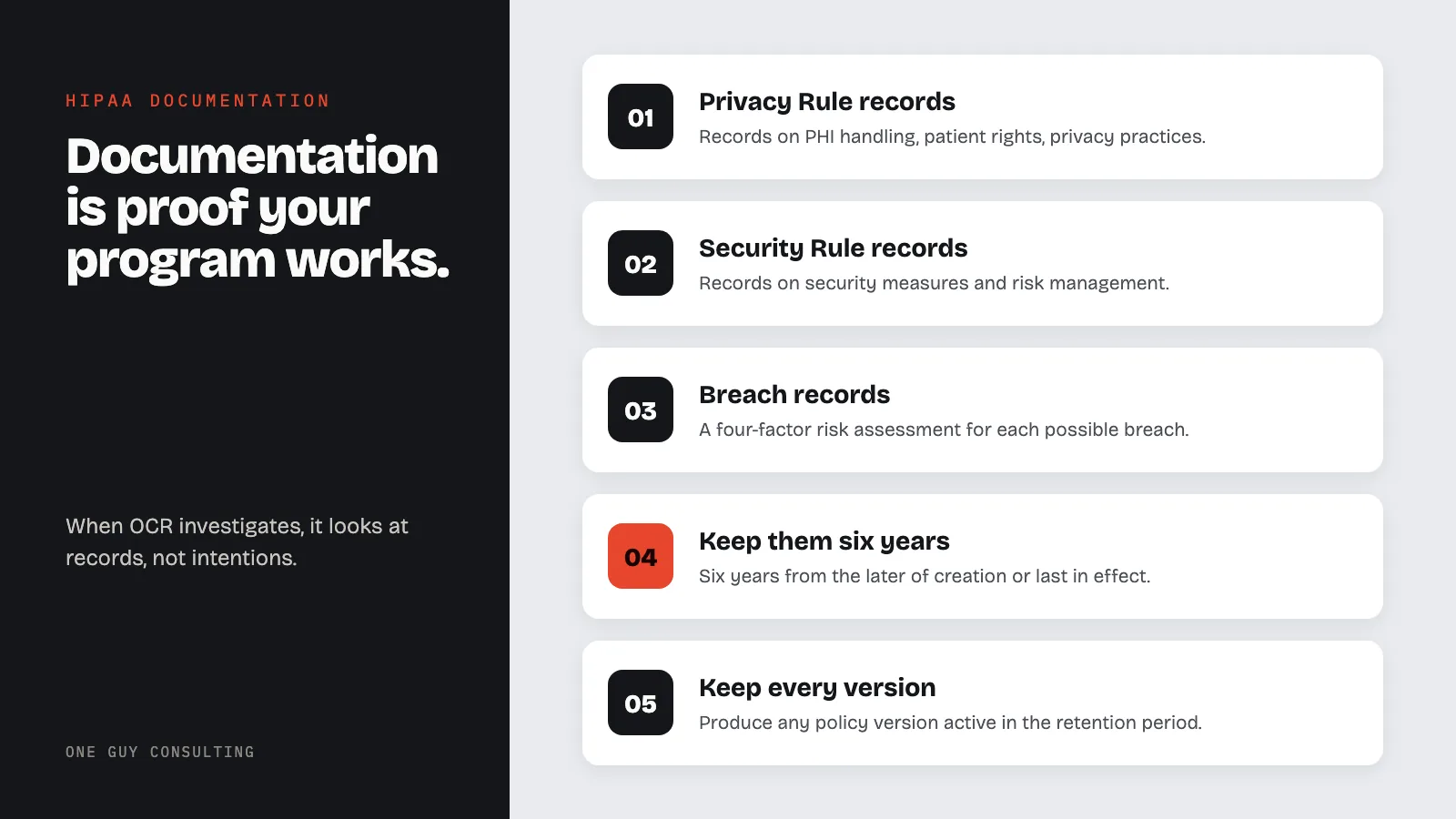
HIPAA requires you to keep your policies and procedures, plus records of the actions HIPAA says to document, for six years. That includes risk analyses, training, business associate agreements, complaints, incidents, and breach notices. The six years start from the date each record was created or last in effect, whichever is later. Records can be written or electronic.
Documentation Requirements for HIPAA Compliance
HIPAA Documentation Essentials
HIPAA documentation is proof that your compliance program exists and works. Without it, even strong compliance efforts are invisible to regulators. When the Office for Civil Rights (OCR) investigates your practice, they look at records, not intentions.
Practices that cannot show full, current records have a hard time proving compliance. This is true even when their actual compliance is solid. Small offices like dental practices often struggle most with documentation gaps. Our HIPAA audit readiness guide for small practices covers how to close those gaps before they become findings. Documents are how you prove what you did.
HIPAA sets specific rules for the Privacy Rule, Security Rule, and Breach Notification Rule. Each rule says what to record, how long to keep it, and how to manage it. This guide covers all of it.
Required Documents List
Privacy Rule Documentation
The Privacy Rule requires covered entities to keep records on PHI handling, patient rights, and privacy practices. These records must be current and complete. Missing any of them can result in OCR findings.
Required Privacy Rule records:
- Notice of Privacy Practices (NPP): A written notice that explains how the practice uses and shares PHI, and what rights patients have.
- Privacy policies and procedures: Full policies covering PHI use, sharing, access, and protection.
- Patient authorization forms: Signed forms for any use or sharing of PHI that needs the patient's written permission.
- Designated record set documentation: A clear list of your designated record sets. These are the records patients have a right to see.
- Accounting of disclosures records: A log of PHI disclosures (times you shared PHI) that patients have a right to ask about. Some disclosures are left out. Examples are those for treatment, payment, or health care operations, and those the patient authorized.
- Patient access request logs: Records of patient requests to see their PHI and how the practice responded.
- Amendment request records: Records of patient requests to change their PHI and the actions taken.
- Restriction request records: Logs of patient requests to limit PHI use or sharing and how the practice responded.
- Minimum necessary decisions: Written rules for routine disclosures that share only the PHI needed for the purpose. This is called the minimum necessary standard. For other requests, write down the criteria you use to decide.
- Workforce privacy training records: Proof that all workforce members received privacy training.
- Privacy complaint log: A record of every privacy complaint received and how each was resolved.
Security Rule Documentation
The Security Rule requires records on security measures and risk management. It also covers how you put administrative, physical, and technical safeguards in place. Every safeguard area needs its own documentation.
Required Security Rule records:
- Risk analysis report: A full analysis of threats, weak points, and risks to ePHI, with risk levels and reduction plans.
- Risk management plan: Documented steps to reduce identified risks to a reasonable and appropriate level.
- Security policies and procedures: Policies covering all administrative, physical, and technical safeguard rules.
- Information system activity review records: Logs of audit log reviews and any issues found. Learn more about the OCR audit program.
- Access authorization records: Records showing who can access ePHI and why.
- Security incident records: Logs of all security incidents, how you responded, and the outcome of each.
- Contingency plan: A written data backup plan, disaster recovery plan, and emergency mode operation plan. The emergency plan covers how you keep ePHI safe while running in an emergency.
- Business associate agreements: Signed BAAs with every business associate that touches ePHI.
- Evaluation records: Records of periodic checks of your security policies, both technical and nontechnical.
- Facility security plan: Documentation of physical safeguards and facility access controls.
- Workforce security training records: Proof that all staff completed security awareness training.
Breach Notification Documentation
- Breach risk assessment records: A four-factor risk assessment for each possible breach.
- Breach notice records: Copies of all notices sent to affected individuals, HHS, and the media (when required).
- Breach log: A full log of all breaches, including those affecting fewer than 500 individuals.
- Investigation reports: Detailed records of breach investigations, findings, and corrective actions.
Retention Periods
The Six-Year Rule
HIPAA requires covered entities and business associates to keep records for six years from the date of creation or the date when it was last in effect, whichever is later. This applies to policies, procedures, training records, BAAs, and other records HIPAA requires you to document.
Understanding "last in effect":
- A policy created in 2020 and replaced in 2024 must be kept until 2030 (six years from the date it was last in effect).
- A BAA signed in 2021 and ended in 2025 must be kept until 2031.
- Training records from 2023 must be kept until at least 2029.
- An incident record from 2024 must be kept until at least 2030.
Important factors:
- State laws may set longer retention periods for certain records. Always follow the longer rule.
- Some records should be kept beyond six years for legal or day-to-day reasons.
- Litigation holds may require keeping specific records longer.
- Consider keeping risk analyses and audit reports permanently as proof of your compliance program's history.
Retention Schedule by Document Type
| Document Type | Minimum Retention | Suggested Retention |
|---|---|---|
| Policies and procedures | 6 years from last in effect | Permanent (all versions) |
| Risk analyses | 6 years from creation | Permanent |
| Training records | 6 years from creation | 10 years |
| BAAs | 6 years from ending | 10 years |
| Incident and breach records | 6 years from creation | Permanent |
| Access authorization records | 6 years from last in effect | 10 years |
| Audit logs | Not set by HIPAA (keep log review records 6 years) | 7 years |
| Patient authorization forms | 6 years from creation | Per state medical records law |
| Complaint records | 6 years from creation | 10 years |
| Sanctions records | 6 years from creation | Duration of employment plus 6 years |
Policy Documentation Best Practices
Policy Structure
Well-structured policies are easier to train on and produce during audits. Use a consistent format across all compliance policies. This saves time and reduces errors.
Suggested policy elements:
- Policy number and title: A unique ID and a clear, descriptive title.
- Purpose: Why the policy exists and what it covers.
- Scope: Who the policy applies to and when.
- Definitions: Key terms used in the policy.
- Policy statements: The actual rules, written in clear and direct language.
- Procedures: Step-by-step instructions for carrying out the policy.
- Responsibilities: Who owns each part of the policy.
- Sanctions: Consequences for breaking the policy.
- Related policies: Links to related compliance records.
- Revision history: Dates and descriptions of all changes.
- Approval signatures: Proof that management reviewed and approved the policy.
Policy Review Cycle
HIPAA says to review your security documentation periodically and update it as needed (45 CFR 164.316(b)(2)(iii)). Policies need to stay current with rule changes, practice changes, and new threats. Stale policies create compliance gaps.
- Annual review: Review all policies at least once per year. Document the review with a date stamp, even if no changes are made.
- Trigger-based review: Update policies when rules change, major incidents occur, the practice structure changes, or new technology is deployed.
- Stakeholder input: Bring in relevant department heads during policy reviews. This keeps policies practical and enforceable.
- Legal review: Have legal counsel review policies at least once a year. Also review with counsel whenever major changes are made.
Risk Analysis Documentation
What to Document
The risk analysis is one of the most important compliance records your practice produces. It drives your entire security program. The Security Rule requires it (45 CFR 164.308(a)(1)(ii)(A)).
Risk analysis documentation should include:
- Scope definition: Which systems, facilities, and procedures were assessed.
- Methodology: The framework and approach used for the analysis.
- Asset list: All systems and locations where ePHI is created, received, kept, or sent.
- Threat identification: All threats to ePHI that can reasonably be expected.
- Vulnerability identification: Weak points in systems, procedures, and controls.
- Current controls: Existing protections and how well they work.
- Risk determination: Likelihood and impact ratings for each identified risk.
- Risk prioritization: A ranked list of risks by overall risk level.
- Reduction plan: Specific actions to address each risk, with owners and timelines.
- Residual risk acceptance: Documented acceptance of risks that will not be fully handled, with justification.
Training Records
Training Documentation Requirements
Training records must show that every workforce member received proper HIPAA training. Gaps in training records can lead to OCR findings. For a full guide to training programs, see our HIPAA training guide.
Training records to keep:
- Training schedule and curriculum for each session.
- Attendance records with names, dates, and signatures or digital verification.
- Training materials used (every version).
- Quiz or test results for each participant.
- Completion records.
- Remedial training records for those who failed tests or broke policies.
- Training program review and improvement records.
Incident Documentation
Incident Record Requirements
Every security incident and possible breach must be written down from first discovery to final resolution. These records show your practice's response ability and due diligence. OCR may ask for them during an investigation.
Incident documentation elements:
- Date and time of discovery.
- Description of the incident.
- How the incident was found.
- Who reported the incident.
- Systems and data affected.
- Number of individuals potentially affected.
- Immediate containment actions taken.
- Investigation steps and findings.
- Root cause analysis.
- Four-factor breach risk assessment (if relevant).
- Corrective actions taken.
- Notices sent (affected individuals, HHS, media).
- Follow-up checks confirming corrective actions worked.
For more on preventing incidents, see our guide on common HIPAA breaches.
Audit Trails
System Audit Logging
HIPAA requires covered entities and business associates to use audit controls (45 CFR 164.312(b)). Audit controls record and examine activity in systems that contain or use ePHI. These logs help you spot problems. Your reviews of them become records you keep. You must review them regularly (45 CFR 164.308(a)(1)(ii)(D)).
What audit logs often cover:
- User access logs: Who accessed what information and when.
- Authentication logs: Successful and failed login attempts.
- Modification logs: Changes to ePHI, including who made the change and what changed.
- Disclosure logs: Records of ePHI sent outside the practice.
- Administrative logs: System configuration changes, user account edits, and privilege changes.
- Physical access logs: Badge swipes, door access events, and visitor sign-in records.
Audit log management:
- Store logs securely with protections against tampering.
- Review logs regularly based on the risk level of the system.
- Keep records of your log reviews for six years. HIPAA does not say how long to keep the raw logs, so set a time in your policy.
- Investigate any issues found during log review.
- Document the results of all log reviews.
Version Control
Managing Document Versions
HIPAA's retention rules and the ongoing changes to compliance records make version control essential. You must be able to produce any version of any policy that was active during the retention period. Without version control, that becomes impossible.
Version control best practices:
- Version numbering: Use a consistent scheme (e.g., 1.0, 1.1, 2.0) that separates minor updates from major revisions.
- Change tracking: Record what changed in each version, who made the change, and why.
- Effective dates: Every record version must have a clearly marked effective date.
- Superseded records: Mark replaced versions as superseded and archive them where they can be found.
- Approval records: Keep proof of who approved each version.
- Central storage: Store all current and past versions in one access-controlled location.
Best Practices for Document Management
Building a Compliance Document System
A well-organized record management system is the backbone of your compliance program. Without it, even full documentation becomes hard to find, keep, and produce when needed. Good systems make audits far less stressful.
Document management system features:
- Centralized storage: All compliance records in one access-controlled system.
- Search capability: Ability to find records by title, content, date, or category.
- Access controls: Role-based access so only authorized staff can view, edit, or approve records.
- Audit trail: The record system itself should log who accessed, changed, or downloaded records.
- Backup and recovery: Regular backups with tested recovery procedures.
- Retention management: Automated tracking with alerts for records nearing their retention deadline.
- Workflow support: Built-in review, approval, and distribution workflows. Compare platforms in our HIPAA compliance tools guide.
Common Documentation Mistakes
Avoid these common documentation failures that lead to OCR findings:
- Missing records: Documents that should exist but do not, especially risk analyses and incident records.
- Outdated policies: Documents not reviewed or updated in years.
- No version history: No way to produce the version of a policy that was active at a specific point in time.
- Incomplete training records: Workforce members with no documented training completion.
- Unsigned BAAs: Business associate relationships with no signed agreements.
- No evidence of review: Policies with no record of regular review and approval.
- Inconsistent retention: Some records kept properly while others are deleted too soon.
HIPAA Documentation FAQ
What is the HIPAA documentation retention period?
HIPAA requires documentation to be kept for six years. The clock starts from the date of creation or the date when it was last in effect, whichever is later. This applies to policies, procedures, training records, business associate agreements, risk analyses, incident records, and other records HIPAA requires you to document. State laws may require longer retention for specific record types.
Can HIPAA documentation be stored electronically?
Yes. HIPAA does not require paper records, and the rule says documentation may be written or electronic (45 CFR 164.316(b)(1)). Electronic storage makes records easier to search, protect, and back up. If the system holds ePHI, it must meet the Security Rule, including access controls, audit controls, and backups. Encryption is addressable under the current rule (45 CFR 164.312(a)(2)(iv)). That means you use it if it is reasonable and appropriate for your practice; if not, you write down why and use an equal alternative if one is reasonable.
What happens if we cannot produce documentation during an OCR investigation?
Not keeping required records is itself a HIPAA violation (45 CFR 164.316(b) and 164.530(j)). It also makes it hard to show you followed other rules. Without training records, you have no proof that training happened. Without a risk analysis on file, you cannot show one was done. Missing records can lead to findings, fines, and corrective action plans.
How often should policies be reviewed and updated?
HIPAA does not set a fixed schedule. It says to review documentation periodically and update it as needed (45 CFR 164.316(b)(2)(iii)). A yearly review of all policies is a good baseline. Also review and update them when rules change, major incidents occur, new systems are deployed, or the practice structure changes. Document every review, including reviews where no changes were made. This shows ongoing compliance program upkeep.
Documentation Requirements: Key Takeaways
Documentation is the proof of your HIPAA compliance program. Without it, regulators cannot see your efforts, and they are hard to defend in an investigation. With it, you show commitment, steady risk management, and ongoing improvement.
Build your program on the rules in this guide. Create a centralized, access-controlled storage. Use consistent version control. Set retention schedules that meet or exceed the six-year minimum. Train your compliance team on documentation standards. Review your system regularly to keep it complete, current, and audit-ready.
One Guy Consulting gives healthcare practices a portal for their HIPAA documentation. It includes policy and procedure templates, staff training and progress tracking, and an incident management system. That way you can keep these records together. Browse policy templates to strengthen your compliance documentation, or explore our HIPAA compliance guide for the full compliance picture. HIPAA policy templates
Documentation is a significant part of the compliance timeline. Learn how long the full HIPAA compliance process takes for a typical organization.
Key stat: Under 45 CFR 164.530(j) and 164.316(b)(2)(i), covered entities must keep HIPAA documentation for six years. The clock starts from the date it was created or the date it was last in effect, whichever is later. Business associates follow the same six-year rule for Security Rule documentation. This includes policies, risk analyses, training records, BAAs, incident reports, and authorization forms.
Frequently Asked Questions
What are the HIPAA compliance documentation requirements?
HIPAA compliance documentation requirements include written policies and procedures covering the Privacy Rule, Security Rule, and Breach Notification Rule. Organizations must also keep a completed security risk analysis, workforce training records showing who was trained and when, signed Business Associate Agreements, incident and breach logs, and signed HIPAA authorization forms. Under 45 CFR 164.530(j) and 164.316(b), all documentation must be retained for six years from the date of creation or the date it was last in effect, whichever is later.
How long must HIPAA records be kept?
HIPAA requires covered entities and business associates to keep required documentation for six years. The six years run from the date it was created or last in effect, whichever is later. This includes policies, risk analyses, training records, BAAs, and incident reports. OCR may ask for records during a complaint investigation or compliance review (45 CFR 160.310).
Sources
- 45 CFR 164.530(j): Documentation Requirements
- 45 CFR 164.316: Policies, Procedures, and Documentation
- 45 CFR 164.308(a)(1): Risk Analysis Documentation
- HHS Security Rule Guidance