HIPAA compliance in 2026 means following three federal rules. The Privacy Rule limits how you use and share patient health information. The Security Rule requires administrative, physical, and technical safeguards for electronic records. The Breach Notification Rule requires notices no later than 60 days after discovery. You also need a risk analysis, staff training, and business associate agreements.
HIPAA Compliance Essentials for 2026
HIPAA compliance is a top priority for healthcare practices and their partners. Covered entities and their business associates must follow its rules for protected health information (PHI). Covered entities are health plans, clearinghouses, and providers that bill electronically. Business associates are vendors that handle PHI for them. Compliance officers and healthcare leaders must act now. Start with our compliance officer responsibilities guide to define the role clearly.
This full guide covers what you need to stay HIPAA compliant in 2026. It applies to covered entities, business associates, and health tech providers. Use it to protect patients and avoid penalties.
The stakes are high. Cyberattacks on healthcare are a real threat. Regulators investigate compliance failures. Patients expect their data to be safe.
What is HIPAA and Why Does It Matter in 2026?
The Evolution of HIPAA
Congress passed HIPAA in 1996 to protect patient privacy and health data. Over 30 years, it grew into a full set of rules. It now covers privacy, security, breach notification, and enforcement.
HIPAA compliance matters more than ever today. Ransomware attacks on hospitals are a serious risk. Regulators can issue large fines to practices that fall short.
Key 2026 Updates and Enforcement Trends
2026 brings several important developments to the HIPAA space:
- OCR Enforcement: The HHS Office for Civil Rights (OCR) investigates complaints and breach reports. It also runs a formal audit program.
- Ransomware and Cybersecurity Focus: OCR targets practices that lack strong technical defenses against ransomware and cyber threats.
- Telemedicine Compliance: OCR has published guidance on how HIPAA applies to telehealth.
- Artificial Intelligence in Healthcare: AI tools in healthcare raise new compliance issues. Key concerns include de-identification and automated decisions that involve PHI.
- Third-Party Risk Management: A proposed update to the Security Rule would add stricter checks on business associates. It was published in January 2025 and is not final yet. For now, the core is a signed BAA and good oversight of your vendors. See our guide on risk assessments for business associates.
The Three Pillars of HIPAA Compliance
HIPAA rests on three core rules. Each one protects a different part of health information. Practices must understand and follow all three.
The Privacy Rule
The Privacy Rule sets standards for how practices handle PHI. It gives patients key rights over their medical data. It also sets clear limits on how data can be used and shared.
Key Privacy Rule requirements:
- Patient Rights: Patients can see and get copies of their PHI. They can ask for corrections. They can also get a list of certain disclosures, meaning times their PHI was shared (called an accounting of disclosures).
- Minimum Necessary Standard: Practices must limit PHI access to only what each job requires.
- De-identification Standards: Data must meet specific criteria to qualify as de-identified under HIPAA.
- Notice of Privacy Practices: Covered entities must give patients a clear, written notice of their privacy practices.
- Patient Authorization: Treatment, payment, healthcare operations, and some other named purposes do not need the patient's permission. Uses the rule does not already allow need the patient's written permission (called an authorization).
- Marketing Restrictions: Using PHI for marketing is heavily restricted and generally needs the patient's written authorization.
- Business Associate Agreements: Covered entities must sign written agreements with every business associate (a vendor that handles PHI on their behalf).
Permitted Uses and Disclosures: The Privacy Rule allows sharing PHI for treatment, payment, and healthcare operations. It also permits sharing for public health, law enforcement, and other named purposes.
The Security Rule
The Security Rule works alongside the Privacy Rule. It sets technical, administrative, and physical safeguards for electronic PHI (ePHI). These safeguards protect the confidentiality, integrity, and availability of ePHI. In plain words: keep it private, keep it accurate, and keep it there when you need it.
The Security Rule establishes three categories of safeguards:
Administrative safeguards:
- Security management and risk analysis.
- One person assigned responsibility for security, plus workforce security policies for your staff.
- Information access management and security awareness training.
- Security incident procedures and contingency planning (backups and emergency plans).
- Business associate agreements and oversight.
Physical safeguards (see the full physical safeguard requirements checklist):
- Facility access controls.
- Workstation security and use policies.
- Portable device and media management.
- Safe disposal and reuse of devices and media.
Technical safeguards:
- Access controls with unique user IDs and emergency access procedures.
- Audit controls and logging.
- Integrity controls (so data is not changed or destroyed improperly) and transmission security (protecting data while it is sent).
- Encryption for data at rest and in transit. This is an "addressable" item; see below.
- Vulnerability scanning and penetration testing. These are proposed in the January 2025 update and are not law yet.
2026 Security Rule Focus Areas: Today, practices must run an accurate risk analysis. They must keep audit controls, which record activity in systems that hold ePHI. They must also write down their security policies and procedures. Encryption is "addressable." That means you must use it if it is reasonable and appropriate for your practice. If it is not, you must write down why and use an equal alternative.
A proposed update to the Security Rule (published January 2025) would make encryption and multi-factor authentication mandatory. Multi-factor authentication means a second login step, such as a code sent to a phone. The proposal is not final yet, and OCR is not enforcing it.
The Breach Notification Rule
The Breach Notification Rule requires covered entities and business associates to act after a breach. They must notify affected individuals and HHS when unsecured PHI is breached. For larger breaches, they must also notify the media. A breach is a use or sharing of PHI that the Privacy Rule does not allow. The exception is when a risk assessment shows a low probability that the PHI was compromised. See our complete Breach Notification Rule compliance guide for deadlines and procedures.
Key Breach Notification Rule requirements:
- Notification Timeline: Practices must notify patients without unreasonable delay and no later than 60 calendar days after discovery.
- Notification Content: Notices must describe the breach, steps patients should take, and what the practice is doing. They must also include contact information.
- Media Notification: Breaches affecting more than 500 residents of a state or jurisdiction require media notice.
- HHS Notification: All breaches must be reported to HHS. If 500 or more people are affected, report within 60 days of discovery. For smaller breaches, you can keep a log and report them within 60 days after the end of the calendar year.
- Investigation documentation: Practices must keep detailed records of the breach assessment and fixes.
- Breach assessment: Not all incidents are reportable breaches. A use or sharing the rule does not allow is treated as a breach. The exception is when a documented risk assessment shows a low probability that the PHI was compromised.
What counts as a Breach: A breach happens when unsecured PHI is accessed, acquired, used, or shared in a way HIPAA does not allow. If the data was encrypted to HHS standards, it is not "unsecured" PHI. Then the breach notice rules do not apply.
HIPAA Compliance Requirements by Organization Type
Covered Entities
Covered entities carry the main HIPAA compliance duty. This category includes:
- Healthcare Providers: Doctors, hospitals, clinics, and other practices that deliver healthcare. They are covered when they send health information electronically for standard transactions, such as insurance claims.
- Health Plans: Health insurance companies, HMOs, and other entities that provide health coverage.
- Healthcare Clearinghouses: Entities that process healthcare information into standard formats.
Covered Entity duties:
- Build full Privacy, Security, and Breach Notification compliance programs.
- Write and keep detailed policies and procedures.
- Run regular workforce training.
- Perform an accurate, thorough risk analysis and keep it up to date.
- Sign business associate agreements with all third parties that handle PHI.
- Keep required policies and compliance records for at least six years.
- Appoint a privacy officer and a security officer.
- Report breaches involving unsecured PHI.
Business Associates
Business associates handle PHI on behalf of covered entities. Common business associates include:
- IT Service Providers: Cloud storage providers, EHR vendors, and software companies. See our roundup of top HIPAA compliance tools to evaluate vendor options.
- Billing and Collection Agencies: Groups that handle patient billing and payment.
- Legal and Consulting Firms: Firms that provide services involving PHI to covered entities.
Business Associate duties:
- Sign a Business Associate Agreement (BAA) with covered entities.
- Comply with the Security Rule and the Privacy Rule limits in their BAA.
- Sign subcontractor agreements (BAAs) with downstream vendors.
- Report breaches and security incidents to covered entities.
- Limit PHI access and use to approved purposes only.
- Answer directly to OCR for their own HIPAA violations.
Subcontractors
Subcontractors are vendors that business associates hire to handle PHI. Their rules include:
- Signing Business Associate Agreements with business associates.
- Setting up proper administrative, physical, and technical safeguards.
- Following all Privacy Rule limits on PHI use and sharing.
- Reporting security incidents and breaches.
- Cooperating with audits and assessments.
Building Your HIPAA Compliance Program
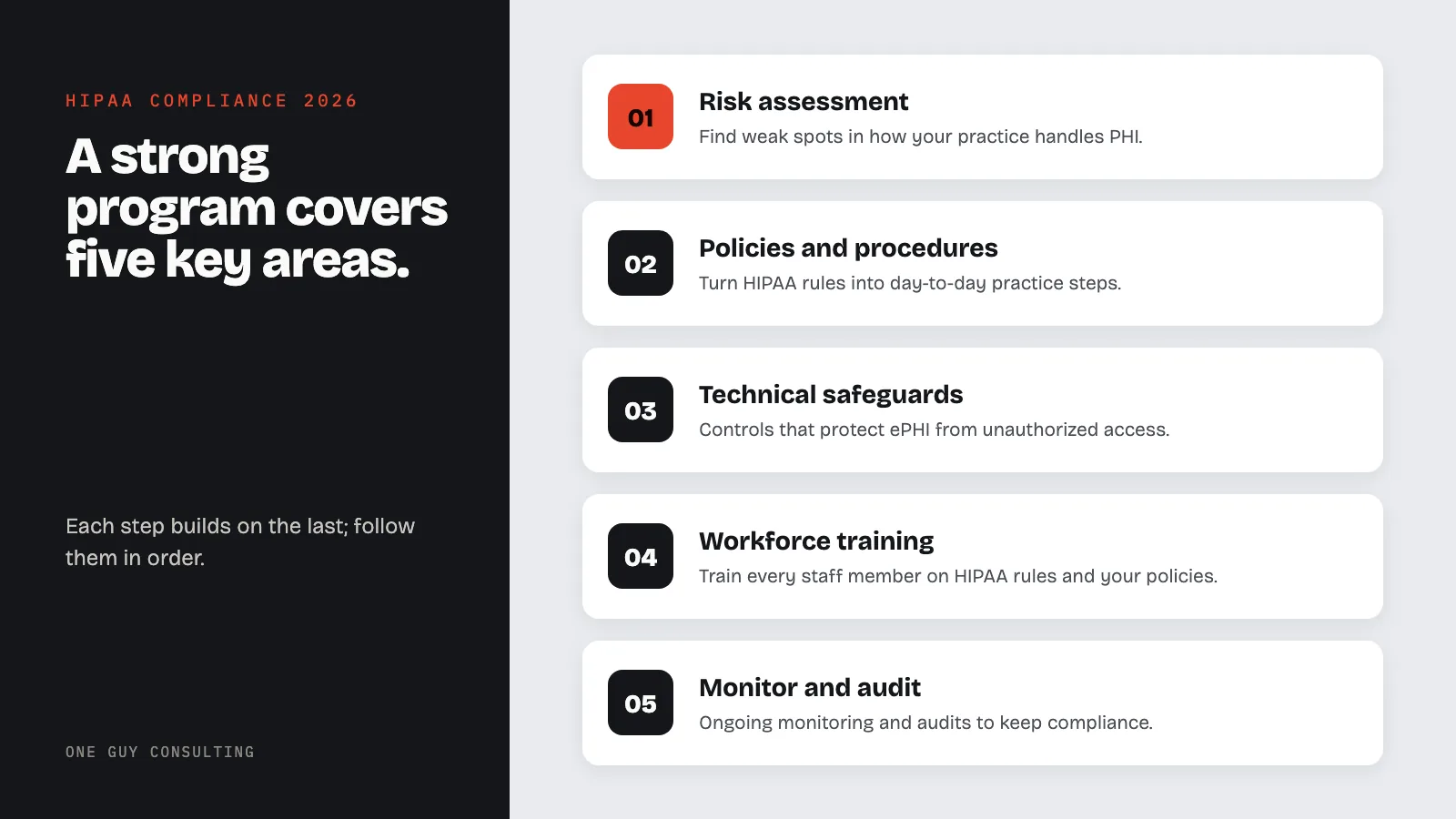
A strong HIPAA compliance program requires work across five key areas. Each step builds on the last. Follow them in order for the best results.
Step 1: Risk Assessment
Run a full risk analysis to find vulnerabilities in how your practice handles PHI. This is the required foundation of any compliance program.
Risk assessment elements:
- List all systems where PHI is stored, sent, or accessed.
- Identify threats such as unauthorized access, malware, ransomware, and physical theft.
- Rate the likelihood and impact of each threat.
- Check how well your current safeguards work.
- Rank vulnerabilities by severity and apply fixes.
- Document findings and keep the records.
Assessment Frequency: HIPAA does not set a fixed schedule. It calls for an ongoing process. HHS guidance notes that some practices do this once a year. Also update it after any major system change.
Step 2: Policies and Procedures
Write detailed policies that turn HIPAA rules into day-to-day practice steps. Every policy must be written, shared, and kept current.
Essential Policies:
- Privacy policies aligned with the Privacy Rule.
- Security policies covering administrative, physical, and technical safeguards.
- Breach response and notice procedures.
- Workforce training programs.
- Business associate management procedures.
- Incident response and disaster recovery procedures.
- Access control and authentication policies.
Step 3: Technical Safeguards
Put strong technical controls in place to protect ePHI from unauthorized access. Some of these are required. Others are addressable. That means you use them when reasonable and appropriate. If not, you write down why and use an equal alternative.
Critical Technical Safeguards:
- Encryption: Encrypt PHI at rest (stored) and in transit (being sent). HIPAA does not name a specific method. HHS guidance points to NIST standards. These include AES for stored data and TLS 1.2 or higher for data being sent.
- Access Controls: Use unique user IDs, strong authentication, and role-based access.
- Audit Controls: Record and review activity in systems that hold ePHI.
- Data Integrity: Use tools such as checksums and digital signatures to detect changes.
- Transmission Security: Protect ePHI while it travels over a network, such as email or file transfers.
- Mobile Device Management: Control access from mobile devices and secure remote work.
Patch systems regularly, run vulnerability scans, and do penetration testing. The proposed January 2025 update would require vulnerability scans at least every six months. It would also require penetration tests at least every 12 months. It is not law yet.
Step 4: Workforce Training
Train every staff member on HIPAA rules and your compliance policies. New staff must be trained within a reasonable time after they join.
Training Program elements:
- Initial HIPAA training for all staff, and for new staff within a reasonable time after they join.
- Refresher training when policies change, plus regular security reminders.
- Role-specific training tied to each job's duties.
- New hire training on your policies.
- Incident response training for security staff.
- Training records and attendance documentation.
Test training results with assessments and record all completions.
Step 5: Monitor and Audit
Set up ongoing monitoring and audits to keep compliance. They also help you spot new problems early.
Monitoring and Audit actions:
- Regular system access reviews to flag suspicious activity.
- Business associate compliance monitoring.
- Periodic internal audits to check program results.
- Documentation reviews to confirm accuracy.
- Breach assessment and root cause analysis.
- Compliance metric monitoring.
- Annual compliance attestations.
When you find gaps, create a corrective action plan with clear deadlines.
Common HIPAA Violations and How to Avoid Them
Knowing the most common violations helps you focus your compliance work. It also helps you prevent costly breaches before they happen.
Unsecured PHI Access
The violation: Weak access controls let unauthorized staff view patient records.
How to Prevent:
- Set role-based access controls so staff see only the PHI their job needs.
- Use strong authentication including multi-factor authentication.
- Keep access logs and review them regularly.
- Run quarterly access reviews.
- Use automatic session timeouts.
Inadequate Encryption
The violation: Sending or storing PHI without encryption exposes patient data. Review the current HIPAA encryption requirements to see what the rule asks for today.
How to Prevent:
- Encrypt PHI at rest, for example with AES.
- Encrypt PHI in transit, for example with TLS 1.2 or higher.
- Use full-disk encryption on computers and laptops.
- Encrypt portable devices and removable media.
Poor Breach Response
The violation: Failing to investigate breaches or missing the 60-day notification deadline causes serious harm. Failing to notify patients and regulators makes it worse.
How to Prevent:
- Write your breach response steps before a breach occurs.
- Name breach response workforce members and give each a clear role.
- Keep a breach log that records all incidents.
- Run full breach assessments that record scope and impact.
- Notify patients and HHS within the required time frames.
- Document all notice efforts and keep the records.
Inadequate Business Associate Management
The violation: Missing BAAs with vendors that handle PHI creates major liability. Failing to track vendor compliance makes it worse.
How to Prevent:
- Keep a list of all business associates that handle PHI.
- Sign written BAAs before sharing any PHI.
- Include specific security and compliance duties in each agreement.
- Run regular business associate compliance audits and monitoring.
- Act quickly on any compliance concerns or breaches.
Missing or Inadequate Risk Assessments
The violation: Skipping risk analyses or running shallow ones leaves your practice exposed.
How to Prevent:
- Run a full risk analysis covering all systems, and review it regularly.
- Document your methods, findings, and remediation plans.
- Use qualified staff to run the analysis.
- Get management approval at the right level.
- Update the analysis after major system changes or security incidents.
Insufficient Training and Documentation
The violation: Weak workforce training on HIPAA rules or poor record-keeping leads to breaches.
How to Prevent:
- Provide full initial training and regular refreshers.
- Keep detailed training records including attendance logs.
- Tailor training to each role's specific duties.
- Keep policies current with regulatory changes.
- Maintain full compliance records for audits and assessments.
HIPAA Penalties and Enforcement in 2026
HIPAA penalties have grown sharply since the HITECH Act expanded enforcement powers. Knowing the penalty structure motivates investment in a strong compliance program.
Penalty Structure
HIPAA violations can result in both civil and criminal penalties. Many state privacy laws impose additional penalties beyond federal HIPAA fines.
Civil Penalties (latest inflation-adjusted amounts, 45 CFR 102.3):
- Tier 1 (You did not know, and could not reasonably have known): $145 to $73,011 per violation.
- Tier 2 (Reasonable cause: you knew or should have known, but it was not willful neglect): $1,461 to $73,011 per violation.
- Tier 3 (Willful neglect, fixed within 30 days): $14,602 to $73,011 per violation.
- Tier 4 (Willful neglect, not fixed within 30 days): $73,011 to $2,190,294 per violation.
Willful neglect means a conscious choice to ignore the rules, or reckless indifference to them. The regulation caps identical violations in one calendar year at $2,190,294. Since 2019, OCR has used lower yearly caps for the first three tiers. HHS adjusts these figures for inflation each year.
Criminal Penalties:
- Knowingly obtaining or disclosing PHI in violation of HIPAA: Up to 1 year in prison and $50,000 in fines.
- Doing so under false pretenses: Up to 5 years in prison and $100,000 in fines.
- Doing so to sell it, for personal gain, or to cause harm: Up to 10 years in prison and $250,000 in fines.
Enforcement Trends
Risk Areas to Watch in 2026:
- Ransomware and incident response readiness.
- Cloud security and third-party vendor management.
- Telemedicine and remote work security.
- AI and automated decision-making safeguards.
- Breach assessment practices and timeliness.
- Risk analysis and patient access to records. OCR runs a Risk Analysis initiative and a Right of Access initiative.
Recent Enforcement Actions: OCR has settled cases involving weak ransomware defenses and poor incident handling. Practices of any size can face large penalties for compliance failures.
Practices that ignore HIPAA or take a passive approach face much higher risk. Watch for problems like these:
- Ransomware Incidents: Practices without proper backups, network segmentation, or incident response plans face large fines. Network segmentation means walling parts of the network off from each other.
- Delayed Breach Notification: The rule says to notify without unreasonable delay. Sixty days is the outer limit, not a target.
- Inadequate Business Associate Management: A missing BAA is a violation on its own. It also leaves a practice exposed when a vendor has a breach.
- Workforce Training Gaps: Staff who do not know the rules make mistakes that lead to breaches.
- Insufficient Risk Assessment: Practices that cannot show a full, documented risk analysis struggle to defend themselves.
Proactive Approach Advantage: The law requires OCR to look at your recognized security practices when it sets a penalty. It must also look at them when it decides whether to end an audit early. Recognized security practices means an established security framework you had in place for the prior 12 months. Documentation is how you prove that. Show ongoing monitoring, regular training, and good-faith effort.
HIPAA Compliance 2026 FAQ
What is the difference between HIPAA and HITECH Act?
The HITECH Act of 2009 strengthened HIPAA enforcement. It made business associates directly responsible for following the rules. It also raised penalties and created the breach notification requirement. Together, HIPAA and HITECH form the full picture of modern healthcare privacy and security rules.
Do small healthcare practices need to comply with HIPAA?
Yes. HIPAA applies to all covered entities regardless of size. Even solo practitioners and small clinics must comply if they send health data electronically for standard transactions, such as insurance claims. Size is not a HIPAA exemption factor. Many small practices believe they are exempt, but that mistake can lead to fines. See our guide on HIPAA compliance for dental practices for a real-world example of how small offices meet these requirements.
Is HIPAA compliance the same as being HIPAA certified?
There is no official HIPAA certification. Practices can get third-party audits and attestations of compliance. Some vendors offer optional compliance attestations for business associates, but these carry no official standing. Always verify that audits are done by qualified, independent professionals.
What is de-identification and how does it affect HIPAA?
De-identification removes personal details so that data falls outside HIPAA rules. HIPAA allows two approaches: removing 18 specific identifiers (Safe Harbor method) or expert confirmation that the risk of identifying anyone from the data is very small (the Expert Determination method). De-identified data can be used more freely for research and analytics without triggering HIPAA rules.
How often should we conduct risk assessments?
HIPAA does not set a fixed schedule. Review your risk analysis regularly. HHS guidance notes that some practices do it once a year. Also review it after system changes, security incidents, new threats, or regulatory updates.
What should we do if we experience a HIPAA breach?
Start your breach response plan right away. Notify affected individuals without unreasonable delay. The outer limit is 60 days after discovery. Notify the media if more than 500 residents of a state or jurisdiction are affected. Report to HHS and run a full assessment that records scope, timeline, and fixes. Keep all breach records for at least six years.
2026 Compliance Guide Takeaways
HIPAA compliance in 2026 demands ongoing work across administrative, technical, and physical areas. Rules keep evolving, enforcement continues, and patient expectations are high. Practices that invest in strong compliance programs lower their risk of big fines and build patient trust.
The five steps in this guide (risk assessment, policies and procedures, technical safeguards, workforce training, and monitoring) form the base of effective compliance. HIPAA compliance is not a one-time project. It is a continuous effort that requires leadership commitment and regular updates.
Key Takeaways for 2026
As you move forward with your compliance efforts, keep these key points in mind:
Prioritize Risk Assessment: Your risk analysis is the foundation of your compliance program. Give it the time and resources it deserves. Update it regularly.
Invest in Technical Safeguards: Access controls and audit controls are required. Encryption is addressable today, as explained above. The proposed 2025 update would make it mandatory. Make sure your IT team understands HIPAA and has the tools to meet it.
Build a Compliance Culture: Compliance needs buy-in from leadership and all staff. Make it a core value, not a checkbox.
Document Everything: Good records protect you during OCR investigations. Keep detailed files on your compliance program, training, risk analyses, and incident responses.
Monitor and Adapt: The threat space changes fast. Stay current with regulatory updates and industry best practices.
For more on HIPAA basics, read What is HIPAA? to build your understanding of the regulatory framework. It covers the foundational knowledge that pairs well with this full compliance guide.
Start using these steps today. Protect your patients, stay compliant, and avoid costly breaches in 2026 and beyond. Your patients trust you with their most sensitive data. Honor that trust with genuine, documented HIPAA compliance.
Helpful tools: security risk assessment tool, staff training requirements, BAA management, policy templates, and gap analysis.
Related: How long compliance takes
When evaluating compliance platforms, see our comparison of One Guy Consulting vs. Compliancy Group to understand the differences in approach and pricing.
HIPAA Compliance Program Timeline
Building a HIPAA compliance program from scratch follows a predictable sequence. This timeline reflects the order most small to mid-size practices should follow.
| Phase | Timeframe | Key Activities |
|---|---|---|
| 1. Foundation | Weeks 1-2 | Designate Privacy and Security Officers, conduct initial risk assessment |
| 2. Policies | Weeks 2-4 | Draft and adopt required policies and procedures |
| 3. Technical | Weeks 3-6 | Implement access controls, encryption, audit logging |
| 4. Training | Weeks 4-6 | Conduct initial workforce training, document attendance |
| 5. Vendors | Weeks 5-8 | Inventory vendors, execute BAAs, assess vendor risk |
| 6. Testing | Weeks 6-10 | Test incident response plan, validate backup procedures |
| 7. Ongoing | Continuous | Annual risk assessment, training refreshers, policy reviews |
Key point: HIPAA compliance is not a one-time project. The Security Rule requires ongoing risk management under 164.308(a)(1)(ii)(B). It also requires periodic evaluation under 164.308(a)(8). The Privacy Rule requires retraining after a major change to your policies under 164.530(b)(2)(i)(C).
One Guy Consulting helps practices of all sizes build and maintain real HIPAA compliance programs; the case studies show the results.
Sources
- 45 CFR Parts 160, 162, and 164: HIPAA Administrative Simplification
- HHS: HIPAA for Professionals
- 45 CFR 164.308: Administrative Safeguards
Related Reading
- HIPAA Compliance for Dental Practices
- What Is a HIPAA Security Risk Assessment?
- HIPAA Compliance Checklist: The Only List You Need
- Is MFA Required for HIPAA? A Plain-English Guide
- HIPAA Fines 2025: The Full Breakdown
- Cloudflare Outage 2026: Business Continuity Lessons
- HIPAA Documentation Requirements
- HIPAA Covered Entity Definition
- HIPAA Compliance Checklists: Do They Actually Work?
- HIPAA Compliance for Websites
- Florida HIPAA Compliance Requirements
- New York HIPAA Compliance Requirements
- Texas HIPAA Compliance Requirements