Direct answer: Initial HIPAA compliance typically takes 2 to 6 months depending on organization size, existing infrastructure, and complexity. A solo practice can achieve a defensible baseline compliance posture in 4 to 8 weeks. A small practice with 5 to 25 staff typically needs 8 to 16 weeks.
A multi-location practice with 50+ staff typically needs 3 to 6 months. Compliance is never finished. It requires ongoing risk assessments, training, policy updates, and vendor management as a continuous operational program.
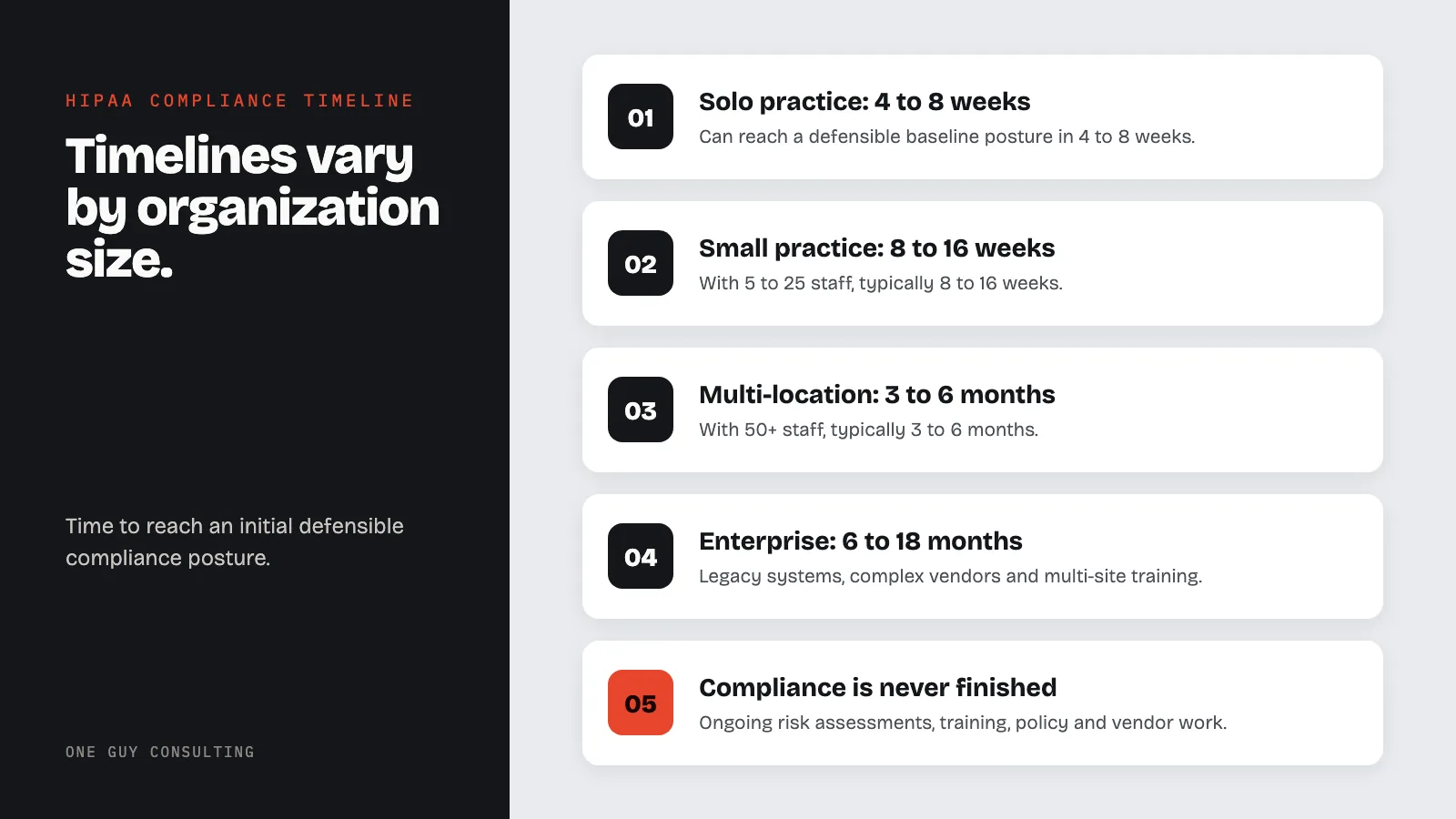
There is no single HIPAA compliance date or deadline that applies to all organizations. HIPAA has been in effect since 1996, and the compliance obligation is continuous. Realistic HIPAA compliance timelines vary by organization size, plus a phased rollout plan grounded in the requirements of the HIPAA Security Rule (45 CFR 164.308-312), Privacy Rule (45 CFR 164.500-534), and Breach Notification Rule (45 CFR 164.400-414). This guide is for leaders, founders, and operations teams who need practical execution, not theory.
Key HIPAA Compliance Dates
| Date | Milestone | Citation |
|---|---|---|
| August 21, 1996 | HIPAA enacted | Public Law 104-191 |
| April 14, 2003 | Privacy Rule compliance date | 45 CFR 164.500-534 |
| April 20, 2005 | Security Rule compliance date | 45 CFR 164.308-312 |
| September 23, 2009 | Breach Notification Rule (HITECH Act) | 45 CFR 164.400-414 |
| September 23, 2013 | Omnibus Rule: more duties for business associates (BAs), the vendors who handle PHI for you | 78 FR 5566 |
| Proposed (not final) | Proposed Security Rule update. It would require multi-factor authentication (MFA), yearly compliance audits, vulnerability scans, and a plan to restore key systems within 72 hours | Draft rule (NPRM) published January 6, 2025. Once a final rule is issued, at least 180 days to comply (45 CFR 160.104(c)(1)) |
Each compliance date added new requirements that organizations must meet on an ongoing basis. There is no expiration date for any of these obligations.
Timeline by Organization Type
| Organization Type | Staff Size | Typical Timeline | Key Variables |
|---|---|---|---|
| Solo provider / micro-practice | 1 to 5 | 4 to 8 weeks | Few systems, small vendor count, one location |
| Small practice / startup | 5 to 25 | 8 to 16 weeks | More staff to train, more BAAs to execute, IT implementation time |
| Mid-size organization | 25 to 200 | 3 to 6 months | Multiple departments, locations, approval cycles, change management |
| Enterprise / multi-site health system | 200+ | 6 to 18 months | Legacy systems, complex vendor landscape, multi-site training logistics |
| Business associate (any size) | Varies | Varies | Depends on PHI access scope, technical complexity, and what your clients (the covered entities you serve) require |
Important: These timelines represent the time to reach an initial defensible compliance posture. HIPAA compliance is an ongoing program, not a one-time project with an end date. After setup, you must keep your risk analysis current under 45 CFR 164.308(a)(1). You must keep training your staff under 45 CFR 164.308(a)(5). You must also keep managing your vendors. The proposed Security Rule update would add vulnerability scans at least every six months.
Factors That Affect Your Timeline
- Current policy state. Organizations starting with no written policies take longer than those updating existing documentation. If you have never conducted a risk assessment, that is step one and cannot be skipped.
- Number of ePHI systems. Every system that creates, receives, maintains, or transmits ePHI (as defined under 45 CFR 160.103) must be inventoried, assessed, and secured. More systems means more technical implementation work.
- Number of business associates. Each vendor handling PHI requires a signed BAA under 45 CFR 164.502(e) and due diligence review. Organizations with 20+ vendors can spend weeks on BAA management alone.
- Staff size and training logistics. Training all workforce members under 45 CFR 164.308(a)(5) takes longer with more staff, especially across multiple shifts, locations, or remote workers.
- IT complexity and legacy systems. Older systems may not support some technical safeguards under 45 CFR 164.312, like audit logs and encryption at rest (encrypting stored data). They may also not support MFA (multi-factor authentication). The proposed Security Rule update would require MFA.
- Prior risk assessment status. Organizations that have never conducted a risk analysis have a larger initial workload. Those updating a previous assessment can build on existing findings.
- Internal decision speed. The single biggest factor. Organizations that name a Security Official under 45 CFR 164.308(a)(2), and give that person real authority to make decisions, tend to finish faster.
Typical Timelines
These timelines assume the team is starting from scratch and must meet all HIPAA Security Rule administrative safeguards (45 CFR 164.308), physical safeguards (45 CFR 164.310), technical safeguards (45 CFR 164.312), and Privacy Rule requirements (45 CFR 164.500-534).
- Small practice (1 to 10 employees): 4 to 8 weeks. Covers security risk analysis under 45 CFR 164.308(a)(1)(ii)(A), written policies, workforce training under 45 CFR 164.308(a)(5), and Business Associate Agreements under 45 CFR 164.502(e).
- Multi-site clinic (10 to 50 employees): 8 to 16 weeks. Adds complexity for multiple physical locations requiring separate facility access controls under 45 CFR 164.310, coordinated incident response under 45 CFR 164.308(a)(6), and vendor management across sites.
- Large organization with legacy systems: 3 to 6 months. Requires comprehensive technical remediation for access controls under 45 CFR 164.312(a), audit controls under 45 CFR 164.312(b), encryption under 45 CFR 164.312(a)(2)(iv), and often significant policy rewrites to meet current standards and to prepare for the proposed Security Rule update.
Realistic HIPAA Compliance Timelines by Organization Size
Timelines vary widely based on org size, existing records, technical setup, and staff capacity. The ranges below are typical, not promises.
Solo provider or micro-practice (1 to 5 staff)
Timeline to first defensible compliance posture: 4 to 8 weeks. Low complexity, few systems, and a manageable vendor count keep this achievable. The biggest time sink is getting Business Associate Agreements signed by every vendor who touches PHI: EHR vendor, billing service, IT support, cloud storage. Using a compliance platform like One Guy Consulting accelerates this to the low end. Here is what happens after you sign up, week by week; DIY documentation approaches take longer.
Small practice or startup (5 to 25 staff)
Timeline: 8 to 16 weeks. More staff to train, more systems to inventory, and more BAAs to execute add complexity. A typical phase breakdown: risk assessment (2 to 3 weeks), policy development (2 to 3 weeks), technical implementation (3 to 4 weeks), training (2 weeks), documentation review (1 to 2 weeks). A common delay is IT implementation. MFA deployment and encryption verification almost always take longer than planned when legacy systems are involved. If you want to see how those phases run when we do them with you, how One Guy Consulting works walks through the roadmap step by step.
Mid-size organization (25 to 200 staff)
Timeline: 3 to 6 months. Multiple departments, locations, and IT systems add internal approval and change management overhead. Getting department heads aligned on policy language, obtaining IT sign-off on technical implementations, and scheduling all-staff training without disrupting operations are the main bottlenecks. Budget planning and vendor selection alone can add 4 to 6 weeks before implementation begins.
Enterprise or multi-site health system (200+ staff)
Timeline: 6 to 18 months for an initial comprehensive compliance posture. Legacy systems requiring significant remediation, complex BAA landscapes with dozens or hundreds of vendors, and multi-site training logistics drive this range. A good approach is to phase the work. First, achieve compliance for the highest-risk systems and workflows. Then, progressively expand the scope.
What Drives Timeline Variance
- ePHI data sprawl: The more systems that create, receive, maintain, or transmit electronic protected health information (ePHI, defined under 45 CFR 160.103), the more access controls, audit logs, and encryption implementations are required.
- Number of business associates: Each vendor handling PHI requires a signed Business Associate Agreement under 45 CFR 164.502(e) and due diligence review. Organizations with 20+ vendors can spend weeks on BAA management alone.
- Legacy technology: Older systems may not support some technical safeguards under 45 CFR 164.312, like audit logs and encryption at rest (encrypting stored data). They may also not support multi-factor authentication, which the proposed Security Rule update would require.
- Internal decision speed: The single biggest factor. Organizations that name a Security Official under 45 CFR 164.308(a)(2), and give that person real authority to make decisions, tend to finish faster.
Fastest Path Without Cutting Corners
The most efficient path follows the order HIPAA itself implies. Start with understanding your risks, then build safeguards around those findings:
- Security Risk Analysis: Conduct a thorough risk analysis under 45 CFR 164.308(a)(1)(ii)(A) to identify all threats and vulnerabilities to ePHI. This is the foundation everything else builds on.
- Risk Management Plan: Develop a remediation plan under 45 CFR 164.308(a)(1)(ii)(B) that prioritizes gaps by severity and assigns ownership.
- Policies and Procedures: Write or update required documentation under 45 CFR 164.316, covering all administrative, physical, and technical safeguard requirements.
- Workforce Training: Train all workforce members with access to PHI under 45 CFR 164.308(a)(5). Training must be documented and ongoing.
- Technical Safeguard Implementation: Deploy access controls (45 CFR 164.312(a)), audit controls (45 CFR 164.312(b)), integrity controls (45 CFR 164.312(c)), and transmission security (45 CFR 164.312(e)).
- Evidence Gathering and Documentation: Gather your compliance evidence. Keep required policies and records in writing for six years (45 CFR 164.316(b) and 164.530(j)). The six years start from when a document was created or when it was last in effect, whichever is later.
The Four Phases of HIPAA Compliance
Regardless of organization size, the compliance process follows roughly the same sequence of phases. Here is what each phase involves and how long each realistically takes.
Phase 1: Risk Assessment and Gap Analysis (25 to 30% of total timeline)
The HIPAA Security Rule requires an accurate and thorough assessment of potential risks and vulnerabilities to ePHI under 45 CFR 164.308(a)(1). This is not optional and cannot be skipped. Before you can fix compliance gaps, you need to know what they are. A proper risk assessment includes an inventory of all systems that store, transmit, or access ePHI; identification of threats and vulnerabilities; likelihood and impact ratings; and an evaluation of controls already in place.
Typical duration: 1 to 3 weeks for small organizations; 4 to 8 weeks for enterprise environments.
Phase 2: Policy and Procedure Development (20 to 25% of total timeline)
HIPAA requires written policies and procedures covering security under 45 CFR 164.316. Privacy and breach notification policies are required under 45 CFR 164.530(i). Generic downloaded templates are a starting point, not a finish line. Policies must reflect your actual operations, systems, and workflows. Areas requiring documented policies include access control, workforce training, incident response, business associate management, device and media controls, facility access, and audit controls.
Typical duration: 2 to 4 weeks for small organizations; 6 to 12 weeks for enterprise organizations including legal review and executive approval cycles.
Phase 3: Technical Implementation (30 to 40% of total timeline)
Technical safeguards are where most timelines slip. The gap between "we decided to implement MFA" and "MFA is deployed across all ePHI systems and all staff are enrolled" is almost always longer than planned. Technical implementation items include MFA deployment across all ePHI-accessing systems (the proposed Security Rule update would require this), encryption verification for data at rest and in transit, audit logging and monitoring configuration, access control review with least-privilege enforcement, automatic logoff settings for workstations, and vulnerability scanning setup (the proposed update would require scans at least every six months).
See how to conduct a HIPAA risk assessment for a detailed walkthrough of the technical gap analysis that precedes this phase.
Typical duration: 3 to 6 weeks for small organizations; 8 to 20 weeks for enterprise environments with legacy system complexity.
Phase 4: Training, Documentation, and Ongoing Maintenance
You must train all workforce members who access PHI and document that training under 45 CFR 164.308(a)(5). Training is not a one-time event. Keep it going as staff and policies change. The rest of compliance is ongoing too: update your risk analysis regularly, review policies regularly, update BAAs when vendors change, and record incidents when they happen. The proposed Security Rule update would add vulnerability scans at least every six months.
Training duration: 1 to 2 weeks to schedule and complete initial all-staff training. Plan for regular re-training after that. Explore One Guy Consulting employee training programs for a structured approach.
The Proposed Security Rule Update
For years, HIPAA compliance operated on a "get there eventually" timeline for many organizations. In January 2025, HHS proposed a major update to the HIPAA Security Rule. It came out as an NPRM (notice of proposed rulemaking), which is a draft rule. It is not final yet. HHS's target date for a final rule has slipped to July 2027. If it becomes final, it would change that picture a lot.
The proposal would add new rules with set time frames: yearly compliance audits, vulnerability scans at least every six months, MFA across all ePHI systems, documented asset lists, and a plan to restore key systems within 72 hours. Once a final rule takes effect, you would have at least 180 days to comply.
What this means for timeline planning: If your organization has not started a compliance program, you are no longer working toward a vague goal. A real deadline will follow once a final rule is issued. If you start today and follow the phased approach above, you can realistically reach a solid, defensible compliance position well before that deadline. If you wait, you will have much less time and more risk of getting it wrong.
The practical takeaway: start now, even if the final rule is not yet out. The proposed rules are spelled out in the NPRM. No team that finishes a risk analysis, deploys MFA, writes policies, and trains staff will need to undo any of that work if the final rule is issued. For the full compliance roadmap, see the HIPAA Compliance Guide 2026.
Final Takeaway
Strong compliance programs share a few key traits. They have a designated Security Official as required by 45 CFR 164.308(a)(2). They also keep current documents under 45 CFR 164.530(j). Additionally, they conduct regular risk analyses and treat compliance as an ongoing requirement, not a one-time project. HIPAA requires continuous risk management under 45 CFR 164.308(a)(1)(ii)(B), making compliance a daily practice, not an annual checkbox.
Related resources: What is HIPAA, HIPAA Compliance Guide 2026, HIPAA Risk Analysis Process, and contact us for setup support.
Need Setup Help?
One Guy Consulting provides practical HIPAA guidance for covered entities and business associates. Book a consultation, start your risk assessment, explore employee training programs and policy templates, or start with a gap analysis.
Related: HIPAA compliance checklist | HIPAA compliance checklist for small practices
Frequently Asked Questions
What is the HIPAA compliance date?
The original HIPAA compliance date was April 14, 2003, for the Privacy Rule, and April 20, 2005, for the Security Rule. Small health plans had an additional year for each deadline. Since those original dates, compliance has been an ongoing obligation with no expiration. Organizations must maintain continuous compliance, update their programs as regulations change, and keep their risk analysis and staff training up to date. If the proposed Security Rule update is finalized, it would add new requirements with their own deadline.
How long does HIPAA compliance take for a small medical practice?
A small medical practice (1 to 10 providers, under 25 staff) can typically reach a first defensible HIPAA compliance posture in 4 to 8 weeks using a compliance platform, or 8 to 16 weeks using a manual approach. The biggest variable is how quickly you can get Business Associate Agreements signed by all vendors who touch PHI, and how long your IT team takes to implement technical safeguards like MFA and encryption verification.
Can I get HIPAA compliant in 30 days?
For a very small organization (a solo practice or startup with 2 to 3 staff and minimal PHI), 30 days is achievable if you use a compliance platform that automates policy generation and risk assessment, already have a relatively clean technical environment, can dedicate significant staff time to the process, and have responsive vendors who can sign BAAs quickly. For most organizations, 30 days is too aggressive for a thorough, defensible compliance posture. For small organizations starting from scratch, 4 to 16 weeks is more realistic.
What is the single biggest factor that slows HIPAA compliance?
A common delay is technical implementation, specifically deploying and enrolling all staff in MFA across all ePHI-accessing systems. Legacy clinical software that does not natively support modern MFA methods, and IT teams that are stretched thin, account for most of the timeline slippage organizations experience between deciding to become compliant and actually completing their technical safeguards.
Does HIPAA compliance ever end?
No. HIPAA compliance is an ongoing program, not a one-time project. Key recurring obligations include: regular staff training, regular risk analysis review, vulnerability scans at least every six months (proposed in the Security Rule update, not yet law), BAA review when vendors change or contracts renew, and incident documentation whenever a security event occurs. The goal is not to "finish" compliance. It is to maintain a continuously defensible posture.
Key stat: Initial HIPAA compliance setup typically takes 4 to 16 weeks for a small practice. But compliance does not end there. Risk analysis updates, regular training, policy reviews, and incident records never stop.