HIPAA Compliance Consulting for Medical Practices
Medical practices are covered entities under HIPAA whenever they transmit health information electronically as part of a covered transaction (45 CFR §160.103). That includes filing insurance claims, checking patient eligibility, sending electronic referrals, and processing billing through a clearinghouse. There is no size exemption. Solo physicians, multi-provider groups, urgent care clinics, outpatient surgery centers, and specialty practices all face the same rules. For a detailed look at what this investment often involves, see our HIPAA compliance cost breakdown.
Yes.HIPAA applies to solo practitioners and large systems alike.
There is no exemption based on practice size, patient volume, or revenue.
Three core HIPAA rules for medical practices.
Medical practices that are covered entities must follow three core HIPAA rules.
How PHI is used and shared
Controls how protected health information (PHI) is used and shared. Medical practices must give patients a Notice of Privacy Practices (NPP), honor patient rights to access and amend records per §164.524 and §164.526, and share only the minimum PHI needed for the task at hand. This applies to every form of PHI: paper charts, electronic records, verbal discussions, and faxed documents.
Safeguards for electronic PHI
Requires administrative, physical, and technical safeguards to protect electronic PHI (ePHI). For medical practices, this covers EHR systems, patient portals, lab interfaces, billing software, email, cloud backups, and any networked device that stores or transmits patient data. The Security Rule is where most enforcement actions begin, because it requires a documented security risk analysis that many practices have never completed.
What to do when PHI leaks
You must notify affected patients within 60 days of discovering a breach of unsecured PHI (§164.404). Breaches affecting 500 or more people must also be reported to HHS and local media (§164.406, §164.408). Medical practices need a documented incident response plan that covers breach detection, the four-factor risk assessment under §164.402, and notification timelines so the 60-day window is never missed.
PHI in Medical Practices
Protected Health Information (PHI) in medical practices includes patient intake forms, medical histories, clinical notes, lab results, diagnostic imaging, prescription records, insurance claims, appointment schedules, and billing data. Any information that identifies a patient and relates to their health condition, treatment, or payment for care counts as PHI under 45 CFR §160.103. This also includes information patients share through a patient portal, over the phone, or via text message.
Electronic health records
The central repository of ePHI for most practices. The EHR must be configured with unique user IDs for every staff member, automatic session timeouts, audit logging that tracks who viewed or modified each record, and encryption for data at rest and in transit. Shared logins are a common violation: they make audit logs useless and remove individual accountability. The EHR vendor must sign a Business Associate Agreement per §164.308(b)(1) before any PHI is stored in or transmitted through their system.
Patient portals
Portals that allow patients to view records, message providers, or schedule appointments must use encrypted transmission (TLS/SSL), strong authentication, and role-based access controls. The portal vendor needs a BAA, and the practice needs documented procedures for how staff assist patients with portal access and how portal-related security incidents are handled.
Connected medical devices
Diagnostic equipment, remote monitoring tools, vital sign monitors, and any device integrated with the EHR create, transmit, or store ePHI and fall under the Security Rule. These devices must be included in the practice's risk analysis, covered by facility access controls per §164.310(a), and their vendors must sign BAAs. Many practices overlook networked devices during their risk assessment, which creates undocumented gaps.
Required HIPAA Compliance Steps
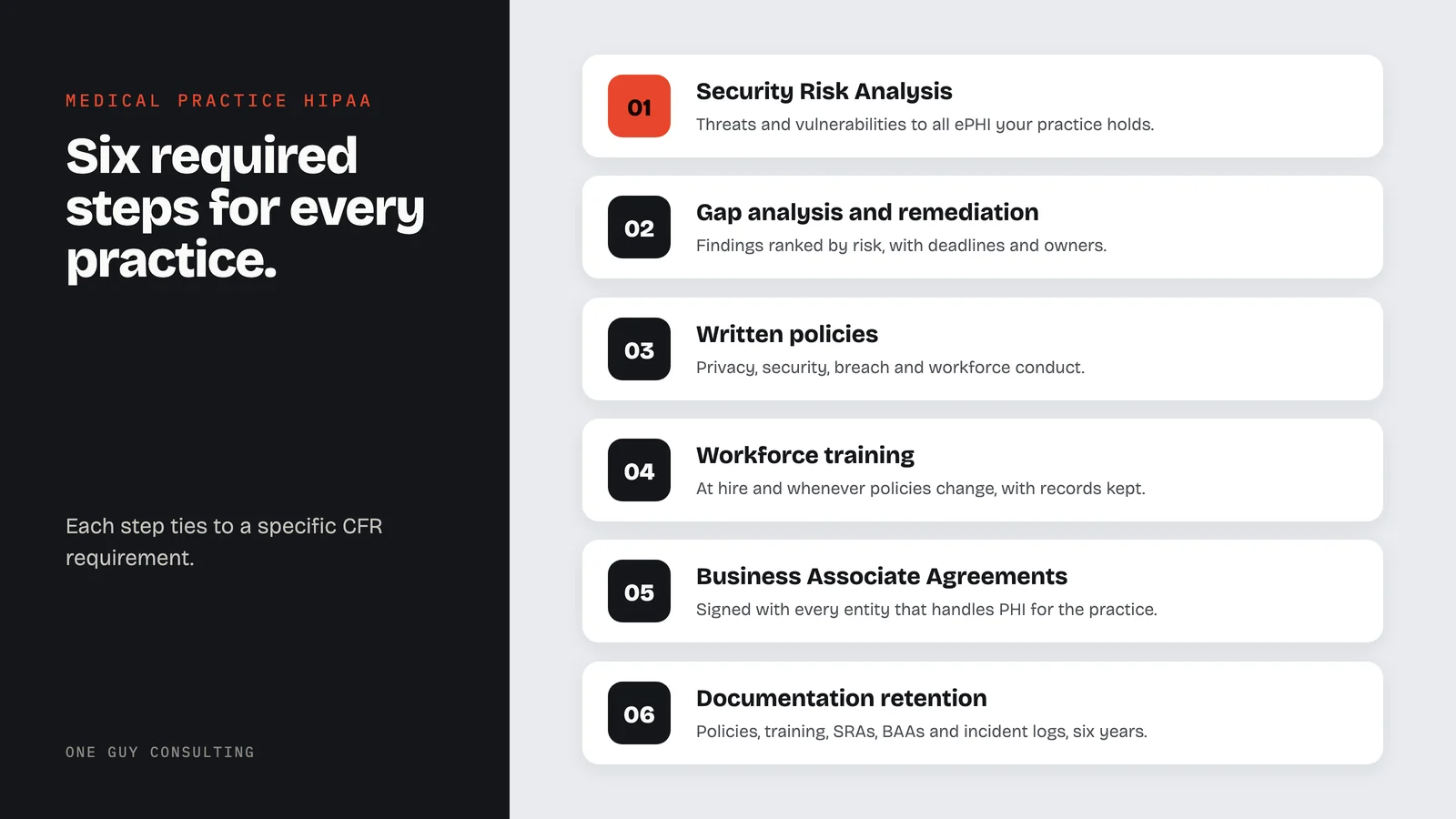
These six steps apply to every medical practice that is a covered entity. Each ties to a specific CFR requirement and carries its own enforcement risk if left undone.
- 01
Security Risk Analysis (SRA)
Must identify threats and vulnerabilities to all ePHI your practice creates, receives, stores, or sends. A documented risk analysis is the single most common missing item when OCR investigates medical practices. It is also the foundation for every other compliance step: without it, you cannot prioritize what to fix first.
Start hereIt sets the remediation priority for everything else. - 02
Gap analysis and remediation plan
Compare current safeguards against the full set of requirements in §164.308 (administrative), §164.310 (physical), and §164.312 (technical). A structured gap analysis ties each finding to the CFR rule it falls under, ranks issues by risk level, and produces a remediation plan with clear deadlines and ownership.
- 03
Written policies and procedures
Must cover privacy, security, breach notification, and workforce conduct tailored to your practice's actual operations. Medical-practice-specific policy templates help practices avoid vague language and map policies to real workflows like patient check-in, lab result handling, prescription management, and records requests.
Medical fitCheck-in, lab results, prescriptions, records requests. - 04
Workforce training
Every person with PHI access (physicians, nurses, medical assistants, front desk staff, billing personnel, and IT support) must receive HIPAA training at hire and whenever policies change. Training records (date, topics, attendees) must be retained for six years per §164.530(j). OCR asks for these records in nearly every investigation.
Keep the proofDate, topics, and attendees, for six years. - 05
Business Associate Agreements
Must be signed with every entity that handles PHI on behalf of the practice: EHR vendors, billing services, clearinghouses, IT providers, cloud storage vendors, shredding companies, answering services, and any other third party with PHI access. A BAA management process ensures no vendor is missed and agreements stay current.
No vendor missedAgreements tracked and kept current. - 06
Documentation retention
HIPAA requires compliance records to be kept for six years. This includes all policies, training records, risk assessments, BAAs, incident logs, and any written decisions about addressable implementation specifications. If you cannot produce these documents during an investigation, OCR treats it as a gap regardless of what you actually did.
Six yearsPolicies, training, SRAs, BAAs, incident logs.
Common HIPAA Compliance Gaps in Medical Practices
The most common gap is the missing or incomplete Security Risk Analysis. Many practices either have never done one, or completed a checklist-style assessment years ago that does not meet the standard OCR expects. Other frequent findings include:
- Shared EHR login credentials among staff, which violates the unique user ID requirement and makes audit trails meaningless.
- No BAAs with IT vendors, cloud backup providers, or answering services that handle PHI.
- Outdated policies that reference old systems or workflows and have not been reviewed since they were first written.
- Missing or incomplete training records: staff were trained but the practice has no records to prove it.
- Workstations in shared areas without automatic logoff or privacy screens, exposing ePHI to unauthorized viewing.
- No documented incident response procedure, so when a potential breach happens the practice does not know the required steps or timelines.
Multi-provider groups and practices with multiple locations face added challenges when building uniform policies across sites with different EHR systems, staffing levels, and physical layouts. A gap analysis at the organizational level is the right starting point before standardizing policies across locations.
HIPAA Regulatory Standards for Medical Practices
Key federal standards that define HIPAA duties for medical practices. Practices in states with additional health privacy laws should also review California HIPAA compliance requirements as an example of how state rules can layer on top of federal requirements.
| Standard | Key Requirements |
|---|---|
| 45 CFR §164.308 | Administrative safeguards: risk analysis, workforce training, access management, contingency planning, and security incident procedures. |
| 45 CFR §164.310 | Physical safeguards: facility access controls, workstation use and security, device and media controls for any hardware containing ePHI. |
| 45 CFR §164.312 | Technical safeguards: unique user IDs, emergency access procedures, automatic logoff, audit controls, integrity controls, and transmission security. |
| Privacy Rule (Subpart E) | Patient rights to access, amend, and receive an accounting of disclosures of their PHI. Requires a Notice of Privacy Practices and minimum necessary use standards. |
| Breach Notification (Subpart D) | Notification to affected individuals within 60 days, HHS reporting, and media notification for breaches affecting 500+ people. |
| Business Associate Contracts | Written BAAs required with every vendor that creates, receives, maintains, or transmits PHI, including EHR, billing, IT, cloud, and shredding services. |
HIPAA Enforcement for Medical Practices
The Office for Civil Rights (OCR) enforces HIPAA for all covered entities, including medical practices of every size. Civil monetary penalties range from $145 to $2,190,294 per violation category per year under 45 CFR §160.404, with four penalty tiers based on the level of culpability.
OCR has investigated medical practices for complaints involving unauthorized disclosures, missing risk assessments, failure to provide patients access to their records within 30 days per §164.524(b)(2), and insufficient safeguards on electronic systems.
The most common trigger for an investigation is a patient complaint or a breach report, and the first document OCR often requests is the security risk analysis.
One flat price for the whole practice.
Two plans, six ways to pay. No per-user fees, so adding a provider or front-desk hire does not change your bill.
- The platform on its own
- SRA, gap analysis, remediation plans
- Policy templates and staff training
- Vendor and BAA management
- Everything in Self-Guided
- 4 hours a month of 1:1 implementation calls with Chuck
- Incident response guidance
- CMS audit response support
One payment, two full years of coverage.
Secure checkout by Stripe. Your payment details go straight to Stripe and never touch our servers.
Medical Practice HIPAA FAQ
How long does it take a medical practice to become audit-ready?+
What EHR access controls does HIPAA require?+
How do we secure a patient portal for HIPAA?+
Do connected medical devices create HIPAA duties?+
What is required when a staff member with PHI access leaves?+
Does HIPAA apply to paper records in medical practices?+
How often must medical practice staff complete HIPAA training?+
Chuck Weiselberg, C.H.P.
Certified HIPAA Professional (C.H.P.). Zero client fines. Zero failed audits.
“One Guy Consulting is super easy to work with. I actually look forward to my implementation meetings for HIPAA.”
Samantha M.
Need HIPAA Support for Your Medical Practice?
One Guy Consulting works with solo physicians, multi-provider groups, urgent care clinics, outpatient surgery centers, and specialty practices. We are based in Queens, New York and work remotely with practices nationwide; see HIPAA compliance services near you.