On February 20, 2026, a bug in an automated Cloudflare cleanup task pulled about 1,100 customer IP prefixes off the internet. The full incident lasted just over six hours. The lesson for small practices: HIPAA’s contingency plan rules require data backups, a disaster recovery plan, and a way to keep working during emergencies like this.
On February 20, 2026, Cloudflare had a major outage. About 25% of its Bring Your Own IP (BYOIP) customer prefixes went offline, and some stayed down for just over six hours. The cause was a single API bug in an automated cleanup task. It silently pulled roughly 1,100 BGP route prefixes off the internet.
If your services went dark that Friday and you weren’t sure why, you weren’t alone. This Cloudflare incident affected businesses across every sector that rely on Cloudflare’s global network to keep their systems reachable, including healthcare organizations for whom availability is not just an operational concern but a HIPAA compliance obligation.
Here’s the full breakdown (sourced from Cloudflare’s own post-mortem and independent reporting), along with the business continuity and cloud systems reliability lessons every organization should take away from it.
Key Terms in This Analysis
Before diving in, a quick reference for the technical and regulatory terms used throughout this analysis:
- Business Continuity Plan (BCP)
- A set of steps that helps a business keep running during and after a major outage. HIPAA does not use the term BCP. The closest HIPAA rule is its Contingency Plan standard (45 CFR §164.308(a)(7)). It requires covered entities and business associates to have policies for emergencies that damage systems holding electronic PHI (ePHI).
- Disaster Recovery (DR)
- The part of business continuity focused on restoring IT systems, data, and infrastructure after a failure. HIPAA requires a formal DR Plan under the Contingency Plan standard.
- BGP (Border Gateway Protocol)
- The routing protocol that moves traffic across the internet between networks. When BGP routes are pulled, traffic has no path. Services go dark without an error. Connections just time out.
- BYOIP (Bring Your Own IP)
- A service model where a customer routes their own IP address ranges through a cloud provider’s network. In this outage, about a quarter of Cloudflare’s BYOIP prefixes were pulled from the global BGP routing table. That made those services unreachable.
- Single Point of Failure (SPOF)
- Any component in a system whose failure brings down the entire system. Organizations that route all traffic through a single cloud provider have created a SPOF, one the Cloudflare outage exposed with painful clarity.
- Covered Entity
- Under HIPAA, a health plan, healthcare clearinghouse, or healthcare provider that sends health information electronically for standard transactions, such as insurance claims. Covered entities bear direct HIPAA compliance obligations.
- Business Associate (BA)
- A vendor or contractor that creates, receives, maintains, or transmits protected health information (PHI) on behalf of a covered entity. Cloud providers handling ePHI must sign a Business Associate Agreement (BAA). See common BAA mistakes to avoid.
- ePHI (Electronic Protected Health Information)
- Any individually identifiable health information that is created, stored, transmitted, or received in electronic form. HIPAA’s Security Rule governs how ePHI must be protected, including requirements for availability during disruptions.
What Caused the Cloudflare Outage on February 20, 2026?
At 17:56 UTC, an automated cleanup task inside Cloudflare’s management system ran a routine query against their internal API. The task was designed to identify a small subset of IP prefixes queued for deletion: standard housekeeping. Instead, a bug caused the query to pass the pending_delete parameter with an empty value.
Instead of filtering for just the prefixes set for removal, the API read the empty string as a request for all BYOIP prefixes. It queued every one for deletion. The result was an unintentional BGP route withdrawal that pulled 1,100 of approximately 4,300 BYOIP prefixes off the internet.
Affected customers didn’t receive an error page. Their services simply became unreachable: connections timed out, packets were lost, and end users saw nothing at all. Cloudflare’s post-incident report traces the root cause to this bug in the API query. The pattern is a familiar one: a loose default on an API that can delete things. At this scale, the results were severe.
Which Cloudflare Services Were Affected?
The Cloudflare outage impact showed up in more than one place. According to an analysis by Dargslan Publishing, there were three separate problems that day, each with its own cause:
1. BYOIP Connectivity and BGP Routing Failures
The core issue. Customers using Cloudflare’s BYOIP service to route their own IP address ranges experienced complete cloud provider downtime. Affected product lines included:
- CDN traffic routing: content delivery failures across affected prefixes
- Cloudflare Spectrum: unable to proxy TCP/UDP traffic
- Dedicated Egress: outbound traffic blocked entirely
- Magic Transit: connection timeouts and DDoS protection gaps
Affected networks experienced what’s known as BGP path hunting, a cascading failure where routers loop endlessly trying to find alternative routes that no longer exist, compounding the disruption.
2. Cloudflare 1.1.1.1 Website Returning 403 Errors
Cloudflare’s public DNS resolver landing page began returning HTTP 403 (Forbidden) errors during the disruption. Importantly, the actual 1.1.1.1 DNS resolution service continued to function normally, a distinction that highlights how modern cloud systems degrade in layers rather than failing all at once.
3. Workers AI Rate Limiting and 429 Error Spikes
Users of Cloudflare’s AI platform saw more HTTP 429 (Too Many Requests) errors than usual the same day. Dargslan treats this as a separate issue with its own cause. Cloudflare’s report on the Cloudflare network outage does not link it to the BYOIP bug.
Cloudflare Outage Timeline: How the Incident Was Resolved
Stopping the damage and fully recovering from it were two very different challenges. Here’s the complete Cloudflare incident timeline:
| Time (UTC) | Event |
|---|---|
| 17:56 | Faulty automated process begins withdrawing BGP prefixes |
| 18:46 | Engineers identify and terminate the faulty process (50 min to detect) |
| 19:19 | Cloudflare publishes customer self-remediation guidance via dashboard |
| 20:20 | Cloudflare reverses many of the changes, restoring about 800 of 1,100 affected prefixes |
| 23:03 | A global settings rollout finishes restoring the remaining prefixes (the full incident took 6h 7m, per Cloudflare) |
The final 300 prefixes proved significantly harder to restore. These weren’t merely withdrawn: their service bindings had been completely removed from Cloudflare’s edge configuration due to a secondary software bug. To recover, Cloudflare had to roll out a settings change across its global network.
Customers who could not bring their own prefixes back online stayed unreachable until Cloudflare restored them.
Root Cause Analysis: Why a Simple Bug Caused a Major Cloud Outage
The technical root cause is straightforward, but the architectural failures that allowed it to reach production are worth examining for anyone who builds or depends on cloud systems.
The online discussion around this Cloudflare incident report surfaced several pointed criticisms from engineers and industry observers:
Dangerous API Design Defaults
The destructive delete path was built on top of an endpoint that defaults to returning everything when given ambiguous input. As one commenter noted, destructive operations should never default to complete scope without explicit confirmation. This is a well-documented anti-pattern in API security and system design, and one that appears with striking regularity in post-incident analyses. If you’re assessing vendor security practices as part of your organizational risk assessment, destructive-operation defaults are a direct line of questioning.
Insufficient Testing for Critical Paths
Even a basic integration test with realistic data (including prefixes not marked for deletion) would have caught this before production. The bug was not subtle. A single manual test of the cleanup subtask would have surfaced it immediately. This represents a significant gap in cloud service reliability practices for a provider of Cloudflare’s scale.
Velocity vs. Reliability
Several observers noted a pattern of increasing Cloudflare service disruptions and attributed it to a culture that prioritizes shipping speed over stability. Whether or not that’s a fair characterization, it reflects a tension every fast-moving technology company faces, and one that customers absorb the consequences of when it tips the wrong way. For healthcare organizations, that tradeoff has regulatory consequences, not just operational ones.
HIPAA Implications: What This Outage Means for Healthcare Organizations
For covered entities and business associates that depend on Cloudflare (or any cloud provider) to maintain access to electronic protected health information (ePHI), this outage is not just an IT war story. It is a concrete illustration of why HIPAA’s Contingency Plan standard exists and what happens when organizations treat it as a compliance checkbox rather than an operational requirement.
The proposed HIPAA Security Rule changes would raise expectations around exactly these scenarios, but they are not final. Here are the provisions that apply today:
45 CFR §164.308(a)(7)(i): Contingency Plan (Required)
This standard requires covered entities and business associates to have policies and procedures for emergencies. It covers any emergency, such as a system failure, that damages systems holding ePHI. A six-hour cloud outage that takes down patient portals, EHR systems, or telehealth is exactly this type of event. If your plan does not cover a cloud provider failure, you have a gap to close.
45 CFR §164.308(a)(7)(ii)(B): Disaster Recovery Plan (Required)
This rule requires procedures to restore any data you lose. If all your clinical data routes through one provider with no backup path, a BGP withdrawal is a data access failure. Your DR plan should cover this scenario, not just server crashes or ransomware.
45 CFR §164.308(a)(7)(ii)(C): Emergency Mode Operation Plan (Required)
Covered entities and business associates must have procedures for emergency mode. Those procedures keep critical work going and keep ePHI protected. If your patient portal goes down, do your staff have steps to keep working? Do they know what can run offline and what needs escalation? Those are the questions this rule is about.
45 CFR §164.308(a)(7)(ii)(D): Testing and Revision Procedures (Addressable)
This spec is about testing and updating your contingency plans on a regular basis. It is addressable. Addressable does not mean optional.
It means you put it in place if it is reasonable and appropriate for your practice. If not, you write down why and what you do instead. An untested DR plan will fail when you need it most. This outage is a good reason to check whether your last test included a “primary cloud provider down” scenario.
45 CFR §164.312(a)(2)(ii): Emergency Access Procedure (Required)
This rule requires steps for getting ePHI during an emergency. If a provider outage blocks your EHR or clinical systems, staff need a tested backup plan. That could be a local cache, a second system, or a manual process. “We couldn’t access records because Cloudflare was down” is not an answer you want to give OCR.
45 CFR §164.308(b)(1): Business Associate Contracts (Required)
If Cloudflare handles ePHI for you, such as proxying traffic to a patient portal, they must have a signed BAA. That BAA should cover data access during outages and set clear notification timelines. Review yours to make sure. For a deeper look at where these agreements typically fall short, see our analysis of common business associate agreement mistakes.
For a broader view of how vendor failures create HIPAA exposure, the vendor compromise response framework applies here as well: availability failures and security failures trigger many of the same compliance obligations.
Business Continuity Lessons From the Cloudflare February 2026 Outage
If your organization depends on cloud systems (and in 2026, that means nearly every organization), this outage offers concrete takeaways for your business continuity planning. For healthcare organizations, many of these steps tie directly to HIPAA’s contingency plan rules.
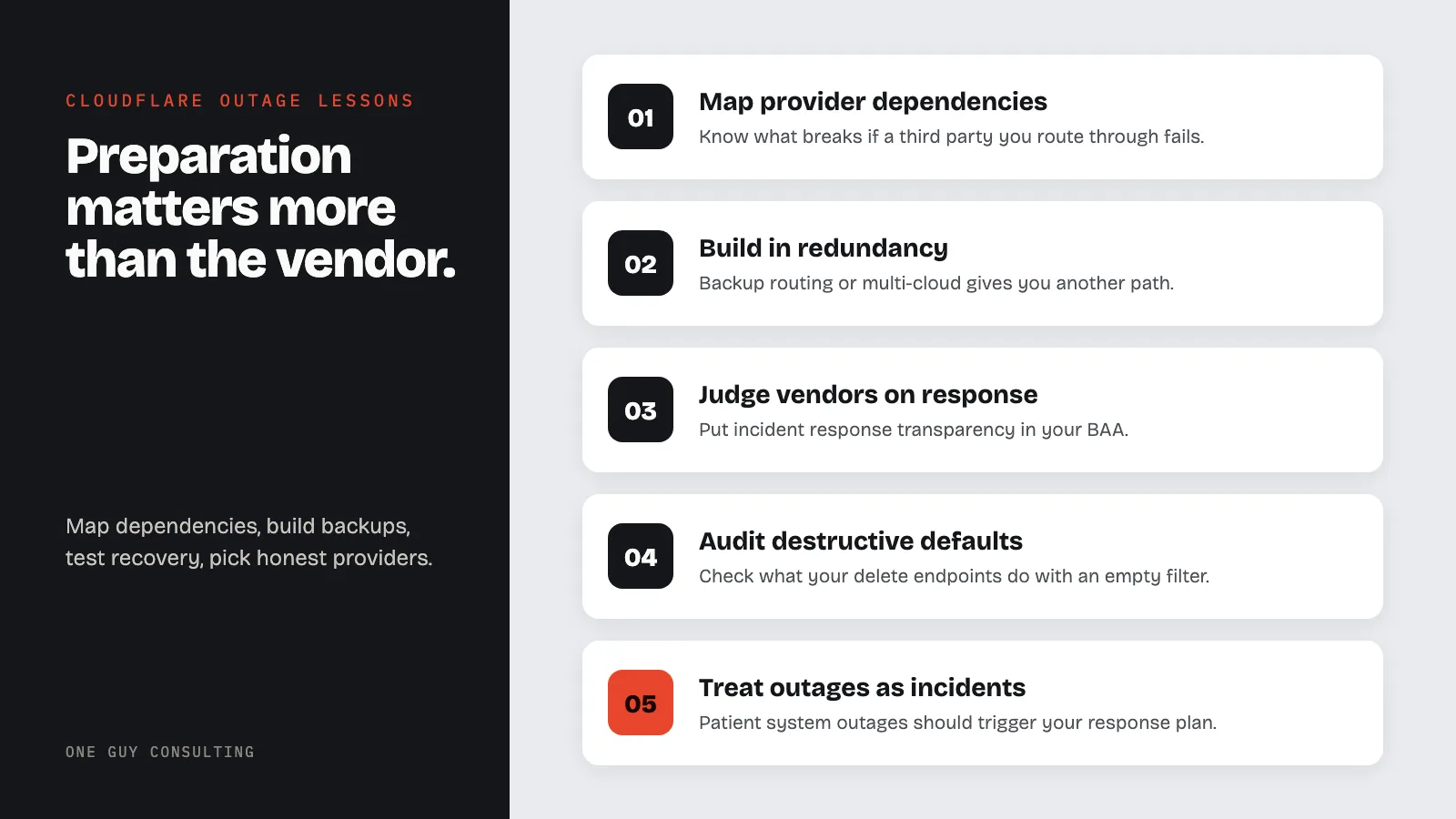
Map Your Cloud Provider Dependencies
Many businesses use Cloudflare without knowing how deep it sits in their stack. If your IPs route through a third party, you need to know what happens when they go down. Do you have a documented runbook? Can your engineers self-remediate using the provider’s dashboard? During this outage, customers who knew how to re-advertise their prefixes via the Cloudflare dashboard could recover sooner than those who waited for Cloudflare to restore them.
This dependency mapping is also a core component of a proper HIPAA risk assessment. You cannot assess risk you have not identified.
Build Redundancy Into Your Network Architecture
BYOIP customers with backup routing or multi-cloud setups had another path to fall back on. Single-provider setups did not. A single point of failure in your cloud stack is always a gamble. For healthcare organizations, a SPOF that cuts off ePHI access puts your HIPAA Contingency Plan to the test. It is not just an IT hassle.
Evaluate Cloud Providers on Incident Response, Not Just Uptime SLAs
Cloudflare’s openness here deserves credit. They published a detailed post-mortem within 48 hours, with the code-level root cause and a clear fix list. That level of cloud provider accountability is what you want from any vendor. A provider that hides behind vague status updates is not safer. They are just less honest about your risk.
When evaluating vendors for healthcare use cases specifically, incident response transparency should be a contractual requirement in your BAA, not an afterthought.
Audit Your Own Destructive API Defaults
This outage started with a lax default on a destructive API endpoint. If you build software, ask: what do your delete endpoints do when they get an empty filter? If the answer is “delete everything,” you have the same flaw Cloudflare had, just at a smaller scale.
Treat Cloud Outages as Incident Response Events
A six-hour outage hitting patient systems should trigger your incident response plan, not just an IT help desk ticket. Know in advance who gets called, what the escalation path is, and when an outage could require notice to patients or regulators (for example, if you learn data was exposed). For a practical framework, the first 72-hour incident response playbook applies equally well to availability incidents as it does to ransomware events. With healthcare breaches rising in 2025, organizations that practice incident response on a regular schedule are better prepared for audits and for their patients.
What Cloudflare Is Doing to Prevent Future Outages
Cloudflare has committed to several specific remediation actions following this disruption:
- API schema standardization to prevent ambiguous parameter interpretation across key endpoints
- Circuit-breaker monitoring to detect rapid, widespread changes and automatically halt dangerous operations
- Snapshot-based rollback capability separating day-to-day and configured database states
- Health-mediated deployments, which check system health while applying configuration snapshots to production
These efforts fall under Cloudflare’s internal “Code Orange: Fail Small” initiative, a push toward controlled, gradual network changes designed to limit the blast radius of any single failure. It is a sound engineering philosophy, and one that healthcare IT teams would do well to apply to their own systems and vendor evaluation criteria.
The Bottom Line for Organizations That Depend on Cloud Infrastructure
The Cloudflare outage of February 2026 is a reminder that even top providers have bad days. The internet is a shared system built on trust and protocol. No single vendor is immune to the kind of chain failure a simple bug can set off.
The organizations that come through these events in good shape are not the ones with the best vendor. They are the ones with the best preparation. Map your dependencies. Build in backup options. Test your recovery steps. Choose providers who are honest when things break.
For healthcare organizations, that preparation is not optional. It is required by 45 CFR Part 164. OCR can ask to see your written plan.
Frequently Asked Questions
Does a cloud provider outage trigger HIPAA breach notification requirements?
Not always, but it can. A cloud outage is not a “breach” under HIPAA unless PHI is accessed, used, or shared in a way HIPAA does not allow. If systems go down but no data is exposed, breach notice rules do not apply.
However, if ePHI stays out of reach for a long time, your Contingency Plan duties kick in, and you should write down what happened and how you responded. If the outage involves a security event like ransomware or unauthorized access, breach notice rules may apply. Under 45 CFR §164.402, any use or sharing of PHI that HIPAA does not allow counts as a breach by default. The exception is when a risk assessment shows a low chance that the data was compromised. Treat any major cloud outage as a possible security incident until the provider’s post-mortem says otherwise. See also: how to respond when a vendor is compromised.
What HIPAA contingency planning requirements apply to cloud-dependent healthcare organizations?
The HIPAA Security Rule’s Contingency Plan standard (45 CFR §164.308(a)(7)) has five parts: a Data Backup Plan, a Disaster Recovery Plan, an Emergency Mode Operation Plan, Testing and Revision Procedures, and an Applications and Data Criticality Analysis. The first three are required. The last two are addressable. That means you put them in place if they are reasonable and appropriate for you. If not, you write down why and what you do instead. All five matter for organizations that depend on the cloud.
The Data Backup Plan requires exact copies of ePHI that you can get back. So it should cover what happens when you cannot reach data stored in the cloud. The Disaster Recovery Plan should include steps for restoring access when a cloud provider fails. The Emergency Mode Operation Plan should keep critical work going even if cloud systems are unreachable.
The proposed Security Rule changes, which are not final, would add more detail to these components, such as a proposed 72-hour target for restoring systems. See our full analysis of the proposed rule changes for details on what would change.
Should healthcare organizations adopt multi-cloud strategies for HIPAA compliance?
Multi-cloud is not required by HIPAA, but it is an option to consider for organizations that need their ePHI systems up with very little downtime. The February 2026 Cloudflare outage illustrates why: a single-provider dependency creates a single point of failure that can render patient-facing systems unreachable for hours. HIPAA’s Emergency Mode Operation Plan requires procedures to keep critical work going during an emergency. Those procedures must also keep ePHI protected.
A well-designed multi-cloud or hybrid setup is one way to support that. At minimum, organizations should have a documented fallback path for their most critical ePHI workflows that does not depend on a single cloud provider. Whether that means active-active multi-cloud, a hot standby, or a documented manual procedure depends on your criticality analysis under 45 CFR §164.308(a)(7)(ii)(E). That is the step where you rank which systems and data matter most. It is addressable, so you put it in place if it fits your practice, or write down why not.
How should healthcare organizations evaluate cloud vendors for HIPAA compliance purposes?
Vendor checks for HIPAA should go beyond uptime SLAs. Key questions:
- Will they sign a BAA? If not, they cannot touch ePHI.
- What are their incident notice timelines, and do they meet your breach duties?
- Do they publish detailed post-mortems, or just vague status updates?
- Can they show tested failover steps?
- Are all sub-vendors that handle ePHI also under BAA?
The Cloudflare outage is a useful test case: the company published a thorough post-mortem within 48 hours. That is the standard of transparency healthcare organizations should require. For a full checklist of where these agreements fall short in practice, see common business associate agreement mistakes.
Sources: Cloudflare Post-Incident Report, Dargslan Publishing Analysis
Key stat: The February 2026 Cloudflare outage withdrew about 1,100 customer IP prefixes at once. It showed how depending on cloud infrastructure can create single points of failure. For healthcare organizations, a cloud outage that blocks access to ePHI tests two HIPAA rules: the contingency plan (45 CFR 164.308(a)(7)) and the emergency access procedure (45 CFR 164.312(a)(2)(ii)).
Sources
Cybersecurity Threats and Lessons
- Kadnap Botnet: Healthcare Threat Analysis
- UMMC Ransomware Attack Lessons
- Vercel Security Incident Analysis