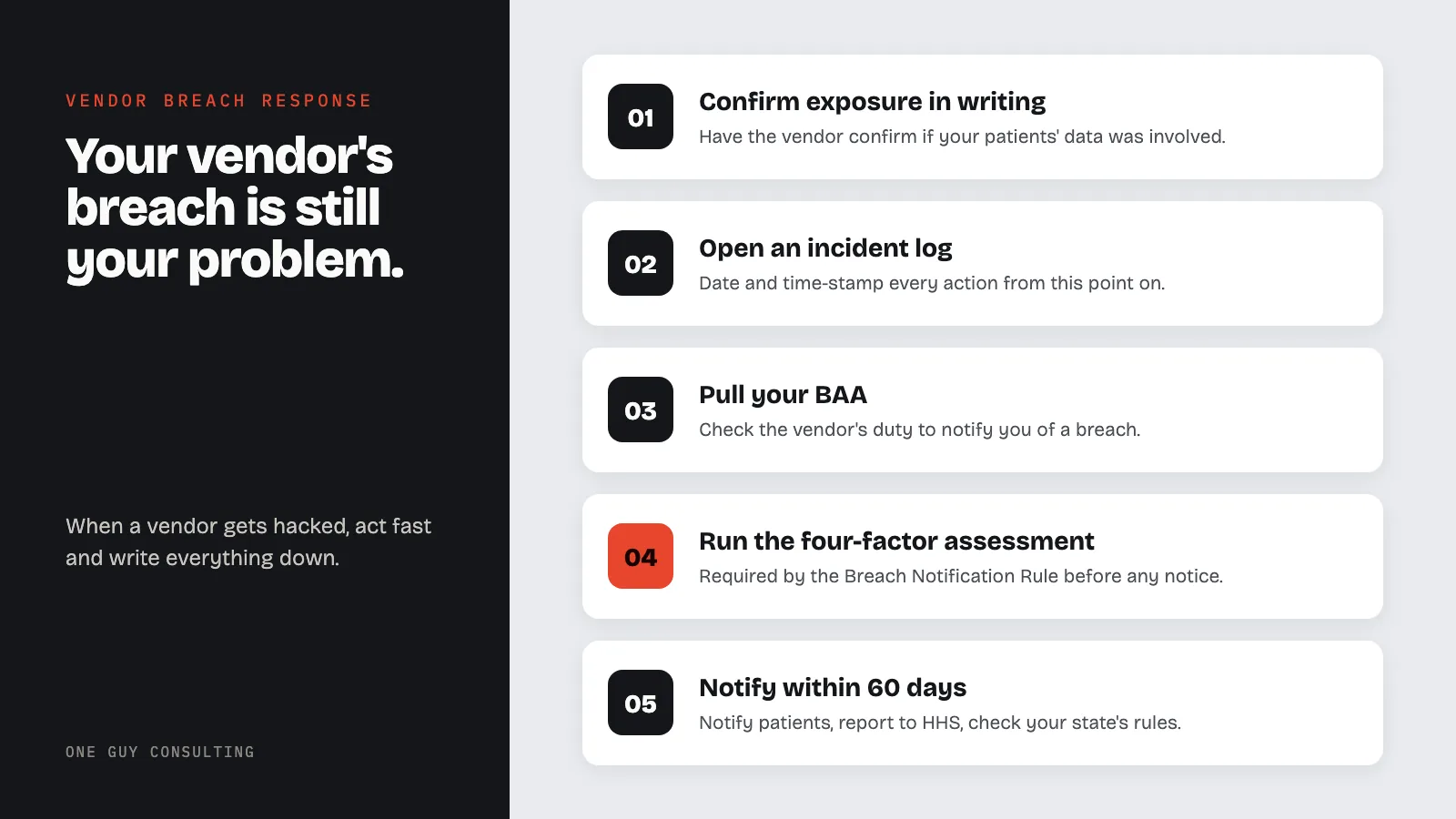
When your vendor gets hacked, act fast and write everything down. Get the vendor to confirm in writing whether your patients' data was involved. Open an incident log, pull your business associate agreement, and run the four-factor risk assessment. If it is a breach, notify affected patients within 60 days of discovery, report to HHS, and check your state's rules.
On February 21, 2024, a ransomware group called ALPHV/BlackCat launched a ransomware attack on Change Healthcare. Change is a claims clearinghouse, a company that passes insurance claims between practices and the plans that pay them. It touches about one in three US patient records. The attackers got in on February 12 with a stolen login for a remote access portal. That portal had no multi-factor authentication (MFA), which is a second login check beyond a password. They were inside the network for nine days before the ransomware went off.
By the time it was over, 190 million people had their health data exposed, more than half of the US population. UnitedHealth Group later raised the count to 192.7 million. That makes it the largest healthcare data breach in history. UnitedHealth says the attack cost it about $3.1 billion in 2024. Thousands of medical practices couldn’t process insurance claims for weeks. Some rural providers came close to shutting down entirely.
Change Healthcare was the largest, but it wasn’t alone. Perry Johnson & Associates, a medical transcription vendor, was breached in 2023, exposing nearly 14 million patient records across dozens of healthcare organizations. Those included Concentra Health Services (4 million patients) and Northwell Health. A weak spot in MOVEit, a file transfer tool, let the Clop ransomware gang hit over 2,500 organizations. They stole data on nearly 100 million people. Kaiser Foundation Health Plan found that tracking tools on its website had been leaking data on 13.4 million members to Google, Microsoft, and X. Even outages with no breach cause chaos, as the 2026 Cloudflare outage showed.
These aren’t isolated incidents. In 2024, vendors were behind several of the biggest healthcare data breaches. According to HIPAA Journal’s count of breaches reported to HHS, a total of 276.7 million healthcare records were breached that year, a 64% jump from the previous year’s already record-breaking total.
Odds are, one of your vendors will get hit at some point. Here’s your step-by-step playbook for when it happens.
Why a Vendor Breach Is Your Problem Under HIPAA
Under HIPAA, you are responsible for protecting patient data even when it’s in someone else’s hands. Your billing company, your EHR vendor, your transcription service, your cloud storage provider: any company that creates, receives, maintains, or transmits protected health information on your behalf is a Business Associate. Their breach is your problem.
The law doesn’t let you outsource the liability. If your business associate is breached and patient PHI is exposed, you have the same notice duties as if your own systems were hacked. You must notify affected patients, report to HHS OCR (the federal office that enforces HIPAA), and in some cases alert the media.
What you can control is how fast and how cleanly you respond. Speed and documentation are your two best defenses. HIPAA penalties come in four tiers.
The tier depends on how much the organization was at fault. The top two tiers are for willful neglect. That means a conscious or reckless failure to follow the rules. The highest tier is for willful neglect not fixed within 30 days of when you knew or should have known about it.
Step 1: Confirm Your Exposure (First Hour)
The moment you learn your vendor has been breached (whether from a vendor notice, a news report, or a patient complaint), do not assume it doesn’t affect you. Start the clock.
Call the vendor directly. Don’t rely on their press release or status page. You need answers to five questions:
- Was your practice’s data involved?
- Which of your patients were affected, and how many?
- What categories of PHI were exposed? (names, SSNs, dates of service, clinical data, insurance information)
- When did the breach occur and when did the vendor discover it?
- Is the attack contained, or is it still ongoing?
Get this in writing. An email or formal written statement from the vendor, not just a phone call summary. You’ll need documentation for everything that follows.
During the Change Healthcare breach, many practices didn’t get clear answers from UnitedHealth Group for weeks. That’s common: vendors often don’t know the full scope right away. Document what you asked, when you asked it, and what the vendor told you. The timeline matters.
Step 2: Activate Your Incident Response Team (First Hour)
If you have a written incident response plan, open it now. If you don’t (and many practices don’t), here’s your ad hoc team:
- Privacy Officer: Leads the response and makes notice decisions
- Practice Manager or Administrator: Handles day-to-day disruptions
- IT Contact (internal or outsourced): Assesses technical exposure
- Legal Counsel: Advises on notice duties and liability (if you have a healthcare attorney, now is when you call them)
For a small practice, this might be two people wearing multiple hats. That’s fine. What matters is that someone is clearly in charge of the response and someone else is handling day-to-day operations so the practice doesn’t grind to a halt.
Open a dedicated incident log. Date and time-stamp every action from this point forward: who you called, what they said, what decisions were made and why. This log is your protection if OCR investigates later. The first 72 hours after a cyber incident are when it is easiest to stop writing things down.
Step 3: Pull Your Business Associate Agreement (First 4 Hours)
Find your BAA with the breached vendor. It should specify:
- The vendor’s duty to notify you of a breach. HIPAA says a business associate must tell the covered entity (the practice or health plan HIPAA covers) about a breach without unreasonable delay. The outer limit is 60 days after the vendor discovers it. Many BAAs set a shorter window, such as 30 days or 10 days. The proposed HIPAA Security Rule changes would add a separate duty. Vendors would have to tell you within 24 hours when they switch on their emergency backup (contingency) plan. HHS published that proposal in January 2025. It is still only a proposal, not law.
- Who handles notifying affected people: you or the vendor.
- What security standards the vendor agreed to keep.
- Indemnification clauses: whether the vendor bears financial responsibility for breach costs.
If you don’t have a BAA with this vendor, that’s a separate HIPAA violation you need to address. But don’t let it distract from the immediate response. Deal with it in parallel.
Step 4: Determine If PHI Was Actually Compromised (First 24 Hours)
Not every vendor security incident is a HIPAA breach. Before you trigger the notice process, conduct the four-factor risk assessment that HIPAA’s Breach Notification Rule requires. It is a written check of how likely it is that the data was compromised. It looks at four things:
- The nature and extent of the PHI involved. Were Social Security numbers exposed, or just names and appointment dates? The more sensitive the data, the higher the risk.
- Who accessed it. Was it a nation-state hacking group that will sell the data? An opportunistic attacker who may not have even looked at it? A researcher who reported the weak spot?
- Whether the PHI was actually acquired or viewed. Data being on a compromised server doesn’t on its own mean it was accessed. Encryption matters here. If the data was encrypted to HHS standards and the key wasn’t stolen or exposed, you may have a safe harbor. That means the data may not count as “unsecured,” so the notice rules may not apply.
- The extent to which the risk has been mitigated. Did the vendor recover the data? Did the attacker’s systems get seized by law enforcement?
Document this analysis in writing. If you can show a low probability that PHI was compromised, you may not have a reportable breach. But the analysis has to exist on paper, not just in your head. OCR can ask for it.
Step 5: Take the Vendor Offline If Necessary (First 24 Hours)
If the breach is ongoing (the vendor’s systems are still compromised) and you’re actively sharing data with them, stop the connection. Suspend data feeds, disable integrations, and halt any automated transfers.
Yes, that might mean manual claims processing, paper workflows, or temporary day-to-day disruptions. That’s far less painful than continuing to feed PHI into a compromised system.
Change Healthcare taught thousands of practices they had a single point of failure. While your primary vendor is down:
- Identify backup vendors or manual workarounds. For claims processing, know your backup clearinghouse options.
- Document the day-to-day impact. Lost revenue, delayed claims, staff overtime: you may need this for insurance claims or litigation.
- Communicate with your staff. They need to know what’s happening and what the temporary workflow looks like.
Step 6: Build Your Affected Patient List (24-48 Hours)
Work with the vendor to get a specific list of which of your patients had data exposed. You need names and the types of PHI involved for each person.
If the vendor can’t provide this list (which happens more often than you’d expect, especially in large-scale breaches), consult with a HIPAA attorney about your options. You may need to notify all patients whose data the vendor had access to, not just those confirmed as compromised.
Perry Johnson & Associates took months to provide complete patient lists to affected healthcare organizations. Concentra didn’t file its report with OCR until January 2024, even though the PJ&A breach was discovered in May 2023. The delay wasn’t unusual. It was the norm. Plan for it.
Step 7: Notify Affected Patients (Within 60 Days of Discovery)
If your risk assessment shows a breach of unsecured PHI, you must notify patients. The clock runs from when you knew or should have known about the breach. It does not wait until you confirm every detail. Often the clock starts the day the vendor tells you. But some vendors act as your agent, meaning they work under your direction. Then the clock can start when the vendor found the breach.
Each patient notice must include, in plain language:
- A short description of what happened. Include the date of the breach and the date it was discovered, if you know them.
- The types of PHI involved (e.g., “your name, date of birth, Social Security number, and insurance information”)
- Steps the patient should take to protect themselves (credit monitoring, fraud alerts, reviewing explanation of benefits statements)
- What your practice is doing to investigate the breach, limit the harm, and prevent future incidents
- How patients can reach you with questions: a toll-free number, an email address, a website, or a postal address
Method: First-class mail to each patient’s last known address (or email, if the patient agreed to get notices by email). If you have outdated addresses for 10 or more people, you must also do two things. First, post a notice on your website homepage for 90 days, or run a notice in major print or broadcast media where they likely live. Second, offer a toll-free number that stays active for at least 90 days.
Media notice: If more than 500 people in a single state or jurisdiction are affected, you must also notify prominent media outlets serving that area within the same 60-day window.
Step 8: Report to HHS OCR
For breaches affecting 500 or more people: Report to OCR within 60 days of discovery through the HHS breach portal. OCR will post these on the public “Wall of Shame” (the Breach Portal that lists every large breach for public viewing).
For breaches affecting fewer than 500 people: You have until March 1 of the calendar year following discovery. For breaches discovered in 2026, the deadline is March 1, 2027. But record everything now while details are fresh. Don’t wait: the March 1 small breach deadline catches practices off guard every year.
OCR’s report will ask about the nature of the breach, PHI types involved, the safeguards you had in place at the time, what you’ve done in response, and your corrective action plan.
Step 9: Check State Breach Notification Requirements
HIPAA isn’t the only notice law that applies. Every state has its own breach notice law, and many have rules that go beyond HIPAA:
- Shorter notice timelines: some states require notice within 30 days or less
- State AG notice: many states require you to notify the Attorney General, not just affected individuals
- Additional content rules: some states mandate offering credit monitoring or identity theft protection
Check the laws for every state where affected patients reside. If you have patients in multiple states, you may have multiple overlapping duties with different deadlines. This is where legal counsel earns their fee.
Step 10: Review and Update Your BAA (Within 30 Days)
Once the immediate crisis is handled, review your BAA with the breached vendor:
- Did the vendor meet its notice duties under the BAA? If it took them four months to tell you, and the BAA says 30 days, that’s a contract breach.
- Did the vendor keep the security standards it agreed to? Change Healthcare didn’t have MFA on a remote access portal. That’s the kind of gap a proper BAA and vendor review should catch.
- Do you need to end the relationship? If the vendor can’t show enough fixes, continuing the relationship creates ongoing risk.
Update the BAA with stronger security rules, shorter notice windows, and specific technical standards (encryption, MFA, access controls). If the vendor won’t agree to tighter terms, find a vendor who will.
Step 11: Conduct a Post-Incident Review (Within 60 Days)
After the dust settles, conduct a formal review with your team:
- What worked? Did your response plan hold up? Did your team know their roles?
- What failed? Where did communication break down? What information took too long to get?
- What would you do differently? Update your incident response plan with specific improvements.
- What vendor changes are needed? Do you need backup vendors? Better vetting steps? Stronger BAA language?
Document the review and its outcomes. This becomes part of your compliance record and shows OCR that you learn from incidents.
Step 12: Audit Every Vendor Relationship
Don’t wait for the next breach to review your other vendors. Make a full vendor list:
- List every vendor that touches PHI
- Confirm a current, signed BAA exists for each one
- Request security documentation: SOC 2 reports, penetration test results, incident response plans
- Ask about prior breaches and how they were handled
- Verify they use MFA, encryption at rest and in transit, and access logging
Vendors who can’t answer these questions need immediate attention. A vendor security questionnaire should be standard practice, not something you create after getting burned. Many of the biggest healthcare breaches trace back to vendor weak spots that nobody checked.
Your Vendor Breach Response Checklist
Keep this somewhere accessible. When the call comes, you won’t have time to research:
The Honest Reality About Supply Chain Attacks in Healthcare
You can’t prevent your vendors from being attacked. Change Healthcare had the resources of UnitedHealth Group behind it. It still got breached through a portal without MFA, and it ran up about $3.1 billion in breach costs afterward. Attackers were inside Perry Johnson & Associates’ systems for over a month before anyone noticed. The MOVEit weak spot affected thousands of organizations at once.
What separates practices that survive a vendor breach cleanly from those that face OCR enforcement isn’t whether the breach happened. It’s whether they responded properly. Had a plan. Documented their actions. Notified on time. Showed OCR they took it seriously.
When the call comes that your vendor has been hacked, be the practice that had a plan, not the one scrambling to figure out what HIPAA requires.
Key stat: Under 45 CFR 164.410, a business associate must tell the covered entity (your practice) about a breach without unreasonable delay. The limit is 60 days after the vendor discovers it. Your own 60-day notice window starts when you discover the breach, or should have. A big vendor breach can make the news before the vendor formally tells you. So keep an eye on your vendors.
Sources
- 45 CFR 164.314(a): Business Associate Contracts
- 45 CFR 164.410: Business Associate Breach Notification to Covered Entity
- 45 CFR 164.308(a)(6): Security Incident Procedures
Related Reading
- The Change Healthcare Breach One Year Later: What 190 million exposed records taught us about vendor risk
- The Business Associate Agreement Mistakes That Will Cost You: Fix these BAA gaps before your next vendor incident
- Healthcare Cybersecurity Framework
- Lost Device HIPAA Incident Response
- Data Breach Prevention Strategy
- HIPAA Data Breach Response Plan
- Ransomware Protection for Healthcare
- Ransomware Hit Your Practice: The First 72 Hours: The incident response playbook for direct attacks
- MFA Under the Proposed HIPAA Rule: What this proposed rule would require, and why Change Healthcare matters
- Healthcare Breaches Doubled in 2025: The vendor-driven breach epidemic by the numbers
Need help building a vendor management program and incident response plan before the next breach hits? One Guy Consulting offers HIPAA compliance plans starting at $60 a month. The $60 plan includes vendor management with digital BAAs and an incident management system. Explore HIPAA compliance services | Business associate agreement management
Related: Vendor management for HIPAA
Related reading: Cyber Insurance and HIPAA: Useful, but No Substitute for Risk Analysis
Frequently Asked Questions
What should I do immediately when my healthcare vendor is hacked?
Notify your internal security officer and legal counsel, demand a written incident report from the vendor, determine whether PHI was involved, and preserve all communications. Do not rely solely on the vendor's self-reporting.
Does a vendor breach trigger HIPAA breach notification requirements?
Usually, yes. You must notify if your patients' unsecured PHI was involved, unless your four-factor risk assessment shows a low chance that it was compromised. Your Business Associate must tell you without unreasonable delay, and no later than 60 days after it discovers the breach. You then have up to 60 days from when you knew or should have known about it to notify the people affected. If 500 or more people are affected, report to HHS in that same window. For smaller breaches, report to HHS within 60 days after the end of the calendar year.
What should a Business Associate Agreement say about breach notification?
A well-drafted BAA should require the vendor to notify you within a specific timeframe, identify the data involved, describe steps taken to mitigate harm, and provide regular status updates throughout the investigation.
Can I be fined for a breach caused by my vendor?
Yes, you can face penalties. Your vendor is directly responsible for its own security failures. But you still owe breach notice to patients and HHS. OCR has also fined covered entities (the practices and health plans HIPAA covers) for sharing PHI with a vendor that had no signed Business Associate Agreement.