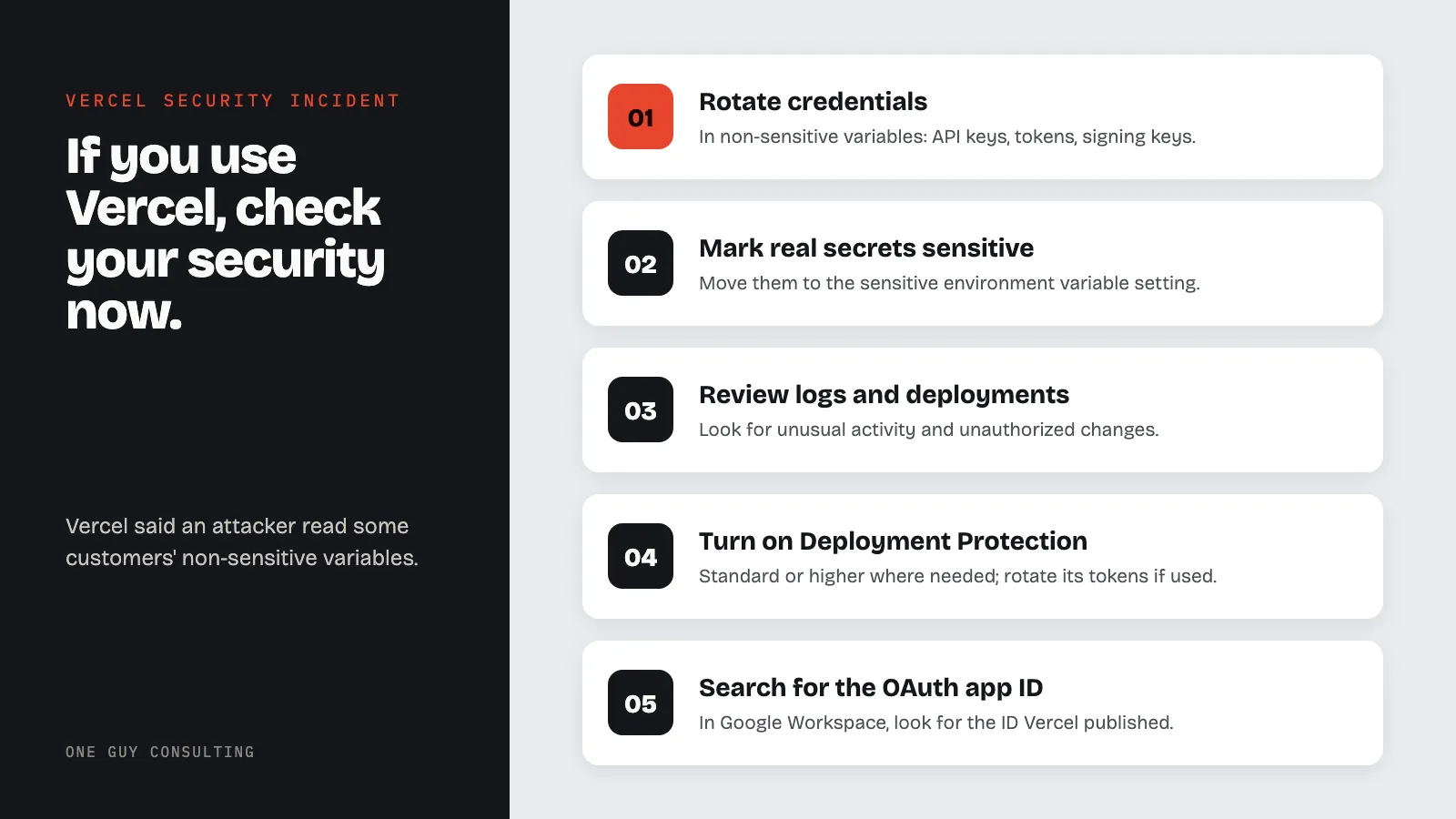
If your site runs on Vercel, change (rotate) any secrets stored in environment variables that are not marked sensitive. These include API keys, tokens, and database passwords. Then check your activity logs and recent deployments. Set Deployment Protection to Standard or higher. On April 19, 2026, Vercel said an attacker read some customers' non-sensitive variables.
On April 19, 2026, Vercel disclosed a security incident. An attacker gained unauthorized access to some internal systems. The breach started when Context.ai, an outside AI tool, was compromised. A Vercel employee used Context.ai. The attacker used this to take over the employee's Google account.
Vercel says the incident affected a small number of customers. But this breach shows a bigger risk. When you use third-party tools, OAuth, and cloud platforms, you increase your attack surface.
If your company uses Vercel, check your security now.
Find out if these items were exposed:
- Credentials
- Configuration data
- Deployment workflows
What happened
An attacker compromised Context.ai. Context.ai was connected to the employee's Google Workspace account through OAuth. OAuth is a common way to let one app access another account. The attacker used this link to take over that Google account. Then they accessed some Vercel internal systems.
The key detail is about environment variables. Some were marked as sensitive. Others were not. The attacker read the ones marked non-sensitive in plaintext.
Vercel brought in Google Mandiant and other security firms to help investigate. It also told law enforcement.
What appears to have been exposed
Vercel confirms a small group of customers were affected. Their non-sensitive environment variables may have been read.
For many companies, this category still includes important secrets. API keys, tokens, and database passwords are all at risk. This matters to business and legal teams.
A platform label doesn't determine if data is truly sensitive. Your team should look at what is actually in those variables. Don't rely on the platform's label alone. Vercel also shared an indicator of compromise. That is a clue you can search for in your own systems. Here, the clue is the ID of the bad OAuth app in Google Workspace:
110671459871-30f1spbu0hptbs60cb4vsmv79i7bbvqj.apps.googleusercontent.com
What Vercel says was not affected
Vercel lets you mark environment variables as sensitive. Vercel stores those values so no one can read them as plain text. Vercel said it had no evidence anyone accessed them. Its April 19 bulletin also said its services were still running. TechCrunch reported that Vercel said its Next.js and Turbopack projects were not affected.
What remains unconfirmed
Unconfirmed reports are circulating. They claim a $2 million ransom demand, stolen source code, and a known attacker group. Be cautious with these claims.
They come from the threat actor, not from Vercel. TechCrunch reported on April 20, 2026 that Vercel said it had not received any ransom messages. For your business, this distinction matters. Separate facts from actor claims and rumors.
What businesses should do now
Take action if you use Vercel. Be practical, document everything, and involve all teams. If HIPAA applies to your practice, keeping records is not optional. The Security Rule covers this in 45 CFR 164.316(b).
When the rule says to document an action, activity, or assessment, you must write it down. You must keep that written record for six years. Rotate any credentials you stored in non-sensitive variables. This includes API keys, tokens, database addresses, and signing keys.
Check your Vercel projects. Move all real secrets to the sensitive environment variable setting. Review logs, deployments, and configuration changes. Look for unusual activity. Check recent deployments for unauthorized changes. Turn on Deployment Protection at Standard level or higher where needed.
Rotate Deployment Protection tokens if you use them.
If you use Google Workspace, search your account for the OAuth app ID that Vercel published (shown above).
Ask these questions:
- Do we need to trigger our incident response plan under 45 CFR 164.308(a)(6)?
- Do we need to notify affected individuals under the HIPAA Breach Notification Rule (45 CFR 164.404)?
- Does our Business Associate Agreement with Vercel meet the requirements of 45 CFR 164.502(e)?
For more on vendor incident response, see: What to Do If Your Vendor Gets Hacked and The First 72 Hours After a Ransomware Attack.
Why this incident matters
This incident is important. Vercel plays a key role in modern web applications. It shows how risk travels through trusted connections. The same pattern showed up in the Telnyx supply chain attack. Attackers do not always go straight at production systems (the live systems your business runs on).
For legal, security, and operations teams, the lesson is simple:
- Third-party tools
- OAuth permissions
- Cloud platform settings
Treat all of these as one control system. Vendor diligence, access control, credential management, and incident response are connected. They're not separate.
Review this incident. It helps you strengthen controls around vendors and cyber readiness:
These tools help you build stronger incident response systems after a vendor breach.
Final takeaway
The Vercel incident shows a common cyber risk pattern:
- Attackers break into a third-party tool,
- They abuse a trusted identity connection,
- They access internal systems,
- Then they expose downstream credentials.
The immediate action for your company is clear:
- Review your integrations
- Check OAuth permissions
- Rotate compromised credentials
- Keep sensitive data truly sensitive in practice, not just in policy.
Companies reviewing incident response, vendor management, privacy, and security should check out OGC's risk assessment and gap analysis services.
HIPAA Compliance Implications of the Vercel Breach
If your organization is a HIPAA covered entity or business associate that uses Vercel to host applications handling protected health information (PHI), this incident may trigger specific regulatory obligations.
- Protected Health Information (PHI): Health information that can identify a person and is held or sent in any form, as defined under 45 CFR 160.103. If environment variables contained database credentials that grant access to systems storing PHI, the exposure of those credentials constitutes a potential security incident under HIPAA.
- Security Incident: The attempted or successful unauthorized access, use, disclosure, modification, or destruction of information or interference with system operations in an information system, as defined under 45 CFR 164.304. The Vercel breach may meet this definition for some customers. It depends on whether their exposed credentials, such as keys or passwords, could open systems that hold ePHI (electronic PHI).
- Business Associate: A person or organization that creates, receives, keeps, or sends PHI for a covered entity (like a medical practice), as defined under 45 CFR 160.103. It also includes some service providers whose work involves PHI. If Vercel hosts apps that store or process PHI, it likely functions as a business associate and must have a signed Business Associate Agreement (BAA) in place.
- Breach Notification Rule: Under 45 CFR 164.400-414, covered entities must tell the people affected, HHS, and in some cases the media after a breach of unsecured PHI. Unsecured means the PHI was not made unreadable, for example through encryption that meets HHS guidance. A breach is when PHI is accessed, used, or shared in a way HIPAA does not allow, and that puts the PHI at risk. If exposed credentials provided access to ePHI, this obligation may apply.
- Risk Analysis Requirement: 45 CFR 164.308(a)(1)(ii)(A) requires covered entities to conduct an accurate and thorough assessment of potential risks and vulnerabilities to ePHI. You should include a vendor breach like this one in that ongoing risk analysis.
- Incident Response Procedures: 45 CFR 164.308(a)(6)(ii) applies to covered entities and business associates. They must spot and respond to suspected or known security incidents. They must limit the harm as much as they reasonably can. They must also write down each security incident and how it turned out. If your Vercel apps touch ePHI, start these steps now.
Required HIPAA Actions After a Vendor Security Incident
Organizations subject to HIPAA should take these steps in addition to the general technical response above:
- Determine if PHI was at risk: Review whether any exposed environment variables, API keys, or database credentials could provide access to systems containing ePHI. If PHI was accessed or shared in a way HIPAA does not allow, 45 CFR 164.402 treats it as a breach. That holds unless you can show a low probability that the PHI was compromised.
- Conduct a four-factor risk assessment: Under 45 CFR 164.402, check at least these factors: (1) the nature and extent of PHI involved, (2) the unauthorized person who accessed it, (3) whether PHI was actually acquired or viewed, and (4) the extent to which risk has been mitigated.
- Review your BAA with Vercel: Confirm that a signed Business Associate Agreement exists under 45 CFR 164.502(e). Verify that breach notification timelines in the BAA were followed. Business associates must report breaches to covered entities without unreasonable delay and no later than 60 days after discovery.
- Document everything: Under 45 CFR 164.530(j), covered entities must keep the records the Privacy Rule calls for. That includes proof of how they handled a possible breach. Keep these records for six years. Record your investigation findings, remediation steps, and breach risk assessment even if you determine notification is not required.
FAQ
Did Vercel disclose a security incident on April 19, 2026?
Yes. Vercel disclosed that unauthorized actors accessed internal systems.
What did Vercel say was exposed?
Vercel said a small group of customers had non-sensitive environment variables compromised.
Did Vercel say sensitive environment variables were accessed?
No. Vercel says there's no evidence that sensitive environment variables were accessed.
Was Vercel's open source tooling affected?
No. Vercel said Next.js and Turbopack were not affected.
What is the most important action for Vercel customers right now?
Rotate credentials in non-sensitive environment variables. Review your account activity for suspicious changes.
Sources
- Vercel security bulletin
- TechCrunch reporting
- Public reporting on Context.ai's March 2026 incident
Key point: One security incident at a hosting platform can reach many of the apps that run on it. Vercel says only a limited group of its customers was affected this time. If your practice uses a hosting platform like this, check how the vendor handles security incidents. Ask whether it will sign a BAA (business associate agreement) and report breaches on time.