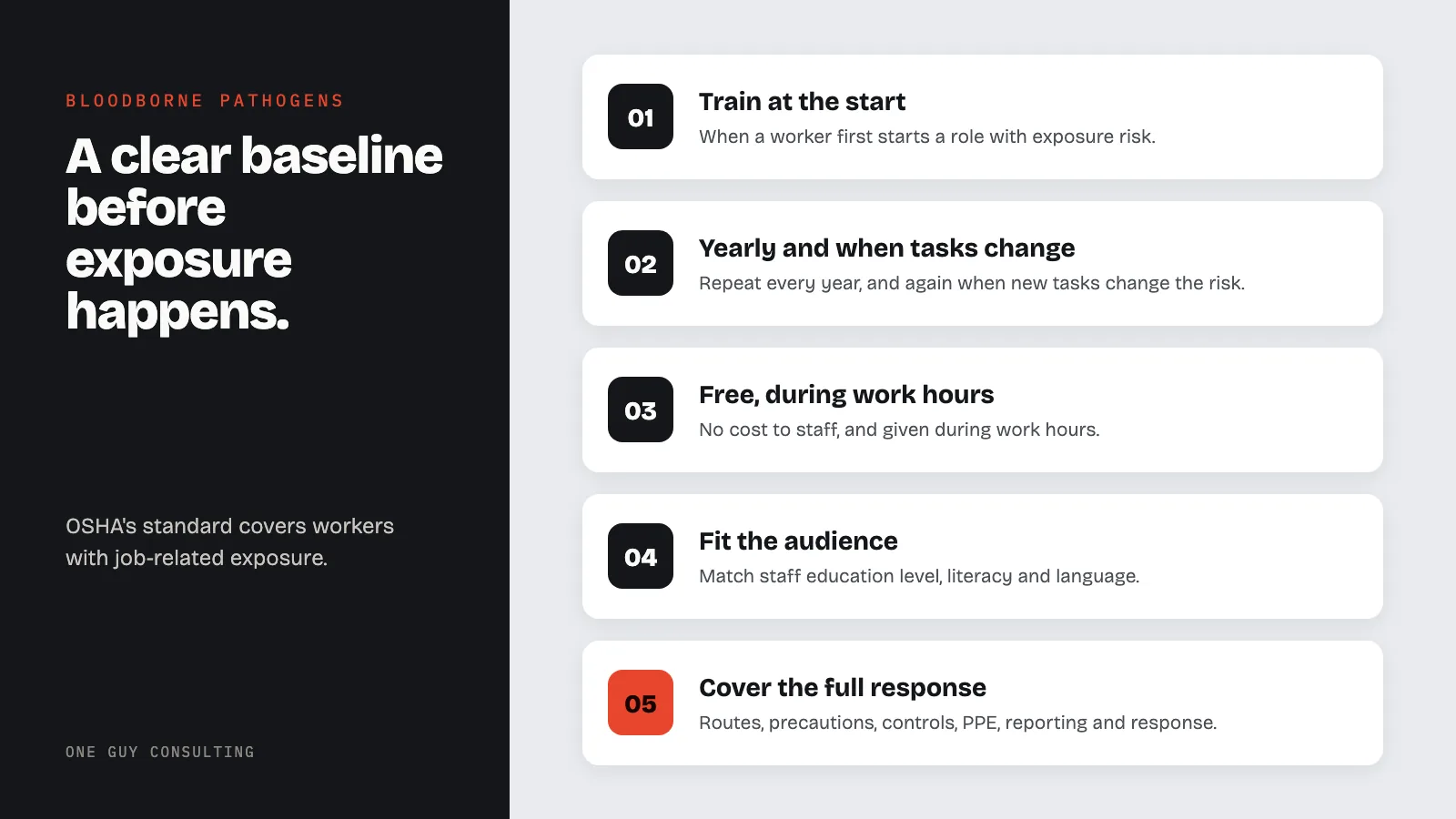
Bloodborne pathogen training is training for workers at risk of exposure to diseases carried in blood, such as Hepatitis B, Hepatitis C, and HIV. OSHA requires it when a worker first starts a role with exposure risk. It repeats every year, and again when new tasks change the risk. It must be free and given during work hours.
Bloodborne pathogen training is the clearest example of training that feels useful right away. An employee facing a possible exposure doesn't need vague safety language. They need to know what bloodborne pathogens are, and what to do next.
That is why bloodborne pathogen training for healthcare workers matters so much. It supports worker safety. It's the kind of training teams need when the risk isn't just a theory.
One Guy Consulting now offers bloodborne pathogen training. We built it around clear language, healthcare relevance, and lasting retention, not generic annual safety fatigue. You can also play our free Sharps Shootout bloodborne pathogens game.
What Is Bloodborne Pathogen Training?
Bloodborne pathogen training is for workers who face exposure risk from diseases found in blood.
In healthcare settings, this training supports a broader safety framework. It helps staff understand what creates risk. It explains the controls that should be in place. It also tells staff the steps to follow if exposure may have happened.
OSHA's Bloodborne Pathogens Standard applies to workers with job-related exposure. The standard requires training when first placing someone in a role with risk. It is also required every year. Training is also required when new tasks or steps change exposure risk.
What Bloodborne Pathogen Training Should Cover
Good bloodborne pathogen training should cover more than a list of terms. It should prepare people for real choices at work. That usually means covering:
- What bloodborne pathogens are
- Routes of job-related exposure
- Universal precautions
- Engineering controls and work-practice controls
- Personal protective equipment (PPE) expectations
- Sharps safety and needlestick prevention basics
- Cleaning, handling, and disposal expectations
- Exposure reporting and post-exposure response steps
OSHA also requires that training is free and held during work hours. The training must use material that fits the educational level, literacy, and language of the staff taking it. That matters because a course can't do its job if staff can't absorb it.
Why Bloodborne Pathogen Training Matters for Your Team
Healthcare teams cannot rely on guesses during exposure events. Staff need a clear baseline before the moment arrives.
It supports worker safety in real situations
Exposure events are stressful. Staff need clear guidance on precautions, PPE, reporting, and next steps. Training helps reduce delay and confusion when timing matters.
It ties procedures to practice
Training is one of the main ways teams connect written rules to daily work. If training is weak, the written plan often becomes abstract and less useful under pressure.
It helps supervisors handle incidents better
Managers need a team that knows the basics of exposure prevention and response. This reduces the chance of uneven handling when something happens.
It supports yearly reinforcement
Memory fades. Guesses creep in. Yearly bloodborne pathogen training helps reinforce what staff need to remember.
Who Needs Bloodborne Pathogen Training?
Who needs this training depends on whether the worker has job-related exposure. In healthcare, that may include:
- Clinical staff
- Certain technicians and assistants
- Workers involved in specimen handling or cleanup
- Workers whose duties may involve contact with blood or other infectious materials
The scope depends on the role and the safety framework in place. This is not a topic to leave undefined.
Why One Guy Consulting's Training Is Better Than Generic Options
There is no shortage of training libraries that offer bloodborne pathogen training online. But many feel removed from how healthcare teams learn about safety. Our approach focuses on being clear and useful in practice.
Clear language instead of generic safety scripts
Staff should not have to decode vague safety language into daily behavior. Our training is built to make duties easier to grasp.
Built for healthcare realities
This is not generic workplace content dropped into a healthcare setting. It's shaped around real exposure risk, team duties, and record keeping.
Made for teams that want training people will remember
A training course is only useful if staff can use it under pressure. We focus on lasting retention, not passive yearly check-offs.
When employees leave the organization, proper termination procedures ensure their training records are documented and access to systems containing exposure data is revoked.
How Bloodborne Pathogen Training Connects to HIPAA Compliance
Bloodborne pathogen training and HIPAA compliance overlap in healthcare settings because exposure incidents create sensitive health records. When a worker reports an exposure, the employer must document the incident, track testing results, and keep confidential medical records. Records the employer keeps in its role as employer are employment records. HIPAA says employment records are not protected health information (PHI) (45 CFR 160.103). OSHA's own confidentiality rules protect them instead (29 CFR 1910.1030(h) and 1910.1020).
Records do become PHI when the organization treats or tests the worker or the source patient as a covered health care provider. A covered health care provider is a provider that HIPAA applies to. Those records follow HIPAA Privacy Rule protections under 45 CFR 164.502.
Specific compliance measures where bloodborne pathogen training intersects with HIPAA include:
- Exposure incident documentation: Post-exposure records contain individually identifiable health information, meaning health details tied to a specific person. When those records are PHI, HIPAA expects three things. Store them securely. Let only authorized staff see them. Keep them as long as state and federal rules require. The HIPAA Security Rule (45 CFR 164.312) requires access controls and audit controls for systems that hold electronic PHI. Access controls limit who can get in. Audit controls record activity in the system.
- Employee medical records confidentiality: OSHA requires employers to keep a confidential medical record for each employee with occupational exposure, meaning job duties that can bring contact with blood or other infectious materials. The rule is 29 CFR 1910.1030(h)(1), and the records are kept in line with 29 CFR 1910.1020. Records the employer holds in its role as employer are not PHI under 45 CFR 160.103. That is true even when the employer is a covered entity. The minimum necessary standard (45 CFR 164.502(b)) means using or sharing only the least information needed. It can apply to PHI the organization creates as a covered health care provider.
- Source individual testing and consent: When a source individual is tested after an exposure event, the results are PHI. HIPAA permits disclosures (sharing of information) that the law requires, such as those OSHA's standard calls for (45 CFR 164.512(a)). The minimum necessary standard does not apply to uses or disclosures required by law (45 CFR 164.502(b)(2)(v)). Other disclosures need an authorization, meaning the person's written permission, unless another Privacy Rule exception applies.
- Breach notification obligations: If exposure records containing PHI are improperly accessed or disclosed, the HIPAA Breach Notification Rule (45 CFR 164.400-414) may require notification to affected individuals, HHS, and potentially the media depending on the scale of the breach.
- Training documentation as compliance evidence: HIPAA requires covered entities to document workforce training under 45 CFR 164.530(b)(2)(ii). Bloodborne pathogen training records serve as evidence that an organization is meeting both OSHA and HIPAA training requirements when the content covers PHI handling during exposure events.
Organizations that treat bloodborne pathogen training and HIPAA compliance as separate programs often create gaps. A staff member trained on exposure response but not on PHI handling may document an incident correctly for OSHA but violate HIPAA in the process. Integrated training that addresses both frameworks reduces this risk.
How Bloodborne Pathogen Training Fits Into a Smarter Training Program
For many healthcare teams, the better model is not to buy standalone yearly modules. It is to build a comprehensive training program that supports real risk. That often includes:
- Bloodborne pathogen training for exposure risk and worker safety
- HIPAA training for privacy, security, and patient data handling
- Cybersecurity awareness training for phishing, device risk, and access practices
- Fraud, waste and abuse training for reporting culture and payment integrity
When training becomes regular, teams understand more and face fewer incidents.
Key Terms Defined
- Bloodborne Pathogens: Infectious microorganisms found in human blood that can cause disease. The most common in healthcare settings are Hepatitis B (HBV), Hepatitis C (HCV), and Human Immunodeficiency Virus (HIV). OSHA defines these under 29 CFR 1910.1030.
- Universal Precautions: An infection control approach that treats all human blood and certain body fluids as if they are known to be infectious. This concept originates from CDC guidelines and is required under OSHA's Bloodborne Pathogens Standard.
- Engineering Controls: Physical devices or equipment that isolate or remove bloodborne pathogen hazards from the workplace. Examples include sharps disposal containers, self-sheathing needles, and splash guards.
- Work-Practice Controls: Procedures that reduce the likelihood of exposure by changing the way a task is performed. Examples include prohibiting two-handed needle recapping and requiring hand washing after glove removal.
- Personal Protective Equipment (PPE): Specialized clothing or equipment worn to protect against exposure to bloodborne pathogens. In healthcare, this includes gloves, gowns, face shields, and eye protection. OSHA requires employers to provide PPE at no cost under 29 CFR 1910.1030(d)(3).
- Post-Exposure Prophylaxis (PEP): Preventive medical treatment started after a potential exposure to a bloodborne pathogen. PEP protocols vary by pathogen and follow CDC guidelines. Timely initiation is critical, especially for HIV exposure.
- Exposure Control Plan: A written plan required by OSHA under 29 CFR 1910.1030(c) that documents how an employer will eliminate or minimize employee exposure to bloodborne pathogens. It must be reviewed and updated at least annually.
- OSHA Bloodborne Pathogens Standard (29 CFR 1910.1030): The federal regulation that requires employers to protect workers with occupational exposure to blood and other potentially infectious materials. It mandates training, exposure control plans, PPE, and post-exposure follow-up.
Frequently Asked Questions
What is bloodborne pathogen training?
This training teaches staff how to reduce exposure risk tied to blood and other infectious materials. It covers exposure routes, precautions, controls, PPE, reporting, and post-exposure response.
Who needs bloodborne pathogen training?
Workers with job-related exposure need this training. In healthcare, this includes staff whose work may involve contact with blood.
How often is bloodborne pathogen training required?
OSHA requires this training when first placing someone in a role with exposure risk. It is also required every year. More training is required when new tasks or steps change exposure risk.
Why is bloodborne pathogen training important?
It helps staff understand exposure risks, builds safe work practices, and supports reporting. This helps teams protect workers, especially when delay or confusion can cause harm.
About One Guy Consulting
One Guy Consulting helps healthcare teams turn compliance and workforce training into something their staff can actually use. If you want practical bloodborne pathogen training that fits how your team works, contact us here.
Compliance overlap: Some healthcare organizations must meet two sets of training rules: OSHA bloodborne pathogen training (29 CFR 1910.1030) and HIPAA workforce training (45 CFR 164.530(b)). This applies when the organization is a HIPAA covered entity and has staff with occupational exposure. A single training event can address both if the content covers exposure control procedures alongside PHI handling safeguards.
Key stat: An estimated 5.6 million workers in the health care industry and related jobs are at risk of occupational exposure to bloodborne pathogens, according to OSHA. Under 29 CFR 1910.1030, employers must train staff when they are first assigned and at least once a year after that. Under HIPAA, exposure records are protected health information when the organization creates them while treating or testing someone as a covered health care provider.
Sources
- 29 CFR 1910.1030: OSHA Bloodborne Pathogens Standard
- 45 CFR 164.530(b): HIPAA Training Requirements
- 45 CFR 164.312: HIPAA Security Rule Technical Safeguards
- CDC/NIOSH Healthcare Worker Safety