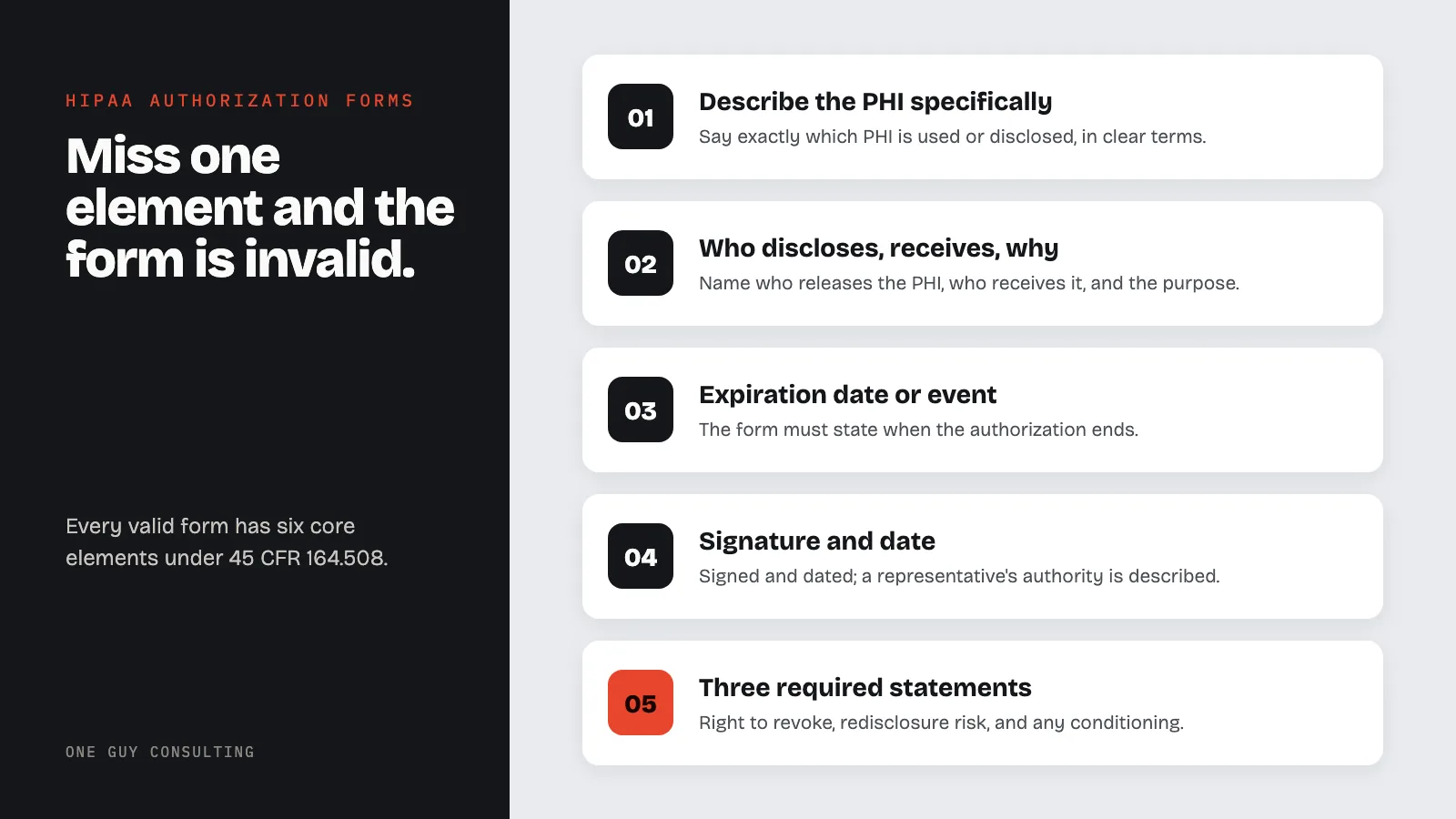
A valid HIPAA authorization must contain six core elements under 45 CFR 164.508: a description of the PHI to be disclosed, the person authorized to make the disclosure, the recipient, the purpose, an expiration date or event, and the individual's signature and date. Missing any one of these elements makes the authorization invalid.
A lot of organizations use the phrase "HIPAA release form" loosely. The problem is that HIPAA does not treat every patient signature the same way, and understanding patient rights under HIPAA is essential context.
Some disclosures are allowed without authorization for treatment, payment, and healthcare operations. Others require a written authorization that meets the specific requirements in 45 CFR 164.508. If the form is missing required elements, bundled improperly, or written so vaguely that the patient cannot understand what they are signing, the authorization may be invalid.
That matters because an invalid authorization is not just bad paperwork. It can turn a disclosure into an impermissible use of protected health information.
If your practice, clinic, or vendor uses HIPAA authorization forms, here is what the rule actually requires and where organizations usually get it wrong.
When HIPAA Authorization Is Required
HIPAA authorization is generally required when a covered entity wants to use or disclose PHI in a way that is not already permitted under the Privacy Rule.
Common examples include:
- Marketing communications that do not fit a HIPAA exception (see how HIPAA applies to marketing agencies)
- Many disclosures to employers
- Many disclosures to attorneys or other third parties
- Sale of PHI
- Most uses and disclosures of psychotherapy notes
- Uses outside normal treatment, payment, and healthcare operations
This is where staff often get confused. A patient requesting that records be sent to a specialist may not require the same form logic as a marketing use, an employment-related disclosure, or a third-party legal request. The workflow has to match the purpose.
If your staff treats every outside request as "just get a signature," you will eventually collect signatures on forms that do not meet the rule.
The 6 Core Elements Under 45 CFR 164.508
A valid HIPAA authorization must include six core elements.
1. A Specific Description of the Information
The form has to describe the PHI to be used or disclosed in a specific and meaningful way.
Bad example:
"Any and all records."
Better examples:
- Behavioral health treatment records from January 1, 2025 through December 31, 2025
- Billing records related to claim number 12345
- Imaging reports and operative notes for the surgery performed on March 10, 2026
The more sensitive the information, the more important precision becomes. Vague, all-purpose language creates unnecessary risk, especially for mental health, substance use disorder, reproductive health, or employment-related disclosures.
2. Who Is Allowed to Make the Disclosure
The authorization must identify the person or class of persons authorized to make the disclosure.
In practice, that usually means the provider, practice, hospital, or covered entity holding the records.
Example:
"One Guy Family Practice" or "the records department of ABC Medical Group."
If the form does not clearly identify who may release the information, the authorization is incomplete.
3. Who Will Receive the Information
The form must identify the person or class of persons who may receive the PHI.
That could be:
- A law firm
- An employer
- An insurance company
- A family member
- Another provider
- The patient directly
This is another place where generic templates fail. "Any requesting party" is not a good practice. The patient should be able to understand exactly where the information is going.
4. The Purpose of the Disclosure
The form must describe the purpose of the requested use or disclosure.
Examples:
- At the request of the individual
- Disability claim review
- Legal representation
- Coordination with a family caregiver
If the patient initiated the request and does not want to provide detail, the statement "at the request of the individual" is sufficient.
5. An Expiration Date or Expiration Event
The authorization must include either:
- a specific expiration date, or
- an expiration event related to the individual or the purpose
Examples:
- "December 31, 2026"
- "Conclusion of the litigation"
- "End of the insurance claim review"
Open-ended forms with no expiration are a common compliance problem. If the form never states when the authorization ends, it is incomplete.
6. Signature and Date
The individual must sign and date the authorization. If a personal representative signs, the form must also describe that person's authority to act for the individual.
That means the workflow needs to support situations involving:
- parents of minors where applicable
- legal guardians
- health care proxies
- executors or personal representatives where permitted
If someone other than the patient signs and there is no documented basis for that authority, the authorization is weak at best and invalid at worst.
The 3 Required Statements Many Forms Miss
In addition to the six core elements, HIPAA requires statements that put the individual on notice of key rights and risks.
The Right to Revoke
The form must explain that the individual has the right to revoke the authorization in writing and either:
- describe how to revoke and the exceptions to that right, or
- refer to the Notice of Privacy Practices if that information is already there
If your form says the patient can revoke but your staff has no process for receiving and documenting revocations, the form and the workflow are out of sync.
Whether Treatment or Benefits Are Conditioned on Signing
The form must explain whether treatment, payment, enrollment, or eligibility for benefits is conditioned on the authorization.
Usually, the answer is that the covered entity may not condition treatment or benefits on signing. There are limited exceptions, such as certain research-related treatment situations, health plan underwriting or enrollment situations, and care given only to create health information for a third party (for example, an exam an employer or insurer asked for).
This language matters because patients need to understand whether refusing to sign has consequences.
Redisclosure Risk
The authorization must warn the individual that information disclosed under the authorization may be redisclosed by the recipient and may no longer be protected by HIPAA.
This statement is especially important when records are going to employers, lawyers, insurers, or other parties outside the original covered entity relationship.
Forms Must Be Written in Plain Language
HIPAA requires the authorization to be written in plain language.
That sounds simple, but a lot of forms fail here. Dense legal wording, undefined acronyms, or giant all-caps blocks may be familiar to compliance teams, but they do not help patients understand what they are signing.
If an ordinary patient cannot tell:
- what information is being released
- who is releasing it
- who is receiving it
- why it is being released
- when the authorization ends
then the form is badly designed even if it looks legally impressive.
What Makes a HIPAA Authorization Invalid
Under the rule, an authorization is defective if it has certain problems on its face.
Common examples include:
- Required elements are missing
- Required statements are missing
- The expiration date has passed, or the event that ends it is known to have happened
- The form is not completely filled out
- The authorization is known to be revoked
- Important information on the form is known to be false
- The form is combined improperly with other documents
- Treatment or benefits were improperly tied to signing it
This is why outdated templates are dangerous. A form can live in a shared drive for years even after operations, services, vendors, or legal workflows change. Staff keep using it because it exists, not because it is still compliant.
The Compound Authorization Problem
HIPAA generally does not allow authorizations to be improperly bundled into a single compound document.
This matters when organizations try to combine:
- consent to treatment
- financial responsibility acknowledgments
- marketing permissions
- broad PHI disclosure authorizations
into one intake packet signature.
That is not automatically allowed. There are limited exceptions, especially around research and certain combinations of authorizations, but the default assumption should be caution.
If your intake paperwork has one signature block that tries to do too many things, it should be reviewed.
Revocation Is Not Just a Sentence on the Form
Patients have the right to revoke an authorization in writing, except to the extent the covered entity has already taken action in reliance on it. There is one more exception. Sometimes a patient signs an authorization to get insurance coverage. In that case, other laws may still let the insurer contest a claim under the policy, or the policy itself.
Operationally, this means you need more than form language. You need a process to:
- receive revocation requests
- document the date received
- stop future disclosures under that authorization
- notify the right internal staff
The form and the process have to match. Otherwise the organization can keep disclosing information under a form the patient already revoked.
Psychotherapy Notes Need Extra Caution
Psychotherapy notes have stricter rules than ordinary medical records. In most cases, you need an authorization to use or disclose them. That authorization can only be combined with another psychotherapy notes authorization. So it cannot be folded into a general records release.
If your organization handles behavioral health information, that area deserves special review. The same is true if you are also dealing with substance use disorder records subject to 42 CFR Part 2, because those consent requirements can be even stricter in certain workflows.
Practical Authorization Form Mistakes
The most common real-world mistakes are not exotic. They are operational.
- Using one generic release form for every scenario
- Allowing staff to hand-edit forms inconsistently
- Listing recipients too broadly
- Leaving expiration blank
- Forgetting the redisclosure warning
- Failing to document personal representative authority
- Accepting old authorizations with stale purposes
- Not having a revocation workflow
- Using intake packets that improperly bundle multiple permissions
These are documentation problems, but they become disclosure problems very quickly.
A Simple HIPAA Authorization Review Checklist
Use this checklist before approving a form for live use:
- Does it describe the PHI specifically and meaningfully?
- Does it identify who may disclose the PHI?
- Does it identify who may receive the PHI?
- Does it state the purpose?
- Does it contain an expiration date or event?
- Does it require signature and date?
- Does it explain the right to revoke?
- Does it explain whether signing is a condition of treatment or benefits?
- Does it include the redisclosure warning?
- Is it written in plain language?
- If your practice asked for the authorization, do you give the patient a copy of the signed form?
- Does the workflow address revocation and representative authority?
- Is it being used only for the scenarios it was designed for?
If the answer to any of those is no, fix the form before staff use it.
Why This Matters Operationally
A valid HIPAA authorization is not just a legal form. It is a control point in your privacy program.
When the form is well designed, it helps the organization:
- limit disclosures to the intended scope
- document patient direction clearly
- reduce staff guesswork
- respond to disputes later
- avoid impermissible disclosures caused by bad paperwork
When the form is poorly designed, every outside disclosure becomes riskier than it needs to be.
Final Takeaway
HIPAA authorization form requirements are not complicated because the rule is mysterious. They are complicated because organizations keep trying to use the same form for every disclosure situation.
The safer approach is narrower:
- use purpose-specific forms where needed
- map each form to the actual workflow
- review the language against 45 CFR 164.508
- train staff on when authorization is and is not required
If your current forms have not been reviewed recently, or if your intake, records, HR, and legal workflows all use different versions, that is a good sign the process needs cleanup.
One Guy Consulting's Full-Scope plan includes policy and procedure templates plus 4 hours a month of 1:1 implementation calls with Chuck to get your plan set up. Learn about HIPAA consulting support
Valid HIPAA Authorization: Required Elements
| Required Element | CFR Reference | What Must Be Included |
|---|---|---|
| Description of PHI | 164.508(c)(1)(i) | Specific and meaningful description of the information |
| Authorized Person (from) | 164.508(c)(1)(ii) | Name or specific description of the person, people, or type of people allowed to disclose the PHI |
| Authorized Person (to) | 164.508(c)(1)(iii) | Name or specific description of the person, people, or type of people receiving the PHI |
| Purpose | 164.508(c)(1)(iv) | Description of each purpose or "at request of individual" |
| Expiration | 164.508(c)(1)(v) | An expiration date, or an ending event linked to the individual or the purpose |
| Signature and Date | 164.508(c)(1)(vi) | Signature and date from the individual or their personal representative. If a representative signs, the form must describe their authority to act for the individual. |
| Right to Revoke | 164.508(c)(2)(i) | Statement that the individual may revoke in writing. It must explain the exceptions and how to revoke, or point to the Notice of Privacy Practices. |
| Conditioning Statement | 164.508(c)(2)(ii) | Whether treatment/payment is conditioned on authorization |
| Redisclosure Statement | 164.508(c)(2)(iii) | Warning that the recipient may share the information again, and HIPAA may no longer protect it |
| Plain Language | 164.508(c)(3) | The whole form is written in plain language |
Key point: An authorization missing any required element listed in 164.508(c) is not valid. You cannot rely on it for a disclosure. Under 164.508(a)(1), when the Privacy Rule requires an authorization, you may not use or disclose PHI without a valid one. So a disclosure under a flawed authorization counts the same as a disclosure with no authorization at all.
Frequently Asked Questions
What must a valid HIPAA authorization contain?
A valid HIPAA authorization must contain six core elements under 45 CFR 164.508(c): a specific description of the PHI to be used or disclosed, the name of the person or entity authorized to make the disclosure, the name of the person or entity to whom the disclosure will be made, a description of the purpose of the use or disclosure, an expiration date or event, and the individual's signature and date. The authorization must also include three required statements informing the individual of their right to revoke, the potential for re-disclosure, and whether treatment or payment is conditioned on the authorization.
What characteristics does a HIPAA authorization have?
A HIPAA authorization has several defining characteristics: it must be written in plain language the individual can understand, it must be specific to the information being disclosed, a covered entity generally may not condition treatment, payment, enrollment, or eligibility for benefits on signing it (45 CFR 164.508(b)(4) lists three narrow exceptions), and it must be signed before the covered entity uses or discloses the PHI. An authorization differs from consent in that it covers uses and disclosures not otherwise permitted under the Privacy Rule, such as marketing, sale of PHI, or disclosures of psychotherapy notes. In general, you cannot combine an authorization with another document, such as a consent to treatment. The rule calls that a compound authorization. There are a few exceptions. For example, certain authorizations can be combined with each other (45 CFR 164.508(b)(3)).
Get the HIPAA authorization form template. It covers the elements the Privacy Rule requires at 45 CFR 164.508, including the description of the PHI, who receives it, the purpose, the expiration and the right to revoke. Updated for 2026 and ready to customize; we email it to you as a PDF.
Sources
- 45 CFR 164.508: Uses and Disclosures Requiring Authorization
- 45 CFR 164.512: Uses and Disclosures Not Requiring Authorization
- 45 CFR 164.502(a): Permitted Uses and Disclosures
- HHS: Disclosures for Mental Health
Related Reading
Try three of our 3D staff training courses free →
Frequently Asked Questions
What is a HIPAA authorization form?
A HIPAA authorization form is a written permission document that allows a covered entity to use or disclose PHI for a purpose not already permitted by the Privacy Rule.
What makes a HIPAA authorization invalid?
Under 45 CFR 164.508(b)(2), an authorization is not valid in any of these cases: it is not filled out completely; its expiration date has passed; it is known to have been revoked; it is improperly combined with another document; it improperly ties treatment or benefits to signing; or it contains information known to be false. A missing required element or statement, such as the right to revoke, also makes it invalid.
Can HIPAA authorizations cover psychotherapy notes or substance use records?
Psychotherapy notes need an authorization for most uses and disclosures. That authorization can only be combined with another authorization for psychotherapy notes (45 CFR 164.508(a)(2) and (b)(3)(ii)). Substance use disorder records covered by 42 CFR Part 2 can have even stricter consent rules. Check those forms carefully.