Direct answer: Vanta is a compliance automation platform built mainly for SOC 2, ISO 27001, and PCI DSS. Vanta offers a HIPAA module for evidence gathering and continuous monitoring. Automation alone does not finish the core HIPAA work. That work includes the risk assessment, your policies, workforce training, and BAA management (business associate agreements).
Some practices need only HIPAA. For them, a HIPAA-specific tool is often faster and more complete.
Key Definitions
SOC 2 (System and Organization Controls 2): An audit framework from the AICPA that rates how a service company handles customer data. It covers five trust service criteria: security, availability, processing integrity, confidentiality, and privacy. Not a legal requirement. It is a voluntary audit standard mainly used by tech companies.
ISO 27001: An international standard for information security management systems (ISMS). It gives a structured way to manage sensitive information through risk assessment, security controls, and steady improvement. Certification requires a third-party audit.
PCI DSS (Payment Card Industry Data Security Standard): Security standards for businesses that handle credit card data. Required for any business that processes, stores, or transmits cardholder data.
Continuous Monitoring: Automated, ongoing review of systems and controls to catch configuration changes, security gaps, or compliance drift in real time.
Evidence Collection: The automated gathering of system settings, access logs, policy documents, and control status for audit records.
ePHI (Electronic Protected Health Information): Any individually identifiable health information created, received, maintained, or transmitted in electronic form. Defined at 45 CFR 160.103.
Security Rule: The HIPAA Security Rule (45 CFR 164.302-318) sets national standards for protecting ePHI through administrative, physical, and technical safeguards.
Thinking about Vanta? You're likely looking for a way to make compliance faster through automation.
Vanta is well known for helping companies manage frameworks like SOC 2 through integrations and automated evidence collection. But for HIPAA, there's one key thing to know:
Automation alone does not equal compliance.
This article breaks down the key differences between Vanta and One Guy Consulting. It's most useful for healthcare companies and business associates that need to become HIPAA compliant fast and correctly. For the category-level question, see HIPAA consulting vs compliance software.
Sources Used for This Comparison
This comparison is based on public product positioning from Vanta and One Guy Consulting, plus primary HIPAA materials from HHS and OCR. Key references include the HHS HIPAA Security Rule overview, OCR risk analysis guidance, the Federal Register proposed Security Rule update, and OCR resolution agreements.
What HIPAA Actually Requires
HIPAA does not require one specific software platform. The Security Rule requires covered entities and business associates to protect electronic protected health information. They must use administrative, physical, and technical safeguards. HHS describes those safeguards as the foundation for protecting the confidentiality, integrity, and availability of ePHI.
OCR's risk analysis guidance also makes clear that compliance work starts with knowing where ePHI is created, received, maintained, or transmitted. From there, practices must find risks and implement reasonable safeguards. So judge a HIPAA tool by whether it helps finish the required work. Tracking evidence alone is not enough.
Vanta vs One Guy Consulting at a Glance
| Feature | Vanta | One Guy Consulting |
|---|---|---|
| Core Function | Audit automation tool | Full HIPAA compliance solution |
| Primary Focus | SOC 2, security frameworks | HIPAA compliance |
| Approach | Integration-driven automation | Guided implementation + automation |
| Technical Requirement | Moderate to high | Minimal |
| Time to Compliance | Ongoing process | Weeks, not months |
| Best For | Tech companies managing many frameworks | Healthcare teams needing full compliance |
HIPAA Capability Comparison
| Capability | Vanta | One Guy Consulting |
|---|---|---|
| Primary framework | SOC 2, ISO 27001, PCI DSS, plus HIPAA and other frameworks | HIPAA (purpose-built) |
| HIPAA depth | Evidence gathering and control tracking mapped to Security Rule | Full-scope implementation: risk assessment, policies, training, BAAs, fixes |
| Risk assessment | Tracks risk assessment evidence. Your team still does the analysis. | Security Risk Assessment tool for the risk analysis HIPAA requires (45 CFR 164.308(a)(1)(ii)(A)). On Full-Scope, Chuck guides you through answering it. |
| Policy templates | HIPAA-aligned policy templates with an in-app editor | HIPAA policy and procedure templates |
| Workforce training | Built-in HIPAA and security awareness training | HIPAA staff training with progress tracking built into the compliance portal |
| BAA management | Collects and tracks vendor BAAs as part of its vendor risk tools | Vendor management with digital BAAs (automated contract signing) |
| Support model | Account team; customer success and support tickets | Full-Scope plan: 4 hours a month of 1:1 implementation calls with Chuck Weiselberg, Certified HIPAA Professional (CHP) |
| Pricing model | Annual plan; contact Vanta for pricing | Flat rate per location: $675 (Self-Guided) or $1,300 (Full-Scope) per year. Monthly and 24-month options are also available. |
What Vanta Leaves to Your Team for HIPAA
Vanta is an evidence gathering and tracking platform. It has tools that support the HIPAA work below. But the work itself is still yours to do:
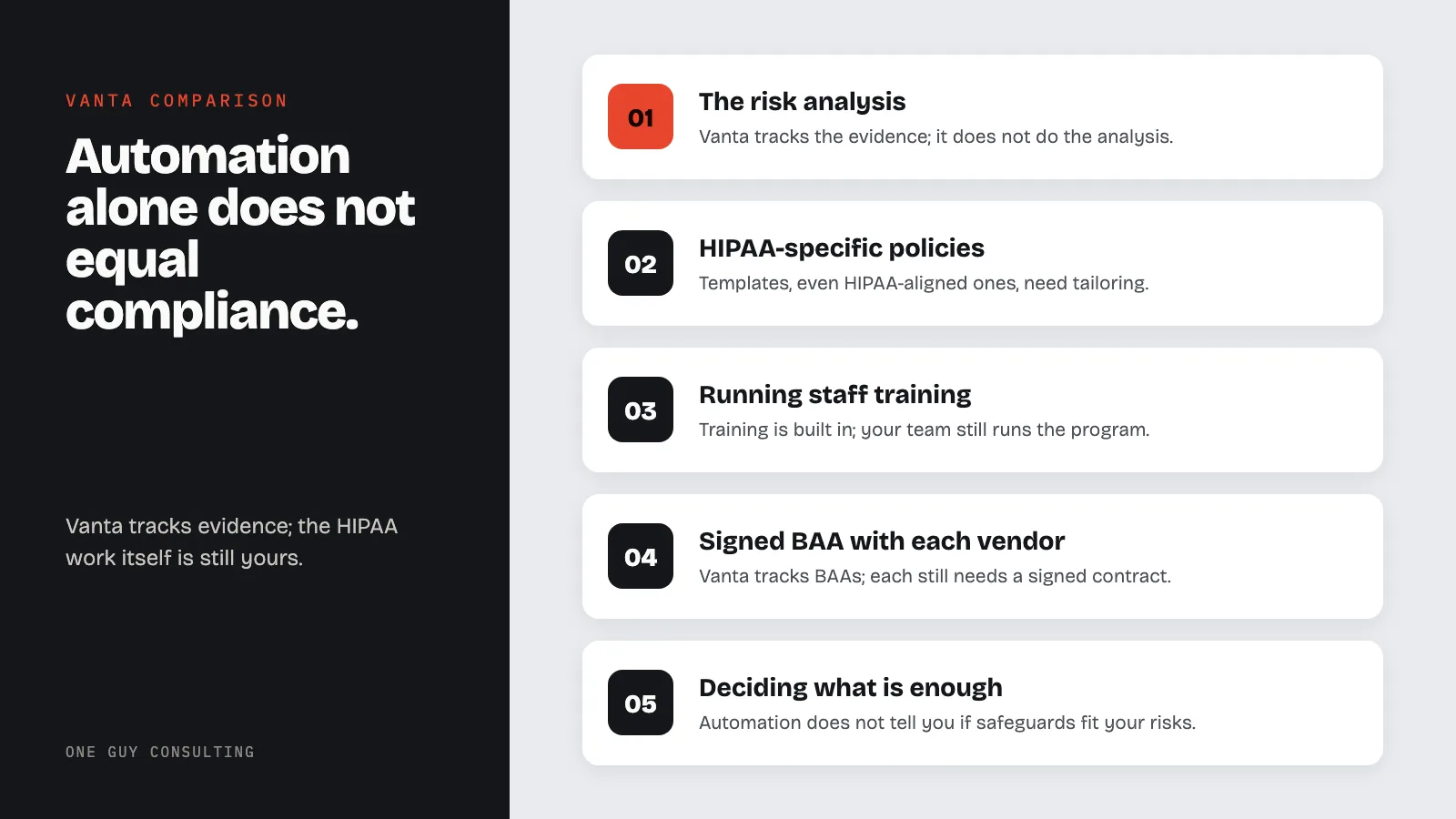
- Conducting the Security Risk Assessment. Vanta can track evidence related to your risk assessment, but it does not do the analysis itself. Someone still has to find threats, weigh weak points, and score risks. That is the risk analysis HIPAA requires under 45 CFR 164.308(a)(1)(ii)(A). Making a plan to fix those risks is a separate step. HIPAA calls it risk management, under 45 CFR 164.308(a)(1)(ii)(B).
- Writing HIPAA-specific policies. Policy templates, even HIPAA-aligned ones, need tailoring to fit your practice. They should match how you handle ePHI (electronic protected health information, meaning patient data kept or sent electronically), your daily workflows, and your risks. Under 45 CFR 164.316(a), you must put in place policies and procedures that are reasonable and appropriate for your practice. A template you never adapt or use is not enough.
- Running your training program. HIPAA requires a security awareness and training program for all staff, including managers (45 CFR 164.308(a)(5)). Covered entities (health plans, clearinghouses, and providers who bill electronically) must also train staff on their own privacy policies and procedures (45 CFR 164.530(b)). Vanta includes built-in HIPAA and security awareness training. But your team still runs the program. You also make sure it covers your own policies.
- Putting Business Associate Agreements in place. Vanta can collect and track vendor BAAs (business associate agreements) as part of its vendor risk tools. But you still need a signed written contract with each business associate (a vendor that handles patient data for you). 45 CFR 164.308(b) requires it, and that job is still yours.
- Deciding what is enough for your practice. Automation sorts compliance evidence. It does not tell you if your safeguards are reasonable and appropriate for your risks. That decision stays with your practice. For legal questions, speak with a lawyer.
When Both Make Sense
Some practices truly need both Vanta and a HIPAA-specific solution. This often applies when:
- Your practice must keep SOC 2 or ISO 27001 for enterprise clients and also comply with HIPAA for healthcare data.
- You have an internal security team that manages Vanta for multi-framework evidence gathering and wants HIPAA-specific software and guidance for the healthcare side.
- You are a health tech company where SOC 2 is required for your product and HIPAA is required for the data your product handles.
In these cases, Vanta handles the multi-framework automation and evidence collection. A HIPAA-specific tool covers the work that automation cannot replace. That means risk assessment, policies, training, and BAA management.
What Vanta Does Well
Vanta is a powerful tool built mainly for startups and tech companies.
Strengths include:
- Automated evidence gathering through integrations
- Continuous monitoring of systems and controls
- Strong support for frameworks like SOC 2, ISO 27001, and similar standards
- Clean interface for tracking compliance status
Does your team have engineering staff and more than one compliance framework to manage? If you also want automation on top of existing systems, it's a strong option.
Where Vanta May Not Fit HIPAA-Focused Companies
Vanta is strong at automation. But applying it to HIPAA can create real challenges.
Built for Frameworks Like SOC 2, Not HIPAA-First
Vanta is built for audit-based frameworks. Those rely heavily on evidence gathering and control tracking. HIPAA works differently. It needs risk analysis, written policies, real-world safeguards, and ongoing admin work. That creates a gap between automated tracking and actual compliance. A gap-first approach to risk assessment covers the practical side that audit tools often miss.
Automation Organizes. It Doesn't Execute.
Vanta helps you collect evidence, monitor systems, and track progress. But you still need to read the rules, set up safeguards, and make sure nothing is missed. Automation supports compliance. It doesn't replace doing the work. For a full breakdown of what separates software platforms from consulting, see HIPAA consulting vs compliance software.
Requires Technical Ownership
To get full value from Vanta, you must set up integrations. You also maintain systems and manage alerts and controls. For non-technical teams, this adds complexity instead of cutting it.
Where One Guy Consulting Is Different
One Guy Consulting was built with a different goal:
Get companies fully HIPAA compliant without making them manage a complex system.
Action vs. Automation
Instead of tracking and integrations, One Guy Consulting focuses on:
- Automated gap analysis to find compliance gaps
- Automated remediation plans (fix plans) to resolve them
- A centralized, cloud-based system for full-scope compliance
You don't configure tools. You don't maintain technical systems. On the Full-Scope plan, Chuck walks you through the software and the process.
Built for HIPAA, Not Adapted to It
One Guy Consulting was built for HIPAA compliance from the start. Workflows match real HIPAA rules. Decisions are driven by outcomes. The system fits how healthcare teams actually work.
Different Philosophies
Vanta:
- Automation-first
- Built for technical teams
- Focused on managing compliance frameworks
- Multi-framework tool
One Guy Consulting:
- Outcome-first
- Built for healthcare compliance specifically
- Focused on achieving compliance, not just tracking it
- Direct access to Chuck on Full-Scope calls
The right pick depends on what you need. Do you need a multi-framework audit tool? Or a focused HIPAA solution?
Enforcement Context: What OCR Looks For
OCR enforcement materials repeatedly point back to practical compliance failures. These include incomplete risk analysis, weak access controls, missing documentation, delayed fixes, and failure to implement safeguards that match the practice's actual risks. The OCR Reports to Congress and OCR resolution agreements are useful primary sources for reviewing those patterns.
That context matters when comparing Vanta and One Guy Consulting. Vanta can help teams organize evidence and monitor controls across many frameworks. One Guy Consulting is narrower: it focuses on HIPAA-specific work such as risk assessment, policies, training, fixes, and business associate compliance.
The right question is not whether automation is useful. It is whether the tool helps your practice complete the HIPAA work OCR expects to see recorded.
Who Should Use Each?
| Need | Likely better fit | Why |
|---|---|---|
| SOC 2, ISO 27001, and HIPAA evidence automation | Vanta | Vanta is built around integrations, control tracking, and audit evidence across many frameworks. |
| HIPAA-specific risk assessment, policies, training, and fixes | One Guy Consulting | One Guy Consulting is focused on completing HIPAA deliverables rather than managing broad framework evidence. |
| Internal IT or security team available to manage integrations | Vanta | Technical teams can get more value from automated evidence gathering and system tracking. |
| Small healthcare practice or business associate with limited technical bandwidth | One Guy Consulting | A narrower HIPAA workflow can reduce setup and make the required work easier to complete. |
Final Take
Vanta is a powerful tool for automating compliance frameworks. It's a great fit for tech companies managing SOC 2 or ISO alongside HIPAA.
But HIPAA needs more than automation. It needs action.
One Guy Consulting is built for teams that want to get compliant without managing a tool built for a different purpose. If you're a business associate trying to understand your duties before picking a solution, start with the common BAA mistakes that lead to fines. It gives a clear picture of what full compliance actually takes.
If your main need is getting HIPAA work done rather than multi-framework audit automation, One Guy Consulting may be a better fit for a small healthcare team or business associate. Review the comparison above, then choose the tool that matches the compliance work you actually need to finish. Learn more about One Guy Consulting
FAQ
Is Vanta a good choice for HIPAA compliance?
Vanta can support HIPAA as part of a broader multi-framework program. But it's built for audit-based frameworks like SOC 2 and ISO 27001. If HIPAA is your only or main need, a HIPAA-specific tool is often faster and simpler. It also fits how healthcare compliance works.
Does Vanta replace the need for a risk assessment?
No. Vanta automates evidence gathering and tracking. HIPAA still needs a recorded risk analysis. That analysis must find threats, gaps, and the chance and impact of a breach. A proper risk assessment goes well beyond what automated tracking covers.
How quickly can a small practice become HIPAA compliant?
With the right approach, a small practice can finish the core work in weeks, not months. That includes the risk assessment, policies, BAAs, and staff training. The timeline depends on how the work is set up and whether you use automation or manual steps.
What do the proposed HIPAA Security Rule changes mean for compliance tools?
In January 2025, HHS proposed updates to the Security Rule. They would add rules such as MFA (a second step to log in), encryption, and stricter deadlines for responding to security incidents. These changes are only proposed. They are not law yet.
HHS aims to issue a final rule by July 2027. Until then, the current Security Rule applies. Ask if a tool can adapt if the proposal becomes final. Learn more about the proposed HIPAA Security Rule changes.
Can I use Vanta for SOC 2 and One Guy Consulting for HIPAA?
Yes. Many teams use Vanta for SOC 2 and ISO while using a HIPAA-specific solution for healthcare compliance. The two solve different problems and can work side by side.
Key point: Multi-framework platforms are built to cover SOC 2, ISO 27001, PCI DSS, and more. A practice that only needs HIPAA may pay for features it will never use. Small healthcare practices and business associates face a choice. Do they need a multi-framework platform, or a tool built just for HIPAA?
Sources
Related Reading
- Compliancy Group vs One Guy Consulting (2026): How Compliancy Group's compliance coach model compares to One Guy Consulting's full-scope approach
- Accountable vs One Guy Consulting (2026): How Accountable's DIY platform compares to One Guy Consulting's automation-driven approach
- Paubox vs One Guy Consulting (2026): How Paubox's email encryption compares to One Guy Consulting's full-scope compliance approach
- Drata vs One Guy Consulting (2026): How Drata's compliance automation compares to One Guy Consulting's HIPAA-focused approach
- Secureframe vs One Guy Consulting (2026): How Secureframe's compliance automation compares to One Guy Consulting's HIPAA-focused approach
- Sprinto vs One Guy Consulting (2026): How Sprinto's compliance automation compares to One Guy Consulting's HIPAA-focused approach
- Dot Compliance vs One Guy Consulting (2026): How Dot Compliance's enterprise QMS compares to One Guy Consulting's HIPAA-focused approach
Frequently Asked Questions
Is Vanta good for HIPAA compliance?
Vanta can support HIPAA compliance, especially for technology companies and business associates that also need SOC 2 or ISO 27001. But HIPAA requires specific work like risk analysis, privacy policies, workforce training, and BAA (business associate agreement) management. That work goes beyond automated monitoring.
Does Vanta do HIPAA risk assessments?
Vanta provides risk frameworks and monitoring. But its software does not do the risk analysis for you. HIPAA requires an accurate and thorough risk analysis under 45 CFR 164.308(a)(1)(ii)(A). The analysis must find the risks and weak spots for ePHI (electronic protected health information, meaning patient data kept or sent electronically). Next, HIPAA requires risk management under 45 CFR 164.308(a)(1)(ii)(B). That means taking steps to lower those risks.
What is the difference between Vanta and One Guy Consulting for HIPAA?
Vanta is a compliance automation platform strongest in SaaS and technology environments. One Guy Consulting is built just for HIPAA. Its content and workflows are designed around covered entities (health plans, clearinghouses, and providers who bill electronically) and business associates (vendors that handle patient data for them).