Secureframe is compliance automation software built mainly for security standards like SOC 2 and ISO 27001. It can also track HIPAA work. One Guy Consulting is built only for HIPAA. It gives you tools and guidance for the risk analysis, policies, workforce training, and BAAs (business associate agreements).
Key Terms
- SOC 2: A voluntary auditing framework developed by the AICPA that evaluates an organization's controls related to security, availability, processing integrity, confidentiality, and privacy. It is not a HIPAA requirement.
- ISO 27001: An international standard for information security management systems (ISMS). Like SOC 2, it is an independent framework and does not satisfy HIPAA obligations on its own.
- BAA (Business Associate Agreement): A contract required under 45 CFR 164.502(e) and 164.504(e) between a covered entity and any vendor that creates, receives, maintains, or transmits PHI on its behalf.
- ePHI (Electronic Protected Health Information): PHI that is created, stored, transmitted, or received in electronic form. Protected by the HIPAA Security Rule (45 CFR 164.302-318).
- Security Rule: The HIPAA rule (45 CFR 164.302-318) that sets standards for protecting ePHI. It covers three kinds of safeguards: administrative (164.308), physical (164.310), and technical (164.312).
- Covered Entity: A health plan, healthcare clearinghouse, or healthcare provider that transmits health information electronically in connection with certain transactions, as defined at 45 CFR 160.103.
- Business Associate: A person or business that creates, receives, stores, or sends PHI for a covered entity. It also includes some service providers whose work involves PHI (45 CFR 160.103).
If you're considering Secureframe, you're likely looking to automate compliance and streamline audit readiness.
Secureframe helps teams manage frameworks like SOC 2 and ISO with integrations (connections to your other software) and ongoing checks. For HIPAA, the key point is simple:
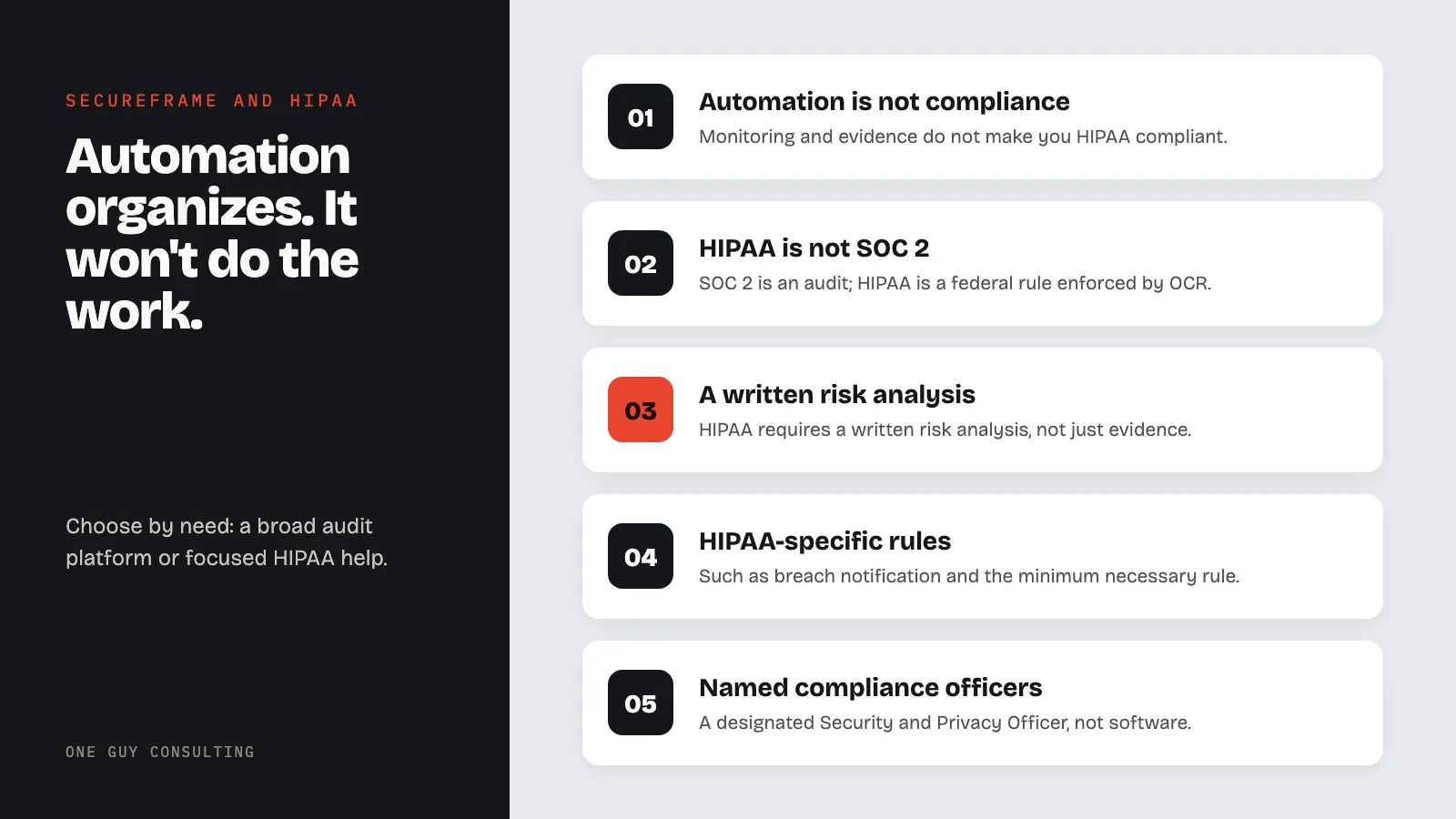
Automation helps organize compliance. It does not do the work for you.
This article compares Secureframe and One Guy Consulting for healthcare teams and business associates that need to become HIPAA compliant.
Plain-English summary: Secureframe is a strong tool when you need broad audit tracking. One Guy Consulting is a better fit when HIPAA is the main job and you want the risk analysis, policies, training, BAAs, and fix plan organized in one focused flow.
Secureframe vs One Guy Consulting at a Glance
| Feature | Secureframe | One Guy Consulting |
|---|---|---|
| Core Function | Compliance tracking platform | Full HIPAA compliance help |
| Primary Focus | SOC 2, ISO, security frameworks | HIPAA compliance |
| Approach | Integration-based automation | Done-with-you execution |
| Technical Requirement | Moderate | Minimal |
| Time to Compliance | Ongoing process | Accelerated completion |
| Best For | Tech companies managing audits | Healthcare teams needing HIPAA help |
Quick Choice Guide
Pick Secureframe if your team needs SOC 2, ISO, and audit tracking in one tool. Pick One Guy Consulting if HIPAA is the main job. We help you find the gaps, fix the gaps, train staff, and keep proof. You do not need a big tech team to get started.
What Secureframe Does Well
Secureframe is a modern compliance platform for startups and growing companies.
Strengths include:
- Automated evidence collection through integrations
- Ongoing checks of systems and controls
- Cleaner audit prep workflows
- Clean, modern interface
For teams with technical resources, several frameworks, and existing systems, it can be an effective tool.
Where Secureframe May Not Fit HIPAA-Focused Teams
Secureframe is strong at automation. Its model is built more for audits than for the day-to-day work of HIPAA compliance.
Built for Audit Frameworks, Not HIPAA-First
Secureframe is built for frameworks like SOC 2, where teams prove work through collected evidence. HIPAA also requires a risk analysis, safeguards, and work that staff actually follow. That creates a gap between tracking compliance and achieving it. A gap-first approach to risk assessment addresses the daily work that audit tools can miss.
Automation Supports, but It Doesn't Execute
Secureframe helps organize compliance, collect evidence, and monitor controls. But users still need to understand the rules, put safeguards in place, and check that nothing is missing. Automation helps the process, but the user still owns the work. To understand the full difference between software-driven and consultant-led approaches, read our comparison of HIPAA consulting vs compliance software.
Requires Ongoing System Management
To use Secureframe well, integrations must be set up, systems must be watched, and controls must stay current. For healthcare teams, this can add work instead of reducing it.
Where One Guy Consulting Is Different
One Guy Consulting was built with a different goal:
Help teams become HIPAA compliant without managing complex systems.
Execution vs. Automation
Instead of focusing on integrations and monitoring, One Guy Consulting provides:
- Automated gap analysis to find compliance issues
- Fix plans to close those gaps
- A cloud-based system for full HIPAA work
This means less setup, less technical overhead, and less guesswork.
Built Specifically for HIPAA
One Guy Consulting is designed for HIPAA compliance. Its workflows match real healthcare work. The goal is to finish the required work, not just track it.
Different Philosophies
Secureframe:
- Automation-first
- Built for technical teams
- Focused on audit readiness and proof
- Multi-framework platform
One Guy Consulting:
- Outcome-first
- Built for HIPAA compliance specifically
- Focused on doing and finishing the work
- Direct expert access, no support layers
The right choice depends on whether you need a broad audit platform or focused HIPAA help.
The Stakes Are Higher Than They Used to Be
Whichever direction you choose, doing nothing is no longer a realistic option. HIPAA penalty amounts have gone up with inflation, and OCR has pursued small practices and business associates, not just large health systems.
A 2025 enforcement breakdown counted 21 OCR enforcement actions that year.
The question is not whether you need HIPAA compliance. It is whether an audit-focused platform is the right tool, or whether you need a solution built for HIPAA execution.
Who Should Use Each?
Choose Secureframe if:
- You manage SOC 2 or ISO frameworks
- You have technical resources to manage integrations
- You want automated audit prep across several standards
Choose One Guy Consulting if:
- You need to become HIPAA compliant
- You do not want to manage integrations or systems
- You want direct help to finish the work
- You prefer speed and simplicity over broad framework coverage
When to Choose Secureframe vs. When to Choose OGC
| Your Situation | Better Fit | Why |
|---|---|---|
| You need SOC 2, ISO 27001, or PCI DSS alongside HIPAA | Secureframe | Multi-framework automation is Secureframe's core strength |
| You have a dedicated IT/security team to manage integrations | Secureframe | The platform requires ongoing system integration and monitoring |
| HIPAA is your primary or only compliance need | OGC | OGC is purpose-built for HIPAA execution, not multi-framework tracking |
| You need a Security Risk Assessment, which HIPAA calls a risk analysis (45 CFR 164.308(a)(1)(ii)(A)) | OGC | OGC's Security Risk Assessment tool walks you through it. The Full-Scope plan adds calls with Chuck, who guides you through answering the assessment. A tracking tool alone does not do the analysis for you. |
| You need HIPAA policies written and implemented, not just tracked | OGC | OGC provides ready-to-use policy templates and implementation guidance |
| You are a small practice or business associate with no IT team | OGC | Lower technical overhead; no integrations or system management required |
| You need workforce training on HIPAA requirements | OGC | OGC includes staff training and progress tracking built for HIPAA |
| You want evidence collection automated across cloud infrastructure | Secureframe | Secureframe integrates with AWS, GCP, Azure, and dozens of SaaS tools for automated evidence |
Common Mistakes When Choosing a Compliance Platform
- Assuming automation equals compliance. A platform that monitors your systems and collects evidence does not mean you are HIPAA compliant. HIPAA requires a documented risk analysis (45 CFR 164.308(a)(1)(ii)(A)), implemented safeguards (45 CFR 164.308, 164.310, and 164.312), workforce training, signed BAAs, and active management of your compliance program. Automation supports these activities but does not replace them.
- Treating HIPAA like SOC 2. SOC 2 is an audit-based framework where you show controls to an auditor. HIPAA is a federal regulation with enforcement by OCR. The compliance model, documentation requirements, and penalties are different. A platform designed for SOC 2 audit readiness may not address HIPAA-specific requirements like the Breach Notification Rule (45 CFR 164.400-414) or the Privacy Rule's minimum necessary standard (use or share only the least patient information needed for the job).
- Not designating a compliance officer even with software in place. HIPAA requires a designated Security Officer (45 CFR 164.308(a)(2)) and Privacy Officer (45 CFR 164.530(a)). Software does not fulfill this requirement. Someone in your organization must own the compliance program, review risk assessment findings, make decisions about safeguard implementation, and manage workforce training. The platform is a tool; the officer is the accountable person.
Final Take
Secureframe is a strong automation platform for compliance frameworks, especially for startups and tech companies that manage SOC 2 or ISO alongside HIPAA.
However, HIPAA compliance requires action, not just organization.
One Guy Consulting is built for teams that want to become compliant without managing a system made for a different purpose. If you're a business associate trying to understand your duties before choosing a solution, start with the common BAA mistakes that lead to fines. It gives a clear picture of what full compliance requires.
Both platforms serve different needs. Secureframe is built for multi-framework audit automation. OGC is built for HIPAA-specific compliance execution. The right choice depends on whether your primary need is broad audit tracking across SOC 2, ISO, and HIPAA, or focused HIPAA implementation with direct expert support. For more on what HIPAA compliance actually requires, see the HIPAA Security Rule administrative safeguards at 45 CFR 164.308 and technical safeguards at 45 CFR 164.312.
FAQ
Is Secureframe a good choice for HIPAA compliance?
Secureframe can support HIPAA as part of a broader compliance program. It is mainly built for audit-based frameworks like SOC 2 and ISO 27001. If HIPAA is your main need, a HIPAA-first solution will usually be faster, simpler, and closer to how healthcare compliance works.
Does Secureframe replace the need for a risk assessment?
No. Secureframe automates evidence collection and monitoring, but HIPAA requires a written risk analysis. That review must identify threats, weak points, and the likely impact of a breach. A proper risk assessment goes beyond automated monitoring.
How quickly can a small practice become HIPAA compliant?
With the right approach, a small practice can complete the core work in weeks, not months. That includes the risk assessment, policies, BAAs, and employee training. The timeline depends on how the work is organized.
What do the proposed HIPAA Security Rule changes mean for compliance platforms?
The proposed Security Rule updates would add new technical duties, such as MFA (a second login step, like a code sent to your phone), encryption standards, and shorter deadlines to respond to security incidents. HHS published the proposal on January 6, 2025. It is not final, so today's Security Rule still applies. Any compliance platform you use should account for these changes. Make sure your tool covers the current rule and can adapt if the proposal becomes final. Learn more about the proposed HIPAA Security Rule changes.
Can I use Secureframe for SOC 2 and One Guy Consulting for HIPAA?
Yes. Many teams use Secureframe for SOC 2 and ISO while using a HIPAA-specific solution for healthcare compliance. The two solve different problems and can work side by side.
Key point: Compliance software can speed up evidence collection and policy tracking. But OCR (the federal office that enforces HIPAA) checks whether you actually do what HIPAA requires. Having software running is not enough. A missing or incomplete risk analysis (45 CFR 164.308(a)(1)(ii)(A)) is a common problem. In late 2024, OCR announced a Risk Analysis Initiative focused on it.
Sources
Related Reading
- Compliancy Group vs One Guy Consulting (2026): Guided platform vs execution-focused help
- Accountable vs One Guy Consulting (2026): DIY platform vs done-with-you HIPAA help
- Paubox vs One Guy Consulting (2026): Email encryption vs full HIPAA support
- Drata vs One Guy Consulting (2026): Broad automation vs HIPAA-focused execution
- 7 Business Associate Agreement Mistakes That Lead to HIPAA Fines: Common BAA errors to avoid
- Sprinto vs One Guy Consulting (2026): Audit automation vs HIPAA-focused execution
- Vanta vs One Guy Consulting (2026): Audit automation vs HIPAA-focused execution
- Dot Compliance vs One Guy Consulting (2026): Enterprise QMS vs HIPAA-focused execution