Dot Compliance is an electronic quality management system (eQMS) for FDA-regulated industries such as life sciences, pharmaceuticals, and medical devices. It is not a HIPAA compliance solution. It addresses FDA quality management (21 CFR Part 11, GxP), not patient data privacy and security under HIPAA (45 CFR Parts 160 and 164).
If you are evaluating Dot Compliance, you are likely dealing with regulatory requirements in a highly controlled environment.
Dot Compliance is built for life sciences, pharma, and industries that need electronic quality management systems (eQMS). For healthcare practices focused on HIPAA, the difference matters:
Not all compliance platforms are built for the same type of compliance.
This article breaks down the difference between Dot Compliance and One Guy Consulting for practices that need practical, fast, and complete HIPAA compliance.
Key Definitions
- eQMS (Electronic Quality Management System): Software that manages quality processes, document control, training records, corrective actions, and audit trails in regulated industries. Designed primarily for FDA-regulated manufacturing and life sciences.
- FDA 21 CFR Part 11: The FDA regulation governing electronic records and electronic signatures. Requires controls for system validation, audit trails, record retention, and access. Applies to pharmaceutical, biotech, and medical device companies.
- HIPAA (Health Insurance Portability and Accountability Act): Federal law requiring covered entities and business associates to protect patient health information. Governed by 45 CFR Parts 160 and 164, covering privacy, security, and breach notification.
- GxP (Good Practice): A general term for quality guidelines and regulations in FDA-regulated industries, including Good Manufacturing Practice (GMP), Good Clinical Practice (GCP), and Good Laboratory Practice (GLP).
- Quality Management System (QMS): A formalized system that documents processes, procedures, and responsibilities for achieving quality policies and objectives. In FDA-regulated settings, a QMS must meet specific regulatory standards.
Key Difference
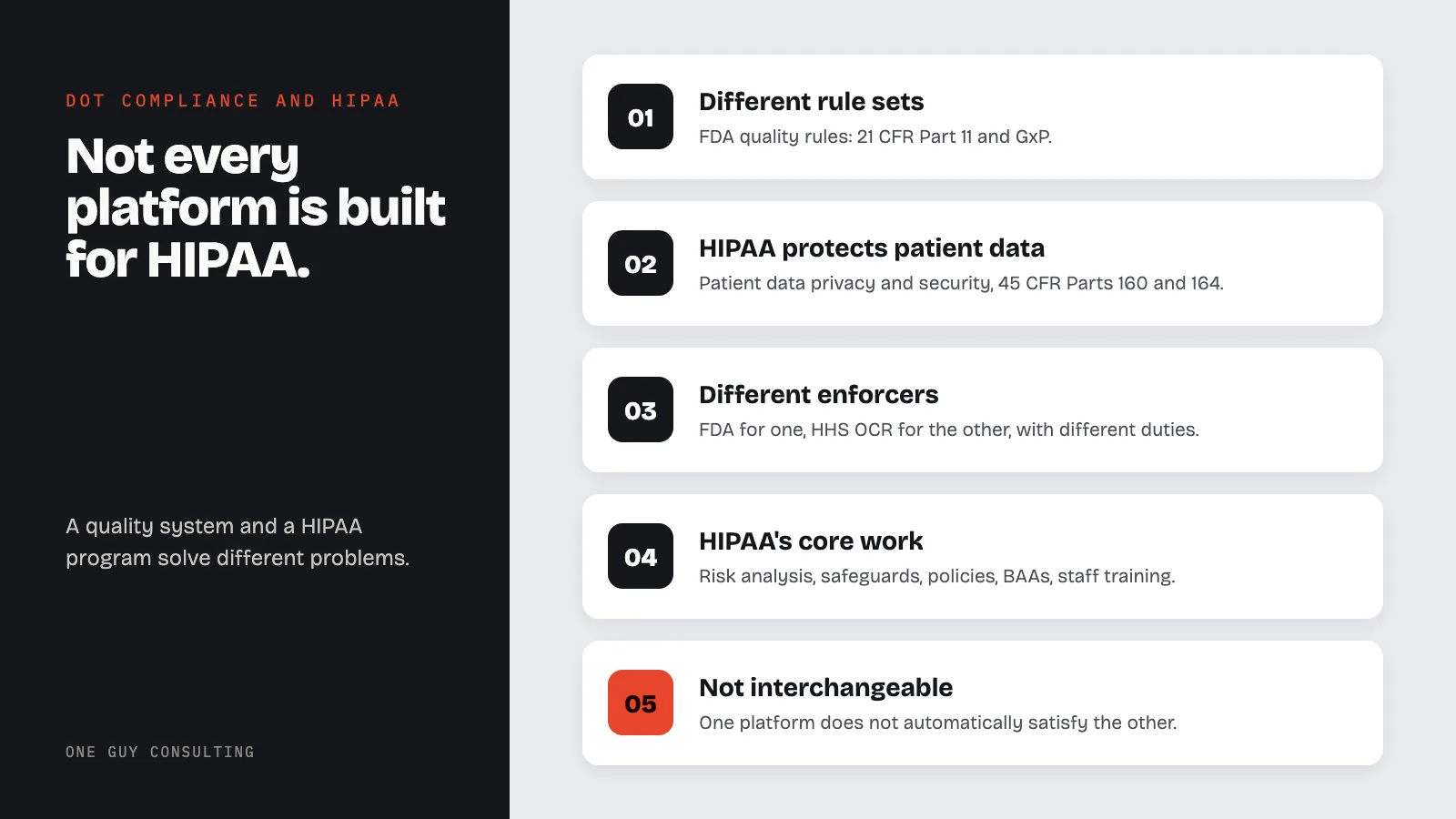
Dot Compliance addresses FDA quality management under 21 CFR Part 11 and GxP frameworks. HIPAA addresses patient data privacy and security under 45 CFR Parts 160 and 164. These are entirely different regulatory frameworks with different requirements, different enforcement agencies (FDA vs. HHS OCR), and different compliance obligations. A platform built for one does not automatically satisfy the other.
Key HIPAA Terms for Evaluating Dot Compliance
HIPAA: The Health Insurance Portability and Accountability Act. Federal law that requires covered entities and business associates to protect the privacy and security of patient data.
PHI (Protected Health Information): Any health data linked to a person, held or sent by a covered entity or business associate.
Covered Entity: A health plan, a health care clearinghouse (a company that converts billing and claims data into a standard format), or a health care provider. A provider counts only if it sends health information electronically for standard transactions, such as insurance claims (45 CFR 160.103). Covered entities must follow HIPAA.
Business Associate: A vendor or contractor that creates, receives, maintains, or transmits PHI on behalf of a covered entity. Business associates must follow the Security Rule themselves (45 CFR 164.302).
Security Rule: The HIPAA Security Rule (45 CFR Part 164, Subpart C) sets national standards for protecting electronic PHI (ePHI) through administrative, physical, and technical safeguards.
Quick Comparison
| Feature | Dot Compliance | One Guy Consulting |
|---|---|---|
| Core Function | eQMS / quality management platform | Full HIPAA compliance solution |
| Primary Focus | Life sciences, pharma, GxP | Healthcare HIPAA compliance |
| Approach | Process-heavy, system-driven | Action + automation |
| Complexity | High | Low |
| Time to Implement | Varies with project size and validation needs | Weeks, not months |
| Best For | Enterprise compliance staff | Small healthcare orgs and business associates |
What Dot Compliance Does Well
Dot Compliance is a strong platform built for tightly regulated fields. Strengths include:
- Structured quality management systems (eQMS)
- Strong support for GxP and FDA-regulated environments
- Detailed workflow management and validation steps
- Enterprise-grade compliance systems
For companies in pharma or life sciences with full-time compliance teams, it is a strong and fitting solution.
Dot Compliance Limitations for HIPAA
Built for Enterprise Quality Systems, Not HIPAA-First
Dot Compliance focuses on quality management and validation steps. HIPAA focuses on risk analysis, safeguard setup, policies, and daily security. These are very different compliance models. A gap-first approach to risk analysis is better suited to HIPAA's day-to-day needs.
Too Complex for Smaller Practices
Enterprise systems come with layered workflows and many modules. For smaller healthcare practices, this is far more than HIPAA calls for.
Longer Setup Cycles
Onboarding requires time, setup, and process changes. That slows time to compliance, a problem when OCR is actively enforcing.
Designed for Teams, Not Individuals
Dot Compliance works best when duties are spread across departments. Many small practices and business associates have one or two people handling compliance.
Where One Guy Consulting Is Different
One Guy Consulting takes a different approach, putting speed and direct action over system setup.
Execution vs. System Management
The platform focuses on:
- Automated gap analysis (a check for what is missing) built around the HIPAA Security Rule safeguards
- Automated remediation plans (step-by-step fix lists) tied to specific HIPAA duties
- A central system built just for HIPAA, scoped to HIPAA rather than adapted from another field’s compliance model
The tradeoff is fewer setup options in exchange for faster time to compliance.
HIPAA-Focused Workflow Design
Workflows map to specific HIPAA rules under 45 CFR Part 164: risk analysis under §164.308(a)(1)(ii)(A), policies under §164.316(a), staff training under §164.308(a)(5)(i), and BAA management under §164.308(b)(1). This design targets small healthcare practices with limited compliance staff.
Regulatory Framework Comparison: Dot Compliance vs. HIPAA
| Dimension | Dot Compliance (FDA/GxP) | HIPAA Compliance (45 CFR Parts 160/164) |
|---|---|---|
| Regulatory Framework | FDA 21 CFR Part 11, GxP, ICH guidelines | HIPAA Privacy Rule, Security Rule, Breach Notification Rule |
| Primary Industry | Life sciences, pharmaceuticals, medical devices, biotech | Healthcare providers, health plans, clearinghouses, business associates |
| What It Protects | Product quality, manufacturing integrity, electronic records | Patient health information (PHI/ePHI) privacy and security |
| Key Requirements | Document control, CAPA, validation, audit trails, electronic signatures | Risk analysis, policies, staff training, BAAs, access controls, encryption |
| Enforcement Agency | FDA | HHS Office for Civil Rights (OCR) |
| Audit Type | FDA inspections, third-party quality audits | OCR investigations and compliance reviews |
| Compliance Officer Role | Quality Assurance Manager or Director | Privacy Officer (45 CFR 164.530(a)(1)) and Security Officer (45 CFR 164.308(a)(2)) |
| Penalties | Warning letters, consent decrees, import alerts, product recalls | Civil fines of up to $2,190,294 per calendar year for repeat violations of the same requirement (45 CFR 102.3, latest inflation update); criminal penalties |
When Dot Compliance Might Be Relevant Alongside HIPAA
Some organizations operate at the intersection of FDA regulation and HIPAA. Examples include:
- Pharmaceutical companies with patient assistance programs that collect and store PHI as part of drug access or copay assistance programs.
- Medical device manufacturers whose connected devices (e.g., remote patient monitoring, implantable devices with wireless data transmission) create, store, or transmit ePHI.
- Clinical research organizations (CROs) conducting clinical trials that involve both FDA-regulated research data and patient health information subject to HIPAA.
- Health tech companies building software that is both a regulated medical device (requiring FDA compliance) and a system that handles ePHI (requiring HIPAA compliance).
In these cases, an organization may need both an eQMS platform for FDA quality obligations and a separate HIPAA compliance program for patient data protection. The two platforms solve different problems and should not be treated as interchangeable.
Enterprise QMS vs. HIPAA-First: Two Approaches
Dot Compliance:
- System-first
- Built for enterprise settings
- Focused on quality management and rule-based workflows
- Designed for large compliance teams
One Guy Consulting:
- Outcome-first
- Scope limited to HIPAA compliance
- Puts speed and rule accuracy first
- Full-Scope plan includes 1:1 implementation calls with Chuck
The right choice depends on whether you need an enterprise quality management system or a focused HIPAA compliance tool.
2025-2026 HIPAA Enforcement Trends
Whichever direction you choose, inaction is not an option. HIPAA fine amounts rose again in the latest inflation update, and OCR has pursued small practices and business associates, not just large health systems.
A 2025 enforcement breakdown walks through the year's OCR actions. A common thread is a missing or weak risk analysis. HIPAA requires one under §164.308(a)(1)(ii)(A). In late 2024, OCR announced a Risk Analysis Initiative to focus on this problem.
The question is not whether you need HIPAA compliance. It is whether an enterprise QMS platform is the right tool, or whether you need a tool built just for HIPAA action.
Which Solution Fits Your Practice?
An enterprise QMS may be better if:
- You operate in pharma or life sciences
- You need a full quality management system (QMS)
- You have a compliance team managing structured workflows
A HIPAA-focused tool may be better if:
- You need to become HIPAA compliant under 45 CFR Part 164
- You want fast setup without enterprise overhead
- You are a covered entity or business associate with limited staff
- You prefer action over process management
Bottom Line: Key Takeaways
The choice between an enterprise QMS and a HIPAA-focused platform depends on your field, team size, and compliance scope:
- Dot Compliance is designed for life sciences and pharma: companies that need structured eQMS, GxP workflows, and FDA-regulated validation steps.
- HIPAA compliance is a separate set of rules under 45 CFR Part 164, centered on risk analysis, safeguard setup, policies, BAAs, and staff training, not quality management.
- Enterprise QMS platforms add layers that may go beyond what HIPAA calls for, above all for small practices and business associates with limited compliance staff.
- HIPAA tools put speed and rule accuracy first by scoping workflows straight to Security Rule and Privacy Rule needs.
- Look at your HIPAA duties: if your compliance needs are limited to HIPAA, an enterprise QMS may add unneeded overhead.
For business associates reviewing their duties, the common BAA mistakes that lead to fines gives a clear picture of what compliance under §164.308(b)(1) really calls for.
For practices looking at their options, the key question is whether your compliance needs match an enterprise QMS or a HIPAA-focused tool. Review the points above to find which approach fits your daily needs.
FAQ
Is Dot Compliance a good choice for HIPAA compliance?
Dot Compliance is built for enterprise quality management in life sciences and pharma, not for HIPAA. HIPAA requires risk analysis, written policies, staff training, and signed BAAs. A platform built around those specific duties is usually faster, simpler, and closer to what OCR expects.
What's the difference between a QMS platform and a HIPAA compliance solution?
A QMS platform like Dot Compliance handles quality processes, validation steps, and records for pharma. A HIPAA tool covers risk analysis, Security Rule safeguards, policies, BAAs, and staff training. They solve different problems. Using the wrong tool creates gaps.
How quickly can a small practice become HIPAA compliant?
With the right approach, a small practice can finish core steps in weeks, not months. That includes risk assessment, written policies, BAAs, and staff training. The timeline depends on how the work is set up and whether you use automated or manual steps.
What do the proposed HIPAA Security Rule changes mean for compliance platforms?
The proposed Security Rule update was published in January 2025. It would add new duties. Examples include required MFA (a second step to log in), required encryption (scrambling data so only approved people can read it), and getting systems back up within 72 hours after an incident. It is a proposal, not law, and the current Security Rule still applies. A good platform follows today's rule and tracks the proposal in case it becomes final.
Do I need both a QMS and a HIPAA compliance solution?
Only if your company works in regulated product fields (pharma, biotech) and also handles PHI. Most small practices and business associates only need HIPAA compliance. A full enterprise QMS adds cost and layers without adding value for HIPAA.
Key fact: Under 45 CFR 164.308(a)(1)(ii)(A), every covered entity and business associate must do a risk analysis. That means an accurate and thorough check of the potential risks to ePHI (patient health information stored or sent electronically). In late 2024, OCR made this an enforcement focus with its Risk Analysis Initiative. A compliance platform is only as effective as the risk assessment underlying it.
Sources
Related Reading
- Compliancy Group vs One Guy Consulting (2026): How Compliancy Group's compliance coach model compares to One Guy Consulting's full-scope approach
- Accountable vs One Guy Consulting (2026): How Accountable's DIY platform compares to One Guy Consulting's automation-driven approach
- Paubox vs One Guy Consulting (2026): How Paubox's email encryption compares to One Guy Consulting's full-scope compliance approach
- Drata vs One Guy Consulting (2026): How Drata's compliance automation compares to One Guy Consulting's HIPAA-focused execution
- Secureframe vs One Guy Consulting (2026): How Secureframe's compliance automation compares to One Guy Consulting's HIPAA-focused execution
- Sprinto vs One Guy Consulting (2026): How Sprinto's compliance automation compares to One Guy Consulting's HIPAA-focused execution
- Vanta vs One Guy Consulting (2026): How Vanta's compliance automation compares to One Guy Consulting's HIPAA-focused execution
Frequently Asked Questions
What is Dot Compliance and what does it do?
Dot Compliance is a quality management system platform built primarily for life sciences organizations subject to FDA regulations such as 21 CFR Part 11 and GxP requirements. It is not a purpose-built HIPAA compliance tool.
Is Dot Compliance appropriate for HIPAA covered entities?
Dot Compliance is designed for pharmaceutical, biotech, and medical device quality management rather than HIPAA compliance programs. Covered entities should evaluate whether a HIPAA-specific platform better maps to OCR enforcement expectations.
What is the difference between Dot Compliance and One Guy Consulting?
Dot Compliance addresses quality management for FDA-regulated industries. One Guy Consulting addresses HIPAA compliance specifically for covered entities and business associates.