HIPAA Compliance Consulting for Pharmacies
Pharmacies need controls for dispensing systems, vendor relationships, staff access, and data sent to PBMs and insurance portals. This applies to both independent pharmacies and large chains.
What We Focus On for Pharmacies
Pharmacies are covered entities under HIPAA and must ensure the confidentiality, integrity, and availability of electronic PHI (ePHI) they create, receive, store, or transmit, per 45 CFR 164.306.
Every dispensing transaction, insurer message, and PBM link can expose PHI without the right controls. Pharmacy-specific PHI includes:
- Prescription records and patient profiles
- Insurance billing data and claims
- E-prescribing transmissions
- PBM communications and adjudication data
- Controlled substance logs
- Immunization records
Each connection to an external system (PBMs, insurance portals, e-prescribing networks, wholesaler ordering systems) represents a point where ePHI may be exposed and must be included in the pharmacy's risk assessment.
Pharmacies must implement encryption and secure transmission methods for ePHI per 45 CFR 164.312, particularly for data sent to PBMs and insurance carriers.
- Risk and gap review for dispensing systems, messages, and patient data
- Policies that match how your pharmacy actually runs
- Staff training by role with tracked completion
- Vendor and BAA setup for your software, PBMs, and fulfillment partners
Who Needs This
- Independent pharmacies without a formal HIPAA program in place.
- Pharmacies adding new dispensing systems, PBM connections, or e-prescribing networks.
- Teams where PHI handling varies by shift or staff member with no consistent standard.
- Organizations preparing for payer audits or regulatory reviews that need documented controls.
- Pharmacy chains that need consistent compliance standards across multiple locations.
Pharmacy-Specific Pressure Points
Pharmacies send data to many outside systems. Each connection can expose PHI. Controls must cover every integration without disrupting dispensing work. The Security Rule's technical safeguards at 45 CFR §164.312 require encryption and transmission security for ePHI in transit.
When PHI moves across several systems, risk grows quickly. Unsecured handoffs between platforms are where many pharmacy gaps appear.
Dispensing systems connect to insurance portals, PBMs, and e-prescribing networks. Each link can expose PHI. Until you document these data flows, compliance gaps stay hidden. A documented risk analysis is required. You cannot satisfy it without knowing where your PHI goes.
Mapping data flows is the foundation of pharmacy HIPAA compliance. You cannot fix gaps you have not found.
How We Execute
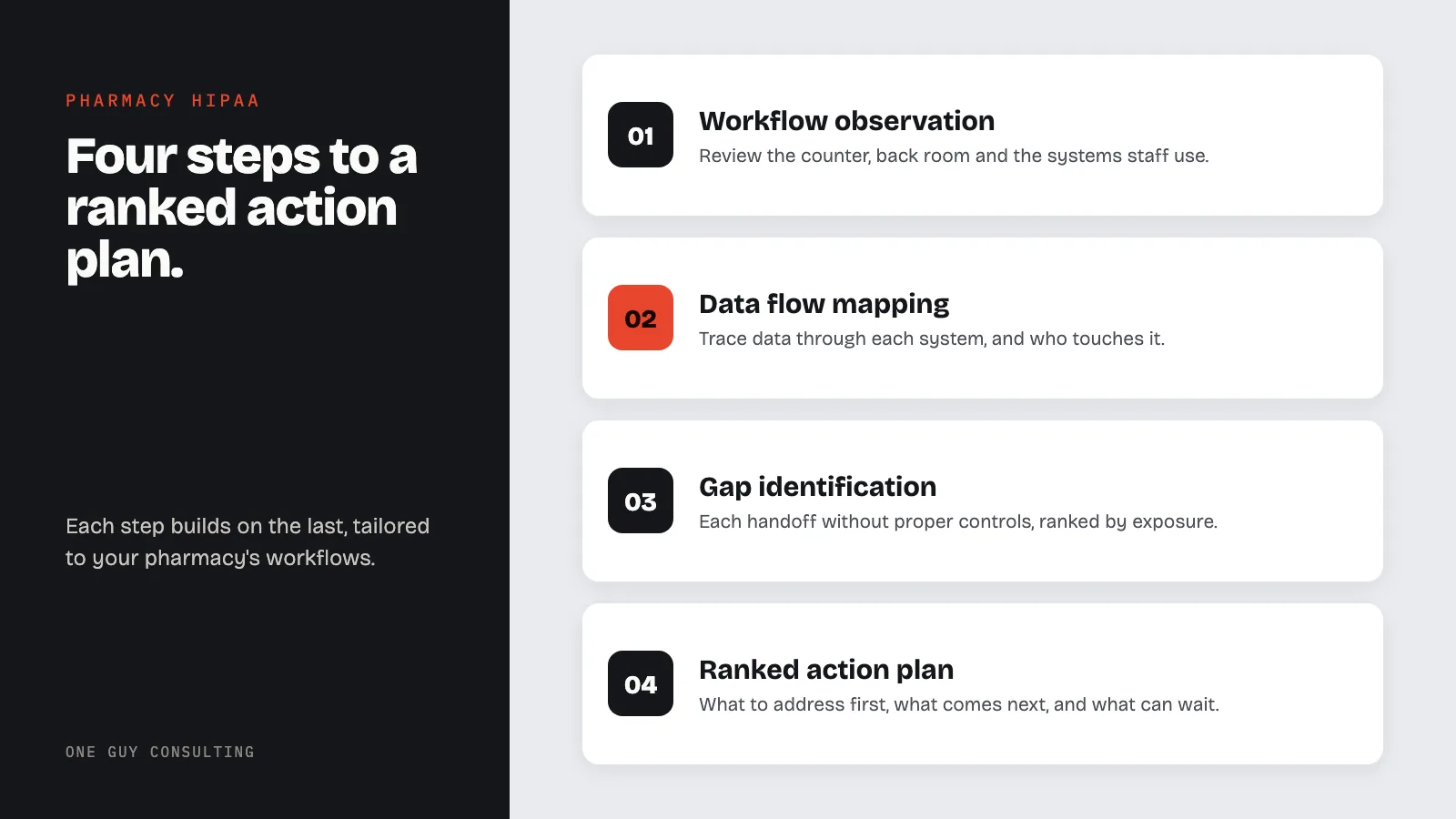
Each step builds on the last. We start with observation and end with a ranked action plan tailored to your pharmacy workflows.
- 01
Workflow Observation
The process starts with direct observation of daily work. We review the counter, the back room, and the systems staff use. This shows how work actually happens, not how a policy document describes it. Findings feed into the risk analysis required.
FeedsThe required risk analysis. - 02
Data Flow Mapping
We trace prescription data through each system connection. This includes dispensing platforms, PBMs, insurance portals, and e-prescribing networks. We document who touches the data at each point. Any third party that handles PHI for you needs a Business Associate Agreement and §164.502(e).
DocumentsWho touches the data at each point. - 03
Gap Identification
We document each handoff where PHI moves without proper controls. The result is a clear map of real compliance gaps, ranked by exposure level. We assess gaps against administrative safeguards, physical safeguards, and technical safeguards.
- 04
Action Plan
The findings create a ranked action plan tailored to the pharmacy's team size and budget. It shows what to address first, what comes next, and what can wait.
RankedFirst, next, and what can wait.
Where Pharmacy Compliance Breaks Down
These are representative patterns we see across pharmacy compliance engagements.
Compliance Gap Distribution by Area
Typical gap distribution at program start · 5 gap areas
Common Pharmacy Compliance Gaps
Gap severity across pharmacy operations
Representative gap patterns. Actual results vary by pharmacy size and operational complexity.
Typical Readiness Score
Before vs. after a structured program
Target post-engagement metrics
Where Does Your Pharmacy Compliance Stand Today?
Adjust the slider to reflect your current program maturity. See what that means for urgency and recommended next steps.
Move the slider to assess your program
Rate your pharmacy compliance program from 0 (no program) to 100 (fully governed, documented, and audit-ready).
From Uncontrolled to Audit-Ready
A multi-location independent pharmacy had been operating without formal HIPAA controls. Prescription data flowed between dispensing systems, PBMs, and insurance portals with no documented BAAs. Staff handled PHI inconsistently across shifts.
Every data flow from counter to clearinghouse was mapped. Seven vendor relationships were found missing BAAs. Role-specific controls were built for pharmacists and technicians, with a review cycle tied to the dispensing workflow.
All vendor BAAs were executed within 30 days. Staff reported clearer boundaries for PHI handling. The pharmacy passed a payer audit three months later with no findings.
Compliance by Pharmacy Type
Compliance controls should match how your pharmacy type operates. Generic programs miss the workflows that matter most.
Independent Pharmacies
Single-location compliance programs scaled to your team size and dispensing volume.
Retail Chain Pharmacies
Consistent compliance standards across multiple locations with centralized policy management.
Mail-Order / Specialty
Controls for high-volume fulfillment, cold chain handling, and specialty medication workflows.
Hospital Pharmacies
Integration with facility-wide compliance programs and clinical workflow coordination.
Compounding Pharmacies
Additional controls for custom formulation documentation and beyond-use dating records.
One flat price, whatever your staff size.
Two plans, six ways to pay. No per-user fees, so pharmacists, technicians, and extra locations do not change your bill.
- The platform on its own
- SRA, gap analysis, remediation plans
- Policy templates and staff training
- Vendor and BAA management
- Everything in Self-Guided
- 4 hours a month of 1:1 implementation calls with Chuck
- Incident response guidance
- CMS audit response support
One payment, two full years of coverage.
Secure checkout by Stripe. Your payment details go straight to Stripe and never touch our servers.
What You Receive
Risk Review
A full review of your current HIPAA risk exposure across dispensing systems, staff access, and vendor connections with findings clearly documented.
Updated Policies for Pharmacy Workflows
Policies written for how your pharmacy actually runs, not generic templates. Covers PHI handling, access controls, and vendor management specific to your operation.
Fix-It Plan Ranked by Urgency
A prioritized action list so your team knows exactly where to start. High-risk items come first. Nothing gets buried in a long report no one reads.
Staff Training Your Team Can Finish in One Sitting
Role-appropriate training that fits into a real workday. Technicians get what applies to their role. Pharmacists get what applies to theirs. Tracked completion for both groups.
Simple Review Cycle
A defined review schedule aligned to vendor changes, staff turnover, and regulatory updates so compliance documentation stays current between audits.
Part of both plans
Self-Guided gives you the platform. Full-Scope adds 4 hours a month of 1:1 implementation calls with Chuck.
Compare plans →A Three-Phase Path to Pharmacy Compliance
Weeks, not months. Each phase builds on the one before it.
- 01
Assessment
- Map dispensing workflows and data flows
- Inventory all vendor and PBM relationships
- Identify BAA gaps and missing agreements
- Assess current staff PHI handling practices
Phase 1Find out where PHI goes and who touches it. - 02
Implementation
- Execute priority BAAs with vendors and PBMs
- Deploy role-based policies for pharmacists and technicians
- Deliver targeted staff training by role
- Establish incident response procedures
Phase 2Close the highest-risk gaps first. - 03
Validation
- Test incident response with pharmacy-specific scenarios
- Verify documentation completeness for audit readiness
- Confirm all data flows are mapped and controlled
- Finalize review cycle for ongoing compliance
Phase 3Prove it works and keep it current.
Common Pharmacy Compliance Pitfalls
Addressing these pitfalls reduces audit exposure and gives your team clearer rules for handling patient data every day.
Unmapped data flows
Prescription data moves between systems with no documentation of where PHI goes or who can access it. A documented risk analysis is required.
Missing vendor BAAs
PBMs, software providers, and fulfillment partners handle PHI without signed agreements, violating 45 CFR §164.502(e).
Generic training
Staff get the same training regardless of whether they are pharmacists, technicians, or admin. Role-appropriate training is required.
Inconsistent access
Different shifts or locations handle PHI differently with no standard controls. Access management is addressed.
No review cycle
Policies are written once and never updated as systems, vendors, or regulations change.
Audit unpreparedness
When a payer or regulator asks for documentation, there is nothing organized to show.
Maintaining Pharmacy Compliance Over Time
A pharmacy compliance program is not a one-time project. Vendor relationships change, dispensing systems get updated, staff turns over, and regulations evolve. The program needs a review cycle that catches these changes before they create gaps.
We build that cycle into your program from the start so compliance stays current without requiring a full rebuild each year. Your team knows when to review, what triggers an update, and who owns each piece.
Trigger Events for Pharmacy Compliance Review
Buyer Checklist for Pharmacy Compliance Services
Before selecting a compliance provider, confirm these capabilities. For a broader view of what to track across your program, see our HIPAA compliance checklists. A strong program should improve how your pharmacy handles patient data, not just produce a binder.
- Controls are tailored to pharmacy dispensing workflows, not generic healthcare
- Data flow mapping covers all PBM, insurance, and e-prescribing connections
- BAA management includes all vendor relationships, not just the obvious ones
- Staff training differentiates between pharmacist and technician responsibilities
- Incident response procedures address pharmacy-specific scenarios
- Review cycle is tied to real triggers like vendor changes and system updates
- Provider can work with your existing dispensing and pharmacy management systems
- Program produces audit-ready documentation, not just policy binders
Common Outcomes for Pharmacy HIPAA Clients
These are the operational and documentation outcomes we consistently see after implementing a structured pharmacy HIPAA compliance program.
- Patient data handled the same way every time
- One person owns each fix, each policy, and each vendor review
- No more last-minute scrambles before an audit
- Clear records ready for any payer or regulatory review
HIPAA Standards Applicable to Pharmacies
The following federal regulations establish the baseline compliance requirements for covered pharmacies. Each standard below is drawn from Title 45 of the Code of Federal Regulations (CFR), Parts 160 and 164. For a detailed look at the enforcement consequences of noncompliance, see our guide to HIPAA violations and penalties.
Administrative Safeguards
Requires covered entities to implement policies and procedures to manage the selection, development, implementation, and maintenance of security measures. Includes mandatory risk analysis, risk management, workforce training, and Business Associate Agreement requirements.
Physical Safeguards
Governs physical access to facilities and workstations where PHI is handled. Pharmacies must implement controls over workstation use, device and media controls, and facility access, particularly relevant for dispensing counter areas and back-office systems.
Technical Safeguards
Requires access controls, audit controls, integrity controls, and transmission security for electronic PHI. Applies to all pharmacy dispensing systems, PBM connections, e-prescribing networks, and insurance portal integrations that handle ePHI.
Uses and Disclosures of PHI
Establishes when and how a covered pharmacy may use or disclose PHI, including the minimum necessary standard. Governs disclosures to PBMs, insurance payers, and prescribers, and requires Business Associate Agreements for vendors who receive PHI to perform functions on the pharmacy's behalf.
Administrative Requirements (Privacy Rule)
Requires covered pharmacies to designate a Privacy Official, train workforce members, apply appropriate safeguards, and maintain policies for at least six years. Includes requirements for documenting sanctions against workforce members who violate privacy policies.
Security Standards: General Rules
The overarching Security Rule requirement applying to all covered pharmacies. Establishes that size, complexity, and capabilities may inform implementation, but the obligation to protect the confidentiality, integrity, and availability of all ePHI applies equally to independent pharmacies and large chains.
Pharmacy HIPAA Frequently Asked Questions
Do independent pharmacies need the same HIPAA rigor as larger chains?+
How should pharmacies protect prescription data shared with third-party systems and PBMs?+
Does PHI received from third-party payers and insurance companies require special handling?+
Do pharmacy technicians need separate HIPAA training from pharmacists?+
Are medication therapy management records subject to HIPAA?+
Do small pharmacies need the same HIPAA rigor as big chains?+
Start With a Compliance Assessment
A 30-minute consultation covers your current pharmacy workflows, system connections, and compliance gaps to determine the right program scope. Consultations are remote, so location is not a barrier; see HIPAA compliance services near you.
Questions About Pharmacy HIPAA Compliance?
Chuck Weiselberg, Certified HIPAA Professional (C.H.P.). Zero client fines. Zero failed audits.
“One Guy Consulting is super easy to work with. I actually look forward to my implementation meetings for HIPAA.”
Samantha M.
Deep-Dive Resources
These resources cover pharmacy-specific compliance topics in more detail: