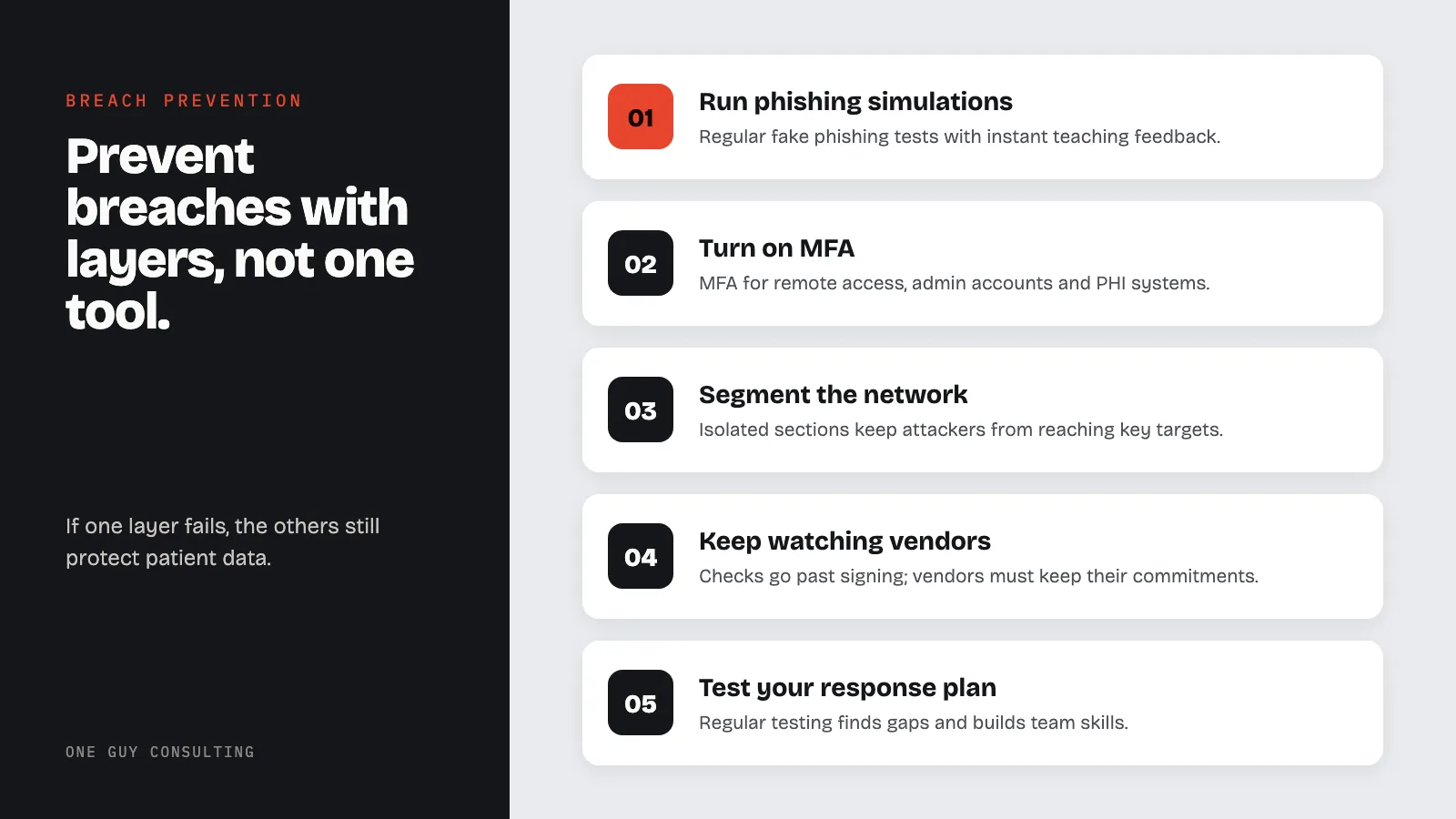
You prevent a healthcare data breach with layers of defense, not one tool. Train staff to spot phishing. Turn on multi-factor authentication and encrypt devices. Split your network into sections. Vet and watch your vendors, check your logs, and keep a tested incident response plan. If one layer fails, the others still protect patient data.
The healthcare data breach crisis keeps growing. In 2025, more than 770 large healthcare breaches were reported to HHS. Each one affected 500 or more people. That set a new yearly record, per HIPAA Journal's count of the HHS breach portal.
Each breach costs healthcare organizations an average of $7.42 million, per the IBM Cost of a Data Breach Report 2025. That is the highest of any industry for the 14th year in a row. The damage goes beyond money. It includes lost operations, harm to reputation, and broken patient trust.
This guide gives security officers and IT teams a complete breach prevention strategy. It covers the threat landscape and layered defenses. It also covers vendor security programs and incident response. All of it is built to meet HIPAA compliance requirements.
The Healthcare Breach Landscape
Breach Statistics and Trends
Healthcare data breaches keep getting worse. Knowing the current landscape helps practices focus their defenses. It also helps them spend resources where they matter most.
Key numbers that define the threat today:
- Large breaches keep coming faster. In 2018, about one large breach (500 or more people) was reported each day. By 2024, it was more than two a day (HIPAA Journal).
- 2025 set a record with more than 770 large breaches reported to HHS (HIPAA Journal).
- Time to find and contain a healthcare breach averaged 279 days in IBM's 2025 report. That gives attackers a long time inside sensitive systems.
- Hacking causes most large breaches. In 2023, hacking caused about 80% of large healthcare breaches. In 2019, it was 49% (HIPAA Journal).
Why Healthcare Is the Top Target
Healthcare practices are attractive targets for several reasons:
- High-value data: Medical records hold personal, financial, and clinical details. Criminals want them because a medical history, unlike a credit card, cannot be canceled.
- Complex IT systems: Healthcare organizations run a mix of old systems, medical devices, cloud apps, and partner networks. This creates a huge attack surface.
- Operational pressure: Hospitals cannot afford downtime. That makes them more likely to pay ransoms to restore care quickly.
- Regulatory gaps: Federal and state rules are complex. Sophisticated attackers exploit the gaps between them.
- Limited resources: Many practices (especially small ones and rural hospitals) lack dedicated security staff and budgets.
The True Cost of a Breach
The financial impact goes far beyond the headline number. Practices must account for costs in several categories:
- Direct costs: Forensic investigation, legal fees, notification expenses, credit monitoring, regulatory fines, and possible lawsuits.
- Operational costs: System downtime, diverted staff time, emergency IT fixes, and workarounds that cut efficiency.
- Reputational costs: Lost patients, trouble hiring staff and partners, higher insurance premiums, and eroded community trust.
- Regulatory costs: OCR investigations, corrective action plans, ongoing monitoring, and possible state attorney general actions.
- Long-term costs: Higher security spending, stricter audit rules, and reputational damage that can last for years.
Threat Vectors in Healthcare
Knowing how breaches happen is key to building solid defenses. Healthcare practices face a wide and evolving set of attack types.
Phishing and Social Engineering
Phishing is one of the most common starting points for healthcare breaches. Attackers send convincing emails that look like they come from insurers, device vendors, government agencies, or colleagues. These attacks exploit the fast, high-pressure healthcare setting. Staff may not check every email closely.
Common phishing tactics targeting healthcare:
- Credential harvesting: Fake login pages for email, EHR systems, or VPN portals.
- Business email compromise: Faking executives to approve wire transfers or data shares.
- Spear phishing: Targeted attacks on specific people who have access to key systems or data.
- SMS phishing (smishing): Text-based attacks targeting clinicians who use mobile devices often.
Ransomware Attacks
Ransomware is now one of the most damaging cyber threats in healthcare. Modern attacks go beyond locking files. They also steal data, threaten to publish it, and target key clinical systems.
Ransomware attacks on healthcare practices often involve:
- Encryption of EHR systems that forces hospitals to divert patients and use paper records.
- Disruption of medical devices and clinical support systems that directly harms patient care.
- Theft of patient data before encryption, so attackers can threaten to publish it unless paid twice.
- Targeting of backup systems to cut off the practice's ability to recover without paying.
Insider Threats
Not all breaches come from outside. Insider threats include both bad actors and careless staff who expose PHI by accident.
- Malicious insiders: Employees who access, steal, or share PHI on purpose (for money, revenge, or other reasons).
- Negligent insiders: Staff who fall for phishing, mishandle data, send PHI to the wrong person, or skip security steps.
- Compromised insiders: Employees whose login details were stolen and used by outside attackers to appear as real users.
Third-Party and Supply Chain Attacks
Healthcare practices rely on many vendors, business associates, and tech partners. Each connection is a possible entry point for attackers.
Third-party breaches come from compromised EHR vendors, medical device makers with weak firmware, billing processors, cloud providers, and managed IT firms. One breached vendor can trigger breaches at dozens or hundreds of healthcare practices at once.
Medical Device Vulnerabilities
Connected medical devices are everywhere: infusion pumps, patient monitors, imaging systems, surgical robots. They create a unique attack surface. Many run outdated operating systems. Many lack encryption and cannot be patched easily. And many were never built with security in mind.
The Breach Prevention Framework
Good breach prevention uses layers of defense. It covers people, processes, and technology. No single control stops all breaches. But a full framework cuts risk sharply and limits damage when attacks succeed.
Defense in Depth Architecture
The defense-in-depth model stacks multiple security controls. If one layer fails, others still protect the data. For healthcare practices, this should include:
- Perimeter defenses: Firewalls, intrusion detection and prevention systems, web application firewalls, email security gateways.
- Network controls: Segmentation, micro-segmentation, zero trust network access, encrypted communications.
- Endpoint protection: Advanced endpoint detection and response (EDR), device encryption, application whitelisting, mobile device management.
- Application security: Secure development practices, regular vulnerability scanning, web application testing, API security.
- Data protection: Encryption at rest and in transit, data loss prevention (DLP), access controls, data classification.
- Identity and access management: Multi-factor authentication, privileged access management, identity oversight, single sign-on with conditional access.
- Monitoring and response: Security information and event management (SIEM), security operations center (SOC), threat intelligence, incident response.
Risk-Based Prioritization
Not all systems carry equal risk. Practices should focus their defenses using a thorough risk assessment that looks at:
- Data sensitivity: Systems with large volumes of PHI need stronger controls than those with less data.
- System importance: Clinical systems that directly affect patient care must stay up and running. They also need stronger protection.
- Threat likelihood: Focus controls on the most probable attack types for your specific setting.
- Regulatory requirements: HIPAA requires certain controls no matter what your risk analysis finds.
- Business impact: The possible operational, financial, and reputational harm from a breach should drive spending decisions.
Technical Controls for Breach Prevention
Network Security and Segmentation
Network segmentation is one of the most effective technical controls available. It divides the network into isolated sections. If attackers break in, they cannot easily move from one section to another to reach high-value targets.
Key network security steps include:
- Clinical network isolation: Separate networks for clinical systems, medical devices, admin systems, and guest access.
- Micro-segmentation: Detailed network rules that limit communication between individual workloads and apps.
- Encrypted communications: TLS/SSL for all network traffic containing PHI, including internal traffic.
- Network access control (NAC): Device authentication and health checks before granting network access.
- DNS filtering: Block access to known malicious domains and attacker-controlled systems.
- Intrusion detection and prevention: Real-time monitoring for suspicious network activity with automated blocking.
Endpoint Security
Every device on your network is a possible entry point. Endpoint security must cover workstations, laptops, mobile devices, and medical devices.
Key endpoint controls:
- Endpoint Detection and Response (EDR): Advanced threat detection that watches endpoint behavior, spots suspicious activity, and enables fast response.
- Full disk encryption: Encrypt every device that holds ePHI (electronic protected health information). Use FIPS 140-2 validated encryption. HIPAA lists encryption as addressable. That means you must use it if it is reasonable and appropriate for your practice. If it is not, write down why. Then use an equal alternative if one is reasonable.
- Application whitelisting: Restrict executable programs to an approved list. This blocks malware from running.
- Patch management: Automated deployment of security patches within set timeframes. Use compensating controls for systems that cannot be patched right away.
- Mobile device management (MDM): Enforce security rules on mobile devices including remote wipe, encryption, and app restrictions.
- USB and removable media controls: Restrict or track removable storage to block data theft.
Identity and Access Management
Controlling who can access what is core to breach prevention. Weak login controls contribute to many healthcare breaches.
Key identity controls:
- Multi-factor authentication (MFA): Require MFA for all remote access, admin accounts, and systems with PHI.
- Privileged access management (PAM): Secure, track, and audit admin accounts that have elevated system access.
- Role-based access control (RBAC): Assign access based on job roles. Enforce the minimum necessary standard. That means staff use and share only the PHI a task needs.
- Just-in-time access: Grant elevated access only when needed. Revoke it automatically after a set time.
- Automated provisioning and deprovisioning: Grant access promptly for new hires. Revoke it right away when someone leaves or changes roles.
- Regular access reviews: Quarterly audits of user access to find and remove excess or unneeded permissions.
Data Protection and Encryption
Protecting data at every stage of its life limits damage even when other controls fail.
- Encryption at rest: AES-256 encryption for all databases, file systems, and storage containing ePHI.
- Encryption in transit: TLS 1.2 or higher for all data transfers, including internal traffic.
- Data loss prevention (DLP): Monitor and block unapproved PHI transfer via email, web uploads, cloud storage, or removable media.
- Data classification: Label and sort data by sensitivity to ensure the right controls are applied consistently.
- Secure data disposal: Use certified destruction methods for physical media and digital storage.
- Tokenization and masking: Replace PHI with tokens or masked values in test environments and analytics systems.
Email Security
Phishing is one of the most common attack vectors. Email security deserves serious attention and investment.
- Advanced email filtering: AI-powered email security that catches sophisticated phishing, business email compromise, and malicious attachments.
- DMARC, DKIM, and SPF: Email authentication standards that stop domain spoofing and impersonation.
- Link protection: Real-time scanning and rewriting of URLs in emails to block malicious websites.
- Attachment sandboxing: Automated analysis of email attachments in isolated environments before delivery.
- User reporting tools: Easy ways for staff to flag suspicious emails, with fast response and feedback.
Administrative Safeguards
Security Policies and Procedures
Clear, well-written security policies form the base of your breach prevention program. Policies must be practical, enforceable, and easy for all staff to find and read.
Key policies for breach prevention:
- Information security policy: The top-level framework that sets security goals, roles, and duties.
- Acceptable use policy: Standards for using practice technology and data properly.
- Access control policy: Rules for user access, authentication, and access rights.
- Incident response policy: Steps for detecting, reporting, containing, and recovering from security incidents.
- Data classification policy: Standards for sorting data by sensitivity and applying the right protections.
- Remote work policy: Security rules for staff who access PHI from outside the practice.
- Vendor management policy: Standards for checking, onboarding, tracking, and offboarding business associates.
Workforce Training and Awareness
Human behavior is the biggest variable in breach prevention. Good training turns staff from a security risk into active defenders.
Build a training program that includes:
- Security awareness training: Train all staff, managers included, on current threats, practice policies, and each person's duties. HIPAA requires a security awareness and training program (45 CFR § 164.308(a)(5)). It does not set a yearly schedule. Training at least once a year keeps it fresh.
- Phishing simulations: Regular fake phishing campaigns that test staff knowledge and give instant teaching feedback.
- Role-specific training: Content tailored for clinical staff, IT staff, admins, and executives based on their specific risks.
- Incident reporting training: Clear steps for recognizing and reporting possible security incidents.
- New hire onboarding: Security training completed before any new hire gets access to systems with PHI.
- Ongoing reinforcement: Monthly security tips, newsletters, and short refresher modules to keep security top of mind.
Risk Management Program
A solid risk management program gives the strategic base for all breach prevention. This program should include:
- Annual risk analyses that find, assess, and rank threats to PHI.
- Continuous vulnerability management with regular scanning and penetration testing.
- Risk register upkeep that tracks known risks, assigned owners, and fix timelines.
- Risk acceptance records for risks that leadership chooses to accept, with clear reasons and review dates.
- Integration with strategic planning so security spending aligns with practice priorities and growth.
Vendor Security Management
Business Associate Due Diligence
Third-party breaches make up a growing share of healthcare data incidents. A strong vendor security program is essential for protecting PHI that leaves your direct control.
Before engaging any vendor that will access PHI:
- Security review: Review the vendor's security through questionnaires, certifications (SOC 2, HITRUST), and audit reports.
- Business Associate Agreement (BAA): Sign a full BAA that clearly states security duties, breach notification rules, and liability.
- Insurance verification: Confirm the vendor has enough cyber liability insurance.
- Reference checks: Contact other healthcare clients to verify the vendor's security track record.
- Incident history: Research the vendor's breach history and compliance record.
Ongoing Vendor Monitoring
Due diligence does not end at contract signing. Ongoing monitoring ensures vendors keep their security commitments throughout the relationship.
- Annual reassessment: Repeat security reviews at least yearly and whenever major changes occur.
- Performance tracking: Track vendor compliance with BAA rules and security service levels.
- Threat intelligence: Monitor for vendor breaches, vulnerabilities, and security incidents through threat intelligence feeds.
- Right to audit: Use contractual audit rights when concerns arise or as part of routine oversight.
- Offboarding steps: Keep clear steps for securely ending vendor relationships, including data return and destruction.
Security Monitoring and Threat Detection
Continuous Monitoring Architecture
Finding breaches fast is key to cutting damage. In IBM's 2025 report, healthcare breaches took 279 days on average to find and contain. That is a long time for an attacker to sit inside your systems.
Key monitoring capabilities:
- Security Information and Event Management (SIEM): Central collection, correlation, and analysis of security events from across the entire environment.
- User and Entity Behavior Analytics (UEBA): AI-powered detection of unusual behavior that may signal compromised accounts or insider threats.
- Network traffic analysis: Deep packet inspection and flow analysis to spot suspicious communications, data theft attempts, and attacker traffic.
- Endpoint telemetry: Continuous monitoring of endpoint activity for signs of compromise.
- Cloud security monitoring: Visibility into cloud systems, SaaS apps, and cloud-hosted PHI.
Threat Intelligence Integration
Proactive threat intelligence helps practices anticipate and prepare for new threats before they cause breaches.
- Healthcare-specific threat feeds: Subscribe to threat intelligence services focused on healthcare, including H-ISAC (Health Information Sharing and Analysis Center).
- Indicator of compromise (IOC) sharing: Join information sharing groups to receive and contribute IOCs.
- Dark web monitoring: Watch dark web forums for mentions of your practice, stolen login details, or PHI for sale.
- Vulnerability intelligence: Prioritize patches based on active exploit data, not just CVSS scores alone.
Audit Log Management
Full audit logging provides the foundation for breach detection, investigation, and regulatory compliance.
- Log all access to PHI including user identity, timestamp, action taken, and data accessed.
- Centralize log storage in a tamper-resistant system with enough retention. HIPAA does not say how long to keep logs. It does require keeping security documents for six years (45 CFR 164.316(b)(2)). Keeping logs that long too is a safe choice.
- Automate log review using SIEM rules and anomaly detection to flag suspicious patterns.
- Conduct regular manual reviews of high-risk access, admin account activity, and after-hours access.
- Protect log accuracy with write-once storage, cryptographic verification, and access controls on log systems.
Incident Response Planning
Building Your Response Capability
Every practice will face security incidents. The difference between a small event and a catastrophic breach often comes down to how fast and effective the response is.
Your incident response plan must include:
- Incident classification: Clear rules for ranking incidents by severity, with matching response steps for each level.
- Response team: Defined roles for incident responders, including IT security, legal counsel, communications, clinical leadership, and executives.
- Communication steps: Internal and external communication steps, including breach notification rules.
- Containment steps: Clear instructions for isolating affected systems while keeping patient care running.
- Evidence preservation: Forensic steps for collecting and protecting evidence needed for investigations and legal proceedings.
- Recovery steps: Clear steps for restoring systems and data from backups and returning to normal operations.
Testing and Improvement
An untested response plan is an unreliable one. Regular testing finds gaps, builds team skills, and shows compliance.
- Tabletop exercises: Quarterly scenario-based discussions that walk through response steps with key stakeholders.
- Technical simulations: Annual technical exercises that test detection, containment, and recovery steps.
- Red team engagements: Periodic adversarial testing that simulates real-world attacks on your defenses.
- Post-incident reviews: Formal after-action reviews after every major incident, with lessons learned and next steps written down.
- Plan updates: Revise the response plan at least once a year and after every major incident or change.
Illustrative Breach Scenarios (Not Real Events)
The three examples below are made up. Each one blends common breach patterns. They do not describe any specific, named organization, and their numbers are for illustration only.
Made-Up Example 1: The Phishing-to-Ransomware Chain
A 400-bed regional hospital was hit by ransomware that started with one phishing email to a billing clerk. The email linked to a fake invoice page that stole the clerk's login details. Attackers used those details to access the hospital's VPN. Over 45 days, they moved across the network. They found and encrypted the backup systems. Then they deployed ransomware across 3,200 endpoints at once.
Impact: 18 days of EHR downtime, patient diversions, $3.2 million in ransom, $8.7 million in total recovery costs, and 1.2 million exposed patient records.
Lessons learned:
- MFA on VPN access would have blocked the initial entry.
- Network segmentation would have limited how far attackers could move.
- Offline backups would have allowed recovery without paying ransom.
- UEBA would have detected the 45-day reconnaissance period.
Made-Up Example 2: Vendor Supply Chain Breach
A medical billing company serving 28 healthcare practices was breached through an unpatched vulnerability in its internet-facing server. Attackers accessed the database containing patient records from all 28 clients. This affected 4.5 million people.
Impact: All 28 practices had to send breach notices. Total costs exceeded $50 million across all affected practices. Several practices ended their relationship with the vendor.
Lessons learned:
- Vendor security reviews must verify patch management practices.
- BAAs should include specific security control rules, not just general compliance language.
- Practices should limit PHI shared with vendors to the minimum needed.
- Ongoing vendor monitoring would have caught the unpatched vulnerability.
Made-Up Example 3: Insider Threat at a Health Plan
A claims analyst at a regional health plan spent two years accessing and downloading member records. They compromised 68,000 records. The data was sold to identity theft rings.
Impact: A settlement with OCR (the Office for Civil Rights, the federal office that enforces HIPAA), class action lawsuits from members, and severe reputational damage in the community.
Lessons learned:
- UEBA would have detected the abnormal access patterns within days.
- DLP controls would have stopped bulk data downloads.
- Regular access audits would have identified the analyst's excess access.
- Access should have been limited to records tied to assigned claims only.
Data Breach Prevention FAQ
What is the average cost of a healthcare data breach?
The average cost of a healthcare data breach is about $7.42 million, per the IBM Cost of a Data Breach Report 2025. That is the highest of any industry for the 14th year in a row. It includes direct costs such as forensic investigation, notification, and regulatory fines. It also includes indirect costs like lost business, a damaged reputation, and higher security spending.
How quickly must healthcare organizations report a data breach?
Under the HIPAA Breach Notification Rule, covered entities must notify the people affected without unreasonable delay. Covered entities are health plans, clearinghouses, and providers who bill insurance electronically. They have no more than 60 calendar days after discovering the breach (45 CFR § 164.404(b)).
If a breach affects more than 500 residents of one state, you must also notify prominent media outlets there (45 CFR § 164.406). If a breach affects 500 or more people in total, report it to HHS at the same time you notify patients. Report smaller breaches to HHS within 60 days after the end of the calendar year (45 CFR § 164.408). Many state laws set shorter deadlines.
What percentage of healthcare breaches are caused by phishing?
There is no single official figure. Estimates vary by source and year. Phishing and social engineering are among the most common ways attackers get in. Hacking incidents often start with a phishing email or stolen login details. In 2023, hacking caused about 80% of large healthcare breaches reported to HHS, per HIPAA Journal.
Is encryption enough to prevent healthcare data breaches?
Encryption is a key control, but it is not enough on its own. It protects data if devices are lost or stolen. But it does not stop breaches caused by phishing, credential theft, insider threats, or application vulnerabilities. Effective breach prevention requires layers: technical controls, administrative safeguards, and workforce training working together.
How often should healthcare organizations conduct penetration testing?
Healthcare practices should run full penetration tests at least once a year. Run extra tests after major system changes, new deployments, or security incidents. Continuous vulnerability scanning should back up the annual tests. It catches new gaps between tests. A proposed update to the HIPAA Security Rule (published January 2025) would require a penetration test at least every 12 months. It is still a proposal, not law.
Breach Prevention Final Thoughts
Healthcare data breach prevention requires a full, layered approach. It must address the wide range of threats facing modern healthcare practices. No single tool, policy, or training program can eliminate breach risk. But a well-designed prevention strategy cuts both the likelihood and impact of attacks.
Practices that protect patient data best share common traits. They invest in both technology and people. They treat security as an ongoing program, not a one-time project. They learn from incidents and update their defenses. And they hold every team member accountable for protecting PHI.
One Guy Consulting walks healthcare practices through a software tool and a step-by-step process for building a breach prevention program. That covers the security risk assessment, policies, staff training, vendor management, and incident response guidance. Get HIPAA compliance help and take the first step toward a stronger defense.
By the numbers: Healthcare data breaches reached record levels in 2025 with over 770 large breaches reported to OCR. In 2023, hacking caused about 80% of large healthcare breaches, up from 49% in 2019, per HIPAA Journal. The average cost of a healthcare data breach is $7.42 million per IBM's 2025 report, the highest of any industry.
Sources
- 45 CFR Part 164, Subpart C: HIPAA Security Rule
- HHS HIPAA Security Rule
- NIST SP 800-66r2: Implementing the HIPAA Security Rule
- CISA Healthcare and Public Health Cybersecurity
- HHS HIPAA Breach Notification Rule
Key stat: Healthcare data breaches affecting 500+ individuals doubled between 2018 and 2024, with hacking and IT incidents accounting for about 80% of large breaches by 2023. The average cost of a healthcare data breach was $7.42 million in IBM's 2025 report. That makes healthcare the most expensive industry for breaches for the 14th year in a row.