HIPAA Gap Analysis: Compliancy Group vs One Guy Consulting
Compliancy Group uses a platform called The Guard, backed by coaches. You complete its self-audits, The Guard flags the gaps, and a Compliance Coach creates your remediation plans (your to-do list for fixing the gaps). One Guy Consulting's portal builds both the gap analysis and the remediation plan from your Security Risk Assessment, ready the moment you submit it.
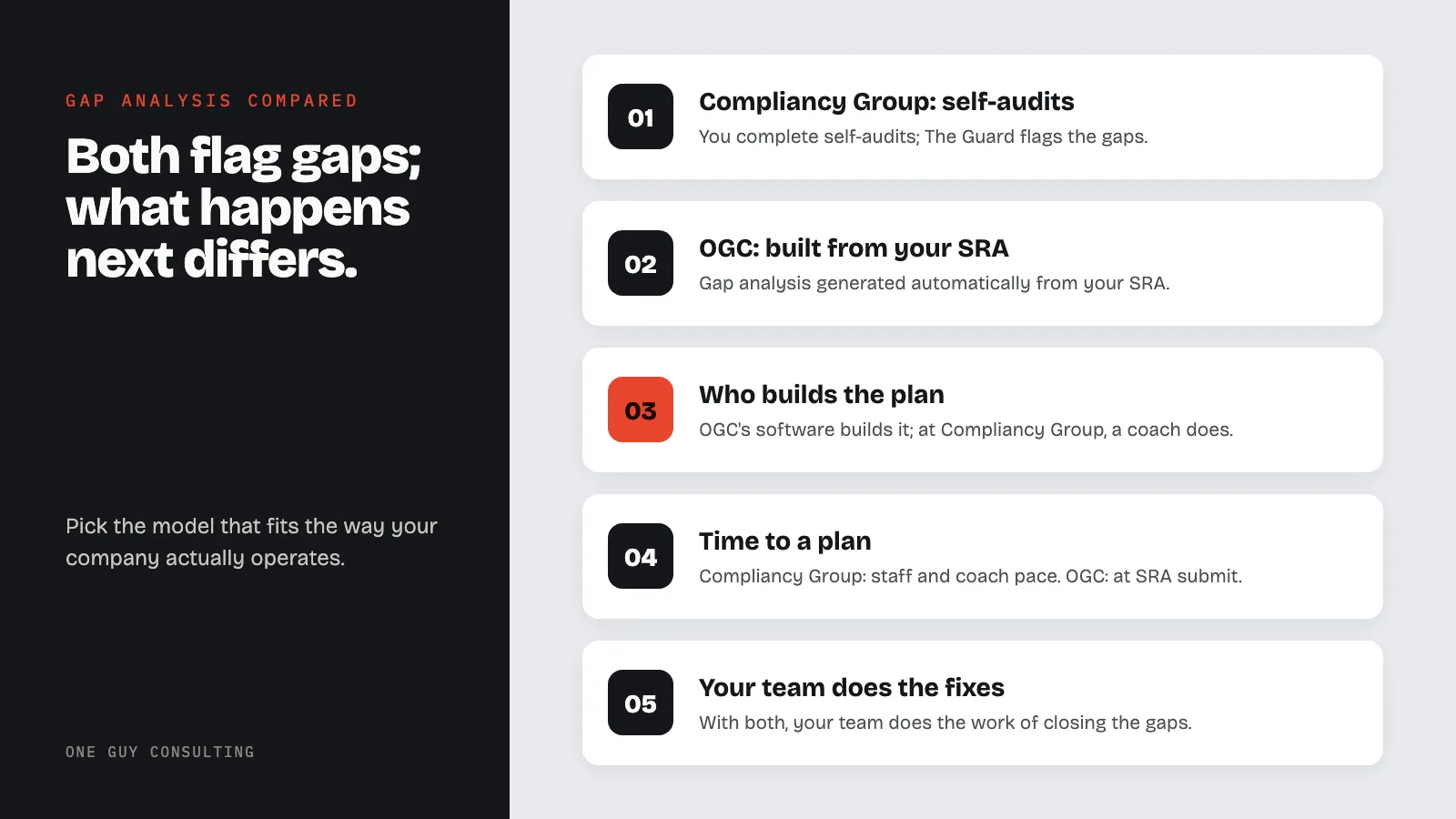
This article breaks down how each company handles HIPAA gap analysis so you can decide which model fits the way your company actually operates.
Key Takeaways
- Compliancy Group runs gap analysis in its platform, The Guard. You complete self-audits, and The Guard flags the gaps. Then a Compliance Coach creates the remediation plans for you to carry out.
- One Guy Consulting generates the gap analysis automatically from your Security Risk Assessment, then auto-builds a remediation plan.
- With Compliancy Group, timing depends on two things: how fast your staff finish the self-audits, and how soon a coach creates the plans. With One Guy Consulting, the gap analysis and remediation plan are ready the moment you submit the SRA.
- Choose Compliancy Group if you want a coach to create your remediation plans with you. Choose One Guy Consulting if you need gaps found fast and want the software to handle the busywork while your team closes them.
Key Terms Defined
- Security Risk Assessment (SRA): A careful check of the risks to your electronic PHI (patient health information you store or send electronically). It looks at what could expose that information, change it, or keep you from getting to it. The rule calls this an "accurate and thorough assessment," and it is required by 45 CFR 164.308(a)(1)(ii)(A). OCR is the HHS Office for Civil Rights, the agency that enforces HIPAA. In late 2024 it launched a Risk Analysis Initiative aimed at this exact requirement.
- Gap analysis: The comparison of your current safeguards against HIPAA’s requirements to find where you fall short. It follows the SRA and feeds the remediation plan.
- Remediation: The work of closing each identified gap. A remediation plan lists those actions with an owner, a due date, and evidence requirements for every item.
- Safeguards: The administrative (45 CFR 164.308), physical (45 CFR 164.310), and technical (45 CFR 164.312) protections HIPAA requires for electronic PHI.
- The Guard: Compliancy Group’s compliance-management platform, where you complete self-audits and the software flags your gaps.
Compliancy Group Gap Analysis vs One Guy Consulting: How Each Approach Works
Both companies use software to flag gaps. The difference is what happens next. At Compliancy Group, a Compliance Coach creates your remediation plans. At One Guy Consulting, the portal builds the remediation plan for you. It uses the same Security Risk Assessment that found the gaps. With both, your team does the work of closing the gaps.
Quick Comparison: Full Platform Overview
| Category | Compliancy Group | One Guy Consulting |
|---|---|---|
| Method | Self-audits in The Guard, guided by Compliance Coaches | Automated pipeline from SRA to gap analysis to remediation |
| Support Model | Dedicated Compliance Coach support | 4 hours a month of 1:1 implementation calls with Chuck (Full-Scope plan) |
| Gap Analysis Approach | Self-audits, mostly yes or no questions; The Guard flags the gaps | Auto-generated from Security Risk Assessment responses |
| Policy Delivery | Custom policies and procedures created with help from a Compliance Coach | Policy and procedure templates delivered through the compliance portal |
| Training Delivery | Built-in training modules with tracking | Staff training with progress tracking and automated annual reminders |
| BAA Management | Vendor questionnaires sent through The Guard; vendor gaps get remediation plans | Vendors sign their BAAs online, and the portal stores and tracks the signed agreements |
| Typical Timeline | Depends on how fast your staff finish the self-audits and how soon a coach creates the plans | Gap analysis and remediation plan ready the moment you submit the SRA |
| Pricing Model | Quote on request; last public list (archived July 28, 2026) started at $99 to $449 a month billed annually, plus $8 to $10 per employee per month | Self-Guided: $60/month, $675 for 12 months, or $1,175 for 24 months; Full-Scope: $120/month, $1,300 for 12 months, or $2,300 for 24 months (flat rate per location) |
Quick Comparison: Gap Analysis Approach
| Feature | Compliancy Group | One Guy Consulting |
|---|---|---|
| Gap Analysis Method | Self-audits in The Guard; gaps flagged automatically | Automated from Security Risk Assessment results |
| Evidence Collection | You upload and organize it in The Guard | Each plan item lists the proof you need to show it is done |
| Remediation Planning | Created by a Compliance Coach for you to carry out | Auto-generated from the gap analysis |
| Time to Actionable Results | Depends on your staff's pace and when the coach creates the plans | The moment you submit the SRA |
| Platform Management Required | Yes: your staff complete the self-audits in The Guard | Minimal: the portal builds the gap analysis and plan |
| Best For | Practices that want a coach to create their remediation plans | Practices that want gaps found fast, with the busywork automated |
How Compliancy Group Handles Gap Analysis
Compliancy Group uses The Guard, their compliance management platform, to walk companies through HIPAA requirements. The process works like this:
- You log into The Guard and complete its self-audits. Most are yes or no questions.
- The Guard flags gaps automatically from your answers.
- A Compliance Coach creates remediation plans for you to carry out.
- Evidence is uploaded and organized within the platform.
- A compliance coach provides guidance along the way.
This model has strengths. The coaching support is real, and companies that have the time and staff to work through the platform methodically can get solid results.
The real question: how much of the work do you want the software to do, and how much do you want a coach to do?
Where The Guard Leaves Work With You
Three things to know about this model.
You Still Answer Every Self-Audit. The Guard flags gaps, but only from your answers. You go through each self-audit and answer each question.
If you answer a question wrong, the gap may not show up. That is true of any questionnaire, including an SRA.
Evidence Collection Is on You. Once the gaps are found, you gather proof that each fix is done. Then you upload and organize that proof in The Guard. The platform does not pull evidence from your systems. You bring it to the platform.
Remediation Plans Come From a Coach. Compliancy Group says its Compliance Coaches create your remediation plans once the gaps are identified. So the plan comes from a person, not the software. You then carry out the plan.
How One Guy Consulting Automates Gap Analysis
OGC's gap analysis works differently. You answer the risk assessment questions in the portal, and the system generates the gap analysis from your Security Risk Assessment results.
Here's the pipeline:
- Complete the SRA inside the portal: a guided questionnaire covering administrative safeguards (45 CFR 164.308), physical safeguards (45 CFR 164.310), and technical safeguards (45 CFR 164.312).
- Gap analysis generates automatically: it is ready the moment you submit the SRA. No separate engagement, no second platform, no report to write by hand.
- Remediation plans auto-generate: the portal builds them from the gaps the analysis finds.
- Track progress in one place: a compliance dashboard shows your progress.
No separate gap analysis engagement. No building remediation plans from scratch. The SRA feeds the gap analysis, and the gap analysis feeds the remediation plan. One pipeline.
What the Automation Replaces
Here's what the portal does for you:
- Manual gap identification becomes automatic comparison of SRA responses against HIPAA requirements.
- Manual remediation planning becomes auto-generated remediation plans.
- Manual evidence tracking becomes a plan where each item lists the proof you need to show it is done.
- Manual progress reporting becomes a compliance dashboard. Training tracking and vendor management live in the same portal.
The key difference: at OGC, the software builds the remediation plan. At Compliancy Group, a coach does. Either way, your team still makes the fixes.
Different Philosophies, Same Regulation
Compliancy Group's model:
- Your team completes the self-audits in The Guard.
- The Guard flags gaps automatically from your answers.
- Compliance Coaches create the remediation plans.
- Coaches guide you through the whole process of putting the plans in place.
One Guy Consulting believes:
- Many small practices don't have compliance staff to train.
- Time spent navigating a platform is time not spent on patient care.
- Software should do the busywork so your team can focus on the fixes.
- A finished remediation plan matters more than the process of building one.
Both approaches can work. The question is which one matches your organization's reality.
Why Gap Analysis Speed Matters in 2026
If you are shopping for a gap analysis tool, you may already be behind on compliance. In late 2024, OCR launched a Risk Analysis Initiative aimed at the SRA. Written policies need to be implemented and tailored to your practice, not just downloaded from a template library. Staff training must be documented. 45 CFR 164.530(b)(2)(ii) says you must keep a record that the training was given.
A practice that's already behind needs two things: its gaps found, and a remediation plan it can start on right away.
With HIPAA fines increasing in 2026, every gap you leave open is a risk you carry until you close it.
What Each Platform Actually Delivers
Compliancy Group (The Guard) delivers:
- Built-in self-audits, most with yes or no questions.
- Dedicated Compliance Coach support.
- Custom policies and procedures created with help from a Compliance Coach.
- Training modules with built-in tracking.
- A HIPAA Seal of Compliance after completing their program (this is a vendor-issued badge, not a government certification).
- Automatic gap flagging from your self-audit answers.
- Remediation plans created by a Compliance Coach for you to carry out.
One Guy Consulting delivers:
- An automated pipeline where the SRA feeds directly into gap detection and remediation planning.
- 4 hours a month of 1:1 implementation calls with Chuck (Full-Scope plan).
- Policy and procedure templates delivered through the compliance portal.
- Automated BAA execution where vendors sign online and agreements are stored and tracked.
- Remediation plans auto-generated from the gap analysis.
- A compliance dashboard that tracks your progress.
Best Fit
Choose Compliancy Group if:
- You have a dedicated compliance officer with bandwidth to work through The Guard.
- You want to build internal compliance management capability over time.
- Your company is mostly compliant and needs a structured way to maintain it.
- You prefer guided coaching over automated output.
- You want a coach to create your remediation plans.
Choose One Guy Consulting if:
- You need gaps identified and remediation started right away.
- You don't have staff to dedicate to platform navigation.
- Your company is behind on compliance and needs to catch up fast.
- You want the SRA, gap analysis, and remediation plan connected in one automated pipeline.
- You want 1:1 implementation calls with the person who built the process (Full-Scope plan).
Final Take
Compliancy Group pairs its software with a coach who creates your remediation plans. One Guy Consulting's portal builds the gap analysis and remediation plan for you the moment you submit your SRA. Your team still does the work, and on the Full-Scope plan Chuck walks you through it. For practices already behind on Security Risk Assessments, BAA management, and policy records, that difference decides how fast you get a plan in hand.
Related Reading
- Compliancy Group vs One Guy Consulting: Which HIPAA Solution to Pick?: The full platform comparison.
- Accountable vs One Guy Consulting: HIPAA Compliance Compared: Another competitor breakdown.
- How to Conduct a HIPAA Risk Assessment: The SRA that feeds your gap analysis.
- HIPAA Fines Increased in 2026: Updated Penalty Amounts: Why gap closure speed matters.
FAQ
What is the main difference between Compliancy Group and One Guy Consulting for HIPAA gap analysis?
With Compliancy Group, you complete self-audits in The Guard and the software flags your gaps. Then a Compliance Coach creates your remediation plans. With One Guy Consulting, your Security Risk Assessment feeds straight into an automatic gap analysis. The portal then builds your remediation plan from it.
Which is faster for finding HIPAA compliance gaps?
One Guy Consulting's gap analysis and remediation plan are ready the moment you submit your Security Risk Assessment. With Compliancy Group, The Guard flags gaps once your self-audits are done. The remediation plans come from a Compliance Coach. So timing depends on how fast your staff finish the self-audits and how soon the coach creates the plans.
Does Compliancy Group automate their gap analysis?
Yes, for finding gaps. Compliancy Group says The Guard automatically finds gaps once you complete its self-audits. Its Compliance Coaches then create the remediation plans. At One Guy Consulting, the software builds both the gap analysis and the remediation plan.
Do I need a separate gap analysis engagement with One Guy Consulting?
No. The gap analysis generates automatically from your Security Risk Assessment results inside the OGC portal. There is no separate engagement, no extra cost, and no manual report assembly required.
Which is better if my company is already behind on HIPAA compliance?
One Guy Consulting is built for companies that are behind. The portal finds your gaps and builds a remediation plan the moment you submit your SRA, so you can start the same day. Compliancy Group's model needs two steps first: your staff finish the self-audits, and a coach creates the plans. That extra step matters when you are under time pressure from enforcement risk or upcoming audits.