HIPAA compliance for an optometry practice means protecting patient records in the clinic and the optical shop as one system. It takes a risk assessment, written policies, staff training, and an incident procedure. You also need business associate agreements (BAAs) with vendors that handle patient data. Nearly every practice must follow HIPAA, because filing vision plan claims electronically is enough.
An optometry practice is two businesses sharing one front door. On one side: a clinical operation with exams, diagnoses, dilations, and electronic insurance claims. On the other: a retail store selling frames, lenses, and contacts to anyone who walks in. The two sides share a computer system, a front desk, and a staff, and that sharing is where optometry's HIPAA problems actually live.
This article covers the covered-entity question, where the clinic-retail line runs through your data, which labs and suppliers need a BAA, and the front-of-house practices that matter when your waiting room is also a showroom.
HIPAA Compliance for Optometry: Where the Line Runs
You Are Almost Certainly a Covered Entity
The test is electronic standard transactions: file claims to vision plans or medical insurance electronically, check eligibility, receive electronic remittance, and you are a covered entity under HIPAA. For optometry, that is nearly everyone. Filing vision plan claims electronically is enough on its own. The full test lives in the covered entity guide, but optometry rarely needs the nuance: if you bill VSP-style plans electronically, or bill medical insurance electronically for eye disease visits, you are in.
What Counts as PHI in an Optometry Practice
The exam record, obviously. But also: the spectacle and contact lens prescriptions, the optical order tied to a patient name, vision plan claims and authorizations, referral letters to ophthalmology, retinal images and OCT scans, and the recall list your reminder system runs on. The instinct to treat "the shop side" as retail data fails in practice, because the frame order references the Rx, the Rx references the exam, and it all lives in one practice-management system. The workable rule: protect the whole system as if everything in it is PHI (protected health information), because functionally it is.
Labs, Suppliers, and BAAs
A BAA (business associate agreement) is a contract HIPAA requires with any outside company that handles patient information to do a job for you. The BAA guide covers what goes in one. In optometry, the clear cases are the claims clearinghouse, the practice-management and EHR (electronic health record) vendor, and the recall/reminder platform. Each one holds patient data to work for you. So each needs a signed BAA before patient data flows.
Optical labs and contact lens fulfillment services are a gray area, even though every job you send a lab carries a patient name and prescription. HIPAA has an exception for health care providers. A provider that gets patient information to treat the patient is not a business associate (45 CFR 160.103).
A lab or supplier filling a prescription may fit that exception. If you are not sure which side a lab is on, asking it to sign a BAA is the cautious choice. A frame vendor you order inventory from with no patient information attached is not a business associate at all. Run the inventory once, then keep it current through vendor management.
A Waiting Room That Is Also a Showroom
Optometry's front desk sits in the middle of a retail floor. Browsers try on frames a few feet from where a tech collects an insurance card and a medical history. The rules here are the ordinary reasonable-safeguard rules (take reasonable steps so others do not see or overhear patient information), applied to an unusual floor plan: check-in conversations at a lowered voice, monitors angled away from the frame displays, dilation and diagnosis conversations in the exam lane rather than at the register, and pickup calls that say the glasses are ready without narrating the prescription. The complete front-of-house set is in the front desk rules.
Contact Lens Releases and Records Requests
Two patient-rights notes specific to this specialty. Federal law already requires releasing the contact lens prescription after fitting; HIPAA's right of access sits alongside it, giving patients their full record within 30 days for a cost-based fee. Requests from a patient's new eye doctor are treatment disclosures and need no authorization at all. Do not make patients fight for prescriptions they are entitled to; it invites a complaint.
The Program, Sized for a Small Practice
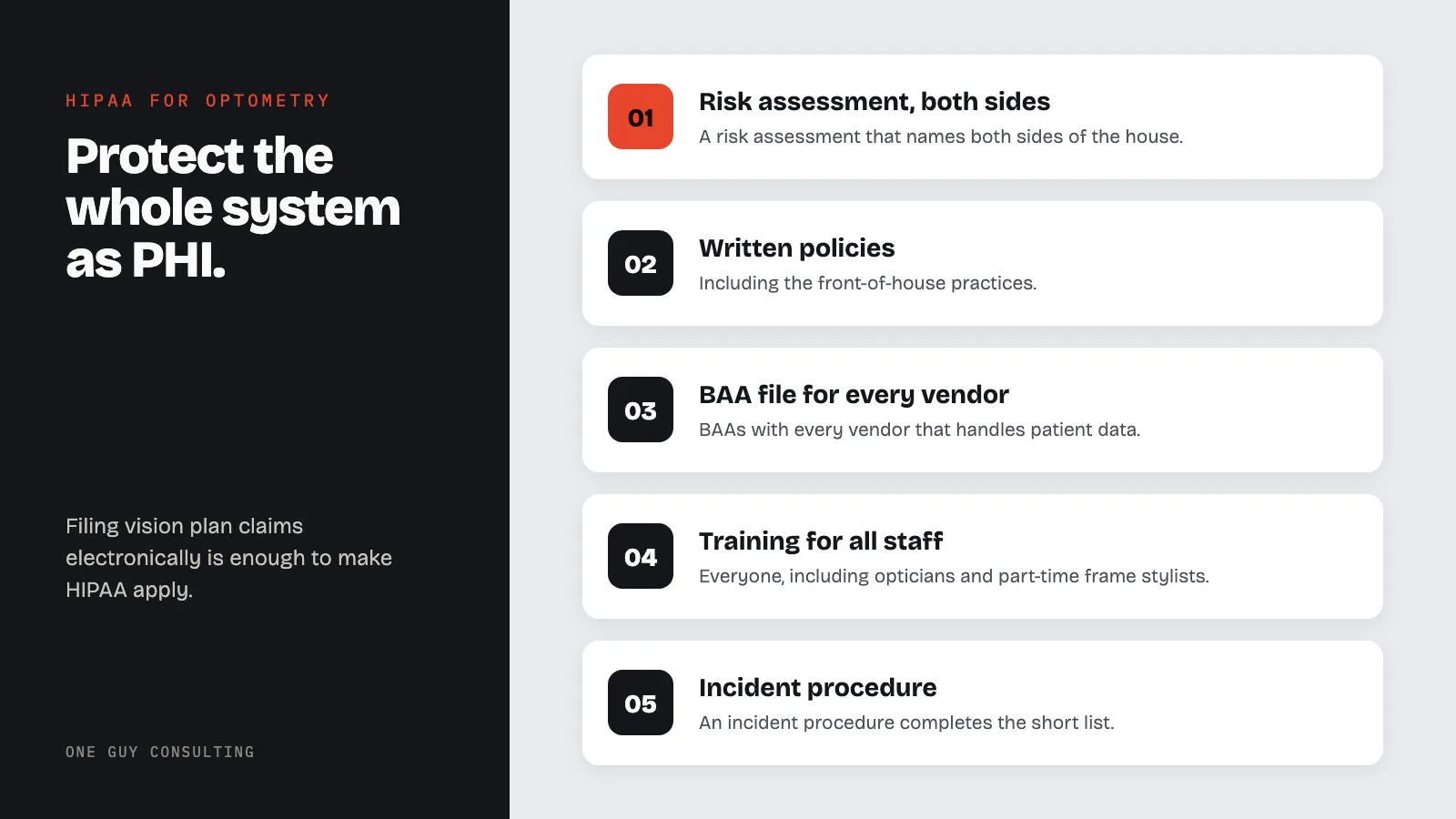
The baseline set: a risk assessment that names both sides of the house, written policies including the front-of-house practices, the BAA file with every vendor that handles patient data (plus any labs you choose to sign with), staff training for everyone including opticians and part-time frame stylists, and an incident procedure. It is a short list.
FAQ
Are optometrists covered entities under HIPAA?
Almost always. Filing vision plan or medical claims electronically, or checking eligibility electronically, makes the practice a covered entity. Filing vision plan claims electronically is enough on its own.
Does an optical lab need a business associate agreement?
Not always. Lab orders carry patient names and prescriptions. But HIPAA has an exception for health care providers: one that gets patient information to treat the patient is not a business associate (45 CFR 160.103). A lab filling a prescription may fit that exception. If you are not sure, asking the lab to sign a BAA is the cautious choice. Vendors that handle patient data for you, like the clearinghouse and EHR vendor, do need one.
Is the optical shop side of the practice covered by HIPAA?
Practically, yes. Frame and contact orders reference prescriptions and exam records in the same system, so the safest and simplest approach is to protect the entire practice-management system as PHI.
Do opticians and frame stylists need HIPAA training?
Yes. Everyone on your staff counts as workforce under HIPAA (45 CFR 160.103), including retail-side staff who look up orders and prescriptions. HIPAA requires training for all workforce members. It also requires a written record that the training happened (45 CFR 164.530(b)).
Do we have to release contact lens prescriptions?
Yes, twice over. Federal contact lens rules require releasing the prescription after fitting, and HIPAA's right of access covers the full record within 30 days for a reasonable cost-based fee.
One Guy Consulting builds compliance programs for exactly this kind of hybrid: clinical obligations, retail floor, small team wearing both hats. Annual plans are $675 (Self-Guided) or $1,300 (Full-Scope). Every plan includes vendor management with digital BAAs. The Full-Scope plan adds 4 hours a month of 1:1 implementation calls with Chuck. Start with a free 30-minute call. No obligation, no pressure.
Sources
Related Reading