Your sign-in sheet is not a HIPAA violation. Calling a patient's name in the waiting room is not a HIPAA violation. Somewhere along the way, front desk staff got taught to treat both like radioactive material, while the thing that actually triggers federal settlements, replying to online reviews, gets done casually on a lunch break.
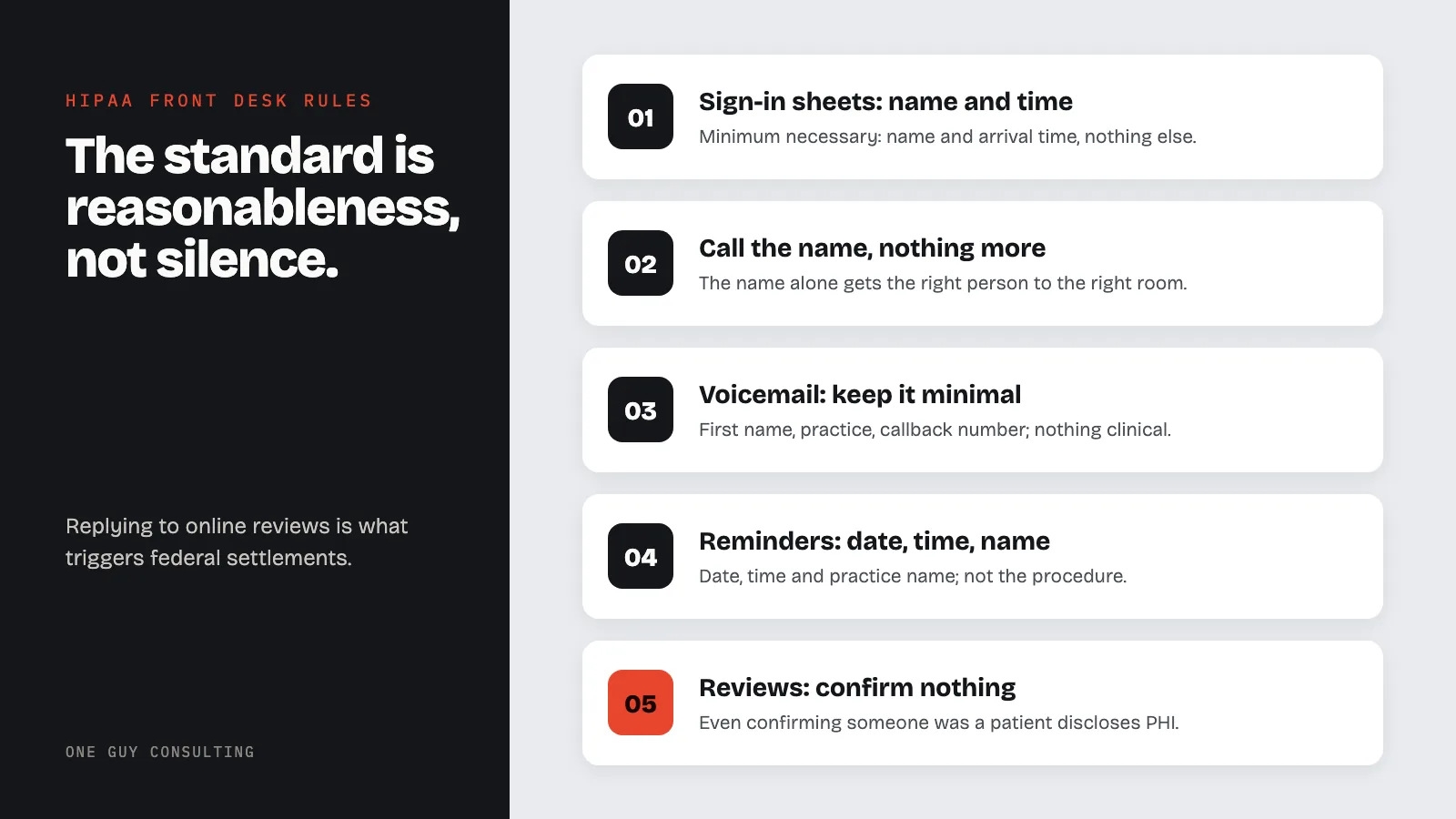
This article walks through the five front desk situations that come up in every small practice: sign-in sheets, calling names, phone calls and voicemail, appointment reminders, and online reviews. For each one: what the rule permits, what it does not, and the one step that keeps you on the right side of it.
HIPAA Front Desk Rules: What the Privacy Rule Actually Permits
Two provisions do most of the work here. First, the Privacy Rule explicitly permits disclosures that are "incident to" a permitted use, at 45 CFR 164.502(a)(1)(iii). In plain words: if you are running a medical office in a normal way, some PHI (protected health information) will be overheard or glimpsed, and the rule accounts for that. Second, 45 CFR 164.530(c) requires reasonable safeguards to limit those incidental disclosures.
Put together, the standard is not silence. It is reasonableness. HHS says this directly in its guidance on incidental uses and disclosures: the Privacy Rule is not intended to impede common health care communications.
The third piece is the minimum necessary rule: use the least information that gets the job done. That principle decides almost every front desk question below.
Sign-In Sheets: Permitted, With One Design Rule
Sign-in sheets are permitted. HHS has said so in published guidance for over two decades. The design rule is minimum necessary: name and arrival time, nothing else.
What gets practices in trouble is the extra column. "Reason for visit" next to a name, visible to everyone who signs in after, is not incidental. It is a design choice that discloses more than needed. Same for sheets that show the doctor's name at a practice where the doctor's name reveals the specialty. A columnless sheet, a sheet with tear-off labels, or a digital check-in kiosk all solve this.
Calling Names in the Waiting Room
Permitted. "Mr. Weiselberg?" is fine. "Mr. Weiselberg, here for your colonoscopy prep?" is not. The name is the minimum necessary to accomplish the task, which is getting the right person to the right room. Everything past the name is volunteered.
The same logic covers conversations at the desk. Checking a patient in, confirming a copay, scheduling a follow-up: all normal, all permitted, even if the person in line behind can hear fragments. Reasonable safeguards here look like lowered voices, a little distance between the desk and the chairs, and turning a monitor so it does not face the lobby. They do not look like soundproof glass.
Phone Calls and Voicemail
You can call patients. You can leave voicemail. HHS guidance asks you to limit the amount of information in the message. A safe voicemail script has three parts: the caller's first name and practice name, a callback number, and nothing clinical. "Hi, this is Dana from the office of Dr. Alvarez, please call us back at 646-555-0100." That is the whole message.
Two rules to write into policy: honor a patient's request to be called at a specific number (that request is a confidential communications right under 45 CFR 164.522(b), and you must accommodate reasonable ones), and never leave results on a machine, even normal ones. Results go to the patient, live or through the portal.
Appointment Reminders
Appointment reminders use PHI for treatment or health care operations (the everyday running of the practice). HIPAA allows them without an authorization. That means you do not need the patient's signed permission form. Postcards, calls, texts, all workable, with the same minimum necessary trim: date, time, practice name. Not the procedure. Not the specialty, if the specialty itself is sensitive.
If reminders go out by text, the texting itself has its own rules about consent and platform security. That is a separate topic, covered in the texting patients article.
Online Reviews: The One That Actually Costs Practices Money
Here is the trap. A patient leaves a one-star review that is unfair, wrong on the facts, and names your staff. Every instinct says correct the record. Under HIPAA, you cannot. Even confirming the reviewer was your patient is a disclosure of PHI, and there is no authorization on file that covers it.
This is not theoretical. OCR settled with a Dallas dental practice for $10,000 after it responded to patient reviews on Yelp with details from their records. The practice did what felt like customer service. The regulator read it as a series of impermissible disclosures.
The compliant response pattern is generic and free of details: "We take patient feedback seriously and are happy to discuss any concerns directly. Please call our office." Nothing that confirms a visit, a date, a diagnosis, or that the person was ever a patient at all. Train the exact wording, because improvisation is where this fails. The broader rules live in the social media compliance article.
What Actually Gets Front Desks in Trouble
The front desk problems worth fixing first are not sign-in sheets. They are: monitors angled toward the lobby with a full schedule on screen, printed schedules left at the desk overnight, speakerphone conversations with the door open, faxes sitting in an open tray, and charts stacked face-up at check-in. Every one of those is a physical safeguards problem with a zero-dollar fix: angle, drawer, handset, tray placement, face-down.
Make It Policy, Not Folklore
Most front desks run on folklore: rules a former office manager taught, half-remembered and over-strict in the wrong places. That is not shameful. It is the normal state of a small practice, and it is the starting point.
The fix is one written front desk policy (sign-in design, name-calling, voicemail script, reminder content, review response template) and fifteen minutes in staff training to walk through it. OCR (the HHS Office for Civil Rights) enforces HIPAA. If OCR ever asks how you control incidental disclosures (what gets overheard or seen by accident), that document is your answer.
FAQ
Are sign-in sheets a HIPAA violation?
No. HHS guidance permits sign-in sheets. Limit them to name and arrival time, and do not include a reason-for-visit column that other patients can see.
Can we call out patient names in the waiting room?
Yes. Calling a name to bring a patient back is a permitted incidental disclosure. Do not attach clinical details to the name.
What can we say in a voicemail under HIPAA?
Keep it minimal: caller first name, practice name, callback number. No test results, no diagnosis, no procedure names. Honor any patient request to use a specific number.
Can we respond to a negative Google or Yelp review?
Only generically. Confirming someone was a patient is itself a disclosure of PHI. Use a neutral template inviting the reviewer to call the office, and never include visit details. A dental practice paid a $10,000 OCR settlement for detailed review replies.
Do appointment reminders require patient authorization?
No. Reminders count as treatment or health care operations (the everyday running of the practice). So HIPAA allows them. Keep the content to date, time, and practice name, and follow the texting rules if reminders go by SMS.
If your front desk rules live in one veteran employee's head instead of a written policy, that is fixable in an afternoon. One Guy Consulting's Full-Scope plan includes policy and procedure templates, staff training, and 4 hours a month of 1:1 implementation calls with Chuck to work through exactly these situations. Start with a free 30-minute intro call. No obligation, no pressure.
Sources
- HHS guidance: Incidental Uses and Disclosures
- 45 CFR 164.502 (permitted uses and disclosures)
- 45 CFR 164.530 (administrative requirements, safeguards)
- HHS enforcement press release: Elite Dental Associates settlement
Related Reading
- The HIPAA minimum necessary rule in daily operations
- HIPAA rules for texting patients
- HIPAA and social media compliance
Related reading: HIPAA for Answering Services: A Business Associate With a Headset