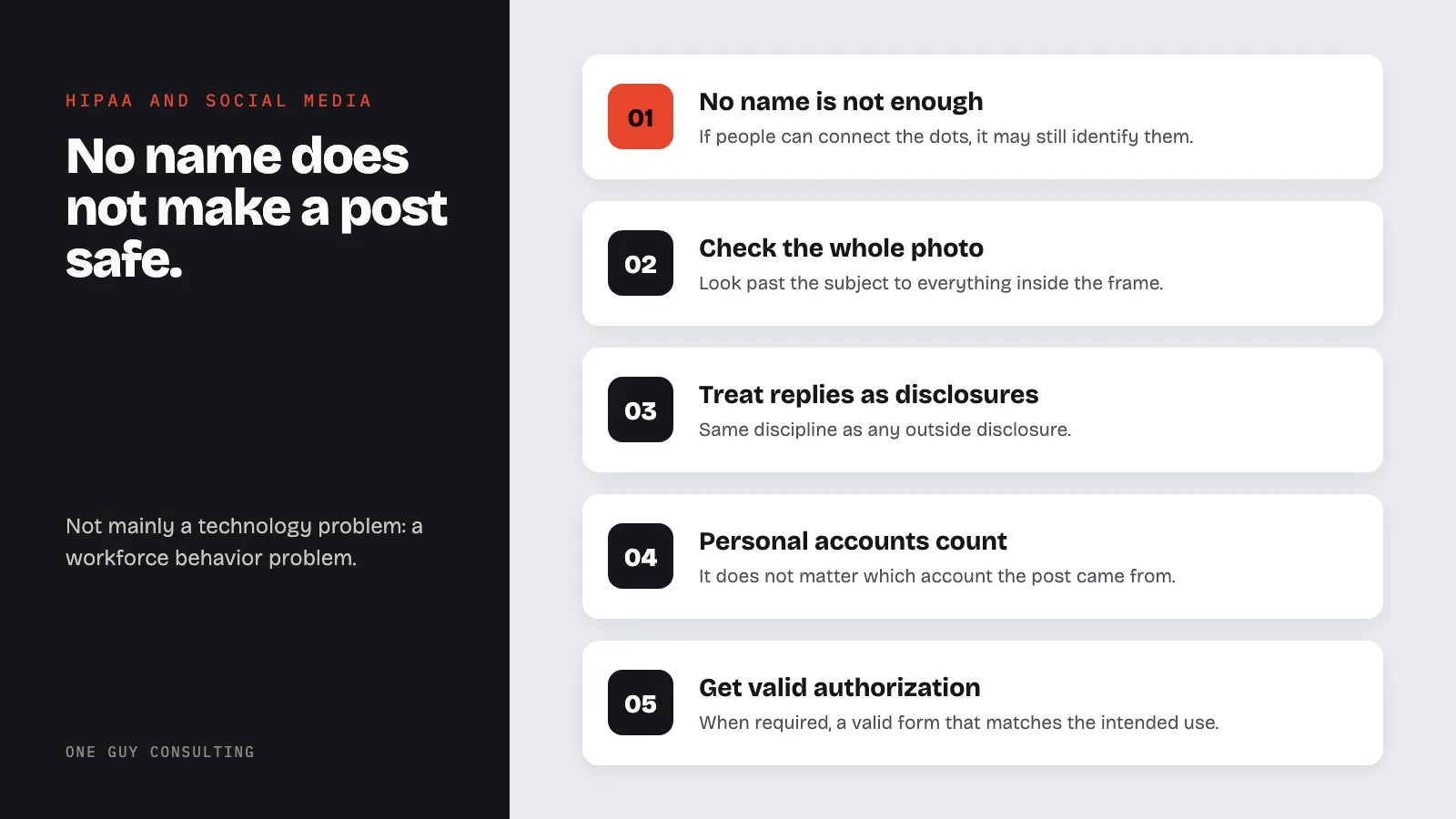
A social media post can violate HIPAA even when no name appears. A name is only one of 18 identifiers; dates, locations, photographs, and unique descriptive details count too. If the patient, family, or community can connect the dots, the post may still be an identifiable disclosure, and HIPAA does not care which account it came from.
Most HIPAA social media problems do not start with a staff member trying to be reckless.
They start with ordinary internet behavior:
- posting about a weird day at work
- sharing a selfie in a clinical setting
- telling a "funny" patient story
- celebrating a case outcome
- replying to a review with too much detail (see the front desk rules on patient reviews)
The staff member thinks they avoided names, so they think they are safe. A lot of the time, they are not.
HIPAA social media compliance (see also: HIPAA for Marketing Agencies) is really about understanding how easily patient information becomes identifiable once details, context, timing, and audience get mixed together. Most organizations treat this as a training footnote when it should be part of the broader privacy-control system that also includes authorization forms, workforce sanctions, and incident response.
If your organization has no real social media guardrails, you are relying on individual judgment in a place where judgment fails all the time.
What Counts as Protected Health Information
Protected Health Information (PHI) is individually identifiable health information that a covered entity or business associate holds or transmits, in any form: spoken, written, or electronic (45 CFR 160.103). It covers a person's past, present, or future physical or mental health condition, the care they received, and payment for that care, whenever the information identifies the person or there is a reasonable basis to believe it could be used to identify them. A name is only one of 18 identifiers; dates, locations, photographs, and unique descriptive details count too. That definition is why a social media post can violate HIPAA even when no name appears.
Why Social Media Creates So Much HIPAA Risk
Social media compresses thought and expands reach.
People post fast. They post casually. They post to mixed audiences. They post from personal accounts and work accounts, on phones, after hours, and while emotionally charged.
That is exactly the kind of environment where privacy mistakes happen.
Healthcare workers often assume Protected Health Information (PHI), any individually identifiable health information held or transmitted by a covered entity or its business associates, means just a patient name or medical record number. But under 45 CFR 164.502, an identifiable disclosure can come from a much wider set of facts:
- date and time
- location
- diagnosis details
- room number
- unusual circumstances
- images in the background
- combinations of small facts that point to one person
One post may seem harmless. In context, it may identify a patient very easily to family, coworkers, neighbors, or the local community.
The Biggest Myth: "I Did Not Use the Patient's Name"
That is the most common failed defense.
Staff think that if they leave out a name, the post is de-identified. But true HIPAA de-identification requires removing all 18 identifiers, and if the post says enough about the situation, identity can still be obvious.
Examples:
- "Craziest trauma case from the highway rollover tonight"
- "Delivered twin girls at 29 weeks and both made it"
- "Can not believe what this local school principal came in for today"
- "Another overdose from the downtown shelter"
No name appears. That does not make the post safe.
If the patient, family, or community can connect the dots, you may still have an identifiable disclosure, meaning information that could reasonably be used to identify a specific individual, even without a name attached. That is why "we did not use the patient's name" is one of the weakest defenses in a HIPAA social media investigation.
Photos Are Worse Than Staff Think
Photos create some of the most obvious and most preventable HIPAA social media incidents.
The risk is not limited to directly photographing a patient. Problems also come from:
- whiteboards in the background
- monitors or open charts
- wristbands
- room numbers
- ambulance run sheets
- printed schedules
- labels on specimen containers
- location clues tied to an event or timestamp
Staff often focus on the subject of the photo and ignore the environment inside the frame.
If your workforce uses phones in clinical areas, your social media policy should be very specific about image capture, not just posting. The same devices that create photo risks also create HIPAA texting risks when staff message patients through unsecured channels. This is especially important for organizations that already struggle with broad internal access or loose workflows in other areas of the privacy program.
Reviews, Comments, and Public Replies
Another high-risk area is replying to patient reviews.
Organizations want to defend themselves publicly when a patient posts something unfair or inaccurate. The temptation is to answer with just enough detail to prove the patient is wrong.
That is where the problem starts.
Even confirming that someone was treated at your facility can be risky in the wrong context. Adding scheduling, billing, clinical, or encounter detail makes it worse.
A bad public reply often sounds like this:
"We reviewed your chart and you were informed of the delay before your MRI."
That may feel like normal brand management. It is also the kind of response that can disclose PHI or confirm a treatment relationship too explicitly.
This is not hypothetical. In 2022, OCR settled with a dental practice for $23,000 after a staff member responded to a patient review on Yelp and disclosed the patient's treatment information. Earlier, Allergy Associates of Hartford paid $125,000 to settle a case where a physician responded to a patient review and disclosed clinical details. Both cases involved responses that felt routine to the person writing them.
Public replies should be handled with the same discipline you would use for any outside disclosure.
Personal Accounts Still Count
Healthcare workers often separate "work accounts" and "personal accounts" in their heads. HIPAA does not care which account the disclosure came from.
If a nurse, receptionist, technician, therapist, or physician posts identifiable patient information from a personal account, it is still a problem.
That means your policy and training cannot stop at official brand channels. Workforce expectations have to cover personal social media use when it intersects with patient information, workplace images, or job-related storytelling.
What Staff Usually Get Wrong
These are the most common failure patterns:
1. Storytelling About Real Cases
The staff member changes a few details and assumes that is enough. It often is not.
2. Clinical Selfies
The focus is on the employee, but the background contains PHI, location clues, or patient information.
3. Good Intentions
Celebrating a recovery, thanking a patient, posting a success story, or honoring a difficult case can still create a disclosure problem if the right permission is not in place.
4. Comment Replies
Someone from marketing or front office responds publicly and reveals too much in an attempt to be helpful or defensive.
5. Group Chats That Behave Like Social Platforms
Not every risky "social media" event happens on public platforms. Staff also overshare in informal group chats, closed groups, and direct-message threads that feel private but are not controlled environments.
What a Workable Social Media Policy Should Cover
Under 45 CFR 164.530(c), covered entities must have reasonable safeguards to protect PHI from intentional or unintentional uses or disclosures that violate the Privacy Rule. A social media policy is one of those safeguards, and it has to be usable, not just strict.
It should clearly address:
- no posting identifiable patient information without proper authorization
- no photos or videos in clinical areas unless specifically allowed
- no screenshots of charts, messages, schedules, or billing systems
- no discussion of patient stories in a way that could identify the person
- no public confirmation of patient relationships in review replies
- clear escalation for marketing, testimonial, and media requests
- sanctions for violations
The policy should also explain what staff are supposed to do instead.
If someone wants to share a patient success story, who approves it? If marketing wants to use a testimonial, what authorization is required? If a negative review appears, who handles the response?
Policies fail when they only say "do not do bad things." Staff need an operational path.
Authorization Changes the Analysis, But It Has to Be Real
Sometimes a patient genuinely wants to participate in marketing, testimonials, or public storytelling. That does not mean a verbal yes is enough.
Under 45 CFR 164.508, if a use or disclosure requires authorization, the organization needs a valid one and it needs to match the intended use. That includes knowing:
- what content will be shared
- on which platforms
- for what purpose
- for how long
If your marketing team is using broad or vague media releases, that deserves review just like any other HIPAA documentation workflow. A loose photo or testimonial release is not a substitute for a proper HIPAA authorization form.
Training Matters More Here Than People Admit
Social media risk is heavily behavioral. That means training matters.
Staff should see realistic examples, not just rules:
- why "no name" is not enough
- how background images create exposure
- what not to say in a review response
- when to escalate a request instead of improvising
If your HIPAA workforce training on this topic is one sentence in a general module, it is probably not enough. For guidance on how often HIPAA staff training should happen, especially at small practices where social media risk is hardest to control, the answer is more frequently than most organizations think.
A Quick Social Media Compliance Checklist
- Do staff know that identifiable disclosures can happen without naming the patient?
- Are photos and videos in clinical areas clearly restricted?
- Is there a defined process for testimonials and marketing approvals?
- Are review responses controlled by trained staff?
- Does the policy cover personal accounts, not just official channels?
- Are sanctions and reporting expectations clear?
If not, the organization is relying too heavily on ad hoc judgment.
Final Takeaway
HIPAA and social media compliance (see also: HIPAA for Marketing Agencies) is not mainly a technology problem. It is a workforce behavior problem.
The risk grows when organizations assume staff will "just know better" online. They often do not, especially when posting feels casual and immediate.
The better approach is straightforward:
- define the boundaries clearly
- control images and storytelling
- centralize public responses
- require proper authorization where needed
- train with real examples
That is how you keep routine posting habits from turning into reportable privacy incidents. The same organizations that stumble here often also have weak controls around minimum necessary access, review-response workflows, and informal data handling.
Need help tightening workforce policies, marketing approvals, and privacy training around social media use? One Guy Consulting helps healthcare organizations build HIPAA controls that staff can actually follow. Learn about HIPAA training support
FAQ
Can a healthcare worker post about a patient if they leave out the name?
Not safely by default. If the story, timing, location, image, or surrounding facts can still identify the patient, the post can still create a HIPAA problem.
Do personal social media accounts count under HIPAA?
Yes. If a staff member discloses identifiable patient information from a personal account, it is still a privacy issue even if the account is not an official work profile.
Can a medical practice reply to negative patient reviews online?
Yes, but carefully. The reply should avoid confirming treatment details or disclosing information that could identify the patient relationship too explicitly.
Do patient testimonials need authorization?
Often yes. If the testimonial, image, or story involves a use or disclosure that requires authorization, the organization needs a valid form that matches the actual intended use.
Key stat: OCR has issued guidance stating that even de-identified patient information can become a HIPAA violation on social media if the combination of details (dates, locations, conditions, photos of clinical settings) makes the patient identifiable. There is no safe harbor for social media posts - the minimum necessary standard applies to every disclosure, including informal ones.
Sources
- 45 CFR 164.502 - Uses and Disclosures of PHI
- 45 CFR 164.508 - Uses Requiring Authorization
- 45 CFR 164.530(b)(e) - Training and Sanctions
- HHS: Minimum Necessary Requirement
Related Reading
- HIPAA Email Compliance Guide: How email rules compare to social media disclosure requirements
- HIPAA Authorization Form Requirements: What a valid authorization must include before using patient stories or testimonials
- HIPAA Minimum Necessary Rule: Why broad sharing and casual over-disclosure create avoidable privacy risk
- Emailing PHI: HIPAA Rules for Safe Communication
- Is Faxing HIPAA Compliant?
- Cloud Storage Compliance for Healthcare
- Your Vendor Got Hacked: Now What?: How public communications and disclosure discipline matter after an incident
- OCR Fined a Substance Abuse Clinic $103K: A reminder that workforce mistakes can quickly become enforcement problems