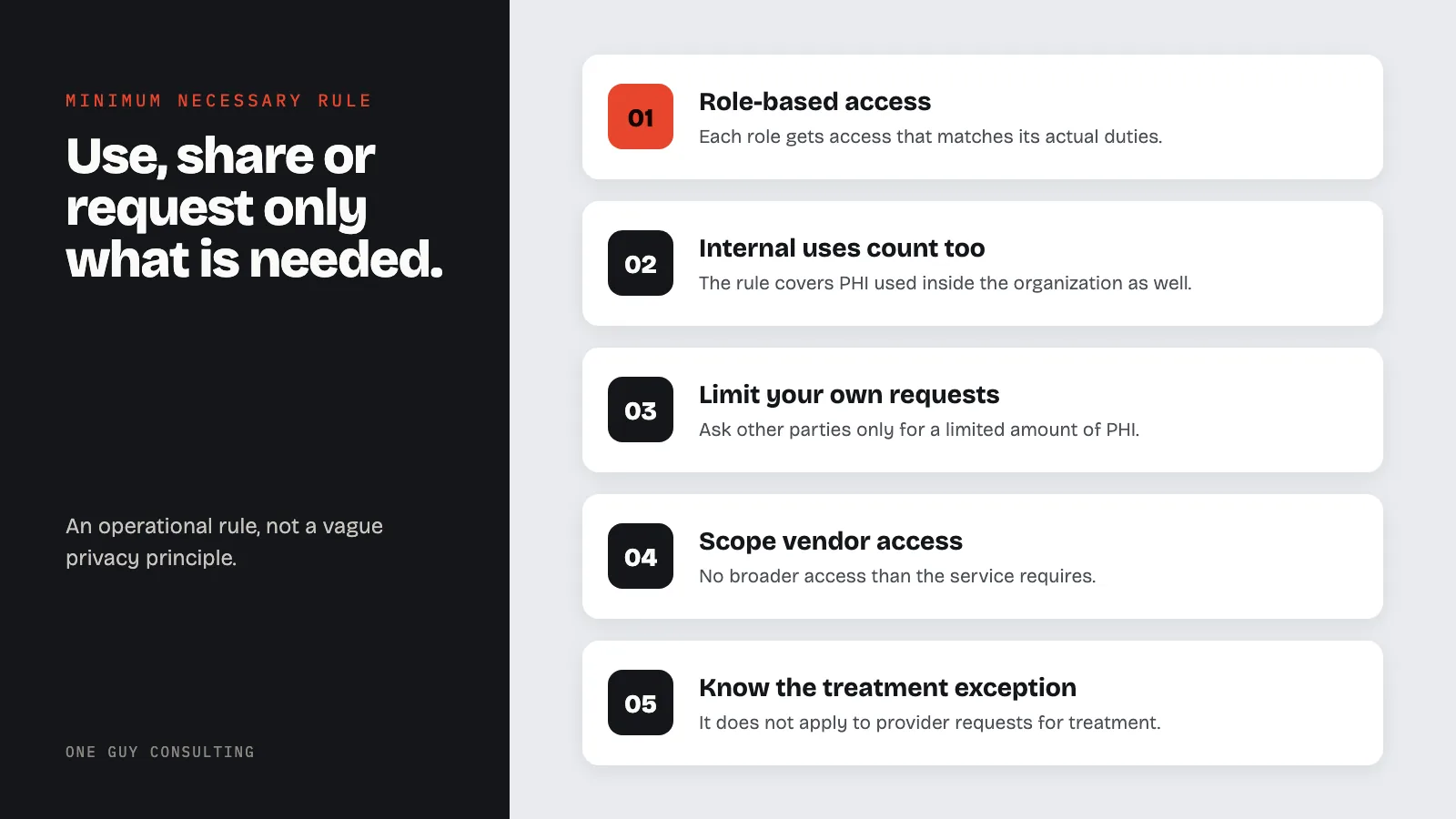
The HIPAA minimum necessary rule says: do not use, disclose, or request more protected health information than is reasonably needed for the job at hand. It is not a vague privacy principle. It is an operational rule under the Privacy Rule, and it affects access design, workflows, disclosures, reporting, and workforce training.
In practice, this is where a lot of organizations get sloppy.
Staff know they are "allowed" to access PHI for work, so they stop asking the next question: how much of that information do I actually need for this task? That is the question the minimum necessary rule is trying to force.
If your organization already struggles with broad access, weak vendor boundaries, or unclear disclosure workflows, this rule usually overlaps with gaps in your risk assessment process and your written HIPAA documentation.
If your organization treats minimum necessary as common sense rather than a documented control, you are leaving a gap in your privacy program.
What the Minimum Necessary Rule Requires
The rule applies to covered entities, such as medical practices. It also applies to business associates, the vendors that handle PHI for them. Both must make reasonable efforts to limit PHI to the minimum necessary to accomplish the intended purpose.
That applies to:
- internal uses of PHI
- disclosures of PHI
- requests for PHI from another party
The core idea is restraint. If a billing employee needs insurance and coding information, that does not mean they need access to every clinical note in the chart. If a vendor needs a dataset to troubleshoot an issue, that does not mean they need unrestricted access to your whole patient population. The same logic applies to business associates, internal teams, and any subcontractor with access to ePHI.
Where the Rule Does Not Apply
This is the part people forget.
The minimum necessary rule does not apply in every HIPAA situation. Some important exceptions include:
- disclosures to or requests by a provider for treatment
- disclosures to the individual who is the subject of the information
- uses or disclosures made pursuant to a valid authorization
- disclosures required for HIPAA compliance activities
- disclosures required by law in certain situations
That means you cannot use "minimum necessary" to interfere with treatment access between providers when HIPAA otherwise permits that disclosure for treatment purposes. But outside those exceptions, the rule matters a lot.
The Daily Operations Version of the Rule
The best way to understand minimum necessary is to stop thinking like a lawyer and start thinking like an operator.
For any use, disclosure, or request, ask:
- what is the purpose?
- what information is actually needed for that purpose?
- who needs it?
- for how long?
- through what system or workflow?
That is what minimum necessary looks like in reality. It is not "be careful." It is scope control.
Minimum Necessary and Workforce Access
This is where most organizations should start.
If every employee can see every patient record, you do not have a meaningful minimum necessary control. You have a convenience-based access model.
The rule supports role-based access. Different workforce roles should have different levels of access based on their actual responsibilities.
Examples:
- front desk staff may need demographic and scheduling information; the front desk HIPAA rules cover the day-to-day application
- billing staff may need claims, insurance, and limited service data
- IT support may need technical access but not routine clinical browsing rights
- HR staff generally should not have access to treatment records at all
A common failure is treating system permissions as an IT matter only. They are also a HIPAA matter. If access is broad because nobody wants to deal with permission mapping, the privacy risk is already baked in. That kind of gap often surfaces later in an OCR investigation, especially if the organization also lacks a current HIPAA risk assessment.
Internal Uses Are Still Uses
Organizations often focus on outside disclosures and miss the internal side of the rule.
Minimum necessary also applies to internal uses of PHI. That means:
- reports should not include fields nobody needs
- shared work queues should not expose unnecessary detail
- exported spreadsheets should be trimmed to purpose
- audit and review workflows should not circulate whole charts when summaries would do
A lot of internal privacy risk is not dramatic misconduct. It is operational laziness. The same over-sharing pattern shows up in communications: staff who text patients without considering HIPAA texting rules often send more clinical detail than the conversation requires.
Requests for PHI Are Part of the Rule Too
When your organization asks another party for PHI, the request itself should be limited.
This matters in:
- employment-related paperwork
- legal requests
- vendor troubleshooting
- payer communications
- audit support
If the task only requires vaccination dates, requesting "all medical records" is a bad request. If the task only requires claim support for one encounter, requesting the entire chart is excessive.
The rule applies to over-requesting just as much as over-disclosing.
The Most Common Minimum Necessary Mistakes
These failures show up constantly:
1. "Full Chart" as the Default
Staff get used to sending the full chart because it is easier than deciding what subset is actually needed.
That is operationally convenient and privacy-poor.
2. Shared Logins or Broad Department Access
If multiple staff use the same credentials, or whole departments inherit broad access regardless of role, you lose both accountability and limitation.
3. Exports With Too Many Fields
CSV exports, billing reports, and spreadsheets often contain far more data than the recipient actually needs. Those files then get emailed, stored locally, or forwarded around.
4. Vendor Access With No Scope Control
Support vendors often get broad access "temporarily" and then keep it indefinitely. That is exactly the kind of workflow that turns a support relationship into a privacy problem.
5. Staff Curiosity
The classic problem is unauthorized access driven by curiosity: a celebrity patient, a coworker, a neighbor, a family member, or a dramatic case. Minimum necessary helps define the line, but only if your training and sanctions process actually back it up.
Minimum Necessary Is Not Just Policy Language
A lot of HIPAA policies say the right words and then stop there.
To make the rule real, the organization needs controls in three places:
Access Design
- role-based permissions
- least-privilege defaults
- periodic access review
- offboarding controls
Workflow Design
- purpose-specific request forms
- limited report templates
- standardized disclosure workflows
- vendor access boundaries
Workforce Management
- training on when the rule applies
- sanctions for inappropriate access
- audit log review
- escalation paths for edge cases
Without those controls, the minimum necessary rule is just a sentence in a handbook.
How the Rule Applies to Vendors and Business Associates
Business associates are not off the hook. If a BA uses or receives PHI on behalf of a covered entity, the same limitation mindset applies.
Examples:
- a billing vendor should not give every employee unrestricted access to every client dataset
- a cloud support team should not use live PHI when de-identified or masked test data would work
- a subcontractor should not be granted broader access than the service requires
Covered entities should also ask how their business associates operationalize minimum necessary, not just whether they signed a BAA. A signed contract does not fix excessive access any more than a BAA fixes the mistakes covered in these common business associate agreement failures.
A Simple Test for Operations Teams
If a staff member or vendor says, "I need access to do my job," ask:
- to which records?
- to which fields?
- for what time period?
- for what exact purpose?
- in what system?
If nobody can answer those questions clearly, the access request is probably too broad.
Minimum Necessary and Incident Risk
The rule is often discussed as a privacy principle, but it is also a damage-limitation principle.
When access is narrower:
- fewer records are exposed when an account is compromised
- fewer people can browse data they do not need
- fewer oversized exports circulate
- fewer vendor accounts become major breach points
You cannot eliminate risk entirely, but minimum necessary reduces the size of the blast radius when something goes wrong.
A Quick Checklist
- Do workforce roles have purpose-based access limits?
- Do reports and exports include only needed data elements?
- Do disclosure workflows default to the smallest practical scope?
- Are vendor and support permissions limited and reviewed?
- Are staff trained on when treatment access is different from minimum necessary situations?
- Are audit logs reviewed for inappropriate access patterns?
If the answer is no to several of those, the rule is not really embedded in operations yet.
Final Takeaway
The HIPAA minimum necessary rule is not about making work harder. It is about making PHI access more intentional.
Organizations get into trouble when they normalize broad access, broad exports, and broad disclosures because it feels faster. That convenience creates privacy risk everywhere.
The better approach is narrower and more disciplined:
- define the purpose
- limit the scope
- document the workflow
- train the workforce
- review access regularly
That is what minimum necessary looks like when it is functioning as a real control instead of a slogan. If you are updating your privacy program this year, pair this work with your authorization forms and your access-control review so the rules match the workflow staff actually follow.
Need help tightening access controls, disclosure workflows, and workforce privacy practices? One Guy Consulting helps healthcare organizations turn HIPAA rules into operational controls that actually hold up. Learn about HIPAA consulting support
FAQ
What is the HIPAA minimum necessary rule in plain English?
It means your organization should use, disclose, or request only the amount of PHI reasonably needed for the task. It is a scope-limitation rule, not just a general privacy idea.
Does the minimum necessary rule apply to treatment?
Generally no. The rule does not apply to disclosures to or requests by a provider for treatment, which is one of the most important exceptions.
How do small practices comply with the minimum necessary rule?
Usually through role-based access, narrower reports, cleaner disclosure workflows, and workforce training. The goal is to stop defaulting to full-chart access or oversized exports when a smaller subset would work.
Does the minimum necessary rule apply to business associates?
Yes. The rule names business associates directly. A business associate should limit access and use of PHI to what is reasonably needed for the contracted service, especially for support staff, subcontractors, and administrative access paths.
Key stat: The minimum necessary standard has six explicit exemptions under 164.502(b)(2): disclosures to or requests by a healthcare provider for treatment, uses or disclosures made to the individual, uses or disclosures made pursuant to a valid authorization, disclosures to HHS for enforcement, uses or disclosures required by law, and uses or disclosures required for HIPAA compliance. Every other use, disclosure, or request must follow the minimum necessary standard.
Sources
- 45 CFR 164.502(b): Minimum Necessary Standard
- 45 CFR 164.514(d): Minimum Necessary Requirements
- HHS: Minimum Necessary Requirement Guidance
- 45 CFR 164.530(c): Safeguards
Related Reading
- HIPAA Privacy Rule Requirements
- Protected Health Information Guide
- PHI vs PII vs ePHI
- Notice of Privacy Practices Guide
- Patient Rights Under HIPAA
- HIPAA Authorization Form Requirements: When a disclosure needs proper authorization and what a valid form must include
- How to Run a Risk Assessment That Won't Get You Fined: The operational review that usually exposes broad-access and workflow gaps
- HIPAA Risk Assessment for Business Associates: How business associates should scope access, vendors, and subcontractor risk
- Why "Addressable" Doesn't Mean "Optional": Another HIPAA misunderstanding that leads to weak controls
Frequently Asked Questions
What is the HIPAA minimum necessary rule?
The HIPAA minimum necessary rule requires covered entities and business associates to make reasonable efforts to limit the use, disclosure, and request of PHI to the minimum amount necessary to accomplish the intended purpose.
Does the minimum necessary rule apply to treatment disclosures?
No. The rule does not apply when you share PHI with a healthcare provider for treatment, or when a provider asks for it for treatment. It also does not apply when you share PHI with the patient, or under a valid patient authorization (the patient’s signed permission). Three more exceptions: sharing with HHS for enforcement, uses or sharing required by law, and uses or sharing required for HIPAA compliance.
How should staff apply the minimum necessary standard day to day?
Staff should share only the specific PHI elements needed for the task at hand. Role-based access controls, clear policies, and regular training help staff consistently apply the standard.
What are common minimum necessary violations in healthcare?
Common violations include sending full medical records when only a subset was requested, granting broad system access to staff whose roles require only limited data, and forwarding entire patient files internally when a summary would suffice.