Short answer: yes, a sanction policy is required, and it is one of the first things an auditor asks to see. A sanction policy is your written rule for what happens when a member of your workforce breaks a HIPAA rule. HIPAA requires you to have a policy, to actually apply it, and to write down what you did.
Snooping in a neighbor’s chart, texting patient information to a personal phone, leaving a workstation logged in and unattended. HIPAA does not let you shrug those off. Most small practices have a policy buried in a binder and have never once used it. That gap is exactly what gets flagged.
Here is what the regulation requires, what a real policy contains, examples of matching the response to the violation, the three situations where you are not allowed to punish someone, and the mistakes that get practices cited.
Is a Sanction Policy Required by HIPAA?
Yes, and it is required twice, once under the Privacy Rule and once under the Security Rule.
What the regulation actually says
The Privacy Rule states it plainly. 45 CFR 164.530(e)(1):
A covered entity must have and apply appropriate sanctions against members of its workforce who fail to comply with the privacy policies and procedures of the covered entity or the requirements of this subpart or subpart D of this part.
The Security Rule says the same thing for electronic protected health information (ePHI). It is a Required implementation specification, not an addressable one, at 45 CFR 164.308(a)(1)(ii)(C):
Sanction policy (Required). Apply appropriate sanctions against workforce members who fail to comply with the security policies and procedures of the covered entity or business associate.
Two things to notice. First, “Required” means required. Unlike addressable specifications, you do not get to document why it does not apply to you and move on. Second, both rules use the phrase “have and apply.” A policy that exists on paper but is never used does not meet the standard. The applying is the requirement.
Business associates carry the same duty. The Security Rule language above names “the covered entity or business associate” directly, so an IT vendor, a billing company, or a managed service provider that touches ePHI needs its own sanction policy for its own workforce.
Have it, apply it, and document it
There is a second, quieter obligation attached to sanctions: you have to keep a record. 45 CFR 164.530(e)(2):
As required by paragraph (j) of this section, a covered entity must document the sanctions that are applied, if any.
And that documentation has a retention period. Under 45 CFR 164.530(j)(2), you must keep it “for six years from the date of its creation or the date when it last was in effect, whichever is later.” So a sanction you applied is not done when the conversation ends. The written record of it lives in your files for six years.
What a Compliant Sanction Policy Includes
The regulation says “appropriate,” which means it does not hand you a script. It leaves the details to you, sized to your practice. A workable sanction policy for a small office covers these pieces:
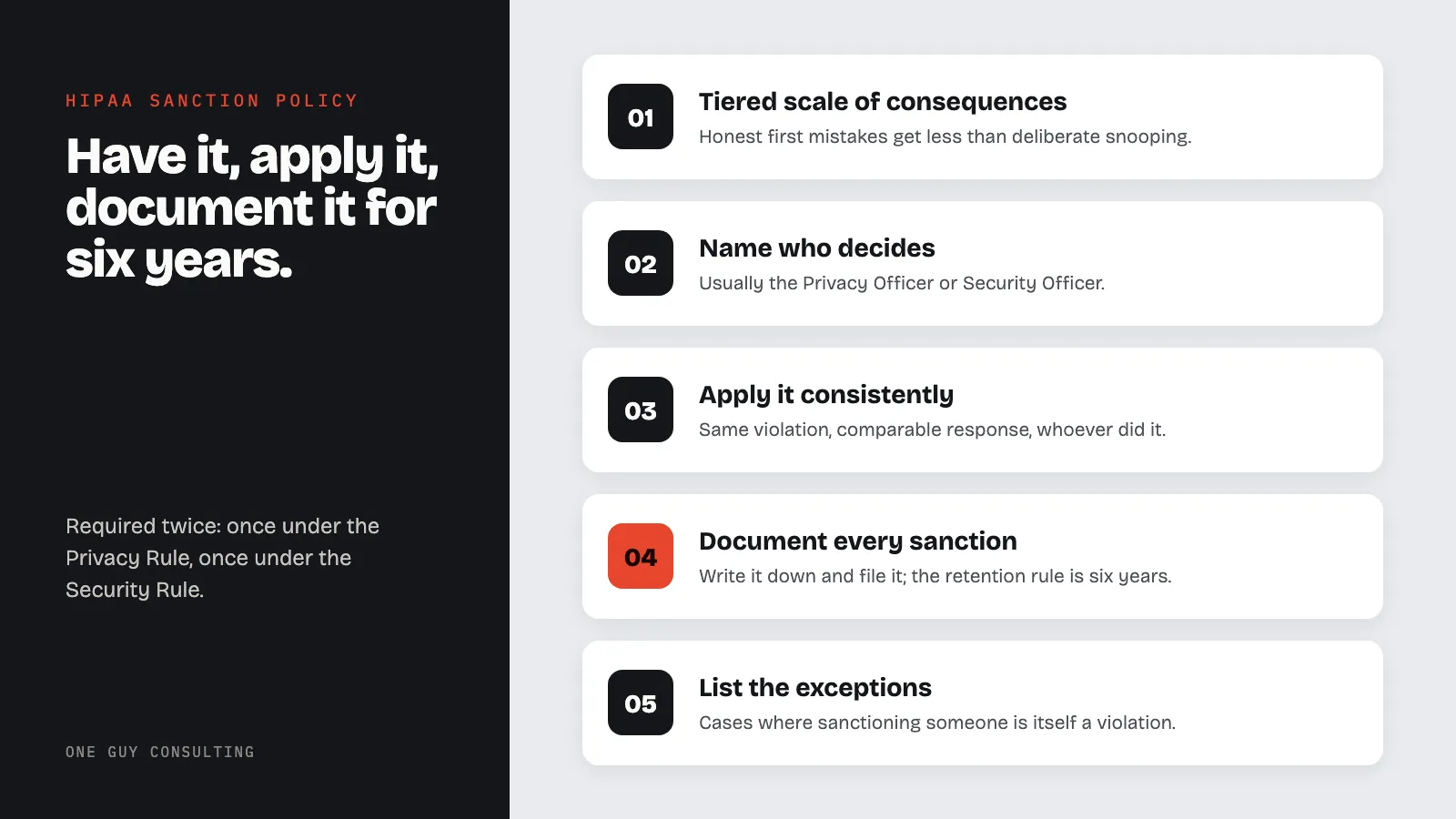
- A tiered scale of consequences. Minor, first-time, honest mistakes get a lighter response than deliberate snooping or repeat offenses. Spell out the range so it is not invented on the spot.
- Who decides and applies it. Name the role, usually the Privacy Officer or Security Officer, so it does not fall through the cracks.
- How the decision is made. A short list of factors: was it intentional, how sensitive was the information, was there patient harm, is it a repeat, did the person self-report.
- Consistency. The same violation gets a comparable response regardless of who did it. Inconsistent discipline is both an employment-law problem and a HIPAA weakness.
- The documentation step. Every applied sanction gets written down and filed, because 164.530(e)(2) and the six-year retention rule require it.
- The exceptions. The situations, covered below, where sanctioning someone is itself a violation.
Sanction Examples: Matching the Response to the Violation
“Appropriate” means the punishment fits the conduct. A first accidental fax to the wrong number is not the same as pulling up a celebrity’s chart out of curiosity. A tiered approach lets you be fair and consistent. The ranges below are a common structure, not a legal mandate; your policy sets your own.
| Violation | Typical first response | If deliberate or repeated |
|---|---|---|
| Accidental disclosure, self-reported (wrong-number fax, misdirected email) | Retraining, documented verbal counseling | Written warning |
| Leaving a workstation logged in, unlocked screen | Documented verbal counseling, retraining | Written warning |
| Sharing a login or password | Written warning, retraining | Suspension |
| Texting or emailing PHI on a personal, non-approved app | Written warning, retraining | Suspension |
| Accessing a record with no work reason (snooping) | Written warning to suspension | Termination |
| Selling or maliciously disclosing PHI | Termination | Termination and referral to authorities |
The point is not the exact rung. It is that you decided the ranges in advance, you apply them the same way to everyone, and you write down what you did.
The Exceptions: When You Cannot Sanction
This is the part practices get wrong, and getting it wrong is its own HIPAA violation. There are situations where disciplining a workforce member is prohibited.
- Whistleblowers and workforce-member crime victims. The sanctions standard itself carves these out. 164.530(e)(1) says it “does not apply to a member of the covered entity’s workforce with respect to actions that are covered by and that meet the conditions of Sec. 164.502(j).” In plain terms, an employee who reports a good-faith belief that the practice is breaking the law, to the right kind of recipient, is protected.
- People exercising their rights. You may not retaliate against anyone for using their HIPAA rights or filing a complaint. 164.530(g)(1) bars a covered entity from taking “retaliatory action against any individual for the exercise by the individual of any right established, or for participation in any process provided for, by this subpart,” including filing a complaint.
- Refusing to sign away rights. Under 164.530(h), you may not require an individual to waive their HIPAA rights as a condition of treatment, payment, enrollment, or benefits, so you cannot punish a refusal to do so.
Before you sanction anyone, check that the conduct is a genuine violation and not a protected act. Punishing a whistleblower or someone who filed a complaint turns your sanction into the finding against you.
Common Mistakes That Get Practices Cited
- A policy that has never been used. “Have and apply.” An empty sanctions log next to real, known violations tells an auditor the policy is decorative.
- No documentation. You handled it verbally and moved on. Under 164.530(e)(2) and the six-year retention rule, undocumented equals did not happen.
- Inconsistency. The front-desk hire gets fired for what a senior clinician got a warning for. That is a discrimination claim and a compliance gap at once.
- Punishing the wrong person. Sanctioning a whistleblower or someone who exercised a right, covered in the section above.
- Skipping business associates. A BA that touches ePHI and has no sanction policy for its own staff is out of compliance under 164.308(a)(1)(ii)(C).
- Confusing a sanction with a breach report. Disciplining the employee does not replace your separate breach-analysis and notification duties when a violation involves unsecured PHI. They are two different obligations.
What a Small Practice Should Do Now
- Find your sanction policy. If you have a HIPAA policy set, it is in there. If you cannot find one, that is the first gap to close.
- Make sure it has a tiered scale, names who applies it, and lists the exceptions above.
- Create a simple sanctions log, even a one-page form: date, what happened, what you decided, who signed off. Start using it.
- Train your staff that the policy exists and is real. A sanction policy nobody knows about does not change behavior.
- Keep every record for six years.
One Guy Consulting builds this into every compliance package: a sanction policy sized to your practice, a plain sanctions log, and the training so your team knows the rules are real before anyone tests them. We would rather help you set the standard now than help you explain a missing one later.
FAQ
Is a HIPAA sanction policy actually required?
Yes. The Privacy Rule requires it at 45 CFR 164.530(e)(1), and the Security Rule requires it as a Required implementation specification at 45 CFR 164.308(a)(1)(ii)(C). “Required” means you cannot opt out.
Does a written policy on its own satisfy HIPAA?
No. Both rules say “have and apply.” A policy that sits unused while known violations go unaddressed does not meet the standard. Applying it, and documenting that you did, is the requirement.
How long do we have to keep sanction records?
Six years. Under 45 CFR 164.530(j)(2), documentation must be retained “for six years from the date of its creation or the date when it last was in effect, whichever is later.”
Do business associates need a sanction policy too?
Yes. The Security Rule spec at 164.308(a)(1)(ii)(C) applies to “the covered entity or business associate,” so vendors, billing companies, and IT providers that handle ePHI need one for their own workforce.
Can we discipline an employee who reported us to OCR?
No. That is prohibited retaliation under 45 CFR 164.530(g), and the sanctions standard itself excludes protected whistleblower actions under 164.502(j). Sanctioning someone for exercising a HIPAA right or filing a complaint becomes a violation by you.
What is an “appropriate” sanction?
One that fits the conduct. An accidental, self-reported mistake warrants a lighter response than deliberate snooping or a repeat offense. The regulation leaves the specifics to you, as long as you apply them consistently and document them.
A HIPAA sanction policy is required, current law, and one of the easiest things to have and the easiest to neglect. The rule is short: have it, apply it, document it for six years, and do not use it against whistleblowers or people exercising their rights. If your policy has never left the binder, that is the gap to close before an auditor closes it for you.
One Guy Consulting offers affordable HIPAA compliance packages for practices of all sizes. See the plans and pricing.
Want to know whether your sanction policy would survive a real look? Book a free 30-minute review, no obligation and no pressure: schedule a time.
Sources
- 45 CFR 164.530 (Privacy Rule administrative requirements, including the sanctions standard at (e) and the six-year retention rule at (j)(2)): https://www.ecfr.gov/current/title-45/section-164.530
- 45 CFR 164.308 (Security Rule administrative safeguards, sanction policy at (a)(1)(ii)(C)): https://www.ecfr.gov/current/title-45/section-164.308
- 45 CFR 164.502 (uses and disclosures, whistleblower conditions at (j)): https://www.ecfr.gov/current/title-45/section-164.502
Related Reading - HIPAA Training Program Implementation - Termination Procedures Under HIPAA - HIPAA Documentation Requirements - HIPAA Privacy Rule Requirements - HIPAA Compliance Officer Guide
This article is educational and is not legal advice. HIPAA compliance depends on your specific circumstances; consult qualified counsel for your situation.