Claude can be HIPAA compliant only on the Enterprise plan or a HIPAA-ready Claude API organization. Either way, you need Anthropic's BAA (Business Associate Agreement). On Enterprise, the Primary Owner must turn on HIPAA and accept the BAA. Then patient information can go only through features the BAA covers. Claude Free, Pro, Max, and Team cannot turn on HIPAA.
In March 2026, OCR announced a settlement with MMG Fusion, a Maryland software company and business associate, after a December 2020 intrusion exposed the protected health information of approximately 15 million individuals. OCR said the company may have broken HIPAA in several ways. Here are two of them. It may not have done an accurate and thorough risk analysis. It may also not have told the covered entities it served about the breach. Covered entities are the providers and health plans HIPAA applies to.
MMG paid $10,000. OCR said it took the company's financial condition into account. MMG also agreed to a three-year plan to fix its problems (a corrective action plan).
The point for a practice choosing an AI vendor is not the dollar amount. The point is this: a software vendor holding patient data can fall short on its own security work. And the practices that rely on it may not hear about a breach from that vendor.
Is Claude HIPAA compliant? Yes, on the Enterprise plan, after a specific person flips a specific switch, and only for the features on Anthropic's covered list. Anthropic offers "a HIPAA-ready version of Claude that is available for organizations on Enterprise plans," which "includes a Business Associate Agreement (BAA), functionality, and safeguards designed to support an organization's HIPAA compliance requirements." Claude Free, Pro, Max, and Team "can't enable HIPAA."
A HIPAA-ready configuration also exists for the Claude API. This guide walks the plan, the B.A.A. (Business Associate Agreement), the features it covers and excludes, and the setup a practice owes on its side.
Is Claude HIPAA Compliant? The Enterprise Switch and the BAA
Does Anthropic Sign a BAA for Claude?
Yes, and the mechanics are unusually self-serve. On Claude Enterprise, "the Primary Owner of the organization must activate HIPAA compliance in the HIPAA-ready Claude Enterprise organization settings under 'Data and privacy' and accept Anthropic's BAA." The BAA "is included in the flow as click-to-accept," it "is a standard agreement and can't be modified," and clicking "Accept and Enable HIPAA" constitutes acceptance. Anthropic is direct about the default: "Standard Claude Enterprise plans do not include BAA coverage without action from a Primary Owner." Buying Enterprise is not enough. Someone has to press the button, and only the Primary Owner can.
Two more details matter. Enabling HIPAA "is a one-way decision" that "can't be reversed from organization settings," and it "resets certain settings across your organization."
Anthropic tells owners to review the BAA and its Implementation Guide for HIPAA Entities before accepting. That guide, on Anthropic's Trust Center, "lists every feature's status and is the authoritative source." Download both during the flow and file them with the date.
The regulation's version of this step is 45 CFR 164.502(e)(2): the assurance "must be documented through a written contract." A screenshot of the checkmark is not the contract. The full checklist for what a BAA must contain is in the business associate agreement guide.
Which Claude Plans Are HIPAA-Eligible?
| Plan or surface | BAA available | Notes from Anthropic |
|---|---|---|
| Claude Free, Pro, Max | No | Individual plans "can't enable HIPAA" |
| Claude Team | No | "Team plans ... can't enable HIPAA" |
| Claude Enterprise (self-serve or sales-assisted) | Yes, after the Primary Owner enables HIPAA and accepts the BAA | Covers Chat and the eligible features listed below |
| Claude API (first-party) | Yes, on a HIPAA-ready API organization | Owner signs the BAA, then Anthropic turns the configuration on; some API features are excluded |
| Claude through a third-party cloud provider | Not Anthropic's BAA | "Anthropic's BAA doesn't apply to services purchased through a third-party cloud provider" |
What the Claude BAA Covers, and What It Does Not
Anthropic publishes a feature table, and the honest summary is that enabling HIPAA "doesn't bring every feature under your BAA." Features fall into "covered by your BAA, available but not covered, and disabled," and P.H.I. (Protected Health Information) "should only be processed through covered features." On Enterprise, as of the fetched page:
- Covered: Chat, Projects, Artifacts, file creation and code execution (excluding network access and external websites), Voice, Web Search, Research, and Skills, for BAAs accepted after December 2, 2025.
- Available but not covered when data goes to third parties: MCP connectors, Enterprise Search, and Claude in Chrome. Anthropic's line: "sending data to 3rd parties via this feature isn't covered under Anthropic's BAA," and administrators who enable these features "are responsible for ensuring their workforce uses them in compliance."
- Not covered in any configuration: Cowork. Beta features such as Claude Design and parts of Claude for Office are also outside the BAA.
- Claude Code: covered "only with zero data retention (ZDR) enabled, and only on qualified accounts." Without ZDR it works but is not covered, "including when Claude Code access is bundled into your Enterprise seats."
- API exclusions on a HIPAA-ready organization: the Batch API, Files API, Skills API, code execution, computer use, and web fetch are "not covered under Anthropic BAA and not accessible for HIPAA-Ready API users."
One wrinkle for the newest models: Anthropic's "Covered Models," including Claude Fable 5, "require 30-day data retention" and cannot run with zero data retention. The covered paths to those models under the BAA are Chat on a HIPAA-ready Enterprise plan and the HIPAA-ready API. Anthropic says there is "currently no configuration" that lets you use them under the BAA in Claude Code or Cowork. Retention is a decision to make knowingly, not a default to discover.
What Stays Your Job
The BAA covers Anthropic's conduct with the PHI you send. Everything about what you send remains yours. 45 CFR 164.502(b)(1) requires a covered entity to "make reasonable efforts to limit protected health information to the minimum necessary to accomplish the intended purpose," and pasting a full chart into a prompt to draft a two-line letter fails that test with or without a BAA. What counts as PHI in an AI prompt is broader than most staff assume; a case description with an age, a date, and a clinic location can identify a patient with no name attached. Where the task allows it, strip the identifiers listed in 45 CFR 164.514(b)(2), as walked through in the de-identification guide, and the question of coverage becomes moot for that prompt.
The other job is the one OCR said MMG Fusion may have skipped. 45 CFR 164.308(a)(1)(ii)(A) requires "an accurate and thorough assessment of the potential risks and vulnerabilities" to ePHI. A HIPAA-ready Claude organization is a system that receives ePHI. It belongs in the risk analysis, with its connectors, its retention setting, and its user list.
How to Set Up Claude for HIPAA
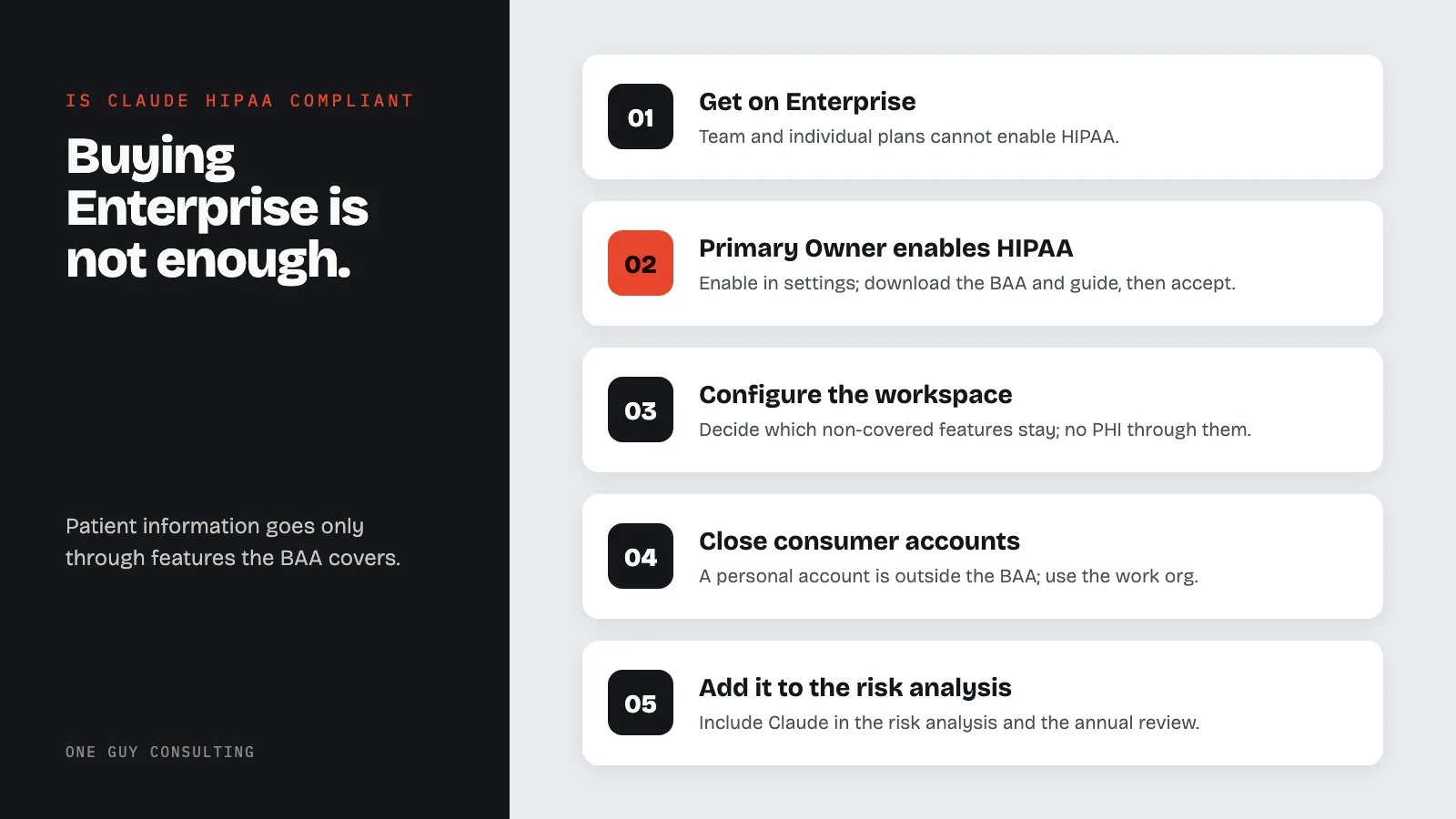
- Get on Enterprise. Team and individual plans cannot enable HIPAA, full stop.
- Have the Primary Owner enable HIPAA. Organization settings, Data and privacy, HIPAA Compliance, Enable. Download the BAA and the Implementation Guide during the flow, then accept.
- File both documents in the vendor register with the acceptance date. If the organization signed an API BAA before December 2, 2025, note that Anthropic says it "does not extend to the HIPAA-ready Enterprise plan," and a new BAA is needed.
- Configure the workspace to the guide. Decide, per Anthropic's table, which non-covered features stay on. If MCP connectors or Claude in Chrome remain enabled, the policy must say PHI never goes through them.
- Settle Claude Code. Either obtain ZDR for a qualified account or write "no PHI in Claude Code" into policy and training.
- Close the consumer accounts. A clinician's personal Pro account is outside the BAA. Require work use through the Enterprise organization only, the same rule the ChatGPT guidance applies to every consumer AI tool.
- Restrict access. Unique logins per person under 45 CFR 164.312(a)(2)(i), multifactor authentication where the console supports it, and prompt removal at termination.
- Write the AI acceptable use policy. Approved tools, prohibited data, approved tasks, an approval path for new tools, and sanctions.
- Add Claude to the risk analysis and to the annual review.
- Train staff on prompts, not just policy. The common slip is copy-paste from the EHR. Show what a minimum-necessary prompt looks like.
Common Claude HIPAA Mistakes
Buying Enterprise and assuming coverage. Anthropic says the opposite in one sentence.
Treating the checkmark as the contract. The BAA is the document you downloaded, dated and filed.
Leaving connectors on for everyone. The feature works; the coverage stops at the third party.
Mixing consumer and Enterprise use. The same person, two accounts, one of them outside the BAA.
Alternatives and Comparisons
| Tool | BAA path | Notes |
|---|---|---|
| Claude | Enterprise (owner enables HIPAA) or HIPAA-ready API | Published covered-feature table; Cowork and some betas excluded |
| ChatGPT | ChatGPT Enterprise and the OpenAI API | Free and Plus have no BAA; see the ChatGPT analysis |
| Microsoft 365 Copilot | In-scope under the Microsoft 365 BAA on commercial plans | Consumer Copilot is not; see the Microsoft 365 guide |
| Google Gemini | Gemini app and Gemini in Workspace are on Google's HIPAA Included Functionality list for paid Workspace with the BAA accepted | Consumer Gemini on a personal account is not |
Claude is one of the few AI assistants with a published, feature-by-feature statement of what its BAA covers. That transparency is useful, and it cuts both ways: the list of what is not covered is right there, and so is the sentence that says the plan alone does nothing. Read both before the first prompt with a patient's name in it.
FAQ
Does Anthropic sign a BAA for Claude?
Yes, for Claude Enterprise organizations after the Primary Owner enables HIPAA in organization settings and accepts the click-to-accept BAA, and for HIPAA-ready Claude API organizations. Free, Pro, Max, and Team plans cannot enable HIPAA.
Is Claude Pro or Claude Max HIPAA compliant?
No. Anthropic states that individual plans (Free, Pro, and Max) and Team plans can't enable HIPAA. A personal Claude account used with patient information is a disclosure to a vendor without a BAA.
Does enabling HIPAA on Claude Enterprise cover every feature?
No. Anthropic publishes a table: Chat, Projects, Artifacts, Voice, Web Search, Research, and Skills are covered; MCP connectors, Enterprise Search, and Claude in Chrome are available but sending data to third parties is not covered; Cowork and some beta features are not covered.
Is Claude Code covered by the BAA?
Only with zero data retention enabled on a qualified account. Without ZDR, Claude Code works but is not covered, even when it is bundled into Enterprise seats. Covered Models such as Claude Fable 5 cannot run under ZDR, and Anthropic says there is currently no setup that lets Claude Code use them under the BAA.
What does a practice still have to do after the BAA is accepted?
Configure the workspace to Anthropic's Implementation Guide, apply the minimum necessary standard to prompts, close consumer accounts, control access, write an AI acceptable use policy, and add Claude to the risk analysis.
AI tools arrive in a practice through the side door, and the policy usually arrives a year later. One Guy Consulting's Full-Scope plan includes vendor management with digital BAAs, policy and procedure templates, and 4 hours a month of 1:1 implementation calls with Chuck. Start with a free 30-minute intro call. No obligation, no pressure.
Sources
- Anthropic support: HIPAA-ready Enterprise plans (vendor page)
- Anthropic support: Business Associate Agreements (BAA) for Commercial Customers (vendor page)
- Anthropic support: Covered Models under a Business Associate Agreement (vendor page)
- 45 CFR 164.502 (uses and disclosures; minimum necessary at (b), business associates at (e))
- 45 CFR 164.514 (de-identification at (b))
- 45 CFR 164.308 (administrative safeguards)
Related Reading