
The 18 HIPAA identifiers are names, geographic data smaller than a state, dates related to an individual, telephone numbers, fax numbers, email addresses, Social Security numbers, medical record numbers, health plan beneficiary numbers, account numbers, certificate and license numbers, vehicle identifiers, device identifiers, web URLs, IP addresses, biometric identifiers, full-face photographs, and any other unique identifying number or code.
HIPAA does not protect all health data. It protects health data that can be tied back to a specific person. The dividing line is a set of 18 HIPAA identifiers defined in the Privacy Rule at 45 CFR §164.514(b)(2). This applies to health information held by a covered entity or its business associate, the two kinds of organizations HIPAA covers. If that information contains any one of these 18 data elements, it qualifies as protected health information, and every HIPAA safeguard applies.
This guide lists all 18 identifiers, explains what each one covers in practice, and shows you how to handle them.
Complete List of the 18 HIPAA Identifiers With Examples
The 18 HIPAA identifiers fall into a few natural categories: personal identity, dates and geography, contact information, government-issued numbers, and technical or biometric data. Below is each identifier as defined in the Safe Harbor de-identification standard, with real examples of how each one shows up in healthcare operations.
1. Names
Any name that identifies the individual. This includes first name, last name, maiden name, nickname, and initials when combined with other data. A patient intake form with "Maria Torres" attached to a diagnosis is PHI. An appointment reminder that says "M.T.: cardiology follow-up" is still PHI if someone in the office can connect those initials to a patient.
2. Geographic Data Smaller Than a State
Street address, city, county, ZIP code, and equivalent geocodes. HIPAA allows the first three digits of a ZIP code only if the geographic unit contains more than 20,000 people. If your billing system exports full addresses alongside diagnosis codes, every record in that export is PHI. A referral letter that includes "patient resides at 4200 Oak Lane, Suite B" converts the clinical information in that letter into PHI.
3. Dates Related to an Individual
Birth date, admission date, discharge date, date of death, and all ages over 89. You can use the year, but not the month or day, for most de-identification purposes. Ages over 89 must be removed or grouped into a single "90 or older" category. A discharge summary dated "January 14, 2026" tied to a diagnosis is PHI. A research dataset that lists exact birth dates alongside treatment codes has not been de-identified.
4. Telephone Numbers
Any phone number associated with the individual, including home, mobile, and work numbers. A call log at the front desk that says "Called 631-555-0188 re: lab results" is PHI because the phone number can identify the patient. Voicemail messages that reference a patient's condition and callback number create PHI the moment they are recorded.
5. Fax Numbers
Still common in healthcare. A fax cover sheet that includes the recipient's fax number and references a patient's treatment creates PHI on both the sending and receiving end. A misdirected fax can disclose PHI to the wrong person.
6. Email Addresses
Any email tied to the individual. An unencrypted email from a provider to a patient at jane.doe@email.com discussing test results is PHI in transit and at rest. Automated appointment confirmations sent to patient email addresses also qualify.
7. Social Security Numbers
Full or partial SSNs. Healthcare organizations frequently collect SSNs during insurance enrollment and billing. If your EHR stores SSNs alongside clinical records, a breach of that system exposes both identity and health data, so it is a HIPAA breach issue, not just an identity theft problem.
8. Medical Record Numbers
Internal identifiers assigned by the covered entity. An MRN like "MR-20260045" is meaningless outside your organization, but inside it, that number connects to every diagnosis, procedure, and note on file. Exporting MRNs in a research dataset without stripping them fails the Safe Harbor standard.
9. Health Plan Beneficiary Numbers
Insurance member IDs, Medicaid numbers, and Medicare beneficiary identifiers. A claims file that lists a beneficiary number alongside a procedure code is PHI. These numbers are issued by the health plan and can be used to identify the individual across providers.
10. Account Numbers
Any financial account number connected to the individual's healthcare, including billing account numbers, patient portal account IDs, and payment processing references. A billing statement mailed to the wrong address that shows account number and services rendered is treated as a reportable breach by default. It stays reportable unless a risk assessment shows a low probability that the information was compromised.
11. Certificate and License Numbers
Driver's license numbers, professional license numbers, and state ID numbers collected during patient registration. Many practices photocopy a driver's license at check-in. That copy, stored alongside clinical records, is PHI.
12. Vehicle Identifiers and Serial Numbers
VINs, license plate numbers, and other vehicle identifiers and serial numbers. This identifier matters most in emergency and trauma settings. An ER record that says "patient arrived via ambulance, vehicle plate ABC-1234 involved in collision" links the vehicle to the individual's health event.
13. Device Identifiers and Serial Numbers
Serial numbers on medical devices such as pacemakers, insulin pumps, CPAP machines, and prosthetics. Device recall notices that include a patient-linked serial number are PHI. If your inventory system tracks which device serial went to which patient, that mapping is PHI.
14. Web URLs
Any URL that identifies the individual. A patient portal URL like portal.example.com/patient/12345 is PHI. URL tracking parameters in appointment confirmation emails that can be traced back to a specific patient also qualify.
15. IP Addresses
An IP address logged alongside a patient's portal activity, telehealth session, or online form submission is PHI. This is the identifier most organizations overlook. If your website analytics tool captures IP addresses on pages where patients enter health information, you may be creating PHI in a system with no BAA. OCR's 2022 bulletin on online tracking technologies specifically addressed this risk.
16. Biometric Identifiers
Fingerprints, retinal scans, voiceprints, and facial geometry. Biometric data used for patient identification at check-in kiosks or employee access to medication dispensing systems creates PHI when linked to health records. Unlike passwords, biometric data cannot be changed after a breach.
17. Full-Face Photographs and Comparable Images
Any photograph or image that shows identifying facial features. Clinical photographs taken during dermatology visits, surgical documentation, or wound care assessments are PHI. A "before and after" photo posted to a practice's social media page without written patient authorization is a HIPAA violation even if the patient's name is not included, because the face itself is the identifier.
18. Any Other Unique Identifying Number or Code
This is the catch-all. Any characteristic or code that could identify an individual, including employee ID numbers used in occupational health records, research subject IDs that can be cross-referenced to identity, or internal tracking codes mapped to patients. If a reasonable person could use the number to identify someone, it qualifies.
Why the 18 HIPAA Identifiers Matter for Your Practice
These identifiers are not an academic list. They define the boundary between data you can share freely and data that triggers every HIPAA obligation: access controls, encryption, audit logging, breach notification, and business associate agreements with every vendor that touches it.
The consequences are concrete. In 2024, OCR settled with multiple covered entities for failures to protect PHI containing these identifiers, with penalties ranging from tens of thousands to millions of dollars.
The practical question is not whether your organization collects these identifiers. You do. The question is whether you know where all 18 appear in your systems and whether each location has appropriate safeguards.
How to Protect the 18 HIPAA Identifiers in Your Organization
Protecting these identifiers starts with knowing where they live. Most healthcare organizations store identifiers across more EHR fields, spreadsheets, email threads, and paper forms than they realize.
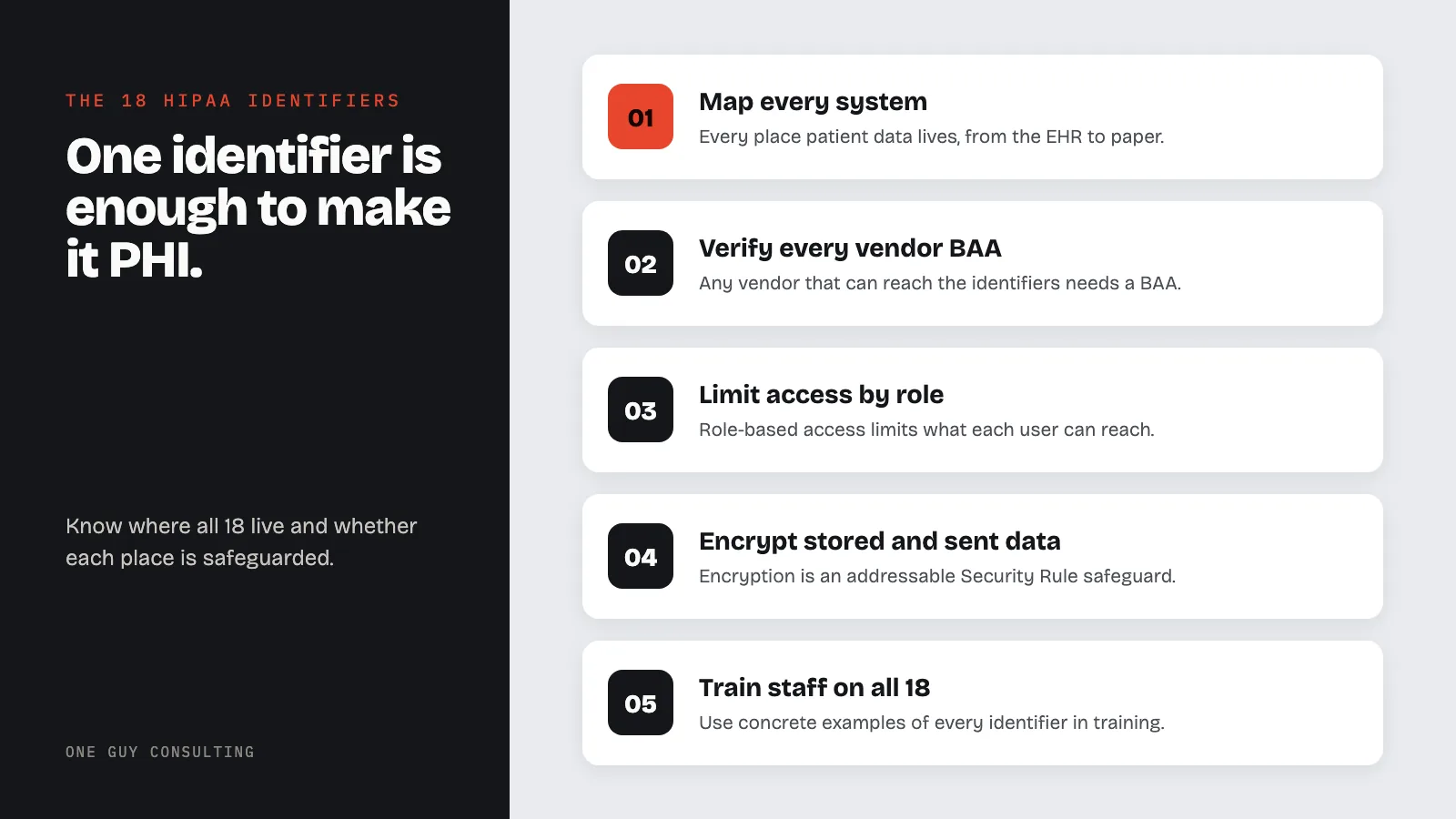
- Map every system that stores patient data. This includes your EHR, billing platform, scheduling software, email, fax, cloud storage, paper files, and any vendor portals. For each system, document which of the 18 identifiers it contains.
- Verify BAAs are in place for every vendor. If a cloud storage provider, billing clearinghouse, or IT support company can access systems containing any of the 18 identifiers, you need a business associate agreement with them. Sharing PHI with a business associate without a BAA is itself a HIPAA violation.
- Apply access controls based on role. Front desk staff need scheduling data. They do not need access to clinical notes. Billing staff need insurance identifiers. They do not need radiology images. Role-based access limits how many identifiers any single user can reach.
- Encrypt data at rest and in transit. Encryption is an addressable safeguard under the Security Rule. Addressable means you must use it if it is reasonable and appropriate for your practice. If it is not, you must write down why and use an equivalent alternative if one is reasonable. Skipping encryption without that written record is hard to defend after a breach. And if encrypted data is lost, breach notification is generally not required. If a laptop with unencrypted patient records is stolen, every identifier on that device is exposed, and the theft is treated as reportable by default.
- Train staff on what counts as an identifier. Most staff understand that names and SSNs are sensitive. Fewer realize that an IP address, a ZIP code, or a device serial number can make health data into PHI. HIPAA training should include concrete examples of all 18 identifiers.
- Run a security risk assessment. A security risk assessment (the Security Rule calls it a risk analysis) is required by the Security Rule at 45 CFR §164.308(a)(1)(ii)(A). This is where you identify gaps in how your organization handles identifiers, including systems that store them without adequate safeguards.
De-Identification: Removing the 18 Identifiers
HIPAA provides two paths to de-identify health data so it no longer qualifies as PHI:
Safe Harbor (45 CFR §164.514(b)(2)): Remove all 18 identifiers, both for the person and for the person's relatives, employers, and household members. You also must not actually know of any way the remaining data could identify the person. This is the method most organizations use because it is prescriptive. If you strip every identifier on the list and know of no such way, the data counts as de-identified.
Expert Determination (45 CFR §164.514(b)(1)): A qualified statistical expert decides that the risk someone could figure out who the data is about (re-identification) is "very small." This method is used mainly in research. The expert must write down the methods and results of the analysis.
For a deeper breakdown of both methods, including common mistakes, see our guide to HIPAA de-identification requirements.
FAQs About the 18 HIPAA Identifiers
Is a ZIP code considered PHI under HIPAA?
A ZIP code alone is not PHI. But a ZIP code combined with any health information, such as a diagnosis, treatment, or provider visit, becomes PHI because geographic data smaller than a state is one of the 18 HIPAA identifiers. The Safe Harbor method allows only the first three digits of a ZIP code, and only if the area has more than 20,000 residents.
Does HIPAA consider an IP address to be PHI?
Yes, when linked to health information. An IP address logged during a telehealth session, patient portal login, or online health form submission qualifies as PHI. OCR's 2022 guidance on online tracking technologies (updated in 2024) covers pages where patients log in or submit health information, like a patient portal or an intake form. It says analytics tools that capture IP addresses on those pages may be creating PHI without a business associate agreement in place. A 2024 federal court ruling struck down the part covering visits to public pages that need no login.
What happens if only one identifier is attached to health data?
One identifier is enough. Say a covered entity or business associate holds health information. If a single data element from the list of 18 is combined with it, the record is PHI and HIPAA applies in full. There is no threshold requiring multiple identifiers.
Can I use patient data for research without removing all 18 identifiers?
You can if you obtain a valid HIPAA authorization from the patient, or if an Institutional Review Board or Privacy Board grants a waiver. Another option is a limited data set, which may keep dates and ZIP codes. You can use one under a data use agreement. Outside those routes and a few narrow exceptions, the data must be de-identified using either the Safe Harbor or Expert Determination method before it can be used for research without authorization.
Are employee health records subject to the 18 HIPAA identifiers?
It depends on context. Employee health records maintained by a covered entity acting as a healthcare provider, such as an employee wellness clinic, are protected by HIPAA. Employment records held by the employer in its capacity as an employer are generally not covered by HIPAA, though they may be covered by other laws like the ADA.
How often should we audit where the 18 identifiers are stored?
At least annually as part of your security risk assessment, and whenever you add a new system, vendor, or workflow that handles patient data. New tools, from scheduling apps to AI transcription services, can introduce new locations where identifiers are stored without your compliance team knowing about it.
The 18 HIPAA identifiers are the line between health data and protected health information. Every HIPAA obligation, from encryption to breach notification, flows from whether your data contains one or more of these identifiers. Knowing the list is the starting point. Knowing where each identifier lives in your systems and whether it is adequately protected is where compliance actually happens.
One Guy Consulting helps healthcare organizations map their PHI exposure, close gaps, and build safeguards that hold up under an OCR investigation. Schedule a free HIPAA checkup to find out where your practice stands.
Find where the 18 identifiers live in your practice. That is the job of a Security Risk Assessment: identify every system, device, and workflow that stores, transmits, or accesses ePHI, then rate the risk. See how the OGC risk assessment works.
Sources
- 45 CFR §164.514: Other requirements relating to uses and disclosures of PHI
- HHS Guidance on De-identification of PHI
- OCR Bulletin on Online Tracking Technologies (2022)
- HHS OCR Resolution Agreements and Civil Money Penalties
- HIPAA Security Rule
Related Reading
- HIPAA De-Identification: Safe Harbor Method & Requirements
- Understanding PHI: A Complete Guide
- PHI vs PII vs ePHI: Key Differences
Related reading: HIPAA and Tracking Pixels: Where a Practice Site Can Use Analytics