Is Your HIPAA Compliance Badge Actually a Compliance Risk?
Direct answer: Third-party HIPAA compliance badges can create compliance risks by embedding tracking scripts, transmitting referrer data (potentially including patient-identifying URL parameters) to external domains, and introducing redirect vulnerabilities. Under 45 CFR 164.502(a), disclosing PHI to a third party without authorization or a Business Associate Agreement is an impermissible disclosure.
A badge that sends visitor data to advertising platforms without a BAA may violate this standard.
You passed your compliance program. You trained your staff. You adopted policies and signed BAAs. And to prove it, you embedded a shiny "HIPAA Compliant" badge on your website from your compliance vendor.
But what if that badge is quietly undermining the very compliance it claims to represent?
We investigated several popular compliance badge implementations and found something alarming: the badges themselves may be creating HIPAA violations for the organizations that display them.
Key Terms Defined
- Tracking pixel: A small image (often 1x1 pixels) embedded on a web page that transmits visitor data (including IP address, browser type, and referring URL) to a third-party server each time the page loads. Any externally hosted image, including a compliance badge, can function as a tracking pixel.
- HTTP referrer header: Information a web browser sends on its own to another site, showing where the visitor came from. Most browsers now send only your domain by default. But some site settings let it send the full page URL. If that URL includes patient details (such as appointment type or condition), the referrer header passes those details to the other site.
- Redirect vulnerability: A security weakness created when a link on your website points to an external URL you do not control. If the external server is compromised, the link can be redirected to a malicious destination without any change to your website.
- Third-party script: Any JavaScript code loaded from an external domain. Third-party scripts can read page content, set cookies, track user behavior, and transmit data to servers outside your control.
- PHI leakage: The unintentional disclosure of protected health information to unauthorized parties. In the context of web tracking, PHI leakage occurs when visitor data that can be linked to health-related activity is transmitted to analytics or advertising platforms.
- Cross-site tracking: The practice of tracking a user's activity across multiple websites using cookies, pixels, or fingerprinting. When a compliance badge loads from a vendor's server, the vendor can track which healthcare websites the visitor has accessed.
How Badge Risks Work, Step by Step
- Badge loads external resources. When a patient visits your healthcare website, their browser requests the badge image from the vendor's server. If the badge includes JavaScript, that script also executes in the patient's browser.
- Browser sends referrer header. The browser automatically includes the HTTP referrer header in the request to the vendor's server. This header tells the vendor which website the patient came from. Most browsers now send only your domain by default. But some site settings let it carry the full URL of the page the patient was viewing.
- URLs may contain patient identifiers. If the full referring URL is sent and includes parameters like
/appointments/mental-health-evaluation,/patient-portal/lab-results, or/schedule?provider=psychiatry, those details are transmitted to the badge vendor and any trackers on the destination page. - This can be an impermissible PHI disclosure. Under 45 CFR 164.502(a), a covered entity may not use or disclose PHI except as permitted. Transmitting individually identifiable health information to advertising platforms that have no BAA with your organization can be an impermissible disclosure (sharing PHI in a way the rules do not allow), even if no one meant to send it.
What Happens When Someone Clicks Your Badge
Most compliance badges work the same way. The image links to a "verification page" on the vendor's domain, something like vendor.com/hipaa-verification/your-company. Sounds reasonable. A visitor clicks it, sees proof you are compliant, and moves on.
Here is what actually happens behind the scenes.
When we tested one popular badge, the verification URL did not load a verification page at all. Instead, it triggered a chain of two 301 redirects before landing on a completely different page: a blog post on the vendor's marketing site.
- Hop 1: Your badge URL redirects to the vendor's www subdomain (standard canonicalization)
- Hop 2: The verification path redirects again, this time to a blog post titled "[Your Company] is HIPAA Compliant"
- Final destination: A marketing page on the vendor's site, not a verification portal
Your organization has zero control over where that redirect chain leads. Today it goes to a blog post. But if a malicious actor were to compromise the vendor's DNS or web server, they could redirect that link to a phishing page, a malware download, or anything else. And every website displaying that badge would be sending visitors straight to it.
The Real Problem: Analytics Platforms Piggybacking on Compliance Badges
The redirect chain is concerning on its own. But the real problem seen across most compliance badges is the analytics companies that sometimes tie into things like this.
The badge we investigated above had seven trackers. One badge, seven analytics platforms tracking it out in the wild. Here is what was firing on the landing page:
- Google Analytics
- LinkedIn Insight Tag
- Microsoft Clarity (which records full user sessions)
- Bing UET (Universal Event Tracking)
- Facebook Pixel
- Mixpanel
- HubSpot
Every single one of these trackers fires when the page loads. And every single one of them receives the HTTP referer header, which tells them exactly which website the visitor came from.
Think about what that means. If a patient visits your healthcare website, sees your "HIPAA Compliant" badge, and clicks it out of curiosity, the following data is immediately shared with seven advertising and analytics platforms:
- The patient's IP address
- Which website they came from (and, with some site settings, the exact page)
- Their browser fingerprint
- The exact timestamp of their visit
- Their device type and operating system
None of these advertising platforms have a Business Associate Agreement with your organization. Most of them never will. Google, for one, says it does not offer BAAs for Google Analytics. Under 45 CFR 164.308(b)(1), covered entities must obtain satisfactory assurances from business associates that they will safeguard PHI. And under 45 CFR 164.312(e)(1), technical safeguards must protect ePHI during electronic transmission. A badge that sends visitor data to seven advertising platforms, with no BAA in place, can fall short of both.
If you are unsure whether your vendor relationships require a risk assessment, they almost certainly do.
The Badge Itself Is a Tracking Pixel
It gets worse. You do not even need to click the badge for tracking to occur.
The badge image is hosted on the vendor's servers. Every time a visitor loads a page on your website that displays the badge, their browser makes a request to the vendor's domain to fetch that image. That request includes:
- The visitor's IP address
- The site they came from (your domain by default, or the full page URL if your site's settings allow it)
- Browser and device information
- A timestamp
This is functionally identical to a tracking pixel, a technique that the HHS Office for Civil Rights has specifically flagged as a compliance risk for HIPAA-covered entities.
What Is a Tracking Pixel and Why Should Healthcare Organizations Care?
A tracking pixel is a small image (often 1x1 pixels, but any externally hosted image qualifies) embedded on a web page that sends data back to a third-party server when the page loads. The visitor never sees it, never clicks it, and never consents to it.
In December 2022, the HHS Office for Civil Rights issued a bulletin on the use of online tracking technologies by HIPAA-covered entities. It updated the bulletin in March 2024. The bulletin warned about tracking tools on pages where patients deal with a covered entity (an organization HIPAA applies to, like your practice). That includes booking appointments, logging into patient portals, or even reading health-related content. The bulletin said these tools can share protected health information (PHI) in ways HIPAA does not allow.
One update matters here. In June 2024, a federal court (American Hospital Association v. Becerra) struck down part of that bulletin. That part said an IP address plus a visit to a public page about a health condition, with no login, is PHI. HHS now shows a notice about the ruling at the top of the bulletin. The ruling did not touch the warnings about patient portals and other logged-in pages.
OCR's position is straightforward: if a tracking technology on your website transmits information that can identify an individual and connects them to health-related activity, that is PHI. Sharing it with a third party without a BAA can be a violation. Understanding the minimum necessary standard is critical here. Your website should only be sharing the minimum data required under HIPAA, and ad trackers share far more than that.
This is not theoretical. OCR has made tracking technologies a known enforcement priority. Multiple healthcare organizations have already faced scrutiny for deploying Meta Pixel and Google Analytics on patient-facing pages. The Vercel security incident in April 2026 is another example of how third-party vendor compromises create downstream compliance exposure for healthcare organizations. Staff mistakes on digital platforms are a growing area of enforcement as well.
Now consider the irony: a badge designed to signal HIPAA compliance is doing exactly what OCR has warned against.
What You Should Do Right Now
If your organization displays a third-party compliance badge on your website, take these steps immediately:
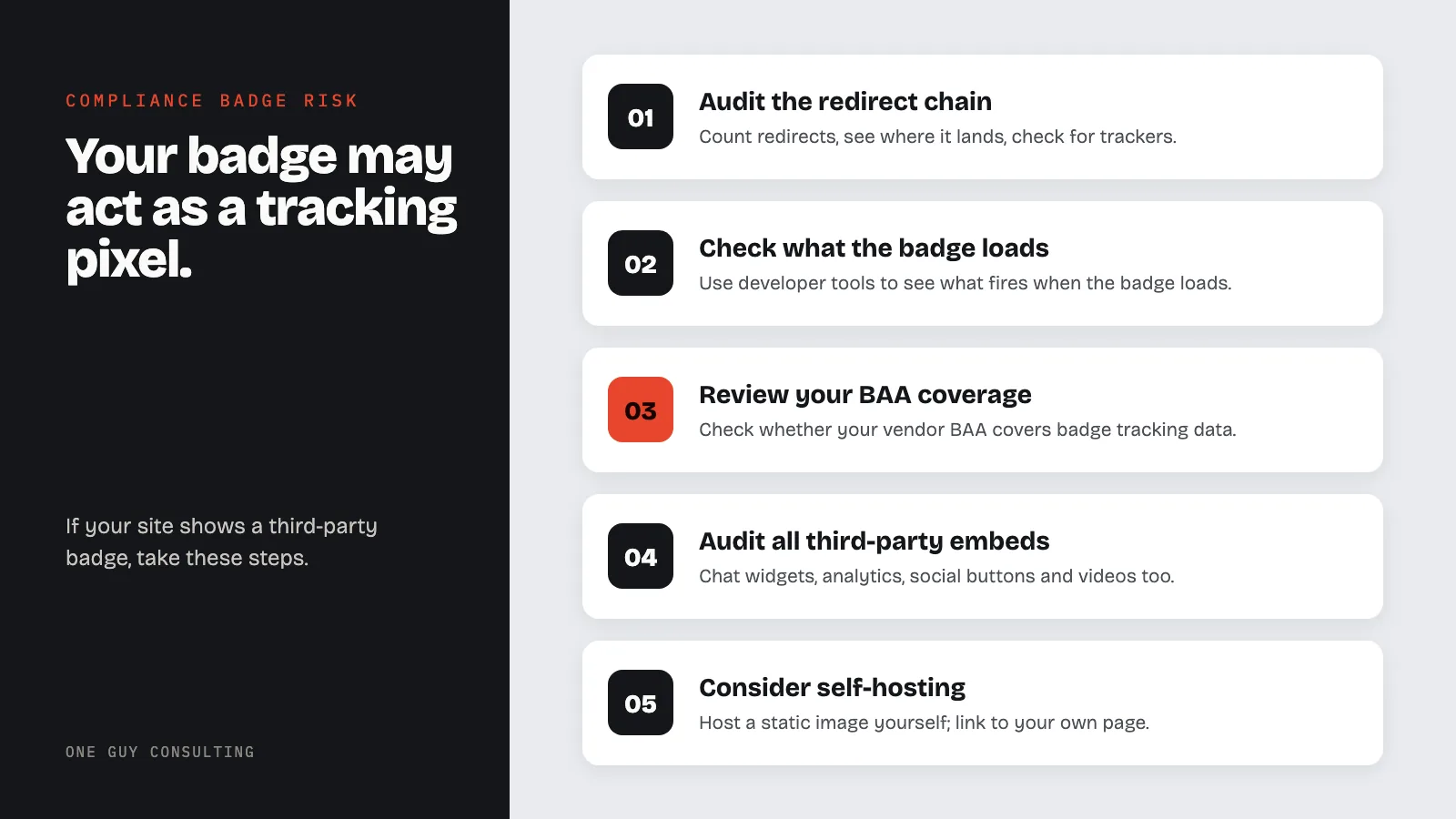
- Audit the redirect chain. Open a terminal and run
curl -v -Lagainst your badge's link URL. Count the redirects. See where you actually land. Check what tracking scripts are on the destination page. - Check what the badge image loads. Use your browser's developer tools (Network tab) to see what requests fire when the badge image renders. Is it hosted on your server or theirs?
- Review your BAA coverage. Does your BAA with the compliance vendor explicitly cover website tracking data generated by their badge? Almost certainly not.
- Conduct vendor risk assessments before signing up. A good practice is to send a vendor risk questionnaire before engaging any third-party service, especially one that will have a presence on your website. Ask what data they collect, where it is stored, who they share it with, and whether they will sign a BAA that explicitly covers web-based tracking. If a vendor cannot answer these questions clearly, that tells you everything you need to know.
- Audit all third-party embeds. The compliance badge is just one example. Chat widgets, analytics scripts, social media buttons, and embedded videos all create similar risks.
- Consider self-hosted alternatives. Instead of embedding a vendor's badge that phones home on every page load, host a static image on your own server and link it to your own compliance documentation page. You maintain control. No third-party tracking. No redirect surprises.
What to Do Instead of Third-Party Badges
If you want to show your organization's commitment to HIPAA compliance on your website without introducing tracking risks, these alternatives eliminate the third-party exposure:
- Self-host a static compliance statement. Create a page on your own website documenting your compliance program: risk assessment completion, workforce training status, BAA management, and policy framework. Link to it with a static image hosted on your own server. No external requests, no tracking, no redirects.
- Publish your compliance commitment as a webpage. A dedicated page stating your organization's HIPAA compliance practices gives patients more useful information than a badge and keeps all data on infrastructure you control.
- Reference your risk assessment and training program. Instead of pointing to a vendor's marketing page, point to a summary of your actual compliance activities. This is more meaningful to informed patients and to OCR if your organization is ever investigated.
- If you must link externally, use
rel="noreferrer". Addingrel="noreferrer"to external links prevents the browser from sending the referrer header. This does not solve all tracking issues (the destination page still receives the visitor's IP address), but it reduces the scope of data transmitted. - Conduct a formal risk assessment covering all website technologies. Under 45 CFR 164.308(a)(1)(ii)(A), you must do a risk analysis. That is an accurate and thorough check of the risks to the ePHI (electronic patient health information) you hold. Website tracking tools that touch ePHI belong in it.
Original research finding: One Guy Consulting tested a popular HIPAA compliance badge and found it triggered two 301 redirects and loaded seven advertising and analytics trackers (including Google Analytics, Facebook Pixel, Microsoft Clarity, LinkedIn Insight Tag, Bing UET, Mixpanel, and HubSpot), all without a BAA. The badge image itself functions as a tracking pixel, transmitting visitor IP addresses and referring URLs to the vendor's servers on every page load. This finding has direct implications for any covered entity or business associate displaying third-party compliance badges.
The Bigger Picture
This is not about any single vendor or any single badge. This is about a pattern in the compliance industry where organizations outsource their compliance posture to third parties without examining what those third parties are actually doing on their websites. The Telnyx supply chain attack showed how vendor software can be compromised upstream, and compliance badges present a similar category of unexamined vendor risk.
HIPAA compliance is not a badge. It is an ongoing operational commitment. And part of that commitment means understanding exactly what happens when someone visits your website, including what your "compliance" tools are doing behind the scenes.
One More Thing: There Is No Such Thing as "HIPAA Verified"
It is worth mentioning that there is no certifying body for HIPAA compliance. No government agency issues a HIPAA certification. No vendor can "verify" that you are HIPAA compliant, because there is no definition from the federal government of what "verified" even means in this context. Verification in HIPAA compliance, quite literally, does not exist.
Any badge that says "HIPAA Verified" or "HIPAA Certified" is using language that has no regulatory basis. Compliance is an ongoing, internal process, not a stamp that a third party can hand you.
Is There a HIPAA Certification?
No. There is no government agency or certifying body that issues a HIPAA certification. HIPAA compliance is an ongoing internal process that requires regular risk assessments, employee training, policy enforcement, and continuous monitoring, not a one-time credential that a third party can grant. Any badge or seal claiming "HIPAA Certified" or "HIPAA Verified" uses language with no regulatory basis.
Website Compliance Audit Checklist
Use this checklist to look for the risks covered above on your healthcare website. For how encryption fits in, see our guide to data protection and encryption standards.
- Identify every third-party script, image, or embed loading on your website
- Run
curl -v -Lagainst each external link to trace redirect chains - Check your browser Network tab for tracking pixels firing on page load
- Verify you have a signed BAA with every third party that receives visitor data
- Remove or self-host any compliance badges loading from external servers
- Complete a vendor risk assessment for every third-party service on your site
- Review your website privacy policy for accuracy on data sharing disclosures
- Confirm all forms and patient-facing pages use HTTPS with current TLS
- Document your findings as part of your regular HIPAA security risk assessment
- Schedule recurring audits. Website tracking changes frequently and new embeds get added without compliance review
Frequently Asked Questions
Can a HIPAA compliance badge cause a HIPAA violation?
Yes. If the badge image is hosted on a third-party server, it functions as a tracking pixel, logging visitor IP addresses, browser data, and the site they came from on every page load. If the badge links to a page with advertising trackers like Facebook Pixel or Google Analytics, clicking it shares visitor data with platforms that do not have Business Associate Agreements with your organization.
Is there an official HIPAA certification or verification?
No. There is no government certifying body for HIPAA compliance. No federal agency issues a HIPAA certification, and no vendor can officially "verify" that an organization is HIPAA compliant. Any badge using the language "HIPAA Verified" or "HIPAA Certified" has no regulatory basis.
What did OCR say about tracking technologies on healthcare websites?
In December 2022, the HHS Office for Civil Rights issued a bulletin stating that tracking technologies on pages where patients interact with a covered entity can result in impermissible disclosures of protected health information. OCR updated the bulletin in March 2024. In June 2024, a federal court struck down the part about public pages with no login. The parts about patient portals and other logged-in pages still stand. OCR has made this a known enforcement priority.
How can I check if my compliance badge is tracking visitors?
Open your browser developer tools (Network tab) and load a page with the badge. Check if the badge image loads from an external server. Then click the badge and inspect the destination page for third-party tracking scripts. You can also run curl -v -L against the badge URL in a terminal to trace the full redirect chain.
Book a free 30-minute intro call.
Key stat: There is no official HIPAA certification or compliance badge issued by HHS or OCR. Any organization displaying a HIPAA Certified badge is referencing a third-party assessment, not a government endorsement. OCR has never created, endorsed, or recognized any HIPAA certification program.
Sources
- HHS HIPAA FAQ
- 45 CFR Part 164: Security and Privacy Rules
- 45 CFR 164.502(a): Uses and Disclosures of PHI: General Rules
- 45 CFR 164.312(e)(1): Transmission Security
- 45 CFR 164.308(b)(1): Business Associate Contracts
- HHS OCR Bulletin on Online Tracking Technologies (December 2022, updated March 2024)