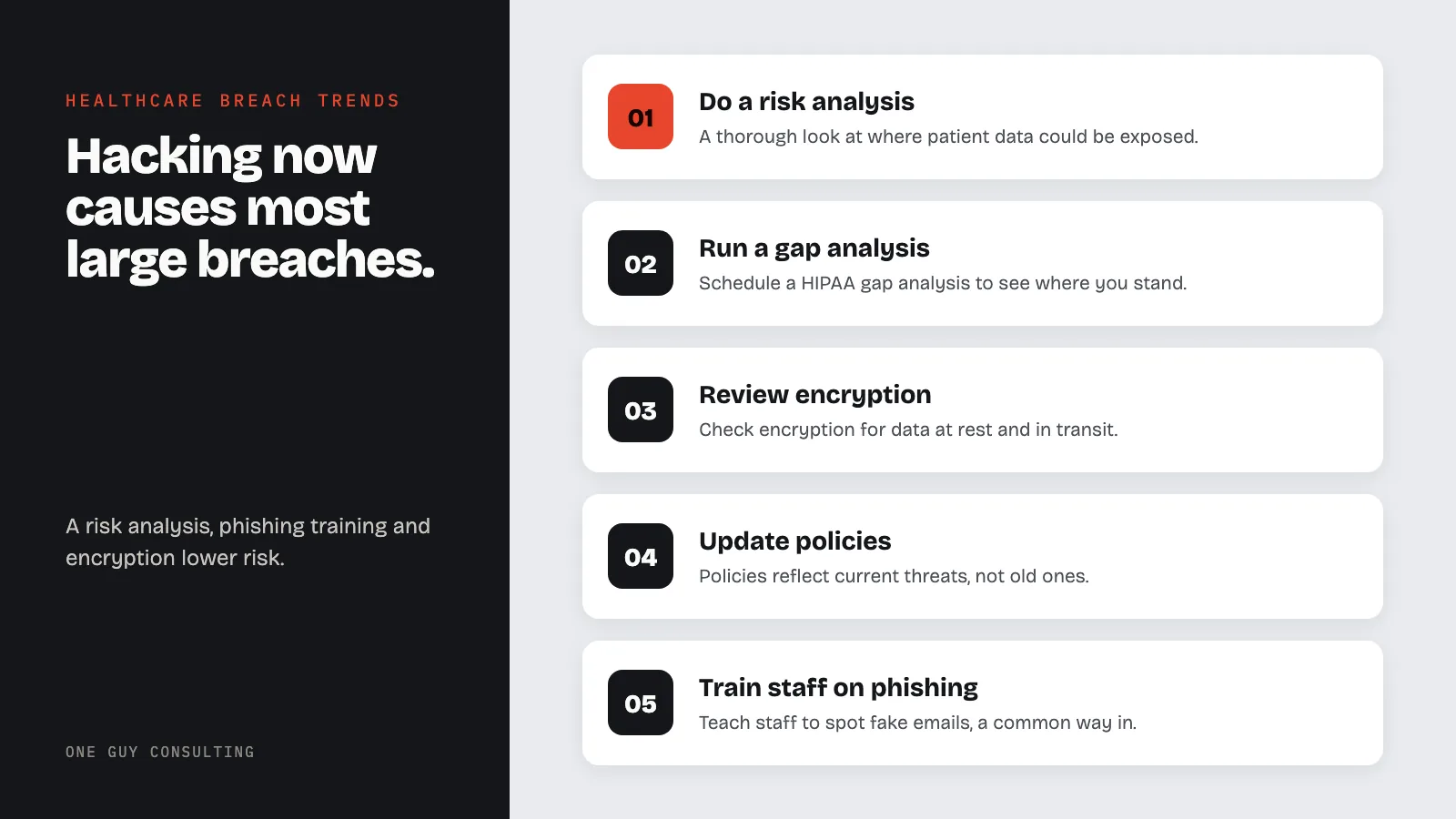
Healthcare data breach numbers tell a clear story: hacking and IT incidents now cause most reported large breaches. No practice is too small to be hit. Patients lose control of sensitive data. Providers face investigations, lawsuits, and notice deadlines. A HIPAA risk analysis, phishing training, and encryption lower your risk.
Healthcare Breach Numbers Signal a Systemic Problem
Healthcare data breaches keep happening, year after year. The HIPAA Journal tracks breach reports. They show a steady flow of cases where someone got into protected health information without permission. That is PHI: the health and personal details a practice keeps about patients. Hospitals, clinics, insurers, and business associates are all getting hit.
The pattern is clear: attackers know healthcare organizations hold valuable data and often lack the security infrastructure to defend it. Health records are worth a lot to thieves. They can hold everything an identity thief needs: names, Social Security numbers, insurance details, and medical histories.
Who Gets Hurt When Healthcare Data Is Exposed
The victims span the entire healthcare ecosystem. Patients lose control of their most sensitive information. Providers face regulatory scrutiny, lawsuits, and reputational damage. Even small clinics that think they are too small to be targeted have found themselves in breach notification lists.
The exposed data typically includes personal identifiers, medical records, and financial information. Once this data is out, there is no pulling it back. Patients face years of monitoring and the constant anxiety that comes with knowing their information is circulating. The Acadia Healthcare breach is a recent example: Social Security numbers and other sensitive patient records, at one of the largest behavioral health providers in the country.
The HIPAA Rules Most Often Violated in Breach Cases
Three rules come up repeatedly in breach investigations:
- Security Rule: Organizations fail to implement adequate technical safeguards. Missing multi-factor authentication, unpatched systems, and poor access controls are the usual culprits.
- Privacy Rule: Access to PHI is not properly limited. Staff can open records they have no reason to see. The Privacy Rule says a practice must make reasonable efforts to limit PHI to the minimum necessary for each task (45 CFR 164.502(b)). In plain terms, people should see only what they need to do their job.
- Breach Notification Rule: Organizations delay notifications, sometimes by months. Under HIPAA, you must tell the affected people without unreasonable delay. The latest you can do it is 60 calendar days after you discover the breach (45 CFR 164.404(b)). Sixty days is the outer limit, not a grace period.
HIPAA requires a risk analysis. This is an accurate and thorough look at where patient data could be exposed (45 CFR 164.308(a)(1)(ii)(A)). OCR, the HHS office that enforces HIPAA, announced a Risk Analysis Initiative in late 2024. It focuses on this exact step. The process makes you look honestly at your weak spots, and most organizations do not like what they find.
What These Trends Mean for Your Practice
If you run a small or mid-size practice, these numbers are not just statistics. They are warnings. Breaches keep happening. Each one brings notice deadlines, possible investigations, and lost patient trust.
Practical steps you can take right now:
- Schedule a HIPAA gap analysis to identify where you stand
- Review your encryption practices for data at rest and in transit
- Make sure your policies and procedures reflect current threats, not the threat landscape from three years ago
- Train your staff to spot phishing emails (fake emails meant to trick them), one of the most common ways attackers get in
Avoiding a breach is less about budget and more about habit. Treat compliance as a daily practice, not a once-a-year checkbox.
Key point: Most large healthcare breaches reported on the HHS breach portal now come from hacking and IT incidents. Years ago, lost or stolen laptops and paper records made up a bigger share. Two things drove the shift: more records are digital, and the attackers going after healthcare are more skilled.
Breach News and Analysis
- Change Healthcare Breach: One Year Later
- HIPAA Breach Notification Rule Compliance Guide
- How to Respond to a HIPAA Data Breach
- Healthcare Data Breach Prevention Strategy
- Healthcare Breaches Doubled in 2025
- Okanogan Breach Settlement
- UMMC Ransomware Attack Lessons
Related Reading
- Acadia Healthcare Breach: What It Exposed
- HIPAA Breach Notification Rule Compliance Guide
- How to Respond to a HIPAA Data Breach
- Healthcare Data Breach Prevention Strategy
- Healthcare Breaches Doubled in 2025
- $6.6M in HIPAA Fines in 2025
- Ransomware: The First 72 Hours
Sources
Try three of our 3D staff training courses free →
Frequently Asked Questions
What are the biggest healthcare data breach trends right now?
A few major trends stand out. Ransomware attacks hit hospital networks. Large breaches happen at outside vendors. Attackers also break into apps that face the internet and into remote access tools (software that lets people log in from outside the office). A business associate is a vendor that handles patient data for a practice. One breach at one business associate can expose a huge number of records at once, as the Change Healthcare breach showed.
How many healthcare records are breached each year?
It changes a lot from year to year. A few huge incidents can drive the total. The Change Healthcare breach alone was reported to affect about 192.7 million people. That figure was reported on July 31, 2025.
What do healthcare breach trends mean for small practices?
No practice is too small to be hit. Small clinics show up on breach notification lists too. Treat HIPAA compliance as your basic security floor. Three steps lower the chance of a breach: a risk analysis, multi-factor authentication, and patched systems. Multi-factor authentication adds a second step to log in, like a code sent to your phone, and patched systems have the latest security updates installed. Tested backups limit the damage if a breach does happen.
Does reporting a breach to HHS result in automatic fines?
No. Reporting a breach does not automatically trigger a fine. Reporting is also required by law. The Office for Civil Rights (OCR) is the HHS office that enforces HIPAA. If OCR finds a violation, the penalty amount depends on factors listed in 45 CFR 160.408. These include how many people were affected, how much harm was done, and your past compliance record.