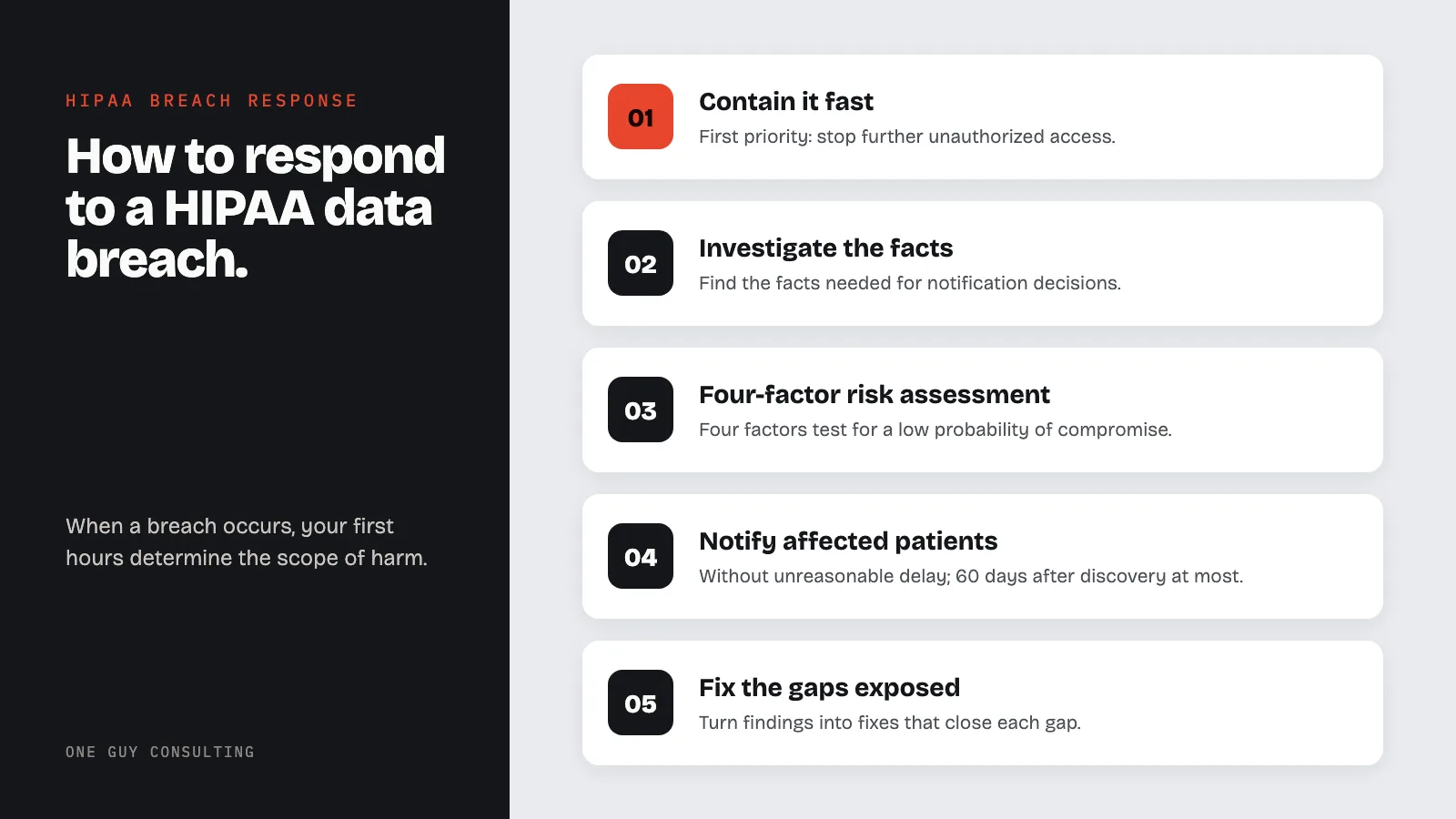
To respond to a HIPAA data breach, contain it fast, find out what happened, and run the four-factor risk assessment. If notice is required, tell affected patients without unreasonable delay. The latest is 60 days after discovery. Report to HHS and keep records for six years. Then fix the gaps the breach exposed.
How to Respond to a HIPAA Data Breach
Responding to a Data Breach
A data breach response plan is not optional for healthcare practices. HIPAA requires written procedures for handling security incidents (45 CFR 164.308(a)(6)). You will use them day to day. Effective incident management starts with a documented process for identifying, containing, and resolving security incidents before they escalate; the incident management guide builds that process step by step. When a breach of health data (PHI) occurs, your first hours determine the scope of harm, and the quality of your incident management process determines the outcome.
Practices that act fast and follow a clear plan minimize damage. Those that hesitate or try to hide a breach can face heavy fines and lost trust. When the Office for Civil Rights (OCR) sets a penalty, it looks at things like how many people were affected and how much harm was done (45 CFR 160.408).
A documented, rehearsed plan helps you act fast and show what you did. The average healthcare data breach costs $7.42 million, per the IBM Cost of a Data Breach Report 2025. Every practice handling PHI should have a tested breach response plan.
This guide gives a step-by-step framework for responding to a HIPAA data breach. It covers the moment you detect an incident through post-incident fixes. For broader context, see our guide on HIPAA Breach Notification Rule compliance.
Immediate Response Steps
Detection and Initial Assessment
The breach response clock starts the moment your practice discovers a possible breach. HIPAA treats a breach as discovered on the first day anyone on your staff knew about it, or would have known with reasonable care (45 CFR 164.404(a)(2)). The person who caused the breach does not count. Act right away when any sign of a breach appears.
Immediate actions upon detection include:
- Activate the incident response team: Notify the privacy officer, security officer, legal counsel, and IT leadership right away.
- Document the timeline: Record the exact date and time of discovery, how you found it, and who was told.
- Assess the scope: Find out which systems are affected, what PHI may be involved, and how many people are impacted.
- Preserve evidence: Save logs, system images, and other forensic evidence before any fixes that might alter it.
- Engage legal counsel: Bring in attorneys early to protect investigation communications where appropriate.
Speed matters, but so does accuracy. Avoid making public statements before you understand the full scope. The HIPAA Breach Notification Rule says to send notices without unreasonable delay. The latest you can send them is 60 calendar days after discovery (45 CFR 164.404(b)). Sixty days is a hard limit, not a target.
Assembling the Response Team
A strong breach response needs a cross-functional team with clear roles. Identify these people before any incident occurs. Run regular tabletop exercises so everyone knows their job.
- Privacy Officer: Leads the compliance investigation and notification process.
- Security Officer: Directs the technical investigation and containment.
- Legal Counsel: Advises on legal duties, privilege, and regulatory communications.
- IT Leadership: Manages technical fixes and system restoration.
- Communications: Handles internal and external messaging.
- Executive Sponsor: Provides authority and resources for the response effort.
Containment and Mitigation
Stopping the Breach
Once you detect a breach, your first priority is containment to stop further unauthorized access. The right containment steps depend on the type of breach. Act quickly but preserve forensic evidence as you go.
- Compromised credentials: Reset affected passwords right away, revoke active sessions, and add enhanced monitoring to affected accounts.
- Malware or ransomware: Isolate affected systems from the network, bring in incident response specialists, and find the full extent of the compromise.
- Unauthorized access by insiders: Suspend the person's access, secure their workstation and devices, and preserve access logs.
- Lost or stolen devices: Start a remote wipe, check whether the device was encrypted, and assess what data was stored locally.
- Third-party vendor breach: Contact the vendor right away, review the business associate agreement for breach response duties, and assess the scope of PHI exposed. The 2026 Vercel incident is a real-world example of this scenario.
Containment must balance urgency with evidence preservation. Shutting down a compromised system stops the damage but may destroy forensic evidence. Work with qualified forensic investigators to pick the right containment approach.
Short-Term Mitigation
After initial containment, take short-term mitigation steps, meaning steps that limit harm. These steps close weak points and limit further risk.
- Patch weak points that enabled the breach.
- Add extra monitoring on affected systems.
- Reset credentials for all users who may be affected.
- Block known malicious IP addresses, domains, or indicators of compromise.
- Turn on enhanced logging on systems near the breach.
Investigation and Risk Assessment
Conducting a Thorough Investigation
A full investigation determines the facts needed for notification decisions. It also supports regulatory reporting. The investigation must answer these questions:
- What happened? The specific events that led to the breach.
- What PHI was involved? The types and volume of information compromised.
- Who is affected? The number and identities of people whose PHI was exposed.
- Who caused the breach? Whether the breach came from external attack, insider action, or system failure.
- What was the duration? When the unauthorized access began and when it ended.
Use qualified forensic investigators for breaches involving sophisticated attacks or large data volumes. Document forensic findings in a formal investigation report.
Performing the Four-Factor Risk Assessment
HIPAA starts by assuming that any improper use or sharing of PHI is a reportable breach. To show it is not, you need a risk assessment showing a low probability that the PHI was compromised (45 CFR 164.402). The assessment looks at four factors. Each factor must be checked and written down carefully.
- The nature and extent of the PHI involved, including types of identifiers and how likely it is that someone could figure out who the patient is (re-identification).
- The unauthorized person who used the PHI or received it.
- Whether the PHI was actually acquired or viewed, as opposed to merely having the chance to do so.
- How much the risk to the PHI has been reduced (mitigated).
If the assessment shows a low probability that PHI was compromised, you may determine that notice is not required. You must record this decision thoroughly. If OCR asks, it is up to you to prove that notice was not required (45 CFR 164.414(b)).
Notification Requirements
Who Must Be Notified
When a breach is confirmed, HIPAA requires you to notify multiple parties. Each party has a specific timeframe. Missing these deadlines can lead to extra penalties.
- Affected individuals: Written notice without unreasonable delay, and no later than 60 calendar days after discovery, by first-class mail or email if agreed to.
- HHS/OCR: For breaches affecting 500 or more people, notify HHS at the same time you notify individuals (so within 60 days), using the HHS breach reporting portal. For smaller breaches, notify within 60 days of the end of the calendar year.
- Media: If more than 500 residents of one state or jurisdiction are affected, notify major media outlets in that area. Do it without unreasonable delay, and no later than 60 days after discovery.
- State attorneys general: Many states have extra notice rules with their own timeframes and content rules.
- Business associates: Must notify covered entities without unreasonable delay, and no later than 60 calendar days after discovery. A business associate agreement can set a shorter deadline.
Content of Breach Notifications
Breach notices to individuals must include specific information. HIPAA requires plain language (45 CFR 164.404(c)(2)), so keep it plain and kind. Focus on helping people understand what happened and what to do.
- A brief description of what happened, including the date of the breach and the date of discovery, if known.
- A description of the types of PHI involved, such as names, Social Security numbers, diagnoses, or treatment information.
- Steps the person should take to protect themselves from possible harm.
- A description of what your practice is doing to investigate the breach, reduce harm to patients, and prevent future ones.
- How people can reach you with questions. This must include a toll-free phone number, an email address, a website, or a postal address.
Avoid legal jargon in notification letters. For a full overview of notification duties, see our guide on HIPAA Breach Notification Rule compliance.
Documentation Requirements
Building the Breach Record
HIPAA requires you to keep documentation of every breach investigation and response for at least six years (45 CFR 164.530(j)). This is your proof of compliance. You will need it if OCR investigates the breach.
The breach record should include:
- Incident detection records: How and when the breach was found, including the source of the report.
- Investigation findings: Forensic analysis results, interview notes, and the four-factor risk assessment.
- Containment and remediation actions: Every step taken to stop the breach and prevent recurrence.
- Notification records: Copies of all notice letters, dates sent, recipient lists, and proof of delivery.
- Regulatory communications: All correspondence with OCR, state attorneys general, and other regulators.
- Timeline documentation: A full chronology of events from detection through resolution.
- Lessons learned: Post-incident analysis findings and resulting policy or procedure changes.
Keep a centralized breach log that tracks all incidents regardless of size. Include near-misses and incidents determined not to be reportable. This log shows a culture of compliance and proactive security management.
Post-Incident Analysis and Security Improvements
Learning from the Breach
Every breach provides valuable lessons for continuously improving your incident management process. A formal post-incident analysis should follow the immediate response. Use it to drive real security improvements.
The post-incident analysis should examine:
- Root cause analysis: What fundamental weak point or failure enabled the breach?
- Detection effectiveness: How quickly was the breach found, and could it have been faster?
- Response effectiveness: Did the response plan work as intended, and where did it fall short?
- Communication effectiveness: Were notices timely, accurate, and helpful to affected individuals?
- Policy gaps: Do existing policies adequately address the scenario that occurred?
Updating Security Measures
Post-incident findings must lead to concrete security improvements. Each update closes a gap the breach exposed. Document every change you make.
- Update the risk analysis to reflect the new threat information gained from the breach.
- Revise policies and procedures to address identified gaps.
- Add technical controls such as enhanced access controls, better encryption, or upgraded monitoring.
- Conduct targeted team training on the specific behaviors or knowledge gaps that contributed to the breach.
- Test the updated response plan through tabletop exercises using lessons learned.
- Review business associate agreements and third-party security requirements if the breach involved a vendor.
Treat breach response and incident management as a continuous improvement cycle. Each incident strengthens your security program when you commit to learning, adapting, and preventing future incidents. For a full approach to preventing future breaches, see our healthcare data breach prevention strategy guide.
Data Breach Response FAQ
How quickly must we report a HIPAA data breach?
HIPAA requires you to notify affected individuals without unreasonable delay, and no later than 60 calendar days after discovery. For breaches affecting 500 or more people, you must also notify HHS/OCR within that time. If more than 500 residents of one state or jurisdiction are affected, you must also notify prominent media outlets there. Business associates must notify covered entities without unreasonable delay, and no later than 60 days after discovery. Many state laws set shorter deadlines, so verify your state's rules.
What is the difference between a security incident and a breach?
A security incident is any attempted or successful unauthorized access, use, sharing, change, or destruction of information. It also covers interference with a computer system (45 CFR 164.304). A breach is getting, accessing, using, or sharing PHI in a way the Privacy Rule does not allow, which puts its security or privacy at risk (45 CFR 164.402). Not every security incident is a breach, but a good incident management system tracks both. Every possible breach needs the four-factor risk assessment, unless you choose to notify anyway.
Can we avoid breach notification if the data was encrypted?
Yes, if it was done right. PHI counts as secured when it was encrypted the way HHS guidance describes (which points to NIST standards) and the keys were not compromised. The Breach Notification Rule covers only unsecured PHI (45 CFR 164.402), so no breach notice is required. This is one of the strongest reasons to use full encryption across all systems that store or transmit ePHI.
What penalties can result from a HIPAA data breach?
Penalties depend on the nature of the breach and the practice's level of fault. Civil fines start at $145 per violation. For willful neglect that is not corrected, fines run from $73,011 to $2,190,294 per violation, capped at $2,190,294 a year for repeats of the same violation (45 CFR 102.3, current inflation-adjusted amounts). Criminal penalties can include fines up to $250,000 and imprisonment. A strong breach response and compliance program can lower your penalty risk.
Should we involve law enforcement in a breach investigation?
Consider involving law enforcement, especially the FBI, when a breach involves criminal action such as hacking, ransomware, or intentional theft of PHI. HIPAA allows a temporary delay in notification if a law enforcement official says notice would get in the way of a criminal investigation (45 CFR 164.412). If the request is in writing, it sets how long you wait. If the request is spoken, write it down, and wait no more than 30 days unless a written request follows. The delay is never open-ended.
What is HIPAA incident management?
HIPAA incident management is the process healthcare organizations use to identify, respond to, contain, and resolve security incidents involving protected health information. Under 45 CFR 164.308(a)(6), covered entities and business associates must implement security incident procedures that include response and reporting mechanisms. Effective incident management goes beyond breach notification. It encompasses incident identification, containment, root cause analysis, remediation, and continuous improvement to prevent future incidents. Major incidents involving PHI require the four-factor risk assessment to determine whether breach notification is required.
Data Breach Response Takeaways
Responding to a HIPAA data breach requires preparation, speed, and a clear process. Practices that build and test their breach response plans before an incident are far better positioned. They contain damage faster, meet regulatory requirements, and keep patient trust.
The framework in this guide, from immediate containment through post-incident improvement, gives every healthcare practice a solid foundation. Adapt it to your specific setting and risk profile. Start before a breach happens, not after.
One Guy Consulting gives healthcare practices an incident management system. The Full-Scope plan adds incident response guidance as needed. Contact us to get your practice ready before a breach happens.
Response speed matters: The faster you find and contain a breach, the less harm it can do. A tested incident response plan helps your team move fast when it counts.
Key stat: Under the Breach Notification Rule, covered entities must notify affected individuals without unreasonable delay, and no later than 60 days after discovering the breach. They must also notify HHS. If more than 500 residents of a state or jurisdiction are affected, they must notify prominent media outlets too. Breaches affecting fewer than 500 individuals can be reported to HHS within 60 days after the end of the calendar year. Late notification is itself a violation that can result in separate penalties.
Sources
- 45 CFR Part 164, Subpart D: Breach Notification Rule
- 45 CFR 164.402: Four-Factor Breach Risk Assessment
- HHS HIPAA Breach Notification Rule
- NIST SP 800-61r3: Incident Response, A CSF 2.0 Community Profile
- 45 CFR 164.308(a)(6): Security Incident Procedures