HIPAA Compliance Consultant for Small Practices
Full-Scope is $1,300 a year. That gets you four hours a month of 1:1 implementation calls with Chuck Weiselberg, plus the full HIPAA compliance platform. Flat fee. No per-user charges.
Is hiring a HIPAA consultant worth it?
For most small practices, yes, when the consultant guides the work and the price is flat. HIPAA requires a documented risk analysis, written policies, workforce training, and a business associate agreement (BAA) with every vendor that handles protected health information (PHI). Those are the gaps OCR (the HHS Office for Civil Rights) settles cases over. A consultant pays for itself when nobody on your staff has built a HIPAA program before, when an audit, insurer, or contract is asking for proof, or when an earlier attempt stalled.
It is less worth it if you already run a working program with a current risk analysis, signed BAAs, and training records, and only need a place to keep them. Then compliance software on its own may be enough.
What the numbers look like
- The going rate. Small practices typically budget $5,000 to $15,000 for HIPAA compliance consulting (source: Medcurity, 2026). Full-Scope is $1,300 a year.
- Skipping the risk analysis. A gastroenterology practice in Ogden, Utah agreed to pay $100,000 and follow a two-year corrective action plan after OCR found it had never done a risk analysis (HHS, March 3, 2020).
- Skipping a BAA. Raleigh Orthopaedic Clinic agreed to pay $750,000 after handing the x-ray films of about 17,300 patients to a vendor with no BAA in place, which HHS called a potential Privacy Rule violation (HHS bulletin).
These are public OCR enforcement cases, not One Guy Consulting clients.
Consultant, software, or do it yourself?
| Option | Fits when | Watch out for |
|---|---|---|
| Do it yourself | Someone on staff has built a HIPAA program before and has time to keep it current | Templates that do not match how you work, and no one checking the gaps |
| Software only | Your program already works and you need one place for records, training, and BAAs | Tasks that sit unfinished because no one owns them |
| Software plus a consultant | It is your first program, an audit or contract needs proof, or an earlier try stalled | Hourly billing and five-figure invoices. Full-Scope is a flat $1,300 a year |
What it has looked like for real practices
- A Florida mental health franchise office had policies that were never written, records with holes, and training half done, with a state auditor due in days. It was audit-ready in under a week and passed its state audit (Case 01).
- A single-location practice had several vendors handling PHI with no BAA. Every missing BAA got signed, and the practice now runs a repeatable vendor review (Case 05).
- A health group with 100+ offices saw program take-up rise about 17% after office-by-office outreach (Case 03).
Book a free 30-minute intro call if you are still deciding.
What hiring Chuck costs, and what you get
Full-Scope is $1,300 a year. You can also pay $120 a month, or $2,300 for two years (Loyalty Discount automatically applied for purchases of 24 month plans!). It includes four hours a month of one on one brainstorm time with Chuck, and the full HIPAA compliance software platform.
- Security Risk Assessment tool
- Automated gap analysis
- Automated remediation plans
- Policy and procedure templates
- Staff training with progress tracking
- Administrative, physical, and technical audits
- Vendor management with digital BAAs
- Incident management system
- Compliance dashboard
- 4 hours a month of 1:1 implementation calls with Chuck
- Personalized implementation
- Incident response guidance
- CMS audit response support
Secure checkout by Stripe. Your payment details go straight to Stripe and never touch our servers.
Who does what on Full-Scope
Three parties share the work: Chuck, your practice, and the platform. The platform automates the repeatable work. Chuck shows you how to use the software at each step. Your practice makes the decisions and keeps the program running.
| Area | Chuck | Your practice | The platform |
|---|---|---|---|
| Security Risk Assessment | Guides you through answering the audit | Tells the platform which systems, devices, and workflows touch ePHI | Scores each risk and turns your answers into a gap analysis |
| Gaps and remediation | Walks you through your gap analysis and remediation plan | Approves the plan and gets the assigned tasks done | Finds the gaps, writes the remediation plan, and tracks your progress |
| Policies and procedures | Walks you through the policy templates and how to adopt them | Reads each policy and adopts it | Stores and maintains all of your HIPAA compliance templates. |
| Staff training | Guides training delivery | Staff complete HIPAA 101 + CyberSecurity Awareness modules before signing policy attestations | Records completion |
| Vendors and BAAs | Answers vendor questions you have + aids technologically as needed with regard to the vendor profile | Has working inventory of every vendor that touches PHI | Execute and store BAAs in vendor profiles, plus automated vendor risk analysis. Only in O.G.C.'s HIPAA compliance software. |
| Incidents | Incident response guidance as needed | Reports the incident | Notifies the Compliance Officer once the incident is logged |
| Audits | CMS audit response support, audit-readiness prep, and evidence packaging (all 3 = as needed) | Pulls the records it is asked for | Retains evidence for at least six years |
How to choose a HIPAA consultant: six questions to ask.
Ask every HIPAA consulting firm the same six questions, then compare the answers side by side. Here are ours.
| Ask this | Why it matters | One Guy Consulting's answer |
|---|---|---|
| Will you do a documented risk analysis? | HIPAA requires "an accurate and thorough assessment of the potential risks and vulnerabilities" to your electronic patient data (45 CFR 164.308(a)(1)(ii)(A)). Everything else builds on it. | Yes. A 63-question Security Risk Assessment in the portal turns your answers into a gap analysis and a remediation plan. |
| Who does the work, and who owns the decisions? | Your practice stays responsible for compliance whoever you hire, so you need to understand and own the program. | Chuck guides your team through each step on 1:1 calls; your team makes the decisions and owns the program. |
| Is the price flat and published? | The per-user fees and add-ons some vendors charge make the real cost hard to compare. | $1,300 a year, $120 a month or $2,300 for 24 months, a flat rate per location, with no per-user fees. |
| Will you need our patients' information? | Anyone who handles your patients' information needs a signed BAA and becomes part of your risk. | No. The One Guy Consulting portal never asks for patient information. |
| What will we have when you are done? | If OCR asks, you have to show the work: policies, training records, BAAs and your risk analysis. | Your risk assessment, gap analysis, remediation plan, policies, staff training records and vendor BAAs, kept in the portal. |
| What if it is not a fit? | You should be able to stop without losing a year of fees. | A 90-day money-back guarantee, and monthly plans cancel any time. |
Chuck Weiselberg
HIPAA Compliance Consultant
Chuck Weiselberg is the Founder and HIPAA Consultant at One Guy Consulting and a Certified HIPAA Professional (CHP). He has been consulting since 2015. He was the founding Director of Customer Success at two industry-leading SaaS companies specializing in compliance, and has spent 20+ years supporting customers, 10 of them as a HIPAA compliance subject-matter expert. All of his work is remote. He has held roughly 23,000 meetings with more than 3,500 organizations. Zero clients fined. Zero failed audits.
By Chuck Weiselberg, Founder and HIPAA Consultant, One Guy Consulting. Read his full bio.
Read the client testimonials.
Chuck is not an attorney, and One Guy Consulting is not a law firm. More about Chuck
Still deciding between a consultant and compliance software? Read HIPAA Consulting vs Compliance Software: Which Fits Your Practice?
One Guy Consulting in 37 seconds
What HIPAA Requires of Every Practice
Core HIPAA Compliance Requirements
These six requirements apply to every covered entity (a health plan, a health care clearinghouse, or a provider that sends health information electronically in standard transactions) and business associate (a vendor that creates, receives, keeps, or sends PHI, meaning protected health information, on a covered entity's behalf). Each has specific duties under the HIPAA regulations. We start with the highest-risk areas first.
- Security Risk Assessment (SRA). An accurate and thorough risk analysis of the electronic PHI (ePHI) you create, receive, maintain, or transmit (45 CFR §164.308(a)(1)(ii)(A)). A gap analysis often comes next.
- Written policies and procedures that match how you really work (§164.316(a)).
- Workforce training. A security awareness and training program for all workforce members (§164.308(a)(5)(i)), and training on your policies for all workforce members, new members within a reasonable time, and anyone whose job a material policy change affects (§164.530(b)).
- Business Associate Agreements (BAAs) with every vendor that creates, receives, maintains, or transmits PHI for you (§164.502(e)).
- Documentation retention. Keep required records for six years from when they were created or last in effect, whichever is later (§164.530(j)).
- Breach notification. Tell affected people without unreasonable delay and no later than 60 days after discovering a breach of unsecured PHI (§164.404(b)). Tell HHS at the same time for 500 or more people, or log smaller breaches and report them within 60 days after the end of the calendar year (§164.408). Have your incident management steps written down ahead of time.
The risk analysis is where every program starts. Here is the rule in its own words:
“Conduct an accurate and thorough assessment of the potential risks and vulnerabilities to the confidentiality, integrity, and availability of electronic protected health information held by the covered entity or business associate.”
45 CFR 164.308(a)(1)(ii)(A), Risk analysis (Required)
Who enforces HIPAA
The Office for Civil Rights (OCR) enforces HIPAA. Civil money penalties under 45 CFR §160.404 run from $145 per violation up to $2,190,294 per violation category, per year. Criminal penalties under 42 U.S.C. §1320d-6 can reach $250,000 and up to 10 years in prison.
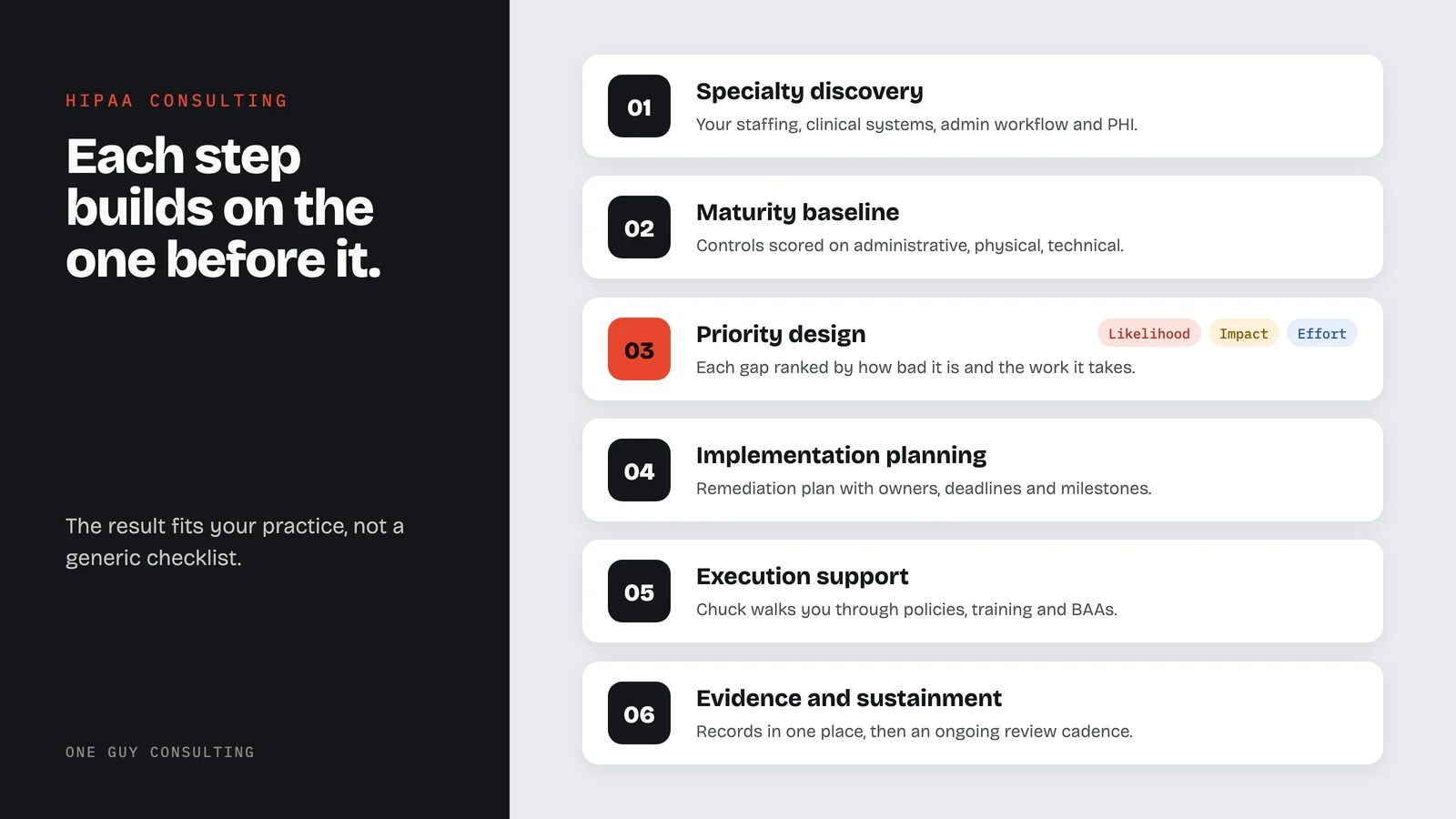
Seven-Step HIPAA Consulting Process
Each step builds on the one before it.
- 01
Specialty Discovery
The SRA starts with your staffing, your clinical systems, your admin workflow, and how you handle PHI.
WorkflowsSystemsPHI handling - 02
Maturity Baseline
The platform scores your controls on the administrative (§164.308), physical (§164.310), and technical (§164.312) safeguards to set a baseline.
- 03
Priority Design
The platform ranks each gap by how bad it is and how much work it takes. The threats to ePHI most likely to land, and to hurt, go first.
LikelihoodImpactEffort - 04
Implementation Planning
Create a remediation plan with assigned owners, deadlines, and milestones aligned to your staffing capacity and operational constraints.
OwnersDeadlinesMilestones - 05
Execution Support
On your 1:1 calls, Chuck walks you through adopting policies per §164.316(a), assigning workforce training per §164.308(a)(5)(i), and executing BAAs per §164.502(e) in the platform.
- 06
Evidence Packaging
The platform keeps your records (risk assessments, policies, training logs, BAAs) in one place, ready to hand an auditor, for the six years §164.530(j) calls for.
- 07
Sustainment
Establish ongoing review cadences for annual risk assessment updates, policy reviews, training refreshers, and BAA renewals to maintain continuous compliance.
Annual SRA updatePolicy reviewsBAA renewals
Consulting Considerations by Healthcare Specialty
HIPAA hits different specialties in different ways.
Medical Practices
Multi-provider EHR access controls, lab integration security, and referral platform data handling. Common risk: shared login credentials across clinical workstations.
Medical guide → BehavioralBehavioral Health
Psychotherapy note protections, 42 CFR Part 2 alignment, and telehealth session security. Common risk: misdirected session notes containing substance use records.
Behavioral health guide → DentalDental Practices
Digital imaging (X-ray, CBCT) encryption, practice management software access, and operatory workstation controls. Common risk: unencrypted imaging files on local drives.
Dental guide → PharmacyPharmacies
Prescription data access controls, POS system security, and wholesaler data link protections. Common risk: patient information visible on screens at the counter.
Pharmacy guide → BABusiness Associates
Contract-grade compliance documentation, multi-client data segregation, and downstream vendor controls. Common risk: missing subcontractor BAAs in the vendor chain.
BA guide →How We Compare to Other HIPAA Platforms
We wrote side-by-side comparisons of One Guy Consulting and other compliance vendors. Read them before you buy anything.
vs Accountable
Self-service software vs 1:1 implementation calls. Which fits your practice?
Comparevs Paubox
Email encryption tool vs full compliance program. See the tradeoffs.
Comparevs Drata
Big-company automation vs healthcare-focused consulting.
Comparevs Secureframe
Multi-framework tool vs HIPAA-only depth. What matters more?
Comparevs Sprinto
Auto evidence collection vs a guided HIPAA program.
Comparevs Vanta
Always-on monitoring vs flat-fee compliance builds.
Comparevs Dot Compliance
Life sciences QMS tool vs healthcare HIPAA consulting.
Deep-Dive Resources
Related guides:
HIPAA Consulting FAQ
Is hiring a HIPAA consultant worth it for a small practice?+
How does the program fit my specialty?+
Do you replace existing compliance teams?+
How much does a HIPAA consultant cost?+
What do the four hours a month cover?+
Need Consulting That Matches How Your Team Actually Works?
Book an intro call and we will look at where your practice stands.
Zero client fines. Zero failed audits.
“One Guy Consulting is super easy to work with. I actually look forward to my implementation meetings for HIPAA.” Samantha M.