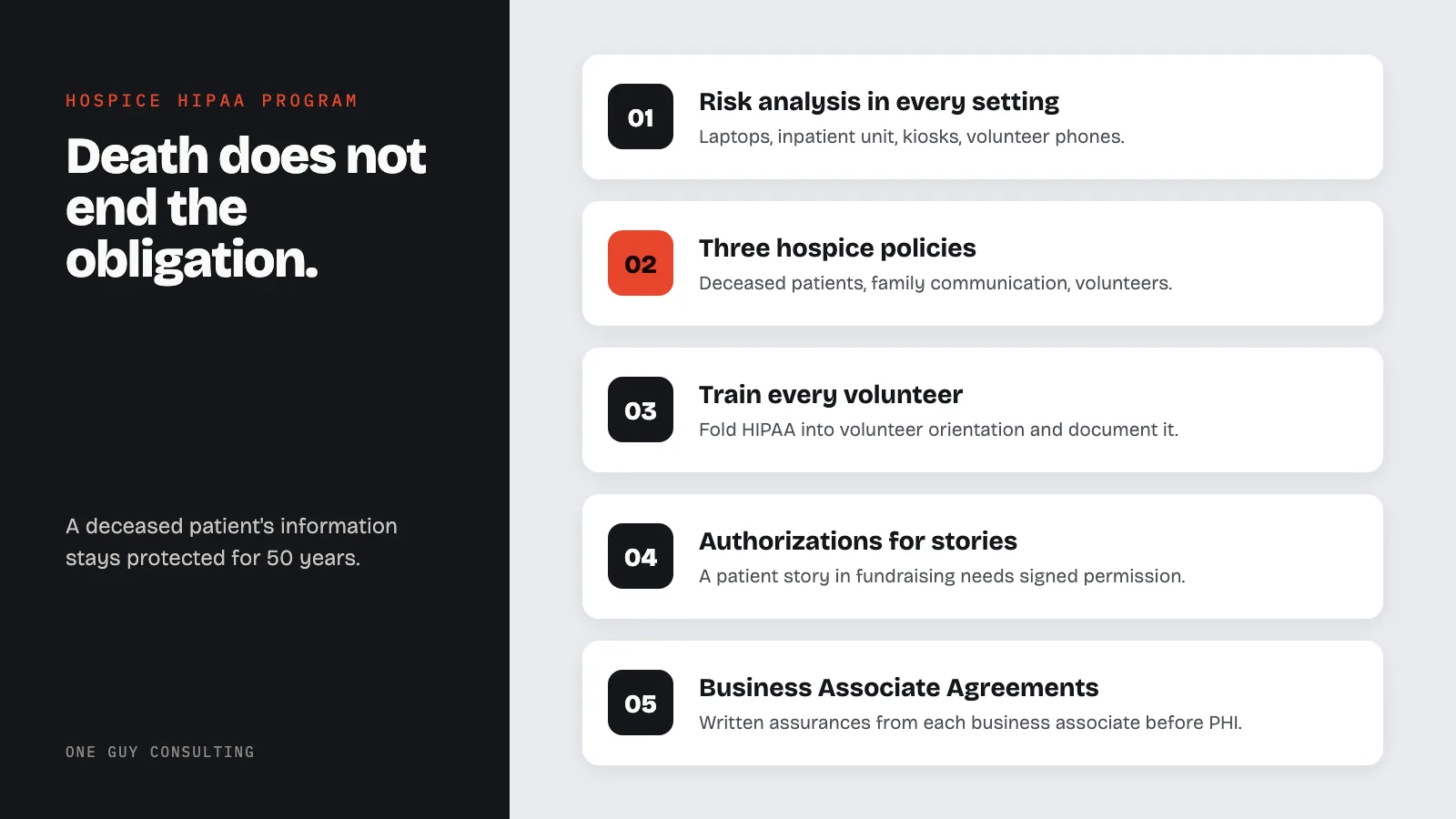
A hospice that bills electronically must follow HIPAA as a covered entity. Its duties keep going after a patient dies. A deceased patient's information stays protected for 50 years. Volunteers count as workforce, so they need training and limited access. Families get information only as the patient wished. Vendors that handle patient information need a Business Associate Agreement.
Tuesday morning, interdisciplinary group meeting. A nurse, a social worker, a chaplain, the medical director, the volunteer coordinator, and two volunteers sit around a table with a census of forty patients on the screen. By Thursday one of those patients has died, the family is asking what the death certificate will say, and a volunteer has drafted a heartfelt Facebook post about the gentleman she sat with every Sunday. Every one of those moments is governed by HIPAA, and hospice is the setting where the rules keep running after the patient is gone.
The HHS Office for Civil Rights (OCR) enforcement listing shows what the ordinary failures cost: a $240,000 settlement over snooping in medical records by hospital security guards (June 2023), a settlement over improper disposal of protected health information (August 2022), and an $800,000 settlement in a medical records dumping case (June 2014). None was a hospice. Each failure is one a hospice faces daily across homes, inpatient units, and nursing facilities.
This guide covers why HIPAA applies to a hospice, what protected health information looks like when the family is the unit of care, the violations specific to end-of-life work, how to build a program that includes volunteers, and which vendors need a Business Associate Agreement.
HIPAA Compliance for Hospice: Why Death Does Not End the Obligation
Why HIPAA Applies to a Hospice
45 CFR 160.103 defines a covered entity to include "a health care provider who transmits any health information in electronic form in connection with a transaction covered by this subchapter." The first covered transaction listed is "health care claims or equivalent encounter information." A Medicare-certified hospice that bills the Medicare hospice benefit electronically is a covered entity, bound by the Privacy Rule, the Security Rule, and the Breach Notification Rule. The definition itself is explained in what is a covered entity under HIPAA.
The definition that makes hospice different is workforce. 160.103 defines it as "employees, volunteers, trainees, and other persons whose conduct, in the performance of work for a covered entity or business associate, is under the direct control of such covered entity or business associate, whether or not they are paid." Volunteers are named outright. And federal rules require a Medicare-certified hospice to use them: the Medicare hospice Conditions of Participation at 42 CFR 418.78(e) state that volunteers "must provide day-to-day administrative and/or direct patient care services in an amount that, at a minimum, equals 5 percent of the total patient care hours of all paid hospice employees and contract staff." A hospice therefore has a legally mandated corps of unpaid workforce members, and HIPAA holds the hospice responsible for every one of them: training, access limits, sanctions, and mistakes.
What P.H.I. Looks Like in Hospice
P.H.I. (Protected Health Information) is individually identifiable health information in any form. In hospice it is unusually intimate, and it extends to people who are not the patient.
- The terminal diagnosis and prognosis. The physician's determination of terminal illness, the related conditions, and the plan of care built around them.
- Interdisciplinary group (IDG) records. Meeting notes, the comprehensive assessment, and the updated plan of care, which combine medical, psychosocial, and spiritual information in one document.
- Family and caregiver information. The Conditions of Participation at 42 CFR 418.64(d) require counseling for "the patient and family." The psychosocial assessment, the caregiver's health and coping notes, and the bereavement plan of care all contain information about spouses and children who are not patients but whose details sit inside the patient's record.
- Spiritual assessments. Religious affiliation and beliefs. Religious affiliation is one of the few items a provider may list in a facility directory (a list of who is in its facility). Under 45 CFR 164.510(a), the provider may share it with clergy. But the patient must first get a chance to object.
- Comfort kit and controlled substance records. Medication counts, disposal witness forms, and pharmacy records for morphine in a private home.
- Advance directives, DNR orders, and portable medical orders. Documents that travel with the patient between home, inpatient unit, and hospital.
- Bereavement records. 418.64(d)(1)(ii) requires bereavement services "up to 1 year following the death of the patient." Every call log, mailing, and grief group roster from that year references a deceased patient and is P.H.I.
- Nursing facility charts. When a hospice patient lives in a nursing home, two providers document the same person in two records, and the hospice's notes sit in the facility's chart.
Common Violations in Hospice Settings
Treating the deceased patient's information as fair game. 45 CFR 164.502(f) is blunt: "A covered entity must comply with the requirements of this subpart with respect to the protected health information of a deceased individual for a period of 50 years following the death of the individual." The memorial newsletter, the annual remembrance slideshow, the volunteer's social media tribute, and the "patient story" on the fundraising page all disclose P.H.I. of a person HIPAA still protects. The authorization has to come from the personal representative, which under 164.502(g)(4) is the "executor, administrator, or other person" with authority to act for the deceased or the estate. The full picture is in HIPAA and deceased patients: the 50-year rule.
Family disclosures without the patient's say. While the patient is alive and able to decide, 164.510(b)(2) permits disclosure to family and close friends involved in care only if the hospice "obtains the individual's agreement," gives "the opportunity to object," or "reasonably infers from the circumstances" that the patient does not object. After death, 164.510(b)(5) permits disclosure to family members "who were involved in the individual's care or payment for health care prior to the individual's death," relevant to that involvement, "unless doing so is inconsistent with any prior expressed preference of the individual." The estranged son who calls for the first time after the funeral is not covered by that paragraph, and the patient's stated wishes control. Document the preference while the patient can still state it.
Volunteers with no training and unlimited access. A volunteer is workforce. 164.530(b)(1) requires a covered entity to "train all members of its workforce," and 164.308(a)(3) requires policies to ensure "all members of its workforce have appropriate access." A volunteer who sits with one patient does not need the census, and the minimum necessary standard at 164.502(b) says so. The daily version of that rule is in the HIPAA minimum necessary rule in daily operations.
Social media and tributes. The enforcement listing shows a $10,000 settlement with a dental practice over social media disclosures of patients' protected health information (October 2019). A hospice tribute post with a name, a photo, or enough detail to identify the patient is the same act. The guardrails are in HIPAA and social media: staff mistakes to avoid.
Curiosity in the chart. The $240,000 snooping settlement above is the price of workforce members reading records they had no role in. In a small community, the neighbor and the former teacher show up on the census eventually. 164.308(a)(1)(ii)(D) requires regular review of "audit logs, access reports," and the sanction policy at 164.308(a)(1)(ii)(C) has to be applied when the review finds something.
Paper coming home after a death. The home folder and the visit notes come back to the office in a bag after the patient dies. 164.530(c) requires safeguards for paper P.H.I., and 164.310(d)(2)(i) makes disposal a Required specification for electronic media. Shred it or lock it. The $800,000 case came from paper records left where anyone could reach them.
Building the Program
Risk analysis that includes every setting. 164.308(a)(1)(ii)(A) requires "an accurate and thorough assessment of the potential risks and vulnerabilities" to ePHI (electronic P.H.I.). A hospice's ePHI lives on field laptops, in an inpatient unit, in nursing facility kiosks, on volunteer phones that receive schedule texts, and in the bereavement coordinator's mail-merge spreadsheet. The analysis has to name all of them. The method is in the risk assessment guide.
Policies hospice actually needs. Beyond the standard set, write three specific to this work: a deceased-patient policy (who may authorize a memorial use, what the tribute rules are), a family communication policy (how the patient's preferences are captured and where staff find them), and a volunteer confidentiality policy (what a volunteer may see, say, and keep).
Training that reaches volunteers. 164.530(b)(2)(i)(B) requires training for each new workforce member "within a reasonable period of time after the person joins." Fold HIPAA into the volunteer orientation that 42 CFR 418.78(a) already requires, and document it. The record must be retained for six years under 164.530(j)(2).
Authorizations for stories and photos. For fundraising, 164.514(f)(1) lets a hospice use only a few details without permission. These are things such as name, contact information, dates of care, and treating physician.
A fundraising appeal built on a patient's story uses far more than that. So under 164.508(a)(1), it needs an authorization (a signed permission form). The patient or the personal representative signs it. The form must include every item listed in 164.508(c).
Business Associate Agreements. 164.502(e) and 164.308(b) require written assurances from every business associate before it handles P.H.I.
Vendor B.A.A. Checklist for Hospice
A business associate under 160.103 is a person who, on the hospice's behalf, "creates, receives, maintains, or transmits protected health information" for a regulated function, or provides "legal, actuarial, accounting, consulting, data aggregation ... management, administrative, accreditation, or financial services" involving P.H.I. The same section excludes "a health care provider, with respect to disclosures by a covered entity to the health care provider concerning the treatment of the individual."
| Vendor category | Typical examples | B.A.A. required? |
|---|---|---|
| Hospice EHR | WellSky, Homecare Homebase, MatrixCare, Netsmart | Yes |
| Hospice pharmacy services | The pharmacy benefit or medication management service that handles formulary, claims, and medication data for the hospice | Yes for the management service. A dispensing pharmacy is a provider for treatment disclosures. |
| Bereavement mailing and grief-support vendors | Any service that sends condolence letters or runs grief groups from the hospice's list | Yes. The list identifies deceased patients and their families. |
| Volunteer management software | Any scheduling tool that pairs volunteers with patients | Yes, if patient names appear in it |
| After-hours answering or triage service | Any service taking patient and family calls for the hospice | Yes |
| Billing, coding, or revenue cycle firm | Any third-party billing company | Yes. Billing is named in the definition. |
| IT managed services, cloud fax, secure messaging | The MSP and the communication platforms | Yes |
| Shredding and record storage | Any document destruction or storage company | Yes |
| Nursing facility, hospital, attending physician, DME supplier | Providers the hospice coordinates care with | No, for treatment disclosures. Both sides remain responsible for their own safeguards. |
| Funeral home | The funeral director receiving the death information | No. 164.512(g)(2) permits disclosure to funeral directors "as necessary to carry out their duties." Limit it to what they need. |
| Contracted chaplain, social worker, or per-diem nurse | Individuals under the hospice's direct control | No. They are workforce and need training instead. |
The Proposed Security Rule Update (Proposed, Not Final)
HHS published a Notice of Proposed Rulemaking on January 6, 2025 to strengthen the Security Rule. It remains proposed, not final, and OCR is not enforcing it. Among other things it would make encryption and multifactor authentication required rather than addressable, require a written asset inventory and network map, require restoration of critical systems within 72 hours, and require automated vulnerability scans "at least once every six months." Current status is tracked in HIPAA Security Rule delayed to 2027.
For a hospice, that asset inventory would reach the inpatient unit, the field laptops, and every volunteer device that receives patient information. The current rule already requires an accurate and thorough risk analysis. Knowing where your ePHI (patient information kept in electronic form) is stored is part of that work. So build that list now.
FAQ
Is a hospice a covered entity under HIPAA?
Yes, if it transmits health information electronically for a covered transaction such as a claim. A Medicare-certified hospice that bills electronically is a covered entity under 45 CFR 160.103 and subject to the Privacy, Security, and Breach Notification Rules.
Are hospice volunteers covered by HIPAA?
Yes. 45 CFR 160.103 defines workforce to include volunteers under the covered entity's direct control, whether or not they are paid. The hospice must train them, limit their access to what their role needs, and apply its sanction policy to them.
Can a hospice share information with the family after the patient dies?
Within limits. 45 CFR 164.510(b)(5) permits disclosure to family members who were involved in the patient's care or payment before death, limited to information relevant to that involvement, unless the patient expressed a contrary preference. Record the patient's preferences while the patient can still state them.
Can the hospice post a memorial or a patient story on social media?
Not without a valid authorization. HIPAA protects a deceased person's information for 50 years under 164.502(f), and a tribute that identifies the patient needs an authorization under 164.508 signed by the personal representative, typically the executor or administrator of the estate.
How long do HIPAA protections last after a hospice patient dies?
Fifty years. 45 CFR 164.502(f) requires a covered entity to comply with the Privacy Rule for a deceased individual's protected health information for 50 years following death, and 160.103 removes the information from the definition of PHI only after that period.
A hospice program that already runs an interdisciplinary group, a volunteer corps, and a bereavement plan has most of the structure HIPAA asks for. What is usually missing is the paperwork that proves it: the risk analysis, the deceased-patient policy, the volunteer training log, and a signed B.A.A. for every vendor. One Guy Consulting's Full-Scope plan gives the hospice a tool for each piece: a Security Risk Assessment tool, policy templates, training tracking, and vendor management with digital B.A.A.s. It also includes 4 hours a month of 1:1 implementation calls with Chuck. Start with a free 30-minute intro call. No obligation, no pressure.
Sources
- 45 CFR 160.103 (definitions: covered entity, business associate, workforce)
- 45 CFR 164.502 (general rules, including deceased individuals and personal representatives)
- 45 CFR 164.508 (authorizations)
- 45 CFR 164.510 (facility directories and involvement in care)
- 45 CFR 164.512 (disclosures without authorization, including funeral directors)
- 45 CFR 164.514 (fundraising communications)
- 45 CFR 164.530 (administrative requirements)
- 42 CFR 418.78 (hospice Conditions of Participation: volunteers)
- 42 CFR 418.64 (hospice Conditions of Participation: core services, bereavement counseling)
- HHS OCR: Resolution Agreements and Civil Money Penalties
- Federal Register: HIPAA Security Rule NPRM (January 6, 2025)
Related Reading