HHS has pushed the final HIPAA Security Rule update to July 2027. It is still only a proposal, not law. The 42 CFR Part 2 deadline for substance use disorder records already passed on February 16, 2026. Start now with a risk analysis and MFA. If you keep Part 2 records, also update your Notice of Privacy Practices.
In February 2026, OCR announced a $103,000 settlement with an Illinois substance abuse treatment center. A phishing breach had exposed the records of 1,980 patients. OCR found the clinic had not done an accurate and thorough security risk analysis. That same week, on February 16, OCR began civil enforcement of 42 CFR Part 2, the federal regulation governing substance use disorder (SUD) patient records. The message was clear: enforcement is not waiting for the Security Rule overhaul.
And that overhaul just got pushed back. HHS moved the HIPAA Security Rule final action to its Long-Term Actions agenda in the 2026 Unified Agenda, projecting July 2027 for finalization. The original target was May 2026.
That delay does not mean you have time to wait. Several major HIPAA regulatory changes are already in effect, and the Security Rule requirements, once finalized, will demand compliance within 240 days of publication.
Here is what is live now, what is coming, and what your practice should be doing today.
HIPAA Regulatory Changes: What Is in Effect vs. What Is Coming
Already in Effect: 42 CFR Part 2 SUD Records Are Now Aligned With HIPAA
The 42 CFR Part 2 final rule took effect April 16, 2024, with a compliance deadline of February 16, 2026. That deadline has passed. If your organization keeps substance use disorder records covered by Part 2, you are already required to comply.
The changes are significant. SUD patient records, historically governed by stricter confidentiality rules than HIPAA, are now aligned with the HIPAA Privacy Rule for treatment, payment, and health care operations (TPO). Specifically:
- Single consent: Patients sign one consent covering all future uses and disclosures for TPO. The old requirement of separate consent for each disclosure is gone.
- Breach notification: The HIPAA Breach Notification Rule now applies to SUD records. Breaches must be reported to HHS and affected individuals.
- OCR enforcement: The Office for Civil Rights (OCR) now handles Part 2 complaints and civil enforcement. Fines start at $145 per violation. They can reach $2,190,294 per calendar year for the same kind of violation.
- Notice of Privacy Practices: Your NPP must be updated to address SUD record protections, permitted disclosures, and the limitations on use in legal proceedings.
If your practice handles SUD treatment records and has not updated its consent forms, NPP, and breach procedures, you are already out of compliance. OCR’s HIPAA settlement with Top of the World Ranch, a substance use treatment center, makes the risk concrete.
Security Rule Final Action: Delayed to Mid-July 2027
The proposed HIPAA Security Rule overhaul (RIN 0945-AA22) is the first major update to the Security Rule since 2013. HHS published the Notice of Proposed Rulemaking on January 6, 2025. The 60-day comment period closed March 7, 2025, drawing nearly 5,000 comments, many from healthcare organizations arguing the requirements were too costly and too prescriptive.
HHS originally targeted May 2026 for final action. That date has slipped to July 2027. Once published, covered entities and business associates will have 240 days to comply, putting the likely compliance deadline around March 2028.
The proposed requirements include:
- Multi-factor authentication (MFA) required to access electronic protected health information (ePHI), which is patient health information kept in electronic form. There would be a few narrow exceptions. A password alone would no longer be enough for systems that hold ePHI. Our MFA implementation guide walks through exactly how to set this up.
- Encryption required at rest and in transit (when data is stored and when it is sent). Today some steps are “addressable,” which means you decide if a step fits your practice and write down why or what you do instead. The proposed rule would remove that label. Every implementation specification (each specific step under a rule) would become required.
- Vulnerability scanning at least every six months, using automated tools to identify weaknesses across systems that store or transmit ePHI. This is a new explicit requirement under the proposed rule.
- Penetration testing annually. Organizations would have to run penetration testing or hire someone to do it. A penetration test is a planned practice attack on your systems that copies what real attackers do.
- Technology asset inventory and network mapping required and kept current. You must know every device, system, and connection that touches ePHI.
- Security incident response and contingency plans tested annually, with specific recovery time requirements.
The full breakdown of all seven major changes is in our Security Rule changes deep dive.
What the Delay Means (and Does Not Mean)
The delay to July 2027 does not change the direction of travel. The proposed rule (called an NPRM) is published. The public comment period is closed. HHS has not said why it moved the date. It may change some requirements before the rule is final. Still, the main proposals show where security expectations are heading: required MFA, required encryption, and regular vulnerability testing.
It does give organizations more preparation time. Use it.
What Your Practice Should Do Right Now
You do not need to wait for the Security Rule to finalize. Many items in the proposed rule are common security practices. The current Security Rule already requires two things.
You must do a risk analysis. You must also use reasonable and appropriate safeguards, meaning protections that fit your practice’s size and risks. Organizations that have been fined in recent enforcement actions were not lacking compliance with proposed future rules. They were failing current ones.
Immediately (if not done):
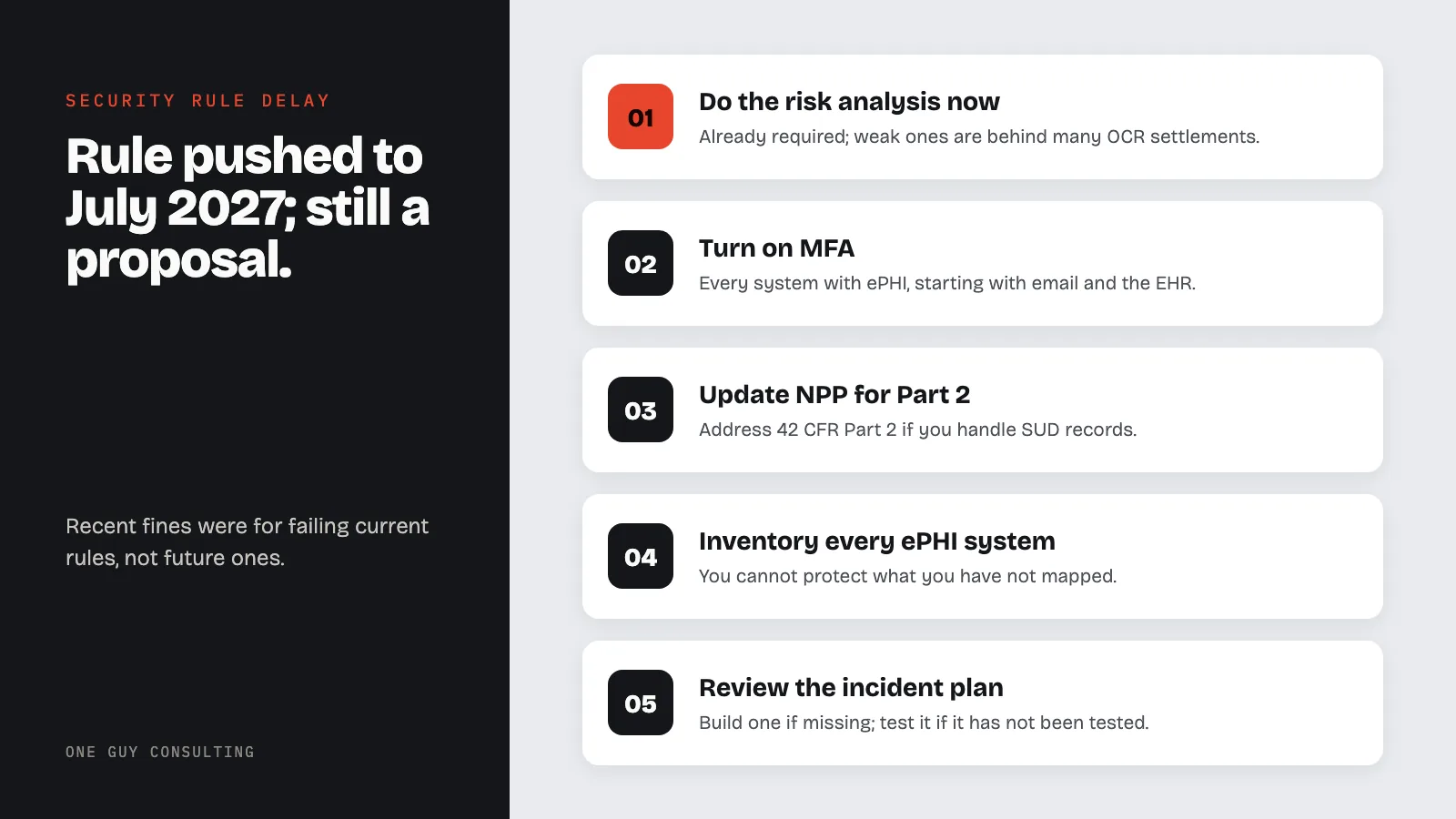
- Conduct a security risk analysis under 45 CFR 164.308(a)(1). This is already required. Weak or missing risk analyses are behind many recent OCR settlements, including the Top of the World Ranch case. Our risk assessment guide covers the process.
- Enable MFA on every system that accesses ePHI. Start with email and your EHR. Use an authenticator app, not SMS.
- Update your Notice of Privacy Practices to address 42 CFR Part 2 if you handle SUD records.
Within 90 days:
- Run a vulnerability scan across your network. Automated vulnerability scanners like Nessus, Qualys, or OpenVAS will identify exposed services, unpatched software, and misconfigured systems.
- Inventory every device and system that stores or transmits electronic protected health information. You cannot protect what you have not mapped.
- Review your incident response plan. If you do not have one, build one. If it has not been tested, test it.
Before the final rule publishes:
- Budget for penetration testing. Annual pen tests would be required under the proposed rule. Get quotes now so the cost is not a surprise.
- Encrypt everything. If any ePHI is stored unencrypted or transmitted without TLS, fix it now. The proposed rule would remove the flexibility the current rule allows.
Frequently Asked Questions
Is the HIPAA Security Rule update canceled? No. HHS moved the final action to its Long-Term Actions agenda with a projected date of July 2027. The rulemaking is still active.
Do I need to comply with 42 CFR Part 2 changes now? Yes. The compliance deadline was February 16, 2026. If your organization handles substance use disorder treatment records covered by Part 2, you must already have updated consent forms, breach notification procedures, and your Notice of Privacy Practices.
What is the difference between vulnerability scanning and penetration testing? Vulnerability scanning uses automated tools to identify known weaknesses in systems and software. Penetration testing goes further: a security professional actively attempts to exploit vulnerabilities to determine what an attacker could actually access. The proposed Security Rule would require both.
Will the final Security Rule be different from the proposed rule? Likely yes. HHS received nearly 5,000 comments, many raising concerns about cost and implementation burden. The final rule may adjust timelines, provide exceptions for small entities, or modify specific technical requirements. HHS has not said which parts will change.
How much will compliance cost a small practice? Costs vary significantly by practice size and current security posture. Authenticator apps such as Microsoft Authenticator and Google Authenticator are free to download.
Free scanning tools such as OpenVAS exist. Paid scanners cost more. Penetration testing is often the largest cost. Prices vary widely, so get quotes early.
Sources
- HHS Fact Sheet: 42 CFR Part 2 Final Rule
- HIPAA Security Rule NPRM, Federal Register (January 6, 2025)
- HHS HIPAA Security Rule Overview
- HHS 42 CFR Part 2 Enforcement
- HHS HIPAA Regulatory Initiatives
- OCR Top of the World Ranch Settlement (February 2026)
- HIPAA Security Rule Delay to July 2027, Clark Hill Analysis
Related Reading
- New HIPAA Security Rule 2026: 7 Major Changes and Your Compliance Deadline
- OCR Fined a Substance Abuse Clinic $103K: Why 42 CFR Part 2 Enforcement Matters Now
- HIPAA MFA Requirement 2026: A Plain-English Guide for Small Practices
- What Is ePHI Under HIPAA?
- HIPAA Encryption Requirements 2026
This content is for educational and informational purposes only and should not be construed as legal advice. Organizations should consult legal counsel for guidance specific to their compliance obligations under HIPAA and 42 CFR Part 2.
One Guy Consulting offers affordable HIPAA compliance packages for practices of all sizes. See HIPAA compliance packages and pricing