Is WhatsApp HIPAA compliant? No. Meta will not sign a Business Associate Agreement (BAA) for WhatsApp. The app also lacks tools that HIPAA calls for: audit logs, admin access controls, and controls over how long messages are kept. Doctors, dentists, and clinics should not use WhatsApp to discuss patients.
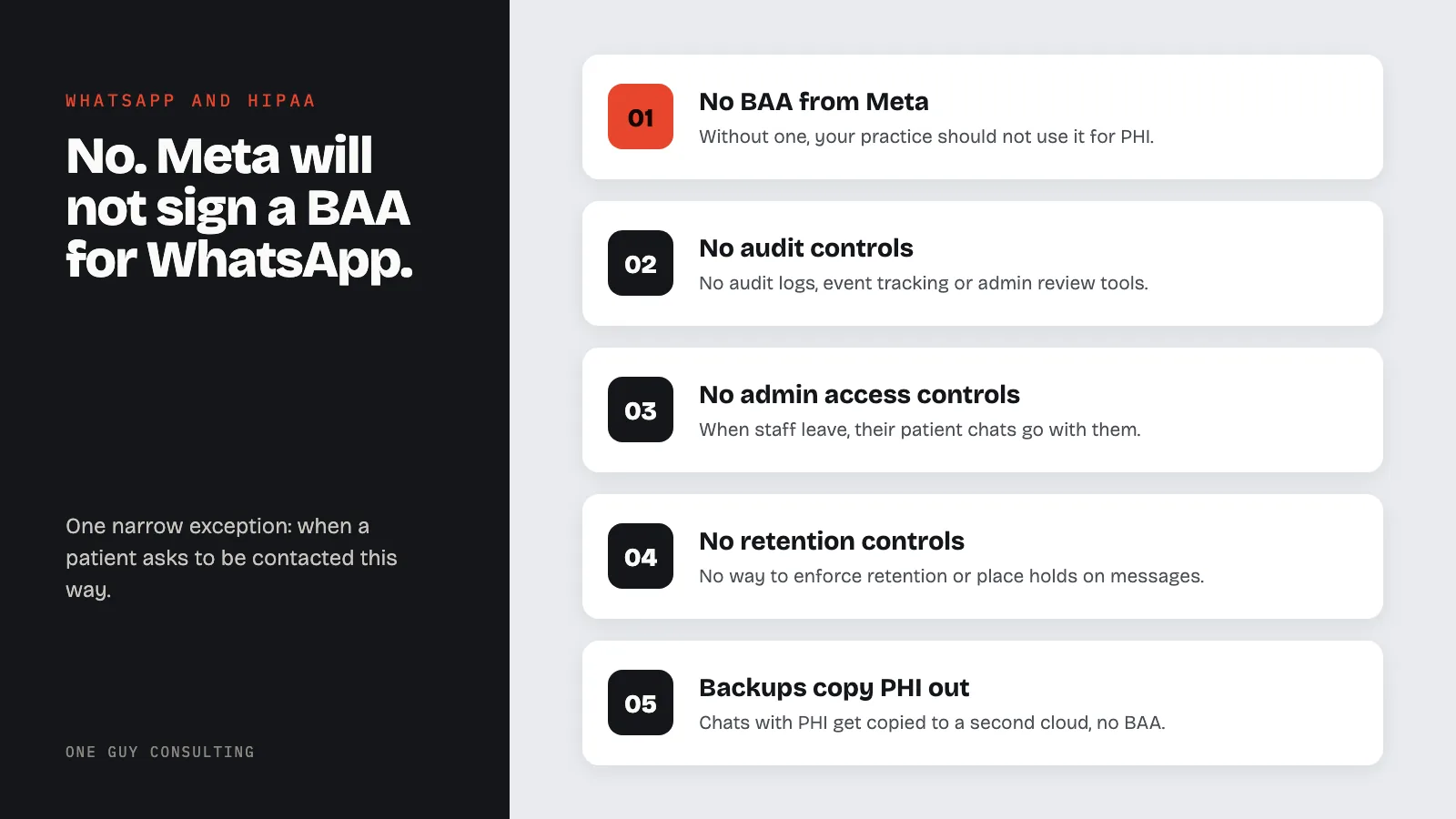
There is one narrow exception when a patient asks to be contacted this way.
WhatsApp is one of the world's most popular messaging apps. Many healthcare staff use it. They text coworkers about patients, share lab results, send wound photos, and plan care.
Almost all of this breaks HIPAA. The app's encryption gives a false sense of safety. Staff treat it like a secure clinical tool. It is not.
Why WhatsApp Fails HIPAA Requirements
WhatsApp's problems go beyond the missing BAA. The app fails several technical safeguard rules under the Security Rule.
No Business Associate Agreement
Meta's business terms for WhatsApp make no promise that the app meets the needs of businesses under strict privacy laws. Meta will not sign a BAA. Without one, your practice should not use WhatsApp for PHI. PHI means protected health information: any health detail tied to a patient.
No other security step can fix this gap. There is one narrow exception, when a patient asks. We cover it below. See our BAA guide for why this contract matters.
No Audit Controls
HIPAA requires tools that record and review activity in any system that holds electronic PHI. These audit logs show who opened what, and when. WhatsApp has no audit logs, no event tracking, and no admin review tools. If a staff member shares PHI through WhatsApp, there is no system-level record to detect or investigate it.
No Administrative Access Controls
WhatsApp accounts are tied to personal phone numbers. An organization cannot:
- Cut off a former employee's access to PHI-containing chats
- Monitor which staff share PHI through the platform
- Enforce password rules or session timeouts beyond the device lock screen
- Set up emergency access when an account owner is unavailable
- Remotely wipe specific conversations without wiping the whole device
When a staff member leaves, every patient conversation they had goes with them. It stays on their personal phone and may be backed up to their personal cloud account.
No Data Retention Controls
HIPAA says you must keep your required compliance documents for six years. That means things like your policies and records of required steps. Your state's law, not HIPAA, sets how long you keep the medical record itself. WhatsApp has a disappearing messages feature, and anyone in the chat can turn it on. It can erase messages your practice may need to keep. On the flip side, WhatsApp gives organizations no way to enforce retention policies or place litigation holds on message data.
The Cloud Backup Problem
WhatsApp backs up messages to Google Drive (Android) or iCloud (iPhone). Neither service signs a BAA for consumer-tier storage. When backups are on, every WhatsApp chat with PHI gets copied to a second cloud service, also without a BAA.
Even if a provider is careful about what they type, a backup that is turned on sends everything to a cloud service with no BAA. To stop it, staff would have to turn off chat backups on each phone. The organization has no way to enforce or verify this setting on personal devices.
The Patient-Initiated Exception
There is one narrow case where WhatsApp may be allowed. Under HIPAA Privacy Rule §164.522(b), patients can ask their provider to contact them a different way or at a different place. That can include WhatsApp.
If a patient starts a WhatsApp chat or asks to be reached on WhatsApp, a provider may honor that request. In fact, the rule says providers must go along with reasonable requests like this. But the provider should:
- Warn the patient about the risks of using WhatsApp for health information
- Keep a record of the patient's request (a provider may require the request in writing)
- Use reasonable safeguards (share minimal PHI, avoid sending full records)
- Keep the documentation in the patient's file
This exception only covers cases where the patient asked first. It does not allow WhatsApp for internal staff chats, doctor-to-doctor consults, or general patient outreach. Even under this rule, share as little PHI as possible.
Common WhatsApp HIPAA Violations
Group chats for clinical coordination. A surgical team creates a WhatsApp group to discuss cases. Every message with patient details breaks HIPAA. When team members change, former members keep the full chat history on their devices.
Photo sharing for clinical consultation. A nurse photographs a wound and sends it to a doctor via WhatsApp. The photo now lives on two personal phones, on WhatsApp's servers, and possibly in two cloud backups. None are covered by a BAA.
Patient appointment reminders. A front desk staffer uses WhatsApp to remind patients of appointments. Even confirming someone has an appointment at a healthcare facility can count as PHI.
Forwarding lab results. A provider forwards lab results to a colleague via WhatsApp instead of using the EHR's secure messaging. The results now exist outside the system of record with no audit trail.
What to Use Instead
Every need that WhatsApp fills has another tool whose company will sign a BAA:
- Internal team messaging: Microsoft Teams or Slack Enterprise Grid: both sign BAAs and offer admin controls, audit logs, and retention policies
- Patient messaging: Your EHR's patient portal, or platforms like Klara, Spruce Health, or OhMD, built for secure patient communication with a BAA
- Video consultations: Zoom for Healthcare, Microsoft Teams, or Doxy.me
- Secure texting: TigerConnect, Imprivata Cortext, or Halo Health, built for clinical messaging with BAAs, audit trails, and remote wipe
Switching means changing how staff work. That is often the hardest part. Add WhatsApp rules to your HIPAA training. Enforce the policy through your security procedures.
Staff will push back because WhatsApp is fast and easy. But ease of use does not override the law. A single WhatsApp chat with PHI can be a breach, and breaches can lead to fines.
Can I use WhatsApp Business for healthcare?
No. WhatsApp Business and WhatsApp Business API have the same limits. Meta does not sign BAAs for any version of WhatsApp. The Business version adds automated responses and catalog management. It does not add audit controls, admin access, or BAA availability. It is not HIPAA compliant.
Is WhatsApp encrypted?
Yes. WhatsApp uses end-to-end encryption for all messages and calls. But encryption alone does not make an app HIPAA compliant. HIPAA also requires audit logs, access controls, a signed BAA, and breach notice steps. WhatsApp's encryption is strong (see our encryption guide), but the app falls short on the other needs above. Cloud backups may not be encrypted by default, which creates a second risk.
What if a patient texts me PHI on WhatsApp?
If a patient starts a WhatsApp conversation, you can respond under the §164.522(b) rule on patient requests. Warn the patient that WhatsApp is not secure for health information. Document their preference. Share as little PHI as possible. Redirect them to your patient portal or a compliant messaging platform for detailed clinical discussions. Do not use one patient's contact as a reason to use WhatsApp for all patients.
Can WhatsApp be used for non-PHI communication?
Technically, HIPAA only covers protected health information. If you use WhatsApp strictly for messages with no PHI (staff meetings, office supplies, general news), HIPAA does not apply. The problem is keeping it that way. Once staff open WhatsApp for "admin" use, the line between PHI and non-PHI blurs fast. Many practices ban WhatsApp for any work that touches patient care. That helps prevent slip-ups.
Related HIPAA Compliance Guides
- Is QuickBooks HIPAA Compliant?
- Is Calendly HIPAA Compliant?
- Is ChatGPT HIPAA Compliant? What Teams Must Know