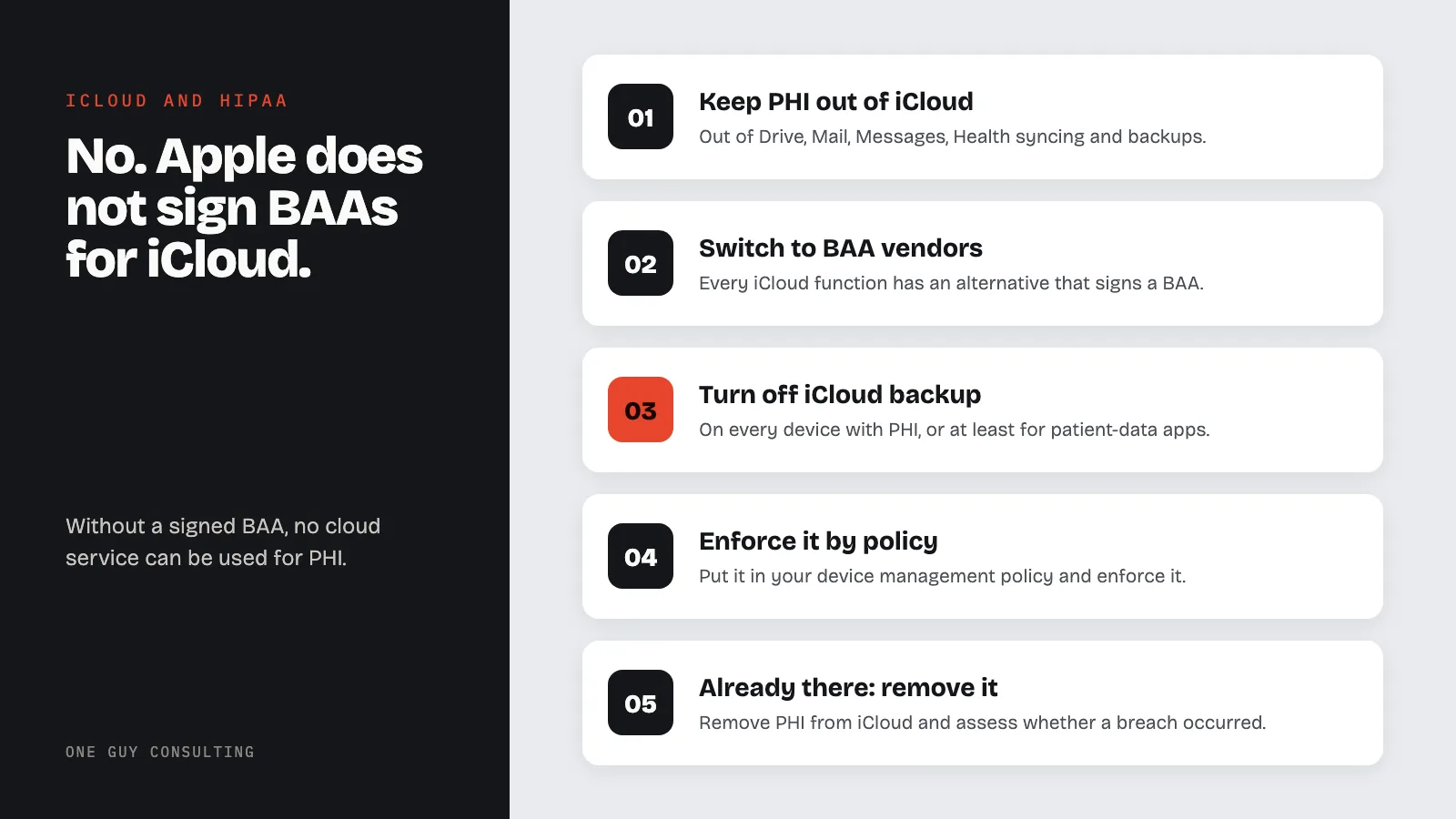
Is iCloud HIPAA compliant? No. Apple does not sign Business Associate Agreements for iCloud, and their iCloud terms say healthcare users may not use iCloud to create, receive, store, or send protected health information (PHI). So patient information has to stay out of iCloud Drive, iCloud Mail, Messages in iCloud, Apple Health syncing, and iCloud backups.
Apple does not offer a BAA for iMessage or FaceTime either.
Apple makes well-built devices and uses strong encryption. But HIPAA compliance is not about encryption alone. Without a signed BAA, no cloud service can be used for PHI. Period. There is no sign Apple plans to change this.
What Apple's Terms Actually Say
Apple's iCloud terms include a specific clause aimed at healthcare organizations. It says that covered entities and business associates agree not to use "any component, function or other facility of the Service" (meaning iCloud) "to create, receive, maintain or transmit any 'protected health information.'" Covered entities are health plans, clearinghouses, and healthcare providers who bill insurance electronically. Business associates are vendors who handle PHI for them.
This is not ambiguity. Apple is explicitly telling healthcare providers: do not put PHI in iCloud. If you do, you are violating both Apple's terms and HIPAA's Business Associate Agreement requirements.
Why Encryption Is Not Enough
Apple uses end-to-end encryption for some iCloud data and encrypts data both in transit and at rest. Advanced Data Protection, introduced in late 2022, extended end-to-end encryption to iCloud Drive, Photos, Notes, and other services.
Healthcare providers sometimes assume this level of encryption makes iCloud "secure enough" for PHI. It does not. HIPAA requires:
- A signed BAA: a contract in which the vendor promises to protect PHI, follow the Security Rule, and report breaches to you
- Audit controls: ways to record and review activity in systems that hold PHI, such as who opened a file and when
- Administrative access controls: tools allowing an organization to manage user permissions, terminate access, and enforce policies
- Breach notification obligations: the vendor must tell you about a breach of unsecured PHI (PHI that was not made unreadable, such as by encryption)
iCloud does not give you these contractual protections. A personal iCloud account also gives you none of these admin controls. A solo practitioner has no way to audit what happens to files stored in iCloud, no way to enforce access policies across staff, and no contractual guarantee that Apple will notify them of a breach involving their data. See our breakdown of HIPAA encryption requirements for what the Security Rule actually mandates.
Every Apple Cloud Service Is Affected
The BAA refusal covers the entire Apple cloud ecosystem:
- iCloud Drive: cannot be used to store patient records, clinical documents, or any files containing PHI. Use Google Drive (through Google Workspace) or Dropbox Business instead. Both offer BAAs
- iCloud Mail: cannot be used for patient communication or sending referrals. Use Google Workspace Gmail or another email provider that signs a BAA
- iMessage: cannot be used for provider-to-provider messaging about patients or any communication containing PHI
- FaceTime: cannot be used for telehealth sessions. Use Zoom (its healthcare plan) or Microsoft Teams (through Microsoft 365). Both offer BAAs
- iCloud Backups: the most dangerous one. If a device backs up to iCloud, its messages, photos, app data, and health data can end up on Apple's servers without a BAA
- Apple Health syncing: syncing health data across devices via iCloud means patient health metrics pass through Apple's servers without BAA coverage
The iCloud Backup Problem
iCloud backups are the most common way PHI accidentally ends up in Apple's cloud. Here is how it happens:
A provider uses a HIPAA-compliant EHR app on their iPhone. The app stores data locally. The iPhone is set to back up to iCloud automatically. That backup can include the app's local data, which may contain PHI. Now that data sits on Apple's servers without a BAA.
The fix: disable iCloud backup entirely on any device that touches PHI, or at minimum disable backup for specific apps that handle patient data. Put this in your organization's mobile device management policy and enforce it. Do not leave it to individual staff.
What to Use Instead
Every function iCloud provides has an alternative from a vendor that will sign a BAA:
- Cloud storage: Google Drive (via Workspace), Dropbox Business, Box, or Microsoft OneDrive. All sign BAAs
- Email: Google Workspace Gmail, Microsoft 365 Outlook, or HIPAA-specific providers like Paubox
- Messaging: Microsoft Teams or Slack (Enterprise Grid) with BAAs
- Video calls: Zoom for Healthcare, Microsoft Teams, or Doxy.me
- Device backup: Local encrypted backups via Finder/iTunes, or MDM-managed backup solutions
The transition takes planning but it is not complicated. Many practices can move to Google Workspace or Microsoft 365 and cover storage, email, messaging, and video under a single BAA. Our risk assessment guide walks through evaluating your current vendor relationships.
Will Apple ever sign a BAA for iCloud?
There is no indication Apple plans to offer BAAs for iCloud. Apple's healthcare strategy focuses on consumer health features (Apple Health, Health Records on iPhone) and research frameworks, not on serving as a business associate for covered entities. Their current iCloud terms still do not allow healthcare users to put PHI in iCloud.
Can I use an iPhone in a healthcare setting?
Yes. The hardware is fine. iPhones are widely used in healthcare through mobile device management platforms that enforce encryption, passcode requirements, and remote wipe. The issue is specifically with iCloud services, not the device itself. Turn off iCloud backup and iCloud sync for any app that handles PHI. With that and your other safeguards in place, the device can be part of a compliant setup.
Is Apple Health HIPAA compliant?
Apple Health as a local app on a patient's personal device falls under the patient's own control and is not subject to HIPAA (HIPAA applies to covered entities and business associates, not patients). Once a patient shares that data with a provider, it becomes PHI in the provider's hands. If the provider then stores or syncs it through iCloud, the same BAA problem applies. Since Apple does not sign BAAs, providers should keep patient data out of iCloud-synced Apple Health.
What happens if I already stored PHI in iCloud?
If PHI has been stored in iCloud, you need to remove it and assess whether a breach has occurred. Under HIPAA, sharing PHI with a vendor that has not signed a BAA is itself a violation. Document the exposure in your risk assessment, remove the data from iCloud, migrate to a compliant platform, and train staff on the approved alternatives.
Under the Breach Notification Rule, sharing PHI in a way HIPAA does not allow counts as a breach by default. The only way out is a written risk assessment. It must show a low chance that the PHI was compromised. The assessment looks at four things: what PHI was involved, who received it, whether anyone actually viewed it, and how well you reduced the risk. Either way, document everything.