Compliance software fits practices with a staff member who has the time and know-how to run a HIPAA program. Guided consulting fits small practices starting from scratch. A consultant guides you through the risk assessment, policies, training, and vendor contracts (BAAs).
Either way, start with the risk analysis. Risk analysis failures show up again and again in OCR’s 2025 enforcement actions.
In October 2024, Bryan County Ambulance Authority in Oklahoma paid $90,000 to settle HIPAA violations after a ransomware attack encrypted the protected health information of 14,273 patients. The Office for Civil Rights (OCR) investigation found the root cause was straightforward: the organization had never conducted a compliant security risk analysis under 45 CFR 164.308(a)(1)(ii)(A). Bryan County also agreed to a corrective action plan, a set of required fixes that OCR monitors.
Bryan County is not unusual. Risk analysis failures show up again and again in OCR’s 2025 enforcement actions. The question for small practices is not whether to get compliant. It is how. And that decision usually comes down to two options: buy compliance software and work through it yourself, or work through it with a consultant who guides you.
Many of the comparison articles on this topic were written by software vendors. This one is written from the other side, by someone who has spent 10 years helping small healthcare organizations build compliance programs and has seen firsthand where each approach works and where it breaks down.
What HIPAA Compliance Actually Requires
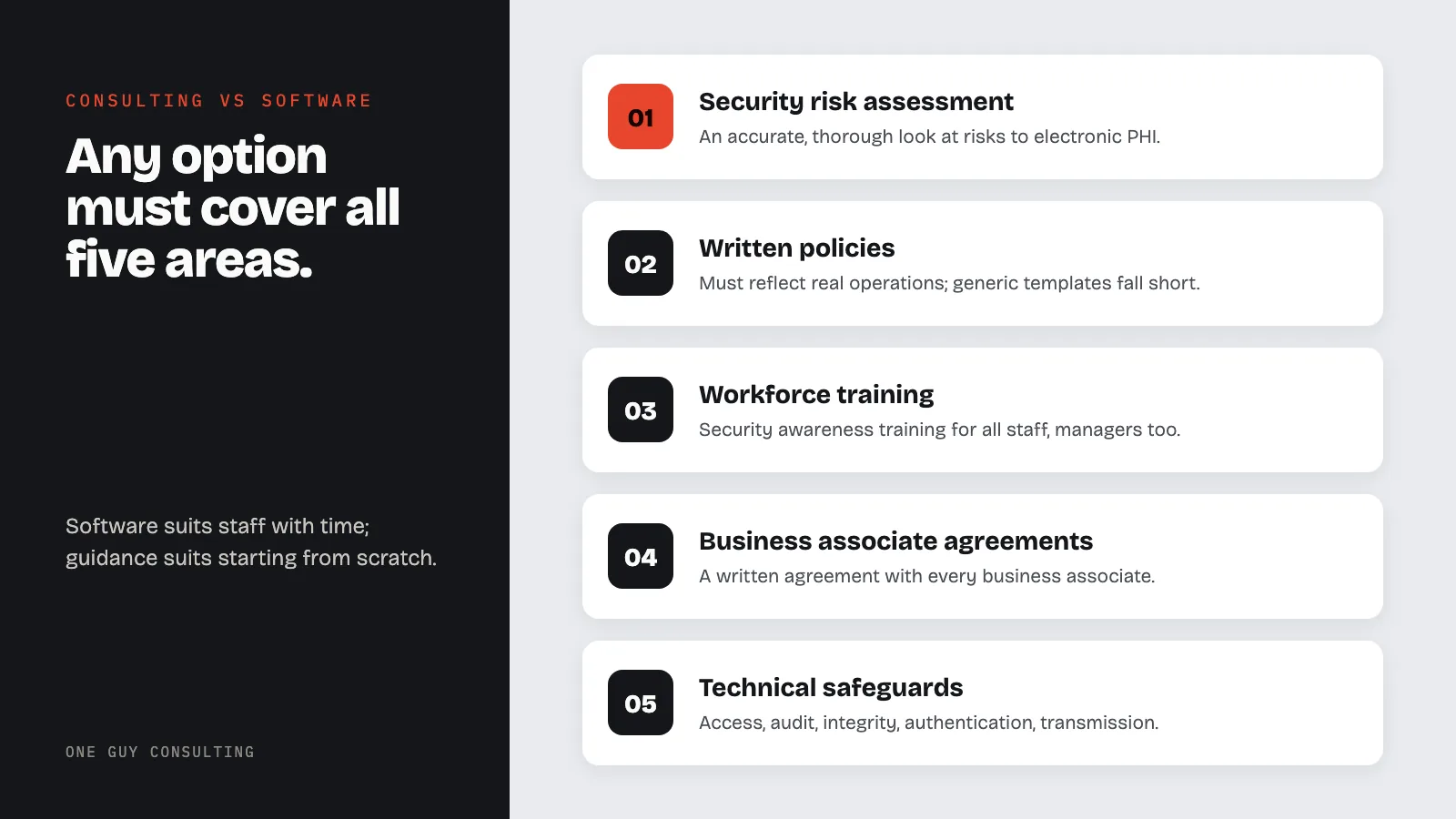
Before comparing approaches, it helps to understand what a complete compliance program involves. The regulations are spread across multiple sections of 45 CFR Parts 160 and 164, but the core obligations break down into five areas:
1. Security Risk Assessment (SRA): 45 CFR 164.308(a)(1)(ii)(A) requires every covered entity and business associate to conduct an accurate, thorough assessment of risks and vulnerabilities to electronic PHI (Protected Health Information). It is the problem OCR cites in most of its recent penalty cases.
2. Written Policies and Procedures: 45 CFR 164.316(a) requires documented policies that are implemented and maintained. Generic templates that do not reflect your actual operations do not satisfy this requirement.
3. Workforce Training: 45 CFR 164.308(a)(5)(i) requires a security awareness and training program for all workforce members, including management. The Privacy Rule adds more rules at 45 CFR 164.530(b). Training must fit each person's job. New staff must be trained within a reasonable time. When a major policy change affects someone's duties, they must be trained again. And you must keep a written record of the training.
4. Business Associate Agreements (BAAs): 45 CFR 164.308(b)(1) requires a written agreement with every business associate. A business associate is a vendor that creates, receives, maintains, or sends electronic PHI for you. See common BAA mistakes that lead to fines.
5. Technical Safeguards: 45 CFR 164.312 requires access controls, audit controls, integrity controls, authentication, and transmission security. The proposed Security Rule updates would make encryption, which is addressable today, required and would add a multi-factor authentication requirement. HHS published them as a Notice of Proposed Rulemaking in January 2025, and they are not final.
Any solution you evaluate should address all five areas with documented outputs that would hold up under OCR review.
Quick Comparison: Consulting vs Software
| Feature | Compliance Software | Guided Consulting |
|---|---|---|
| Approach | Self-service platform with guides | Consultant guides you through each step |
| Who Does the Work | Your team, using the software | Your team, with a consultant guiding the setup |
| Risk Analysis | Questionnaire-driven, template-based | You answer the questions about your own setup and workflows, with a consultant guiding you |
| Policies | Generic templates you customize | AI-tailored templates, set up with 1:1 guidance |
| Training | Pre-built modules, self-paced | Training modules, with a consultant guiding how you deliver them |
| BAA Management | Varies by platform; some track and store BAAs | Digital BAAs with automated signing |
| Time to Compliance | Weeks to months | Weeks, not months |
| Cost Range | Varies widely by platform; Vanta and Sprinto quote prices on request | $120/month, $1,300 for 12 months, or $2,300 for 24 months per location (One Guy Consulting Full-Scope) |
| Best For | Organizations with internal compliance staff | Small practices that want a person guiding them |
What Compliance Software Does Well
Software platforms serve a real purpose. They provide structure, reminders, and a centralized place to track compliance activities over time. Not every platform that shows up in a HIPAA search is built for HIPAA: Dot Compliance, for example, is a quality management system for FDA-regulated companies, and Secureframe is built for SOC 2 and ISO 27001 first, not for a HIPAA program.
Compliancy Group pairs its platform with compliance coaches, human support layered on top of the software. That hybrid model works well for organizations that want guidance but prefer to manage compliance internally. They have been in the HIPAA space for years and have a large customer base.
Vanta and Sprinto bring strong automation for evidence collection, continuous monitoring, and multi-framework compliance (SOC 2, ISO 27001, HIPAA). For technology companies that need HIPAA alongside other frameworks, that breadth has value.
Paubox handles email encryption for healthcare. That is one technical safeguard. It falls under 164.312(e)(1), which covers protecting data while it is sent. It solves one piece of the compliance puzzle well.
Each of these platforms addresses legitimate needs. The question is whether your practice is the right fit for a software-first approach.
Where Software Alone Falls Short
Risk Analysis Requires Judgment, Not Checkboxes
The risk analysis is one of the first documents OCR asks for when an investigation opens. OCR began its Risk Analysis Initiative in late 2024. By March 2026 it had announced 12 enforcement actions under it.
Software platforms typically walk you through a series of questions and generate a report. But the rule asks for more than a checklist. It calls for an “accurate and thorough” assessment. See 164.308(a)(1)(ii)(A). In practice, that means identifying where ePHI actually resides in your environment, evaluating threats specific to your operation, and assessing the likelihood and impact of each risk. That requires someone who understands your practice: your physical layout, your workflows, your vendor relationships, and your staff behavior patterns.
A 5-person dental office and a 30-person multi-location orthopedic group face different risks. Software gives both the same questionnaire.
Generic Policies Can Work Against You
Under 164.316(a), policies must be implemented. That means staff must actually follow them, and there must be evidence they do. Documentation that does not represent what your practice actually does can work against you during an investigation.
Software platforms provide policy templates. But a template that describes procedures your office does not follow can be worse than no policy at all. It creates written evidence that you are not following your own rules.
Training Must Be Role-Specific
Under the Privacy Rule at 164.530(b)(1), training must be “as necessary and appropriate for the members of the workforce to carry out their functions.” Your front desk staff, billing team, clinical staff, and IT personnel each handle PHI differently. A single generic training module does not address those differences.
Software platforms deliver training content. Designing role-appropriate training programs that reflect your actual workflows requires understanding those workflows first.
Email Encryption Is Not a Compliance Program
Paubox and similar tools solve transmission security under 164.312(e)(1). But encrypted email is one technical safeguard out of dozens of requirements. An organization with Paubox but no risk analysis, no written policies, no documented training, and no BAA program is not compliant. It just has secure email.
What Consulting Delivers
Everything Set Up From Scratch
The search queries that led you to this article tell a clear story. Practices are asking: What if we need everything set up from scratch? That is the consulting use case.
A consultant who specializes in small healthcare organizations does not hand you a login and wish you luck. At One Guy Consulting, the software does the busywork, and on the Full-Scope plan Chuck walks you through the rest on 4 hours a month of 1:1 implementation calls.
He guides you through answering the risk assessment. Your policies start from AI-tailored templates, and you finish them with guidance instead of guesswork. He guides your training delivery. BAAs go out to your vendors for digital signature from the portal.
You do the work, but you never do it alone. Our process lays out every step from the first call to a maintained program.
For a detailed guide on the risk assessment process, see the step-by-step walkthrough.
One Point of Contact vs. a Dashboard
When OCR sends a data request, you do not submit a software-generated report and hope for the best. You need to be able to explain your compliance program. Why did you make the choices you made? How do your safeguards address your specific risks? What evidence supports your work? On the Full-Scope plan, Chuck supports you through an OCR letter or a CMS audit.
Software gives you a dashboard. A consultant gives you a phone call.
The Enforcement Data Is Clear
OCR is not slowing down. In 2024, the agency closed 22 enforcement actions with a penalty or settlement. In 2025, it collected $8.33 million across 21 actions. That is the second-highest number of penalty cases in one year on record. See the 2025 enforcement breakdown for the full case list.
Enforcement is not limited to large health systems. Recent penalties and settlements involving smaller organizations include:
- Bryan County Ambulance Authority (Oklahoma EMS): $90,000 settlement (October 2024): ransomware, no risk analysis, 14,273 patients affected
- Gums Dental Care (dental practice): $70,000 civil money penalty (October 2024), a fine OCR imposed for not giving a patient timely access to their records
- Health Fitness Corporation (Illinois business associate): $227,816 settlement (March 2025): risk analysis failure, more than 4,000 people affected
- Elgon Information Systems (Massachusetts BA providing EHR/billing): $80,000 settlement (January 2025): ransomware, no risk analysis
HIPAA fine amounts rose again in the latest inflation update, and the Risk Analysis Initiative continues under the current administration. The SAI360/Strategic Management Services national survey found that fewer than 40% of organizations rated themselves “very prepared” for a HIPAA audit or OCR investigation.
The question is not whether enforcement will reach small practices. It already has.
Who Should Choose Which?
Choose compliance software if:
- You have someone internally who can own the compliance program
- You have time to work through tasks, customize templates, and manage the process
- You need multi-framework coverage (SOC 2 + HIPAA + ISO)
- Your organization is already partially compliant and needs ongoing management
- You are a technology company with internal compliance expertise
Choose guided consulting if:
- You need to get compliant quickly and do not have months to work through a platform
- You are starting from scratch: no risk assessment, no policies, no documented training
- You are a small medical, dental, or behavioral health practice without a dedicated compliance officer
- You are a business associate that needs a BAA program and policies in place fast
- You want someone to walk you through building your compliance program rather than hand you the tools and leave you to it
- You are already behind and need to catch up before a breach or audit forces the issue
For deeper comparisons of specific platforms, see:
- Compliancy Group vs One Guy Consulting
- Vanta vs One Guy Consulting
- Sprinto vs One Guy Consulting
- Paubox vs One Guy Consulting
Final Take
Compliance software and consulting are not competing solutions. They solve different problems for different organizations.
Software works when you have the bandwidth, expertise, and time to manage compliance internally. It provides structure and tracking. That is valuable for the right buyer.
Consulting works when you need a guide to get compliance done. That fits when the practice is small, the staff is stretched, and the risk assessment has never been done. It provides guidance and accountability.
Most of the organizations that end up in OCR enforcement actions had some compliance activity underway. They had started a risk assessment but never finished it. They had policies written but never implemented. They had training scheduled but never documented. The gap was not awareness. It was execution.
If your practice has the internal capacity to execute, software is a reasonable tool. If you need someone to guide you while you do the work, that is what consulting is for.
Related Reading
- Compliancy Group vs One Guy Consulting: Which HIPAA Solution to Pick?
- Vanta vs One Guy Consulting: Which HIPAA Solution to Pick?
- Sprinto vs One Guy Consulting: Which HIPAA Solution to Pick?
- Paubox vs One Guy Consulting: Which HIPAA Solution to Pick?
- How to Conduct a HIPAA Risk Assessment and Avoid Fines
One Guy Consulting offers affordable HIPAA compliance packages for practices of all sizes. Explore One Guy Consulting's HIPAA compliance packages.
FAQ
How does Compliancy Group compare to HIPAA consulting for a small practice that wants help instead of software?
Compliancy Group provides a guided platform with compliance coaching. You work through tasks in their system with support from assigned coaches. One Guy Consulting takes a different approach: its Full-Scope plan includes 4 hours a month of 1:1 implementation calls with Chuck to get your plan set up. For a detailed comparison, see the full Compliancy Group vs One Guy Consulting breakdown.
What HIPAA compliance consulting is best for a small medical practice that needs everything set up from scratch?
Look for a consultant who covers all five core requirements (risk assessment, written policies, workforce training, BAA management, and technical safeguard evaluation) and guides you through each one, rather than one who runs an assessment and hands you a report. You should finish with a working program: policies that fit your practice and training built around your team’s roles. Flat-rate pricing with no per-user fees matters for small practices watching overhead costs.
Which HIPAA consulting service is best for a dental office that needs policies, training, and a security risk assessment?
Dental practices face specific compliance challenges: digital imaging systems, patient portals, insurance claim processing, and high staff turnover in front-desk roles. The right consulting service guides you through a risk assessment that covers dental workflows, helps you fit your policies to how your office actually operates, and guides training for clinical and administrative staff. Generic compliance software may not account for these specialty-specific considerations.
Can compliance software replace a HIPAA consultant?
Software can replace a consultant for organizations that have internal compliance expertise and the bandwidth to manage the process. Software cannot replace a consultant when the organization needs someone to guide it through the risk analysis, help fit its policies to the practice, guide role-based training, or support its response when OCR or CMS comes asking. The regulation at 45 CFR 164.308(a)(1)(ii)(A) requires an “accurate and thorough” risk assessment, and that takes judgment about your own practice, not just answers typed into a questionnaire.
How much does HIPAA consulting cost compared to compliance software?
Compliance software pricing varies widely, and enterprise tools like Vanta and Sprinto (which are primarily built for SOC 2 and treat HIPAA as an add-on) quote prices on request. Compliancy Group now quotes prices on request; its last public list (archived July 28, 2026) started at $99 to $449 a month billed annually, plus $8 to $10 per employee per month. One Guy Consulting’s flat-rate plans start at $675/year (Self-Guided) and $1,300/year (Full-Scope) per location, with no per-user fees. Both cover risk assessment, policies, training, and BAA management. Full-Scope adds 4 hours a month of 1:1 implementation calls with Chuck, a Certified HIPAA Professional.
Sources:
- HHS OCR Resolution Agreements
- 45 CFR 164.308: Administrative Safeguards
- 45 CFR 164.312: Technical Safeguards
- 45 CFR 164.316: Policies and Procedures
- HIPAA Journal: HIPAA Violation Fines
- HIPAA Journal: 2025 Healthcare Data Breach Report
- National Law Review: Risk Analysis Initiative Continues Under New Administration
- SAI360 / Strategic Management Services: 4th National HIPAA Compliance Survey
This content is for educational and informational purposes only and should not be construed as legal advice.